
The Protégé Effect: Why Teaching Others is the Best Way to Learn
Cognitive science reveals that explaining a concept to someone else—or even just preparing to do so—dramatically improves your own understanding and retention.
By Factlen Editorial Team
- Cognitive Science Researchers
- Argue the Protégé Effect is essentially a manifestation of active recall and generative processing, where the benefit comes from the mental effort of retrieving and organizing information.
- Educational Practitioners
- Value the Protégé Effect for its secondary benefits in the classroom, such as building student autonomy and fostering collaborative peer-to-peer relationships.
- Self-Directed Learners
- Focus on practical utility, utilizing frameworks like the Feynman Technique and rubber duck debugging to rapidly acquire new skills independently.
What's not represented
- · Students with learning disabilities
- · Corporate training directors
Why this matters
Understanding the Protégé Effect allows students, professionals, and lifelong learners to stop wasting time on passive study methods like highlighting and re-reading. By shifting from consuming information to explaining it, anyone can dramatically improve their ability to master complex subjects and retain knowledge long-term.
Key points
- The Protégé Effect is a cognitive phenomenon where teaching others improves the teacher's own understanding.
- The Feynman Technique leverages this by forcing learners to explain complex topics in simple, jargon-free language.
- Preparing to teach changes how the brain encodes information, favoring deep structure over rote memorization.
- The benefits rely heavily on active recall; teaching from memory is vastly superior to teaching from notes.
- The 'student' does not need to be real; explaining concepts to inanimate objects or imaginary audiences still works.
You have likely experienced the illusion of competence. You spend hours reading a textbook, highlighting key passages, and nodding along to a lecture. The information feels intuitive and familiar. Yet, when you sit down to take the test or apply the knowledge, your mind goes blank. The concepts that seemed so clear just hours ago suddenly feel fragmented and slippery. This phenomenon is a universal frustration in education, stemming from a fundamental mismatch between how we consume information and how our brains actually encode it for long-term retrieval. Passive absorption feels like learning, but cognitive scientists warn that it rarely builds lasting mastery. To truly cement a concept in your mind, you have to do something much more demanding: you have to give it away.[6]
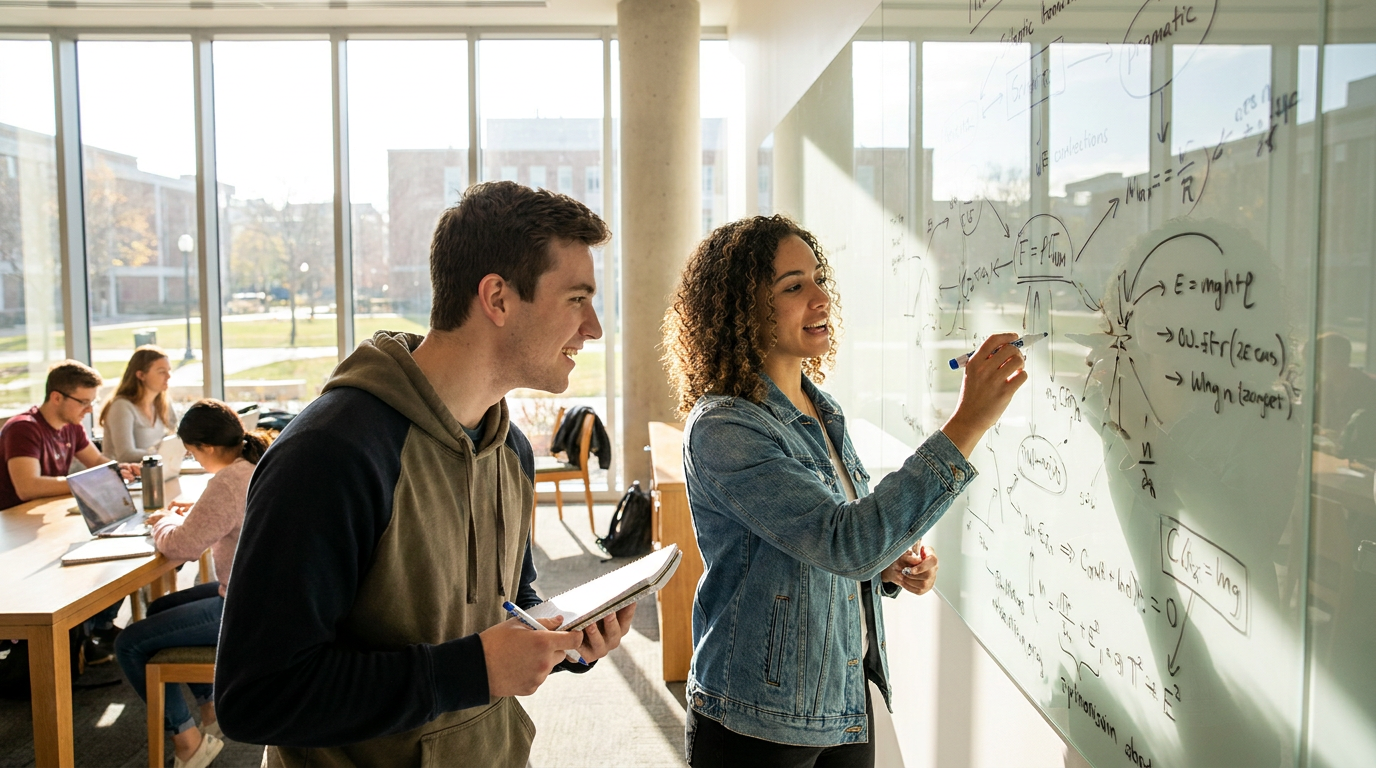
Over two thousand years ago, the Roman philosopher Seneca observed, "Docendo discimus"—we learn by teaching. Today, cognitive psychologists refer to this phenomenon as the "Protégé Effect." The premise is elegantly simple: the act of explaining a concept to someone else dramatically improves the teacher's own understanding and retention of the material. While traditional education models place the teacher as the sole distributor of knowledge and the student as the receiver, modern research flips this dynamic. When a student is tasked with becoming the instructor, a cascade of powerful cognitive mechanisms is triggered, transforming them from a passive receptacle into an active architect of their own knowledge.[2][5]
One of the most famous modern applications of this principle is the Feynman Technique, named after the Nobel Prize-winning physicist Richard Feynman. Known as the "Great Explainer," Feynman possessed an uncanny ability to distill the most impenetrable realms of quantum mechanics into plain, accessible language. He believed that the ultimate test of knowledge was simplicity; if you could not explain a concept to a freshman, you did not truly understand it yourself. The technique he inspired is a four-step iterative process designed to ruthlessly expose what you don't know, forcing you to confront the gaps in your understanding before they sabotage you.[4]
The Feynman Technique begins with selecting a concept and writing it at the top of a blank page. The second, and most crucial, step is to write out an explanation of that concept as if you were teaching it to a child—or at least a layperson with no foundational vocabulary in the subject. This constraint is vital. It strips away the crutch of academic jargon and complex terminology, which students often use to mask their own confusion. When you are forced to rely on simple analogies and foundational logic, you can no longer hide behind big words. You must actually understand the mechanics of the idea you are trying to convey.[4][6]

Inevitably, this process leads to step three: the breakdown. As you attempt to explain the concept simply, you will hit a wall. You will forget a crucial step, struggle to connect two ideas, or realize your analogy doesn't quite hold up. In the Feynman Technique, this failure is not a setback; it is the entire point. This breakdown highlights the exact boundaries of your knowledge. Once you identify these specific gaps, step four dictates that you return to your source material—the textbook, the lecture notes, or the academic paper—and re-learn the missing pieces until you can seamlessly integrate them into your simple explanation.[4][6]
But why does this process work so much better than simply re-reading a textbook? Cognitive scientists point to a mechanism called "metacognitive vigilance." Metacognition is the act of thinking about your own thinking. When you study solely for yourself, it is easy to gloss over difficult paragraphs and assume you understand them. However, when you are responsible for someone else's learning, your brain adopts a heightened state of alertness. You become acutely aware of your own potential blind spots because you are anticipating the questions and confusions of your prospective student. This responsibility forces a deeper, more critical engagement with the material.[2][5]
But why does this process work so much better than simply re-reading a textbook?
Furthermore, the Protégé Effect relies heavily on what researchers call "generative processing." When you read a text, the author has already done the hard work of organizing the information into a coherent structure. If you merely highlight it, you are just acknowledging their structure. Teaching, on the other hand, requires you to tear that structure down and rebuild it in your own mind. You have to select the most relevant pieces of information, organize them into a logical sequence, and generate new connections and analogies. This active construction builds robust neural pathways that make the information much easier to retrieve later.[2][6]
The physical act of teaching also harnesses one of the most robust findings in all of cognitive science: the testing effect, or active recall. A 2018 study published in Applied Cognitive Psychology by Aloysius Wei Lun Koh and colleagues sought to isolate exactly why teaching is so effective. They found that the magic does not lie in the communication itself, but in the retrieval. When you explain a concept to someone else without looking at your notes, you are forcing your brain to actively pull that information out of long-term memory. This strenuous mental effort strengthens the memory trace far more effectively than passively reviewing the material.[1][4]
Crucially, Koh's research established a vital boundary condition for the Protégé Effect. In their experiment, students who taught a lesson while reading from their notes did not experience the same long-term retention benefits as those who taught from memory. The researchers concluded that the learning-by-teaching strategy works primarily because it is a disguised form of retrieval practice. If you remove the retrieval element by relying on a script or a textbook while you teach, the cognitive benefits evaporate. The struggle to remember the information is the exact mechanism that cements it in your brain.[1][6]
Remarkably, you do not even need to actually deliver the lesson to reap some of the benefits. A landmark 2014 study by Nestojko and colleagues demonstrated the power of the "expectation effect." In their experiment, two groups of students were given the same material to study. One group was told they would be tested on the material, while the other group was told they would have to teach it to another student. Even though neither group actually ended up teaching, the group that expected to teach significantly outperformed the test-expectant group on a subsequent exam, particularly on questions requiring deep comprehension.[3][5]

The expectation of teaching fundamentally alters how the brain encodes information. Students who think they will be tested tend to focus on rote memorization, hunting for isolated facts and keywords that might appear on a multiple-choice exam. Conversely, students who expect to teach adopt a broader, more structural approach. They look for the underlying principles, the connections between concepts, and the overarching narrative of the material, knowing they will need to present a coherent picture to their future student. This shift in mindset alone is enough to dramatically improve learning outcomes.[3][6]
These findings have profound implications for how we structure both formal education and self-directed learning. In classrooms, educators are increasingly moving away from pure lecture models and incorporating peer-to-peer tutoring and reciprocal teaching. By pairing students up and having them take turns explaining concepts to one another, teachers can activate the Protégé Effect across the entire classroom. This not only improves academic performance but also fosters communication skills, empathy, and a more collaborative learning environment.[2][5]
For solo learners, professionals, and autodidacts, the Protégé Effect can be harnessed even without a willing audience. Computer scientists have long utilized a technique called "rubber duck debugging." When a programmer is stuck on a piece of broken code, they will place a rubber duck on their desk and explain the code, line by line, to the inanimate object. The simple act of vocalizing the logic and breaking it down for a "novice" often reveals the hidden error. The duck doesn't need to understand; the programmer just needs the cognitive friction of explaining.[5][6]

Similarly, modern educational technology is experimenting with "teachable agents"—digital avatars that students are tasked with instructing. Studies have shown that students will spend more time and effort learning material if they believe they are responsible for the "knowledge" of their virtual protégé. Whether you are explaining quantum physics to a classmate, breaking down a marketing strategy for a new hire, or talking to a rubber duck on your desk, the underlying truth remains the same. The most reliable path to mastering any subject is to embrace the responsibility of giving it away.[2][5][6]
How we got here
1st Century AD
Roman philosopher Seneca writes 'Docendo discimus' (we learn by teaching), an early observation of the Protégé Effect.
1980
Researchers Bargh and Schul publish foundational work showing people learn better when preparing to teach than preparing for a test.
2014
Nestojko et al. demonstrate the 'expectation effect,' proving that merely expecting to teach alters how the brain encodes information.
2018
Koh et al. publish findings linking the Protégé Effect directly to retrieval practice, showing teaching must be done from memory to be fully effective.
Viewpoints in depth
Cognitive Science Researchers
Focus on the underlying mechanisms of memory and retrieval.
For cognitive psychologists, the Protégé Effect is less about social interaction and more about the mechanical realities of the human brain. They argue that the benefits of teaching are essentially a manifestation of active recall and generative processing. When a student teaches a concept, they are forced to retrieve information from long-term memory and organize it into a coherent mental model. It is this strenuous mental effort—not the act of communication itself—that strengthens neural pathways and ensures long-term retention.
Educational Practitioners
Focus on classroom dynamics and student engagement.
Teachers and educational theorists value the Protégé Effect for its transformative impact on classroom culture. Beyond the raw cognitive benefits, peer-to-peer tutoring and reciprocal teaching build student autonomy and foster collaborative relationships. Practitioners argue that shifting the classroom from a teacher-centered model to a student-centered environment increases intrinsic motivation, as students feel a sense of responsibility for their peers' success.
Self-Directed Learners
Focus on practical utility and independent skill acquisition.
This camp, which includes autodidacts, professionals, and programmers, utilizes frameworks like the Feynman Technique and rubber duck debugging to rapidly acquire new skills. They emphasize that the 'student' doesn't even need to be a real person to achieve the cognitive benefits. For self-directed learners, the Protégé Effect is a practical tool to break through plateaus, identify blind spots, and ensure they aren't fooling themselves into a false sense of competence.
What we don't know
- While the effect is robust for conceptual learning, it is less clear if teaching provides significant advantages for pure rote memorization tasks.
- Researchers are still determining the optimal balance of time spent studying versus time spent teaching for maximum efficiency.
- The long-term impact of AI 'teachable agents' on student motivation compared to human peer-tutoring remains an active area of study.
Key terms
- Protégé Effect
- The psychological phenomenon where teaching, or preparing to teach, information to others helps a person learn and retain that information better.
- Feynman Technique
- A four-step learning method that involves explaining a concept in plain language to identify and fill gaps in one's understanding.
- Metacognition
- The awareness and understanding of one's own thought processes; thinking about thinking.
- Active Recall
- A study method that involves actively stimulating memory to retrieve a piece of information, rather than passively reviewing it.
- Generative Processing
- The cognitive act of actively making sense of learning material by organizing it and integrating it with prior knowledge.
Frequently asked
Do I need a real person to teach?
No. Research shows that explaining concepts to an imaginary student, a digital avatar, or even an inanimate object like a rubber duck can trigger the same cognitive benefits.
Does the Protégé Effect work for math and science?
Yes. It is highly effective for STEM subjects because it forces the learner to break down complex, abstract mechanisms into simple, logical steps.
Can I just read my notes out loud to someone?
No. Studies indicate that the benefits of the Protégé Effect disappear if you teach while reading from notes. The effort of retrieving the information from memory is crucial.
Sources
Source coverage
6 outlets
3 viewpoints surfaced






[1]Applied Cognitive PsychologyCognitive Science Researchers
The learning-by-teaching effect has been demonstrated in many studies
Read on Applied Cognitive Psychology →[2]Cambridge University PressCognitive Science Researchers
Learning by Teaching: Cognitive Mechanisms
Read on Cambridge University Press →[3]Memory & CognitionCognitive Science Researchers
Expecting to teach enhances learning and organization of knowledge in free recall of text passages
Read on Memory & Cognition →[4]MindOMaxSelf-Directed Learners
Feynman Technique vs Active Recall
Read on MindOMax →[5]EffectiviologyEducational Practitioners
The Protégé Effect: How You Can Learn by Teaching Others
Read on Effectiviology →[6]Factlen Editorial TeamEducational Practitioners
Synthesis by Factlen editorial team
Read on Factlen Editorial Team →
Every angle. Every day.
Get education stories with full source coverage and perspective breakdowns delivered to your inbox.