
Smart Ring vs. Smartwatch: The 2026 Evidence-Based Comparison
As wearable technology fractures into two distinct philosophies, the choice between a smart ring and a smartwatch comes down to a trade-off between passive sleep accuracy and active workout versatility.
By Factlen Editorial Team
- Passive Tracking Advocates
- Prioritize invisible, continuous tracking, sleep comfort, and recovery scores without screen distraction.
- Active Training Proponents
- Rely on real-time data, GPS pacing, and on-wrist workout dashboards for structured athletic training.
- Holistic Data Analysts
- Evaluate wearables based on their ability to integrate comprehensive health metrics across both active and resting states.
What's not represented
- · Traditional watchmakers
- · Medical professionals diagnosing sleep disorders
Why this matters
Choosing the wrong wearable often leads to abandoned devices and wasted money. Understanding the physiological differences in how these devices gather data ensures you invest in a tool that actually matches your daily habits and health goals.
Key points
- Smart rings offer superior accuracy for sleep staging and resting heart rate due to stable finger placement.
- Smartwatches remain essential for active athletes who require real-time pacing, GPS, and visible workout dashboards.
- Rings typically boast a 6-to-8-day battery life, while watches require daily charging.
- Advanced health safety features, such as ECG and fall detection, are currently exclusive to smartwatches.
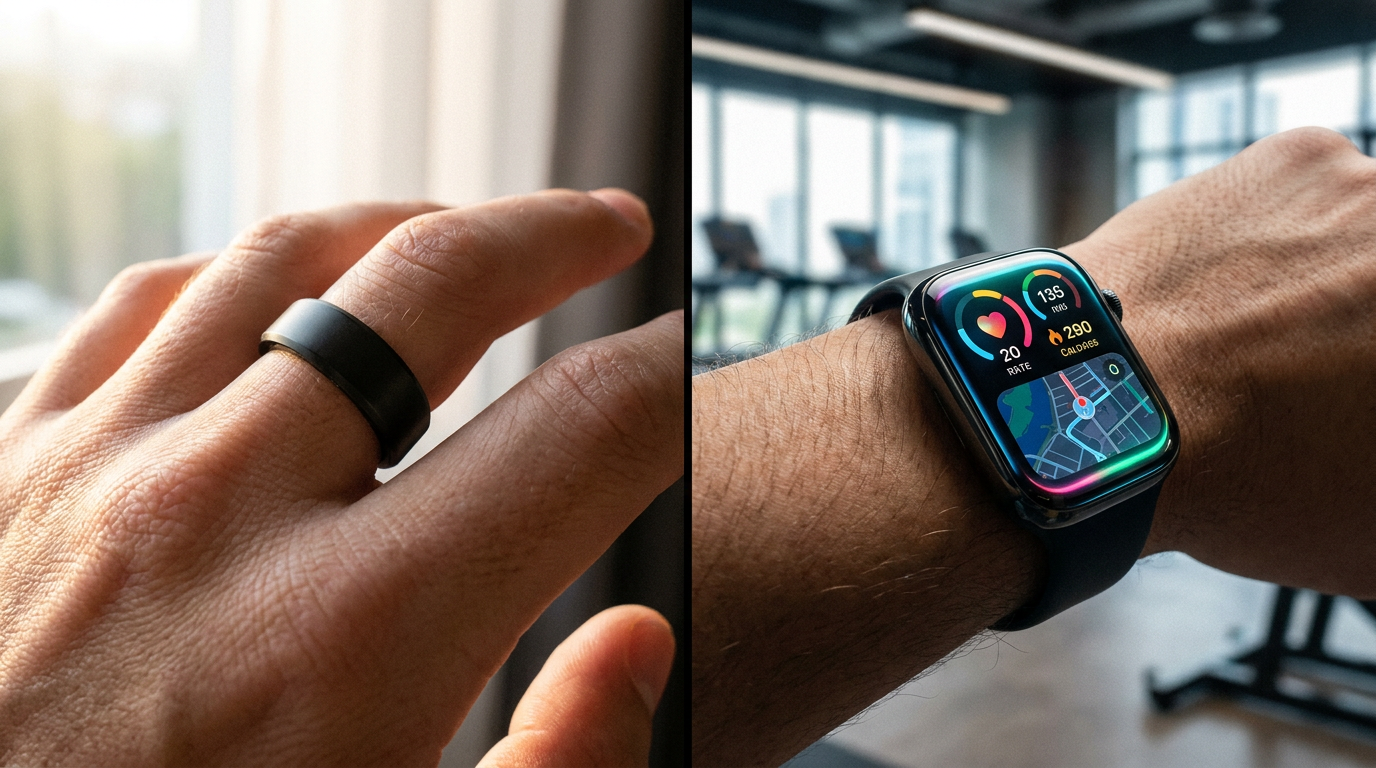
The wearable market has fractured into two distinct philosophies: the active dashboard of the smartwatch and the invisible monitoring of the smart ring. As devices from Samsung, Oura, and Apple dominate the landscape, consumers are increasingly forced to choose between wrist-based versatility and finger-based subtlety.[1][4]
The core difference lies in how the devices interact with the user. Smartwatches are designed to command attention, offering real-time notifications, pacing data, and interactive apps. Smart rings, conversely, are entirely passive. They collect biometric data in the background without screens or vibration alerts, syncing quietly to a smartphone app to provide a holistic picture of recovery and readiness.[6][9]
When it comes to sleep tracking, the physical placement of the sensor dictates the quality of the data. The finger offers a distinct physiological advantage over the wrist. Blood vessels in the finger are closer to the surface, providing optical photoplethysmography (PPG) sensors with a much clearer signal than they can achieve through the thicker tissue and bone of the wrist.[2][3]
This anatomical advantage translates into measurable accuracy differences. A landmark 2024 study published in the journal Sensors compared consumer wearables against clinical polysomnography (PSG)—the gold standard for sleep labs. The research revealed that while wrist-based devices like the Apple Watch excel at detecting when a user falls asleep, they struggle with sleep staging, overestimating light sleep by an average of 45 minutes and underestimating deep sleep by a similar margin.[2]

In contrast, premium smart rings demonstrated no statistically significant difference from clinical PSG data across sleep stages. For users relying on wearables to optimize their rest, this discrepancy is not a minor rounding error; it fundamentally alters the recovery scores and readiness metrics that dictate their daily routines.[2][7]
Comfort also plays a massive role in sleep data continuity. A smartwatch requires wearing a bulky glass-and-metal case strapped tightly to the wrist overnight, which many users find disruptive to their sleep. A smart ring, weighing less than five grams, is easily ignored, leading to higher compliance and more consistent long-term data collection.[5][10]
However, the smartwatch reclaims its dominance the moment the user begins a structured workout. During high-intensity interval training, weightlifting, or sprinting, the fingers constantly move and change shape, which can cause a smart ring to shift and lose its sensor connection. A smartwatch strap can be tightened to ensure the sensors remain firmly pressed against the radial artery, providing uninterrupted heart rate data during vigorous movement.[8]
However, the smartwatch reclaims its dominance the moment the user begins a structured workout.
Furthermore, smartwatches are essential for athletes who require real-time feedback. A runner aiming for a specific heart rate zone or a cyclist tracking GPS pacing needs a visible screen. Because smart rings lack displays and built-in GPS, they cannot guide a workout in real time or map a route without a companion smartphone actively running in the user's pocket.[1][8]
Health safety features also remain firmly in the smartwatch's domain. Devices like the Apple Watch Series 11 and advanced Garmin models feature FDA-cleared electrocardiogram (ECG) sensors capable of detecting atrial fibrillation, as well as accelerometers calibrated for fall detection. A smart ring can track baseline health, but it cannot tap your wrist to warn you of a sudden cardiac event or automatically dial emergency services if you take a hard spill.[1][5]
Battery life presents another stark contrast in the daily user experience. Because they lack power-hungry OLED displays and constant cellular or Wi-Fi connections, premium smart rings routinely deliver six to eight days of battery life on a single charge. This multi-day endurance allows users to wear the device continuously, capturing a seamless picture of their circadian rhythms.[1][6]

Smartwatches, by design, demand a daily charging ritual. Most full-featured models offer 18 to 36 hours of battery life, forcing users to find a window—often right before bed or during a morning shower—to tether the device to a charger. This frequent removal inevitably creates blind spots in the user's health data, particularly for overnight metrics.[5][6]
The financial models of these devices have also diverged significantly by 2026. While smartwatches typically require a higher upfront investment ranging from $250 to $800, they rarely lock core health features behind paywalls. The smart ring market has historically relied on subscription models, with companies charging monthly fees to access detailed sleep and recovery analytics. However, newer entrants like Samsung and RingConn have disrupted this model by offering comprehensive data without ongoing subscriptions, changing the long-term cost calculus.[1][6]
Recognizing the distinct advantages of both form factors, a growing demographic of serious athletes and health optimizers has adopted a dual-device approach. They rely on a smartwatch during the day for notifications, contactless payments, and structured workout tracking, then switch exclusively to a smart ring at night to capture high-fidelity sleep and heart rate variability data without wrist discomfort.[1]

Ultimately, the smart ring fits well when a user prioritizes invisible, continuous health tracking, places a premium on sleep comfort, and prefers to wear traditional mechanical watches during the day. It is the ideal tool for gathering long-term baseline data on recovery, stress, and illness prediction without introducing another distracting screen into daily life.[6][9]
Conversely, the smart ring does not fit when a user needs live workout metrics, relies on wrist-based notifications, or requires built-in GPS for phone-free outdoor training. For those use cases, the smartwatch remains the undisputed champion.[8][9]
The smartwatch fits well when the user views their wearable as an active extension of their smartphone—a tool for communication, safety, and real-time athletic coaching. It does not fit when the user suffers from notification fatigue, finds wrist-worn devices uncomfortable at night, or experiences anxiety over daily charging requirements.[4][8]
How we got here
2015
Oura launches its first-generation smart ring via Kickstarter, establishing the finger-worn wearable category.
2020
Smartwatches widely adopt ECG and blood oxygen sensors, cementing their role as clinical-grade health monitors.
2024
Independent studies confirm that smart rings match clinical sleep tracking more closely than wrist-based wearables.
2026
Major tech manufacturers fully enter the smart ring market, introducing subscription-free models and mainstreaming the category.
Viewpoints in depth
Passive Health Advocates
Users who prioritize invisible, continuous tracking and sleep comfort without screen distraction.
This camp argues that the best wearable is the one you forget you are wearing. They point to the high abandonment rates of smartwatches caused by notification fatigue and charging friction. By removing the screen, smart rings ensure that biometric data is collected consistently across days and nights, providing a much more accurate baseline for recovery and readiness scores.
Active Performance Athletes
Users who rely on real-time data, GPS pacing, and on-wrist workout dashboards for structured training.
For this group, a wearable is an active coaching tool, not just a passive monitor. They argue that heart rate data is most useful when it can be acted upon in the moment—such as adjusting pace during a run to stay within a specific aerobic zone. They view the smartwatch's daily charging requirement as a minor trade-off for the ability to leave their phone at home while retaining GPS tracking and emergency communication.
The Dual-Device Pragmatists
Users who wear a mechanical watch or no watch during the day, use a smartwatch for workouts, and a ring for sleep.
Recognizing the inherent limitations of both form factors, this growing segment refuses to compromise. They utilize the smartwatch strictly as a fitness and productivity tool during waking hours, then switch to the smart ring at night to ensure clinical-grade sleep tracking without the discomfort of a wrist strap. They argue that until a single device can perfectly balance active utility and passive comfort, wearing both is the only way to capture a complete health picture.
What we don't know
- Whether upcoming miniaturization breakthroughs will allow smart rings to incorporate reliable GPS without destroying their multi-day battery life.
- How long-term subscription models in the wearable space will evolve as major hardware manufacturers begin offering subscription-free alternatives.
Key terms
- Photoplethysmography (PPG)
- An optical sensor technology that uses light to measure changes in blood volume, used by wearables to track heart rate.
- Heart Rate Variability (HRV)
- The variation in time between each heartbeat, used as a key indicator of physical recovery and nervous system stress.
- Polysomnography (PSG)
- The clinical gold standard for sleep studies, measuring brain waves, blood oxygen, and heart rate in a lab setting.
- SpO2
- An estimate of blood oxygen saturation levels, useful for detecting sleep apnea or altitude acclimatization.
Frequently asked
Can a smart ring track my runs without my phone?
Most smart rings lack built-in GPS and rely on a connected smartphone to track distance and mapping. If you want to leave your phone at home during a run, a GPS-enabled smartwatch is required.
Do all smart rings require a monthly subscription?
No. While some pioneers like Oura require a monthly fee for full data access, newer models from Samsung and RingConn offer comprehensive health insights without any ongoing subscription costs.
Which device is better for heart rate tracking?
Smart rings are generally more accurate for resting heart rate and overnight tracking due to stable finger placement. However, smartwatches perform better during high-intensity workouts because the wrist strap prevents the sensor from shifting.
Can a smart ring detect irregular heart rhythms?
Currently, advanced safety features like FDA-cleared ECG readings and irregular rhythm notifications are exclusive to smartwatches. Rings track baseline trends but do not offer real-time cardiac alerts.
Sources
Source coverage
10 outlets
3 viewpoints surfaced










[1]SmartRingHQPassive Tracking Advocates
Smart Ring vs Smartwatch: The Honest 2026 Comparison
Read on SmartRingHQ →[2]Sahha AIPassive Tracking Advocates
If your product builds on wearable sleep data, read this
Read on Sahha AI →[3]The Longevity StoreHolistic Data Analysts
Compare the best sleep trackers of 2026
Read on The Longevity Store →[4]SamsungActive Training Proponents
Smart ring vs smartwatch: what are the key differences?
Read on Samsung →[5]Garage Gym ReviewsHolistic Data Analysts
Oura Ring vs Apple Watch Comparison
Read on Garage Gym Reviews →[6]RingConnPassive Tracking Advocates
Smart ring vs smartwatch comparison 2026
Read on RingConn →[7]Mattress MiraclePassive Tracking Advocates
Oura Ring 4 vs Whoop 5.0 vs Apple Watch: Sleep Tracking Compared
Read on Mattress Miracle →[8]KospetActive Training Proponents
Smart ring vs smartwatch: Which fits your life?
Read on Kospet →[9]Sensio AIActive Training Proponents
Health and Fitness Tracking: Depth vs Versatility
Read on Sensio AI →[10]boAt LifestyleActive Training Proponents
Smart Ring vs Smartwatch: What are the Main Differences?
Read on boAt Lifestyle →
More in shopping
See all 6 stories →E-Bike Tech
How to Choose an E-Bike in 2026: A Complete Buying Guide
7 sources

Pet Nutrition
Fresh Dog Food vs. Premium Kibble: A 2026 Cost and Nutrition Comparison
6 sources

Wearable Tech
Do Sleep Trackers Actually Work? The 2026 Clinical Evidence Guide
7 sources

Motorcycle Tech
The Trickle-Down of Flagship Safety: Why 2026 is the Safest Year to Buy a Beginner Motorcycle
7 sources

Every angle. Every day.
Get shopping stories with full source coverage and perspective breakdowns delivered to your inbox.