
The Rise of the 'Cozy Web': How Digital Third Places Are Reshaping Internet Culture
As the public internet becomes increasingly algorithmic and hostile, users are retreating to private digital burrows and decentralized networks to rebuild authentic communities.
By Factlen Editorial Team
- Cozy Web Adopters
- Users who prioritize psychological safety and intimate connection over public reach.
- Decentralization Advocates
- Technologists and creators focused on open protocols, data ownership, and the Fediverse.
- Physical Space Traditionalists
- Sociologists warning against the loss of physical community and serendipitous weak ties.
What's not represented
- · Commercial platform executives losing ad revenue to the Cozy Web migration.
Why this matters
Understanding this shift is crucial for anyone feeling exhausted by modern social media. It reveals that the internet isn't inherently toxic—we are simply learning to build healthier, human-scale neighborhoods within it.
Key points
- Users are increasingly abandoning centralized, algorithmic social media platforms in favor of private, gatekept communities known as the Cozy Web.
- Digital third places, such as Discord servers and multiplayer games, are replacing physical cafes and pubs as primary social hubs.
- The Fediverse and IndieWeb movements are experiencing sustained growth as users seek to reclaim ownership of their data and digital identities.
- While digital spaces offer unprecedented accessibility, sociologists warn that the loss of physical 'weak ties' could increase societal polarization.
The internet of 2026 is undergoing a quiet but profound architectural shift. For the past decade, the dominant model of online life was the public square: massive, centralized platforms where billions of users broadcasted their thoughts to algorithmic feeds designed to maximize engagement. Today, a growing cohort of users is actively abandoning that model. They are not logging off entirely, nor are they staging loud protests. Instead, they are migrating inward, seeking shelter in smaller, more intimate digital neighborhoods. This transition marks a fundamental change in how people view the internet—no longer as a global megaphone, but as a series of private, interconnected rooms where genuine human connection can flourish away from the noise of viral metrics and corporate surveillance.[7]
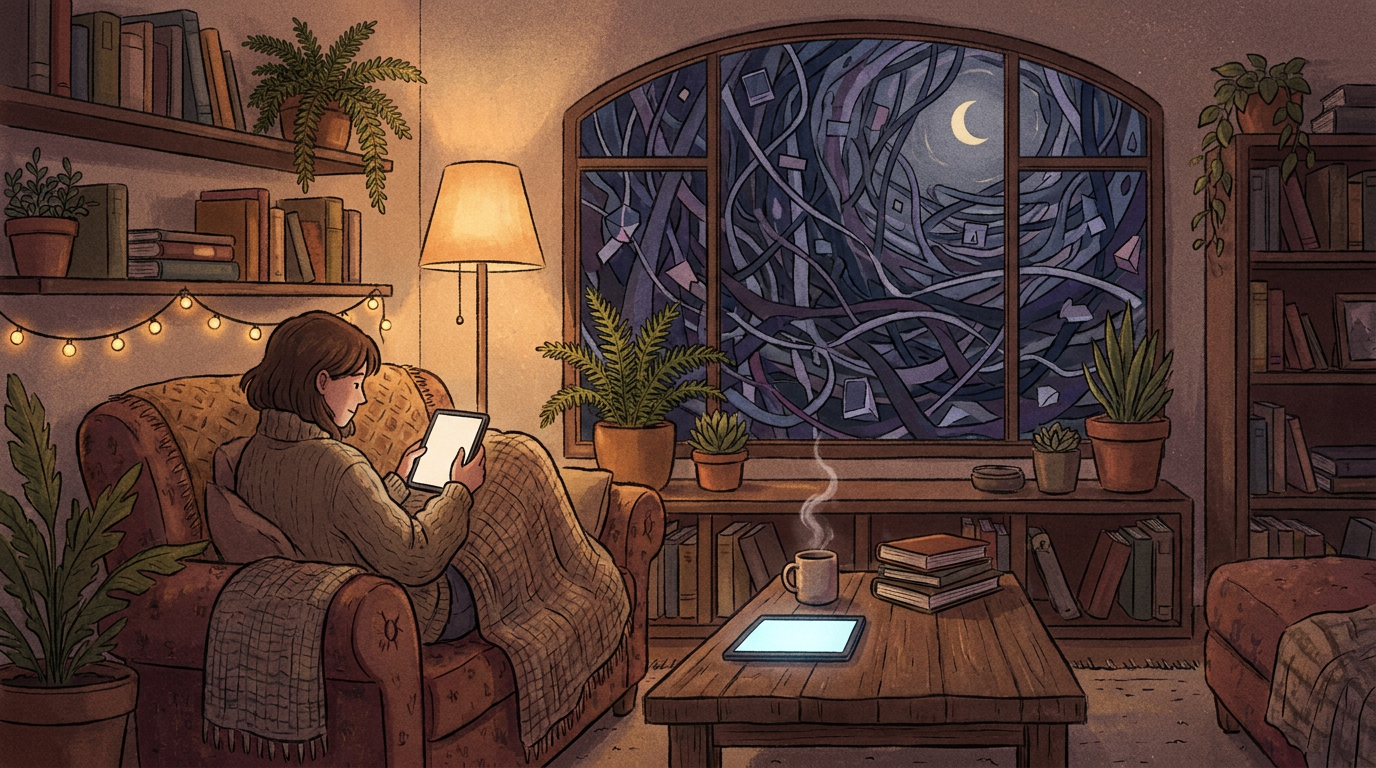
Internet theorists and cultural observers have dubbed this emerging landscape the "Cozy Web." Coined by writer Venkatesh Rao and popularized by digital anthropologists, the Cozy Web refers to the private, unindexed, and highly gated corners of the internet. Unlike the public web, which is indexed by search engines and scraped by artificial intelligence bots, the Cozy Web exists behind closed doors. It is composed of invite-only Discord servers, encrypted WhatsApp group chats, private Telegram streams, and gated community forums. These spaces are intentionally difficult to find and harder to access, functioning entirely on human protocol rather than algorithmic distribution.[1][5]
This migration is largely a reaction to what is known as the "Dark Forest" theory of the internet. In this framework, the public web has become a hostile, predatory environment filled with advertisers, automated bots, algorithmic outrage machines, and bad-faith actors. In the Dark Forest, expressing an authentic opinion or sharing a personal moment carries disproportionate reputational risk, ranging from context collapse to targeted harassment. Consequently, users have learned to stay quiet in public. They leave the main feeds to brands, influencers, and performers, retreating to digital burrows where they can take off their armor and speak freely without fear of algorithmic amplification.[1]

In these smaller, gatekept rooms, the social stakes are dramatically lowered. A poorly phrased joke or a half-baked idea shared in a group chat of ten friends dies instantly; on a public feed, it could invite a mob. This psychological safety allows for the incubation of what sociologists call "thick culture." Thick culture consists of inside jokes, shared histories, deep niche interests, and complex context that cannot survive the flattening, context-free environment of viral algorithms. By removing the pressure to perform for an invisible, infinite audience, the Cozy Web allows users to reclaim the weird, textured, and highly specific internet culture of the early 2000s.[1][5]
Parallel to the rise of the Cozy Web is the mainstream emergence of "Digital Third Places." Sociologist Ray Oldenburg originally defined the "third place" as a social environment separate from the home (the first place) and the workplace (the second place). Historically, these were physical locations like neighborhood cafes, local pubs, public libraries, and community centers. They were accessible, informal settings that offered people freedom from rigid structures and fostered civic engagement. However, in 2026, physical third places are increasingly inaccessible for a large portion of the population.[2]
Rising commercial rents, the premium cost of a simple cup of coffee, and the post-pandemic shift toward remote work have severely eroded these traditional community hubs. For many, especially younger generations and marginalized groups, digital spaces have seamlessly stepped in to fill the sociological void. Multiplayer gaming environments, such as No Man's Sky or Fallout 76, along with dedicated hobbyist Discord servers, now serve the exact function that the neighborhood diner once did. They offer a reliable environment for human connection that transcends geographical boundaries and economic limitations.[2][4]
Rising commercial rents, the premium cost of a simple cup of coffee, and the post-pandemic shift toward remote work have severely eroded these traditional community hubs.
These digital third places offer unique advantages over their physical counterparts. They provide a level playing field where real-world social hierarchies—such as wealth, physical appearance, or status—are less visible. Furthermore, they are profoundly essential for individuals who are disabled, immunocompromised, or living in isolated rural areas. For these populations, a thriving digital community is not a lesser substitute for a physical gathering; it is a vital lifeline that provides a sense of psychological ownership, identity, and belonging that would otherwise be entirely out of reach.[4]

While the Cozy Web represents the private sphere of this new internet, the "Fediverse" and the "IndieWeb" represent its new public square. Rather than relying on corporate silos owned by tech billionaires, users are turning to decentralized networks built on open, interoperable protocols like ActivityPub. Platforms such as Mastodon for microblogging, Pixelfed for ad-free image sharing, and Lemmy for community forums operate on a federated model. This means that no single entity controls the network, and users can communicate across different platforms just as seamlessly as sending an email from Gmail to Outlook.[3][6]
Growth in the Fediverse has been characterized by distinct, wave-driven surges rather than the smooth, viral curves of legacy platforms. Every time a centralized platform changes its API pricing, increases its ad load, or modifies its moderation policies, a new wave of users migrates to the decentralized web. Data from early 2026 indicates that the Fediverse is projected to cross 15 million registered users. More importantly, the retention rate of these migration waves continues to improve. Users who make the jump are increasingly deciding to stay, drawn by the chronological feeds and the absence of engagement-baiting algorithms.[3][7]

Alongside the Fediverse, the IndieWeb movement has experienced a massive cultural resurgence. Personal blogs, RSS feeds, and self-hosted "digital gardens" are returning as users actively reclaim ownership of their digital identities. The core philosophy of the IndieWeb is simple: publish on your own domain first, and syndicate elsewhere only if you choose to. By utilizing open standards like Webmentions, independent sites can communicate with one another, allowing creators to build audiences and interact without ever surrendering their data or their creative control to a centralized tech giant.[6][7]
However, this widespread digital retreat is not without its critics and sociological uncertainties. Experts warn that while digital third places provide valuable connection, they fundamentally alter the nature of community by eliminating "weak ties." In a physical cafe or public park, individuals are forced into serendipitous interactions with people outside their immediate demographic, economic, or ideological bubble. These weak ties are crucial for societal cohesion and mental health. The Cozy Web, by its very nature of being invite-only and highly curated, risks accelerating societal polarization by trapping users in comfortable, self-reinforcing echo chambers.[2][4]
Furthermore, the decentralized architecture of the Fediverse presents unique, ongoing challenges regarding content moderation. Because there is no central authority dictating the rules, individual server administrators must set and enforce their own community guidelines. While this allows communities to tailor their environments to their specific values, it can also lead to fragmented enforcement against harmful content. If a server becomes a haven for bad actors, the only recourse for the rest of the network is to "defederate" or block that server entirely, creating isolated islands rather than a truly unified public square.[6]

Despite these structural challenges, the overarching trajectory of internet culture in 2026 is unmistakable. The era of the monolithic, one-size-fits-all social network is fracturing, likely permanently. In its place, a more fragmented, intentional, and human-scale internet is taking root. Whether through the encrypted safety of a group chat, the decentralized freedom of a Mastodon instance, or the creative ownership of a personal blog, users are proving that the internet does not have to be an exhausting battleground. It can still be a place to call home.[1][7]
How we got here
1989
The World Wide Web is invented with an open, decentralized vision for information sharing.
2010s
Centralized corporate platforms like Facebook and Twitter dominate the internet, creating the algorithmic public square.
2019
The 'Dark Forest' theory of the internet is popularized, describing the initial user retreat from public platforms.
2022–2024
Major platform policy changes and acquisitions trigger massive migration waves to the decentralized Fediverse.
2026
The 'Cozy Web' and digital third places become mainstream cultural defaults for community building.
Viewpoints in depth
Cozy Web Adopters
Users prioritizing psychological safety and intimate connection over public reach.
For this camp, the public internet is fundamentally broken by engagement algorithms and bad-faith actors. They argue that true community cannot exist in a space where every statement is optimized for viral reach or scrutinized by a global audience. By retreating to gated group chats and private servers, they believe they are preserving authentic human culture and protecting their mental health from the exhaustion of the 'Dark Forest.'
Decentralization Advocates
Technologists and creators focused on open protocols and data ownership.
This perspective argues that the solution to the internet's toxicity is not to hide in private chats, but to rebuild the public square on open infrastructure. Proponents of the Fediverse and the IndieWeb believe that users must own their data and their social graphs. They point to the interoperability of ActivityPub as proof that social media can exist without corporate surveillance, algorithmic manipulation, or billionaire owners dictating the rules of engagement.
Physical Space Traditionalists
Sociologists and urbanists warning against the total abandonment of physical community.
While acknowledging the accessibility benefits of digital spaces, this camp warns that online forums cannot fully replace the sociological function of physical third places. They argue that digital communities are inherently self-selecting, which eliminates the 'weak ties' formed by serendipitous encounters with diverse strangers in a local cafe or park. They caution that a complete retreat into curated digital burrows will ultimately accelerate societal polarization and real-world loneliness.
What we don't know
- It remains unclear if decentralized platforms can develop sustainable funding models to support their infrastructure as their user bases scale into the tens of millions.
- The long-term psychological impact of replacing physical community spaces entirely with curated digital burrows is still being studied by sociologists.
Key terms
- Cozy Web
- Private, unindexed digital spaces like group chats and invite-only servers where users seek shelter from public algorithms.
- Dark Forest Theory
- The concept that the public internet is a hostile environment, causing genuine users to hide their authentic selves to avoid harassment or surveillance.
- Digital Third Place
- An online environment, such as a gaming server or forum, that serves the informal social function of a cafe or park.
- Fediverse
- A network of interconnected, decentralized social media platforms running on open protocols, allowing users on different servers to interact.
- IndieWeb
- A movement encouraging people to publish content on their own personal domains rather than relying on corporate platforms.
- ActivityPub
- An open, decentralized social networking protocol that allows different platforms in the Fediverse to communicate with one another.
Frequently asked
What is the difference between the Cozy Web and the Fediverse?
The Cozy Web refers to private, invite-only spaces like group chats and Discord servers where users hide from public view. The Fediverse is a public, decentralized network of independent social media servers that communicate with each other.
Are digital third places replacing physical ones?
For many people, yes. Rising costs of physical spaces and the convenience of global connection have made online communities the primary social outlet, especially for younger generations and remote workers.
What is the Dark Forest theory of the internet?
It is the concept that the public internet has become a hostile environment filled with bots, trolls, and advertisers, causing real users to stay quiet and retreat to private spaces for safety.
Sources
Source coverage
7 outlets
3 viewpoints surfaced







[1]MediumCozy Web Adopters
The Dark Forest and the Cozy Web: A Psychological Retreat
Read on Medium →[2]Easy Reader NewsPhysical Space Traditionalists
The Evolution of Connectivity: Digital Third Places
Read on Easy Reader News →[3]FediViewDecentralization Advocates
A data-driven overview of fediverse growth in 2026
Read on FediView →[4]The Good TradePhysical Space Traditionalists
Finding Community in Digital Third Places
Read on The Good Trade →[5]SubstackCozy Web Adopters
The Alt-Digital is Community-Oriented
Read on Substack →[6]GDIDecentralization Advocates
Opportunities and risks of decentralized social networks
Read on GDI →[7]Factlen Editorial TeamDecentralization Advocates
Synthesis by Factlen editorial team
Read on Factlen Editorial Team →

Every angle. Every day.
Get culture stories with full source coverage and perspective breakdowns delivered to your inbox.