
EV vs. PHEV in 2026: The Complete Guide to Costs, Range, and Trade-Offs
As electric ranges expand and hybrid prices drop, the choice between a fully electric vehicle and a plug-in hybrid comes down to daily charging habits and long-term maintenance costs.
By Factlen Editorial Team
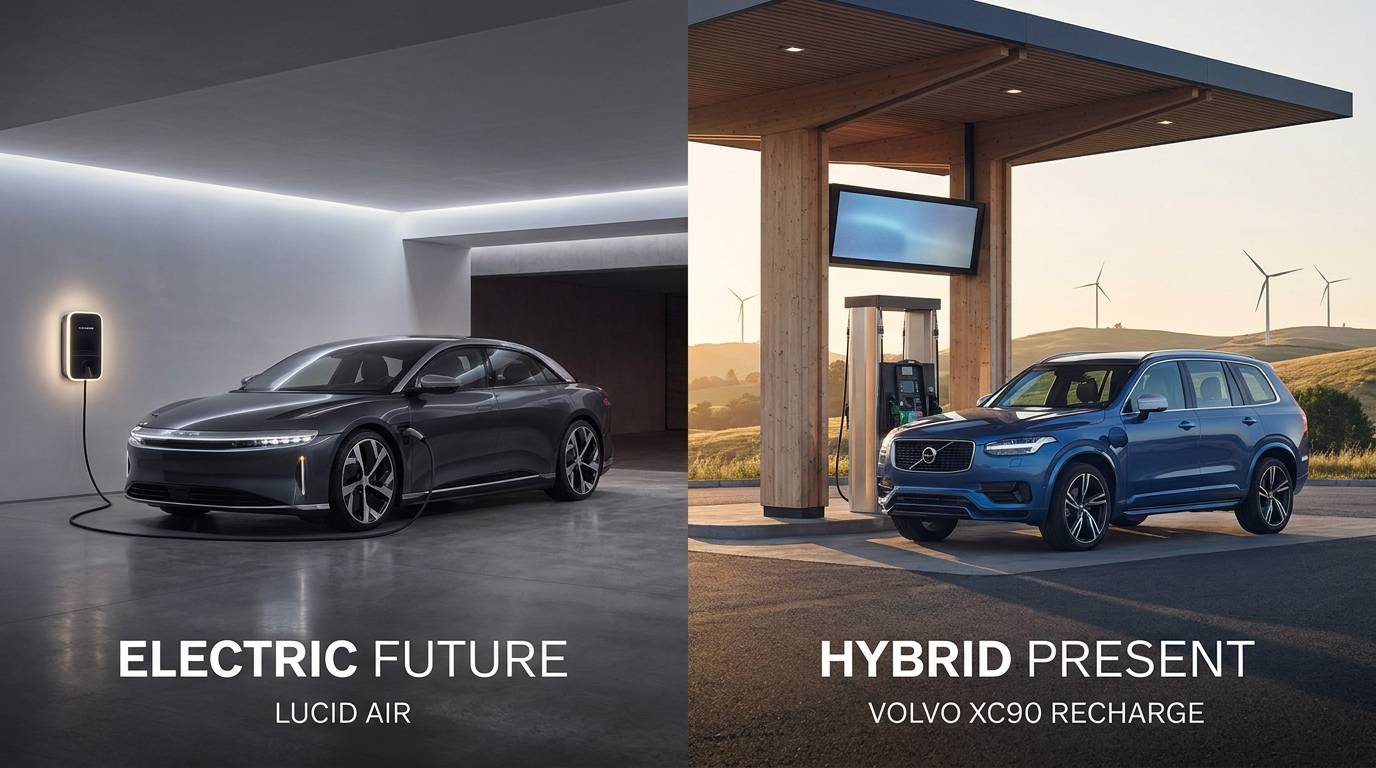
- Pure EV Advocates
- Focus on zero emissions, mechanical simplicity, and long-term total cost of ownership.
- Pragmatic Hybrid Buyers
- Prioritize road-trip flexibility, lower upfront costs, and avoiding charging infrastructure gaps.
- Automotive Reliability Analysts
- Focus on depreciation, market share, and mechanical problem rates.
What's not represented
- · Public infrastructure planners managing grid load
- · Used-car market dealers evaluating long-term battery health
Why this matters
Choosing between an EV and a PHEV is a multi-thousand-dollar decision that dictates your daily routine, your maintenance bills, and your environmental impact for the next decade. Understanding the total cost of ownership prevents buyers from purchasing a vehicle that misaligns with their actual driving habits.
Key points
- EVs cost roughly $14,400 more upfront than PHEVs in 2026.
- PHEVs are mechanically complex and average higher annual maintenance costs.
- EVs offer the lowest cost per mile when charged at home.
- Uncharged PHEVs suffer from poor fuel economy due to battery weight.
- Modern EVs routinely achieve 375 miles (600 km) of range per charge.
- PHEVs remain the optimal choice for drivers lacking reliable home charging.
The 2026 automotive market has forced a reckoning for buyers caught between fully electric vehicles (EVs) and plug-in hybrid electric vehicles (PHEVs). As the industry transitions away from traditional combustion engines, consumers are no longer just comparing sticker prices; they are evaluating complex trade-offs involving daily routines, charging infrastructure, and long-term mechanical reliability. While EVs represent the definitive zero-emission future, PHEVs have surged in popularity as a transitional technology, offering a battery for daily commutes and a gas tank for weekend road trips. The decision between the two has become the defining consumer choice of the decade, requiring a rigorous look at the evidence behind upfront costs, maintenance burdens, and real-world utility.[2][4]
The most immediate divergence between the two platforms lies in the upfront financial commitment. In 2026, the average new fully electric vehicle commands a premium, sitting at approximately $62,000, while the average new hybrid or PHEV is priced significantly lower at roughly $47,600. This $14,400 gap represents a substantial hurdle for budget-conscious buyers, particularly in markets where sweeping federal tax credits have expired or face strict battery-sourcing limitations. For many households, the lower barrier to entry makes the PHEV an attractive proposition, allowing them to dip a toe into electrification without financing a luxury-tier price tag. However, automotive economists warn that focusing solely on the sticker price obscures the long-term financial reality of both powertrains.[2][4][8]
When evaluating the case for and against each vehicle through the lens of maintenance, the evidence heavily favors the pure electric vehicle. A fully electric drivetrain is a marvel of mechanical simplicity, containing roughly twenty moving parts compared to the thousands found in a combustion engine. Data from 2026 fleet analyses indicates that annual EV maintenance averages just $949, as owners bypass oil changes, spark plug replacements, and transmission fluid flushes entirely. Furthermore, regenerative braking systems drastically reduce wear on brake pads, allowing them to last well over 100,000 miles. For drivers prioritizing minimal time spent in the mechanic's waiting room, the EV presents a compelling argument.[2][6]

Conversely, the plug-in hybrid is arguably the most mechanically complex vehicle on the road today, housing both a high-voltage battery system and a traditional internal combustion engine. This duality means owners must maintain two separate powertrains. Annual maintenance for a PHEV averages $1,279, reflecting the inescapable reality of regular oil changes and engine upkeep alongside electrical system diagnostics. Recent reliability surveys from Consumer Reports highlight this vulnerability, noting that PHEVs experience higher rates of mechanical and software glitches than their fully electric counterparts. The evidence suggests that while PHEVs offer peace of mind on the highway, they introduce a higher probability of component failure over a ten-year lifespan.[2][3][6]
The daily operating costs of both vehicles hinge entirely on a driver's charging habits and access to infrastructure. An EV offers the lowest possible cost per mile, provided the owner can charge at home during off-peak hours. In 2026, charging an EV overnight costs a fraction of a tank of gasoline, yielding profound savings for high-mileage commuters. A plug-in hybrid can replicate these savings, but only if the driver operates strictly within the vehicle's 30-to-50-mile electric range and plugs it in diligently every night. When utilized correctly, a PHEV driver might go months without visiting a gas station, effectively enjoying the economic benefits of an EV for their daily routine.[5][7][8]
The daily operating costs of both vehicles hinge entirely on a driver's charging habits and access to infrastructure.
However, the case against the PHEV emerges when driving habits misalign with the technology. If a plug-in hybrid is not charged regularly, it essentially becomes a heavy gasoline-powered car burdened by the dead weight of an empty battery and an electric motor. In this scenario, fuel efficiency plummets, and the vehicle becomes more expensive to operate than a standard hybrid or a traditional gas car. Industry analysts note that a significant percentage of PHEV owners fail to maximize their electric range, ultimately eroding the anticipated fuel savings and negating the environmental benefits of the platform.[5][8]
Range anxiety, once the primary deterrent to EV adoption, has been largely mitigated by technological leaps in 2026. Modern electric vehicles now routinely achieve benchmark ranges of 600 kilometers (roughly 375 miles) on a single charge, comfortably covering the weekly needs of the vast majority of global drivers. Coupled with the rapid expansion of high-voltage fast-charging networks along major corridors, the logistical hurdles of EV ownership have shrunk considerably. Yet, for drivers who frequently traverse rural routes or undertake spontaneous cross-country trips, the reliance on public charging infrastructure remains a valid concern, leaving the door open for the PHEV's unique value proposition.[6][7]
The plug-in hybrid answers the infrastructure challenge by offering an unlimited total range, constrained only by the availability of gas stations. This makes the PHEV an exceptional safety net for single-car households that require a vehicle capable of handling both a five-mile school run on battery power and a five-hundred-mile holiday road trip on gasoline. The evidence shows that for drivers living in apartments without dedicated overnight charging, or those in regions with sparse public networks, the PHEV eliminates the logistical friction that still occasionally hampers the pure EV experience.[5][7]

Depreciation and resale value also play a critical role in the total cost of ownership equation. Historically, early electric vehicles suffered steep depreciation curves, but the 2026 secondary market has stabilized. Premium EVs from established brands are now holding their value remarkably well, bolstered by consumer confidence in battery longevity and the increasing implementation of zero-emission zones in major cities. PHEVs also maintain strong resale values due to high consumer demand for transitional vehicles, though their long-term viability in the resale market may wane as global mandates for fully zero-emission vehicles approach in the 2030s.[4][8]
Ultimately, deciding between these two technologies requires a clear-eyed assessment of lifestyle and driving conditions. A fully electric vehicle fits well when a driver has reliable Level 2 charging at home, commutes daily within a predictable radius, and prioritizes long-term maintenance savings and zero tailpipe emissions over the initial purchase price. The EV is the optimal choice for multi-car households where it can serve as the primary daily driver, effortlessly absorbing the bulk of the family's mileage at the lowest possible operating cost. Conversely, an EV does not fit well when a driver lacks overnight charging access, relies heavily on street parking, or regularly drives long distances through charging deserts.[1][4][8]
A plug-in hybrid electric vehicle fits well when a buyer wants to drastically reduce their daily fuel consumption but frequently embarks on long-distance trips that make relying on public fast chargers impractical. It is the ideal solution for a one-car household seeking the flexibility of gasoline and the daily economy of electricity, provided they have the discipline to plug the vehicle in every night. However, a PHEV does not fit well when a driver has a daily commute that far exceeds the vehicle's 40-mile electric range, or if they lack the intention to charge it regularly, as the added weight and mechanical complexity will ultimately result in higher overall costs than a standard hybrid or a pure EV.[3][5][7]

The 2026 data reveals that the total cost of ownership break-even point between an EV and a PHEV typically occurs around the three-to-five-year mark, depending heavily on annual mileage and local electricity rates. High-mileage drivers will quickly recoup the EV's higher upfront cost through profound savings on fuel and maintenance. However, for those who drive less frequently or face high insurance premiums, the PHEV's lower sticker price may keep it financially advantageous for a longer period. Both vehicles represent a massive leap forward from traditional combustion engines, ensuring that whichever path a consumer chooses, they are driving toward a more efficient future.[4][8]
How we got here
2010
First mass-market EVs and PHEVs introduce the modern electric era.
2020
Battery technology leaps forward, pushing standard EV ranges past the 250-mile mark.
2023
Consumer Reports data highlights growing pains in EV reliability and the mechanical complexity of PHEVs.
2025
Expiration of broad federal EV tax credits in the US shifts the financial calculus toward hybrids.
2026
PHEV sales surge as a transitional technology, while EVs hit new benchmarks in range and charging speed.
Viewpoints in depth
Pure EV Advocates
Supporters of fully electric vehicles emphasize zero emissions and long-term financial savings.
This camp argues that the internal combustion engine is a technological dead end. By eliminating the gas engine entirely, drivers benefit from a mechanically simple drivetrain that slashes maintenance costs and eliminates tailpipe emissions. They point to the rapidly expanding fast-charging network and 600-kilometer battery ranges as evidence that range anxiety is an outdated concern, making the EV the only logical choice for future-proofing a vehicle purchase.
Pragmatic Hybrid Buyers
Advocates for PHEVs prioritize flexibility and the mitigation of charging infrastructure gaps.
For this group, the plug-in hybrid represents the ultimate 'best of both worlds' compromise. They argue that since 90% of daily driving falls well within a PHEV's 40-mile electric range, owners can achieve near-zero emissions for their commutes without being tethered to public charging stations during long road trips. This camp values the lower upfront purchase price and the psychological safety net of a gas tank.
Automotive Reliability Analysts
Data-driven analysts focus on the mechanical complexity and total cost of ownership.
Analysts looking at long-term reliability data, such as Consumer Reports surveys, warn that PHEVs carry inherent risks due to their dual powertrains. By housing both a high-voltage electrical system and a combustion engine, PHEVs present twice the opportunity for component failure. This camp advises consumers to carefully calculate their break-even points, noting that high-mileage drivers will almost always save more money over five years by opting for a pure EV.
What we don't know
- How the used-car market will value aging PHEVs once their battery ranges naturally degrade.
- Whether future government incentives will pivot back to favoring pure EVs over hybrids.
- The exact timeline for when public fast-charging infrastructure will achieve full parity with gas stations.
Key terms
- PHEV
- Plug-in Hybrid Electric Vehicle; a car with both an electric motor for short trips and a gas engine for longer distances.
- BEV
- Battery Electric Vehicle; a car powered entirely by electricity with no internal combustion engine.
- Regenerative Braking
- A system that captures energy normally lost during braking and uses it to recharge the vehicle's battery, reducing brake wear.
- Level 2 Charging
- A 240-volt charging system, commonly installed in homes, that can fully recharge an EV overnight.
- Total Cost of Ownership (TCO)
- The comprehensive financial cost of a vehicle over its lifespan, including purchase price, fuel, maintenance, insurance, and depreciation.
Frequently asked
What is the main difference between an EV and a PHEV?
An EV runs entirely on battery power and must be plugged in. A PHEV has both a battery for short electric trips and a gas engine for longer journeys.
Do I need a home charger to own a plug-in hybrid?
While not strictly required, a home charger is highly recommended. Without regular charging, a PHEV operates as a heavy gas car, negating its fuel-saving benefits.
Are electric vehicles cheaper to maintain?
Yes. EVs have significantly fewer moving parts, eliminating the need for oil changes, spark plugs, and transmission fluid, which lowers annual maintenance costs.
How far can a PHEV drive on electricity alone?
Most 2026 plug-in hybrids offer an electric-only range of 30 to 50 miles before the gasoline engine seamlessly takes over.
Which vehicle is better for road trips?
A PHEV is generally more convenient for frequent, spontaneous road trips as it can refuel at any gas station, avoiding reliance on public fast-charging networks.
Sources
Source coverage
8 outlets
3 viewpoints surfaced








[1]JD PowerAutomotive Reliability Analysts
2026 U.S. Electric Vehicle Experience (EVX) Ownership Study
Read on JD Power →[2]Automotive MustPure EV Advocates
EV vs. Hybrid: The 2026 Landscape and What Changed
Read on Automotive Must →[3]AP NewsAutomotive Reliability Analysts
Consumer Reports survey finds EVs and plug-in hybrids have growing pains
Read on AP News →[4]Clean Fleet ReportPure EV Advocates
Deconstructing the 5-Year Ownership Costs of EVs and Hybrids
Read on Clean Fleet Report →[5]Consumer NZPragmatic Hybrid Buyers
Comparing engines: Hybrid, PHEV, Electric
Read on Consumer NZ →[6]Cars.co.zaPragmatic Hybrid Buyers
EV vs PHEV vs REEV: Which is best for you?
Read on Cars.co.za →[7]ZenithPragmatic Hybrid Buyers
EV vs PHEV at a glance: 2026 Guide
Read on Zenith →[8]Jinyu AutosAutomotive Reliability Analysts
Simulated 5-Year Total Cost of Ownership Calculation
Read on Jinyu Autos →




Every angle. Every day.
Get guides stories with full source coverage and perspective breakdowns delivered to your inbox.