
US and Iran Open Nuclear Talks in Switzerland Amid Strait of Hormuz Threats
Vice President JD Vance and Iranian officials have arrived in Switzerland for a crucial 60-day window of nuclear negotiations, even as regional tensions spike over Iran's threat to close the Strait of Hormuz.
By Factlen Editorial Team
- US Administration
- Seeks to freeze Iran's nuclear advancement and stabilize global energy markets through a mix of diplomatic pressure and deterrence.
- Iranian Leadership
- Aims to secure sanctions relief while using regional military threats as leverage to force concessions and halt Israeli operations.
- Global Energy Markets
- Primarily concerned with the uninterrupted flow of oil through the Strait of Hormuz and the inflationary risks of a blockade.
- Diplomatic Observers
- Views the 60-day timeline as highly ambitious and warns that linking nuclear talks to regional conflicts complicates a resolution.
What's not represented
- · Lebanese civilians affected by the strikes
- · European nations heavily reliant on Gulf energy imports
Why this matters
The Strait of Hormuz facilitates nearly 20% of the world's oil consumption; a closure would trigger an immediate global energy crisis and spike inflation. Meanwhile, the nuclear talks represent the most significant diplomatic effort between Washington and Tehran in years, carrying massive implications for Middle Eastern stability.
Key points
- Vice President JD Vance and Iranian officials have arrived in Switzerland for direct nuclear negotiations.
- The summit aims to establish a 60-day framework to address uranium enrichment and economic sanctions.
- Talks are overshadowed by Iran's threat to close the Strait of Hormuz following Israeli strikes in Lebanon.
- The Strait of Hormuz facilitates roughly 20% of global oil consumption, making it a critical economic chokepoint.
- Global energy markets have already seen price spikes in Brent crude due to the geopolitical risk.
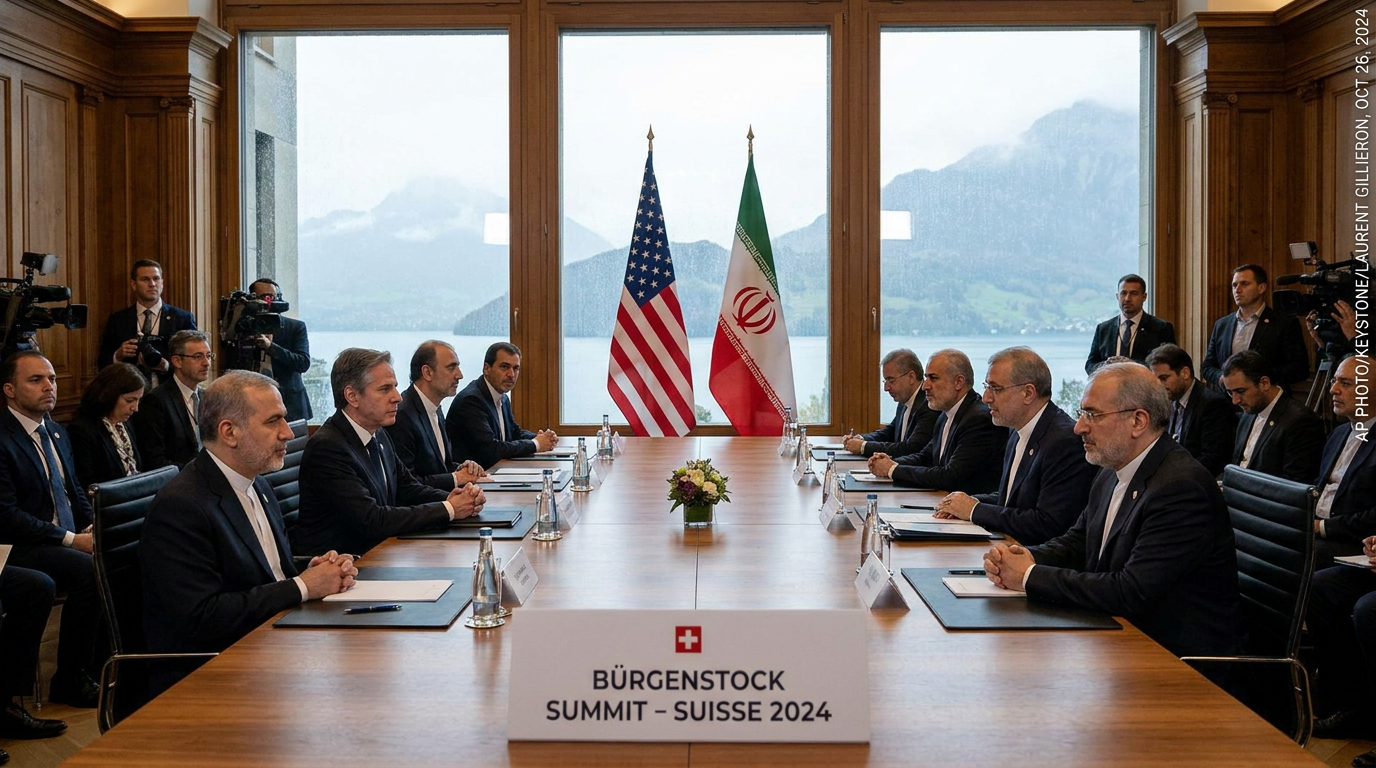
Vice President JD Vance arrived in Switzerland on Saturday, setting the stage for a high-stakes diplomatic summit with Iranian officials at the Bürgenstock ski resort. The meetings, scheduled to begin on Sunday, mark the first direct nuclear negotiations between the United States and Iran since the Islamabad summit in April. The diplomatic push aims to launch a structured 60-day window for comprehensive nuclear talks, an ambitious timeline designed to address Tehran's accelerating uranium enrichment program and Washington's stringent economic sanctions. However, the serene Alpine setting stands in stark contrast to the rapidly deteriorating security situation in the Middle East, which threatens to derail the negotiations before they even begin.[1][8]
The immediate catalyst for the heightened tension is a severe escalation in the Levant, where Israeli military strikes in Lebanon recently killed 16 people. In direct response to the Israeli military action, Iranian officials announced on Saturday that they are preparing to shut down the Strait of Hormuz, a critical maritime chokepoint. This dual-track reality—diplomats shaking hands in Europe while military forces posture in the Persian Gulf—creates an extraordinarily volatile environment for the talks. The Iranian delegation's arrival in Switzerland was confirmed by state media, but their public statements remained heavily focused on condemning the violence in Lebanon rather than outlining their nuclear negotiating positions.[2][3][7]
The Strait of Hormuz, a narrow waterway situated between Oman and Iran, serves as the most important oil transit chokepoint in the global energy market. At its narrowest point, the strait is just 21 miles wide, with the shipping lanes in both directions only two miles wide. Through this narrow corridor flows approximately 20% of the world's total oil consumption, including massive exports from Saudi Arabia, the United Arab Emirates, Kuwait, and Iraq. Any disruption to this flow, whether through physical blockades, naval mining, or the harassment of commercial tankers, immediately sends shockwaves through global energy markets and threatens the stability of the global economy.[4][6]

Financial markets are already reacting to the rhetoric out of Tehran. Brent crude, the international benchmark for oil prices, saw immediate upward pressure as traders priced in the geopolitical risk premium associated with a potential Hormuz closure. Energy analysts warn that a sustained blockade of the strait could drive oil prices significantly higher, exacerbating global inflation and forcing central banks to reconsider their interest rate trajectories. The US administration views the stabilization of energy markets as a critical domestic and international priority, adding immense pressure on the diplomatic team in Switzerland to de-escalate the immediate maritime threat.[5][6]
The core focus of the Bürgenstock summit, assuming the Hormuz crisis can be managed, is the establishment of a 60-day framework to renegotiate the boundaries of Iran's nuclear program. Since the collapse of previous agreements, international inspectors have warned that Tehran has steadily increased its stockpile of highly enriched uranium, bringing it closer to the threshold required for weaponization. The US delegation, led by Vice President Vance, is expected to demand immediate, verifiable freezes on enrichment activities and the restoration of comprehensive access for International Atomic Energy Agency (IAEA) inspectors. In exchange, the US is prepared to discuss a phased timeline for sanctions relief, though the exact parameters remain closely guarded.[1][8]

Vice President Vance's role as the lead negotiator signals the high priority the administration is placing on these talks. Typically, such negotiations might be handled by the Secretary of State or a specialized special envoy, but elevating the diplomatic mission to the vice-presidential level is intended to project both authority and urgency. Vance's mandate is twofold: secure a binding commitment from Iran to halt its nuclear advancement, and establish a deterrence framework that prevents regional proxies from triggering a broader war. This approach requires balancing hardline rhetoric with pragmatic diplomatic concessions, a tightrope walk complicated by the ongoing violence in the region.[1][5]
Vice President Vance's role as the lead negotiator signals the high priority the administration is placing on these talks.
From the Iranian perspective, the negotiations are viewed as a necessary mechanism to alleviate crippling economic sanctions, but Tehran is unwilling to negotiate from a position of perceived weakness. By explicitly linking the nuclear talks to the situation in Lebanon and threatening the Strait of Hormuz, Iranian leadership is attempting to maximize its leverage. This strategy, often referred to as "escalate to de-escalate," is designed to force the United States and its European allies to pressure Israel into halting its military operations. Iranian state media has framed the delegation's presence in Switzerland not as a concession, but as a demonstration of diplomatic strength backed by regional military capability.[3][7]
The intertwining of the nuclear issue with the Israel-Lebanon conflict presents a massive structural challenge for the negotiators. The United States has historically attempted to compartmentalize nuclear talks, arguing that mixing regional security disputes with non-proliferation efforts makes an agreement impossible. However, Iran's explicit threat to close the Strait of Hormuz over the Lebanon strikes shatters that compartmentalization. US diplomats must now address the immediate maritime security crisis before they can realistically expect progress on uranium centrifuges. This dynamic gives Tehran the ability to control the pacing and focus of the Bürgenstock summit.[2][8]
Military posturing in the Persian Gulf is accelerating in tandem with the diplomatic efforts. The US Navy's Fifth Fleet, headquartered in Bahrain, maintains a continuous presence in the region specifically to ensure the free flow of commerce through the Strait of Hormuz. In response to Iran's threats, maritime security coalitions have heightened their alert levels, and commercial shipping companies are reviewing their risk assessments for vessels transiting the area. While a full physical closure of the strait is militarily difficult for Iran to sustain against US naval power, even asymmetrical harassment of tankers can effectively halt commercial traffic by driving insurance premiums to prohibitive levels.[4][6]

A significant area of uncertainty hanging over the summit is whether Iran's threat regarding the Strait of Hormuz is a genuine military objective or a tactical bluff designed to extract concessions at the negotiating table. Historically, Tehran has frequently threatened to close the waterway during periods of high tension, but has rarely taken steps to fully block it, recognizing that such an action would also choke off its own oil exports and likely trigger a massive military response from the United States. However, the unprecedented nature of the recent regional escalations has led intelligence analysts to caution that past restraint does not guarantee future behavior.[6][8]
Another major question is the viability of the 60-day negotiation window. Nuclear diplomacy is notoriously complex, involving highly technical details regarding centrifuge cascades, heavy water reactors, and financial clearinghouses. Attempting to resolve these issues within two months is an exceptionally aggressive timeline. Skeptics argue that the 60-day framework is more about creating a temporary diplomatic pause—allowing both sides to step back from the brink of regional war—than it is about finalizing a comprehensive, long-term treaty. If the deadline passes without a breakthrough, the risk of a rapid, uncontrolled escalation increases significantly.[1][8]
European allies, who are heavily invested in both the non-proliferation aspects of the talks and the stability of global energy markets, are watching the Bürgenstock summit with intense apprehension. European diplomats have been working behind the scenes to facilitate the dialogue, viewing a diplomatic resolution as the only viable alternative to a catastrophic regional conflict. They are particularly concerned about the economic fallout of a Hormuz disruption, which would hit European economies—already grappling with the long-term effects of the shift away from Russian energy—especially hard. Their role in the coming days will likely be to mediate the sharpest disagreements between the US and Iranian delegations.[4][8]
As the formal sessions begin on Sunday, the immediate indicator of success will not be a breakthrough on nuclear enrichment, but rather the rhetoric surrounding the Strait of Hormuz. If the Iranian delegation walks back the threat of closure, it will signal a willingness to engage constructively on the nuclear file. Conversely, if regional proxies escalate their attacks or if naval incidents occur in the Persian Gulf, the Bürgenstock summit could collapse into a mechanism for managing a crisis rather than resolving one. The world is watching Switzerland, but the true test of the negotiations will play out in the waters of the Middle East.[2][5][7]

How we got here
April 2026
The United States and Iran hold a diplomatic summit in Islamabad, laying the groundwork for future talks.
June 20, 2026
Israeli military strikes in Lebanon kill 16 people, prompting Iran to threaten a closure of the Strait of Hormuz.
June 21, 2026
US and Iranian delegations officially begin a 60-day window of nuclear negotiations in Switzerland.
Viewpoints in depth
US Administration's View
The priority is freezing Iran's nuclear progress while preventing a broader regional war.
The US delegation views the 60-day window as a critical opportunity to halt Tehran's accelerating uranium enrichment program before it crosses the weaponization threshold. By elevating the talks to the vice-presidential level, the administration is signaling both the urgency of the non-proliferation goal and its commitment to stabilizing global energy markets. However, US diplomats insist that nuclear negotiations cannot be held hostage by regional proxy conflicts, demanding that Iran separate its maritime threats from the diplomatic table.
Iranian Government's View
Nuclear talks are a tool for sanctions relief, but regional military leverage must be maintained.
Tehran approaches the Bürgenstock summit seeking relief from crippling economic sanctions, but refuses to negotiate from a position of weakness. By explicitly linking the nuclear discussions to the violence in Lebanon and threatening the Strait of Hormuz, Iranian leadership is employing an 'escalate to de-escalate' strategy. They aim to force the US and European allies to pressure Israel into halting military operations, using their capability to disrupt global oil supplies as their primary diplomatic leverage.
Global Energy Markets' View
The primary concern is the uninterrupted flow of oil and the prevention of inflationary price spikes.
Energy analysts and financial markets are watching the summit with deep apprehension, focused less on centrifuge counts and more on the security of the Strait of Hormuz. Because 20% of the world's oil transits the chokepoint, even the threat of harassment drives up insurance premiums and crude prices. Market observers warn that a failure in Switzerland could lead to a sustained blockade, driving oil past $100 a barrel and forcing central banks to rethink global inflation strategies.
European Allies' View
A diplomatic resolution is essential to prevent both nuclear proliferation and a devastating economic shock.
European nations are heavily invested in the success of the 60-day negotiation window. Already managing the economic transition away from Russian energy, Europe is highly vulnerable to any disruption in Middle Eastern oil and gas supplies. European diplomats are working behind the scenes to mediate the sharpest disagreements between Washington and Tehran, viewing a negotiated settlement as the only viable alternative to a catastrophic regional conflict that would severely damage the European economy.
What we don't know
- Whether Iran's threat to close the Strait of Hormuz is a genuine military objective or a tactical negotiating bluff.
- If the highly complex technical details of a nuclear agreement can realistically be resolved within a 60-day window.
- How regional proxies and ongoing military operations in the Levant might disrupt the diplomatic schedule in Switzerland.
Key terms
- Strait of Hormuz
- A highly strategic maritime chokepoint between the Persian Gulf and the Gulf of Oman, essential for global oil shipments.
- Uranium Enrichment
- The process of increasing the concentration of the U-235 isotope in uranium, which can be used for civilian nuclear power or, at high levels, nuclear weapons.
- US Navy Fifth Fleet
- The naval command responsible for US maritime operations in the Arabian Gulf, Red Sea, Gulf of Oman, and parts of the Indian Ocean.
Frequently asked
Why are the US and Iran meeting in Switzerland?
The two nations are launching a 60-day negotiation window aimed at addressing Iran's nuclear enrichment program and discussing potential sanctions relief.
Why is the Strait of Hormuz important?
It is a narrow waterway between Oman and Iran through which approximately 20% of the world's total oil consumption passes. A closure would severely disrupt global energy markets.
What triggered the recent threat to close the strait?
Iran threatened to shut down the waterway in response to Israeli military strikes in Lebanon that reportedly killed 16 people.
Sources
Source coverage
8 outlets
4 viewpoints surfaced







[1]AxiosUS Administration
Vance travels to Switzerland for nuclear talks with Iran
Read on Axios →[2]Al JazeeraIranian Leadership
Iran war live: Vance heads to Switzerland; Israel kills 16 in Lebanon
Read on Al Jazeera →Iranian delegation arrives in Switzerland for US peace talks
Read on Al Jazeera →[4]ReutersGlobal Energy Markets
Strait of Hormuz threat looms over US-Iran nuclear summit in Switzerland
Read on Reuters →[5]Fox NewsUS Administration
Vance arrives in Switzerland for high-stakes Iran nuclear negotiations amid Middle East escalation
Read on Fox News →[6]BloombergGlobal Energy Markets
Oil Prices Jump as Iran Threatens Hormuz Closure Ahead of Nuclear Talks
Read on Bloomberg →[7]IRNAIranian Leadership
Iranian delegation arrives in Bürgenstock, demands end to Lebanon strikes
Read on IRNA →[8]The New York TimesDiplomatic Observers
A 60-Day Window: U.S. and Iran Embark on High-Wire Diplomacy in the Alps
Read on The New York Times →
More in news politics
See all 5 stories →
Every angle. Every day.
Get news politics stories with full source coverage and perspective breakdowns delivered to your inbox.