
Private Fusion Investment Crosses $13 Billion as Startups Race Toward Commercial Power
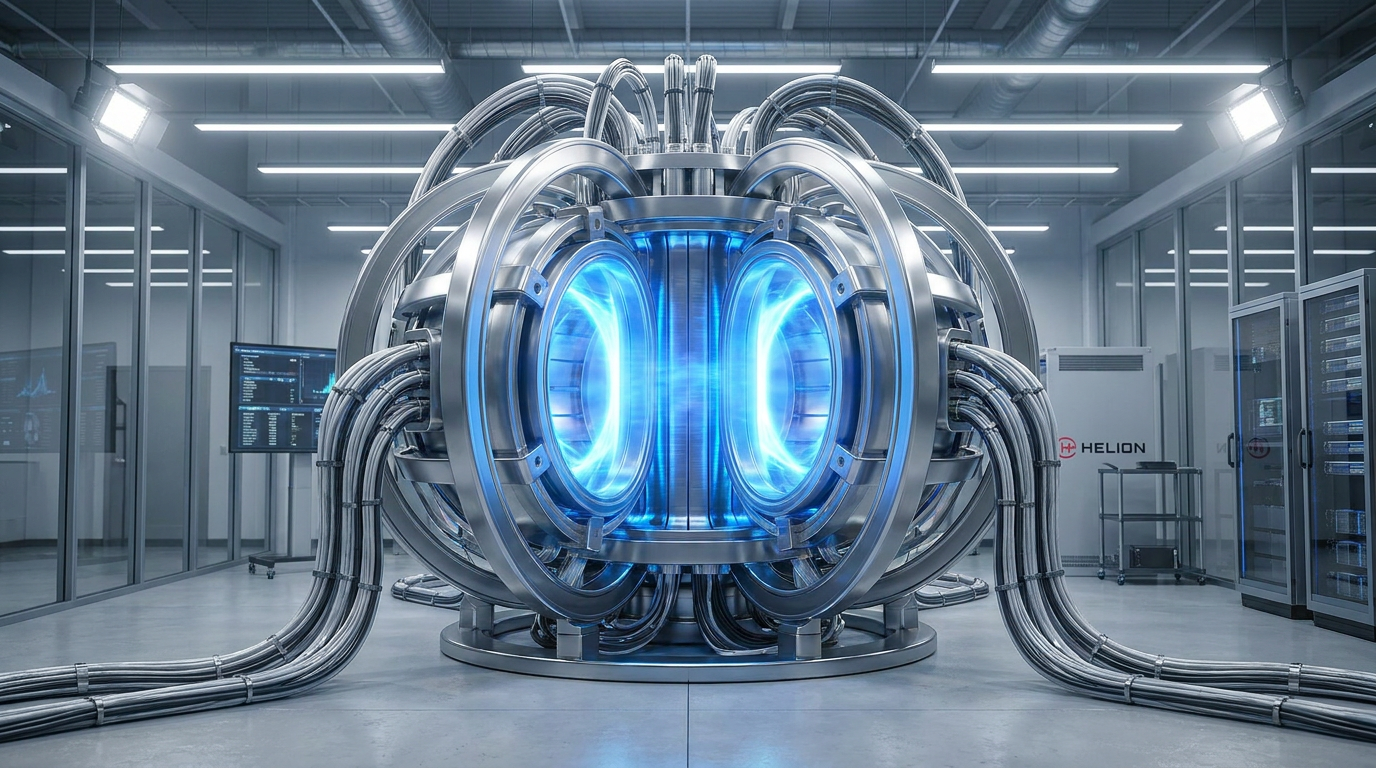
A wave of massive funding rounds for startups like Helion Energy and Focused Energy has pushed total private investment in nuclear fusion past $13 billion, signaling a shift from theoretical physics to near-term commercial deployment.
By Factlen Editorial Team
- Commercial Fusion Developers
- Argue that massive capital and AI-driven modeling have compressed timelines, making commercial fusion viable by the late 2020s.
- Scientific Skeptics
- Emphasize that commercial net energy gain remains unproven and warn against overly aggressive deployment timelines.
- European Energy Strategists
- View fusion as a sovereign security imperative, blending public and private capital to ensure Europe isn't left behind by US startups.
What's not represented
- · Traditional fossil fuel utilities
- · Renewable energy deployment advocates
Why this matters
If these startups succeed, they will unlock a nearly limitless, zero-carbon source of baseload electricity that could permanently solve the global energy crisis. The massive influx of capital means the timeline for commercial fusion has shifted from a distant scientific hope to a near-term infrastructure race.
Key points
- Total private investment in nuclear fusion startups has officially crossed the $13 billion mark.
- Helion Energy reached a $15.5 billion valuation after closing a $465 million funding round.
- 17 different fusion startups globally have now raised more than $100 million each.
- European startups like Focused Energy are blending venture capital with government grants to stay competitive.
- Helion maintains an aggressive target to deliver commercial electricity to Microsoft by 2028.
- Skeptics note that no private company has yet demonstrated commercial-scale net energy gain.
The quest to harness the power of the stars has officially transitioned from a theoretical physics challenge into a heavily capitalized industrial race. In June 2026, total private investment in nuclear fusion startups surpassed $13 billion, marking a historic milestone for the climate technology sector. The surge is driven by a wave of massive funding rounds, signaling that venture capitalists and institutional investors believe commercial fusion is no longer a distant sci-fi dream, but a viable near-term infrastructure play.[1][4]
Leading the charge is Helion Energy, which closed a massive $465 million funding round this month, catapulting its private valuation to an astronomical $15.5 billion. The Washington-based startup, backed heavily by OpenAI CEO Sam Altman, is pursuing a pulsed magnetic approach to plasma containment. The new capital injection is earmarked for the final construction phases of its Polaris facility, which the company claims will demonstrate net electricity production.[2]
Helion is not just building prototypes; it is actively selling future power. The company maintains an aggressive timeline to deliver commercial electricity to Microsoft by 2028 under a first-of-its-kind power purchase agreement. If Helion meets this target, it would become the first private entity to achieve commercial fusion power generation, fundamentally altering the global energy landscape.[5]

But the American startups are no longer running alone. The European contingent has rapidly gained ground, reflecting a broader strategic bet on continental energy independence. Germany’s Focused Energy recently closed a $240 million Series A round, uniquely structured by combining $400 million in private venture funding with $200 million in government grants. Other European players, including Munich-based Proxima Fusion and Marvel Fusion, have also pulled in nine-figure sums, ensuring that the continent remains competitive in the race for next-generation baseload power.[3]
The sheer volume of well-funded competitors indicates a rapidly maturing ecosystem. According to industry tracking, 17 different fusion startups have now raised more than $100 million each. Commonwealth Fusion Systems (CFS), spun out of MIT, still leads the pack in total historical capital with roughly $3 billion raised to date. CFS expects its SPARC tokamak reactor, currently under construction in Massachusetts, to achieve a burning plasma state by late 2026 or early 2027.[1][6]
The sheer volume of well-funded competitors indicates a rapidly maturing ecosystem.
Behind CFS and Helion sits a deep bench of heavily capitalized contenders. TAE Technologies boasts nearly $1.8 billion in pre-merger funding, while Pacific Fusion and Shine Technologies have each secured roughly $1 billion in milestone-based commitments. The Fusion Industry Association notes that the pace of capital deployment is accelerating, with cumulative private investment crossing the $8 billion mark just last year before surging past $13 billion this June.[1][4]

Despite the financial exuberance, the fundamental scientific reality remains daunting. Academic physicists and industry analysts caution that no private fusion company has yet demonstrated "net energy gain"—the crucial threshold where a reactor produces more energy than it consumes to sustain the reaction—at a commercial scale. While the National Ignition Facility achieved a brief net gain in a government lab setting in 2022, replicating that feat in a continuous, commercially viable power plant is an entirely different engineering challenge.[7]
Skeptics warn that fusion timelines have a long history of slipping, and the 2028 commercial targets may be overly optimistic. The engineering hurdles involve not just sustaining plasma at temperatures hotter than the sun, but also developing novel materials capable of withstanding intense neutron bombardment over decades of operation. Furthermore, extracting the generated heat and converting it into electricity efficiently remains a complex bottleneck for several of the leading reactor designs.[7]
To mitigate these risks, investors are deliberately spreading their bets across a diverse array of technological approaches. While CFS relies on traditional tokamak designs supercharged by high-temperature superconducting magnets, Helion uses field-reversed configuration, and Focused Energy is pursuing inertial confinement using advanced lasers. This diversification ensures that if one containment method hits an insurmountable physics wall, the broader industry can pivot to alternative architectures.[3][6]

The sudden acceleration in fusion progress is also heavily intertwined with the artificial intelligence boom. Advanced AI models and massive supercomputing clusters are now being deployed to simulate plasma behavior and optimize magnetic field configurations in real-time. This computational leap allows startups to iterate on reactor designs digitally in days, rather than spending years building physical prototypes, dramatically compressing the traditional research and development timeline.[4]
Regulatory clarity is providing an additional tailwind for the sector. In recent years, regulatory bodies in the US and the UK have signaled that fusion power plants will be regulated under different, less burdensome frameworks than traditional nuclear fission reactors, owing to fusion's lack of long-lived radioactive waste and zero risk of a meltdown. This regulatory de-risking is a critical factor in unlocking institutional capital.[4]
The stakes for the global economy are difficult to overstate. A successful commercial fusion reactor would provide a nearly limitless, clean, and dispatchable baseload power source, capable of replacing fossil fuels without the intermittency issues of solar and wind. As the 2020s draw to a close, the billions of dollars flowing into these startups guarantee that the industry will soon face its ultimate test: translating theoretical physics and venture capital into actual electrons on the grid.[5]
How we got here
Dec 2022
The US National Ignition Facility achieves the first-ever net energy gain in a fusion experiment.
May 2023
Microsoft signs the first commercial fusion power purchase agreement with Helion Energy.
2025
Cumulative private investment in the fusion sector crosses the $8 billion mark.
June 2026
Total private funding surpasses $13 billion as Helion and Focused Energy close massive rounds.
2028
Helion Energy's target date to begin delivering commercial electricity to the grid.
Viewpoints in depth
The Commercial Optimists
Industry leaders believe commercial fusion is achievable within the decade.
Backed by billions in venture capital, commercial fusion developers argue that the fundamental physics problems have largely been solved. They point to the integration of high-temperature superconducting magnets and AI-driven plasma modeling as the catalysts that have dramatically compressed development timelines. For these optimists, the remaining hurdles are purely engineering and manufacturing challenges, making targets like 2028 ambitious but entirely plausible.
The Scientific Skeptics
Academic physicists warn against overly aggressive deployment timelines.
While acknowledging the impressive influx of capital, scientific skeptics emphasize that commercial net energy gain remains unproven outside of highly controlled, brief government lab experiments. They argue that sustaining a burning plasma continuously, extracting the heat efficiently, and building materials that can survive decades of neutron bombardment are monumental challenges that cannot simply be solved by throwing venture capital at them. They caution that the industry risks a 'trough of disillusionment' if 2028 targets are missed.
The European Sovereign Push
European strategists view fusion as a critical pillar for long-term energy independence.
For European policymakers and regional startups, the fusion race is as much about geopolitics as it is about climate change. Unwilling to rely entirely on American or Asian technology for next-generation baseload power, European entities are blending private venture capital with substantial government grants. This hybrid funding model aims to ensure that companies like Focused Energy and Proxima Fusion can compete at scale, securing Europe's sovereign energy future.
What we don't know
- Which of the competing plasma containment technologies (tokamak, pulsed magnetic, inertial confinement) will ultimately prove most commercially viable.
- Whether any private startup will actually achieve sustained net energy gain before 2030.
- How quickly national grids will be able to integrate and distribute fusion-generated baseload power once it becomes available.
Key terms
- Nuclear Fusion
- The process of combining light atomic nuclei to form a heavier nucleus, releasing massive amounts of energy—the same process that powers the sun.
- Net Energy Gain
- The critical threshold where a fusion reactor produces more energy than is required to heat and sustain the plasma.
- Tokamak
- A device that uses a powerful magnetic field to confine plasma in the shape of a torus (donut), currently the most researched fusion reactor design.
- Baseload Power
- The minimum amount of electric power needed to be supplied to the electrical grid at any given time, traditionally provided by coal or nuclear fission.
Frequently asked
When will fusion power actually be available?
While startups like Helion are targeting 2028 for early commercial delivery, many scientists believe widespread grid-scale fusion is still a decade or more away.
Is fusion energy safe?
Yes. Unlike traditional nuclear fission, fusion does not produce long-lived highly radioactive waste, and a runaway chain reaction or 'meltdown' is physically impossible.
Why is so much money flowing into fusion now?
Advances in high-temperature superconductors, AI-driven plasma modeling, and successful government lab experiments have convinced investors that the remaining hurdles are engineering challenges rather than theoretical physics problems.
Sources
Source coverage
7 outlets
3 viewpoints surfaced







[1]TechCrunchEuropean Energy Strategists
Private fusion funding crosses $13B as 17 startups raise over $100M
Read on TechCrunch →[2]BusinessWireCommercial Fusion Developers
Helion Energy Secures $465M to Accelerate Commercial Fusion Deployment, Reaching $15.5B Valuation
Read on BusinessWire →[3]TheNextWebEuropean Energy Strategists
European fusion startups gain ground as Germany's Focused Energy raises $240M
Read on TheNextWeb →[4]Fusion Industry AssociationCommercial Fusion Developers
Global Fusion Industry Report 2026: The Transition to Commercialization
Read on Fusion Industry Association →[5]ReutersCommercial Fusion Developers
Microsoft-backed Helion maintains 2028 target for commercial fusion power
Read on Reuters →[6]BloombergCommercial Fusion Developers
Commonwealth Fusion Systems Nears Milestone as Private Capital Floods Sector
Read on Bloomberg →[7]MIT Technology ReviewScientific Skeptics
The $13 billion fusion question: When will we see net energy gain on the grid?
Read on MIT Technology Review →


Every angle. Every day.
Get business stories with full source coverage and perspective breakdowns delivered to your inbox.