
AI Decodes Sperm Whale 'Alphabet,' Revealing Complex Language Structure
Researchers using advanced artificial intelligence have identified a phonetic alphabet and vowel-like structures in sperm whale communication, marking a historic breakthrough in interspecies translation.
By Factlen Editorial Team
- Marine Biologists
- Focus on understanding the rich social and cultural lives of whales.
- AI Researchers
- Focus on the technical breakthrough of applying LLMs to non-human bioacoustics.
- Conservationists
- Argue that decoding animal language should lead to stronger legal protections.
What's not represented
- · Commercial shipping and fishing industries affected by potential new marine protections
- · Skeptical linguists who maintain that true language requires human-level syntax
Why this matters
Understanding that animals possess complex, structured languages fundamentally shifts humanity's relationship with nature. By proving that cetaceans have a capacity for language, scientists hope to accelerate new legal protections and conservation efforts for marine life.
Key points
- AI has identified a phonetic alphabet and vowel-like structures in sperm whale clicks.
- Machine learning models can predict the next whale click in a sequence with 99% accuracy.
- Whales vary the rhythm, tempo, and duration of their clicks to construct complex meanings.
- The discovery suggests sperm whales have passed down cultural dialects for millions of years.
- Researchers aim to fully comprehend 20 distinct whale expressions within the next five years.
- The breakthrough could lead to stronger legal protections and conservation efforts for marine life.
For decades, the clicks and calls echoing through the deep ocean were a mystery, recognized as communication but impossible to decipher. Now, artificial intelligence has unlocked the door to interspecies translation. Researchers have discovered that sperm whales utilize a complex phonetic alphabet, complete with vowel-like structures, fundamentally challenging the long-held belief that structured language is a uniquely human trait.[1][5]
The breakthrough comes from Project CETI (Cetacean Translation Initiative), a multidisciplinary team of marine biologists, cryptographers, and machine learning experts. By feeding thousands of hours of underwater recordings into advanced AI models, the team identified patterns that parallel human phonology. The AI revealed that sperm whales do not just emit holistic, fixed sounds; instead, they combine distinct acoustic elements to form a vast array of meanings.[1][2][5]
Sperm whales communicate in rapid bursts of clicks known as "codas." Researchers found that the whales vary the rhythm, tempo, and duration of these codas in highly structured ways. Much like humans combine letters to form words and alter their tone to change meaning—similar to languages like Mandarin or Slovenian—sperm whales use these variations to construct a sophisticated, modular language.[1][4]

The application of large language models to bioacoustics has dramatically accelerated this research. Using unsupervised machine translation—an AI technique that finds structural patterns without needing a parallel dictionary or "Rosetta Stone"—the models achieved a staggering 99 percent accuracy in predicting the next click in a whale's sequence. This predictive capability proves that the codas follow strict grammatical rules rather than random generation.[2][5]
The application of large language models to bioacoustics has dramatically accelerated this research.
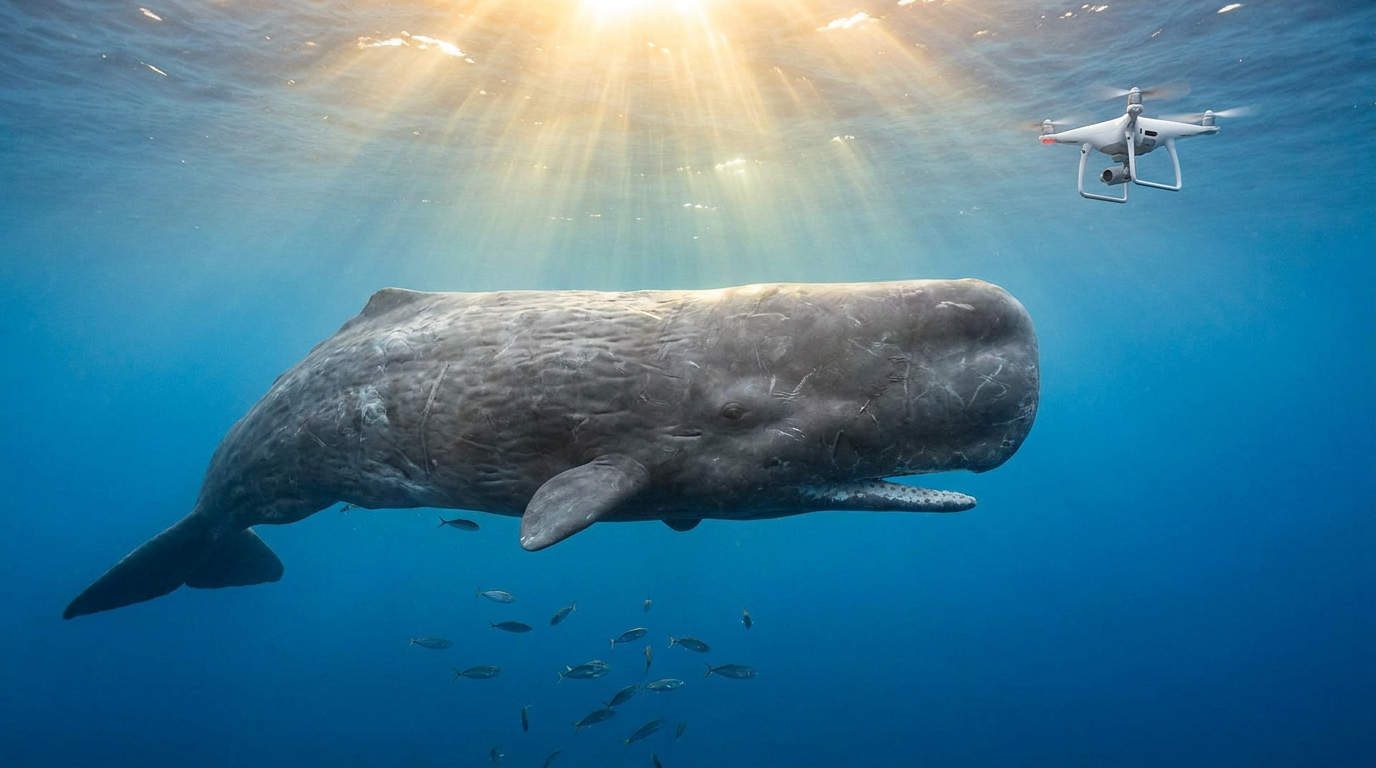
To gather this unprecedented dataset, scientists deployed non-invasive drones and soft robotics off the coast of Dominica, observing a well-documented population of sperm whales. By synchronizing the audio recordings with high-resolution overhead footage of the pods, researchers are beginning to map specific codas to distinct social behaviors, such as collective foraging, nursing, and deep diving.[2][5]
The findings highlight the profound social complexity of sperm whales, which possess the largest brains on Earth and live in tight-knit, matrilineal family units. Experts note that these enduring family bonds are shaped by deep cultural traditions. The newly decoded language structures suggest these whales have been passing down cultural information and distinct family dialects from generation to generation for potentially 20 million years.[1][4][5]

This milestone is part of a broader movement to decode the "Tree of Life." Organizations like the Earth Species Project are developing "NatureLM," a state-of-the-art large audio-language model designed to analyze vocalizations across various species. By learning the shared structures of communication—from human speech to environmental noise—these models aim to uncover the diverse intelligences sharing our planet.[6]
Beyond the scientific marvel, decoding animal language carries massive implications for conservation and environmental law. Advocates argue that proving cetaceans possess a capacity for language could disrupt current legal frameworks, bolstering arguments for their right to cultural preservation. Understanding their communication could illuminate the suffering caused by underwater noise pollution and commercial exploitation, spurring stronger global protections.[3][5]
While scientists caution that two-way communication remains a distant goal, the pace of discovery is accelerating. Project CETI has set an ambitious target: to fully comprehend 20 distinct vocalized expressions within the next five years. As AI continues to peel back the layers of non-human communication, humanity inches closer to a future where we can finally listen to, and perhaps one day understand, the other inhabitants of Earth.[1][5]
How we got here
1950s
Scientists first confirm that sperm whales vocalize using clicks.
2020
Project CETI begins applying machine learning to massive datasets of whale clicks.
May 2024
Researchers publish the first evidence of a 'sperm whale phonetic alphabet.'
April 2026
AI models successfully identify vowel-like structures and predict whale communication patterns with 99% accuracy.
Viewpoints in depth
Marine Biologists & Ethologists
Focus on how language reveals the rich social and cultural lives of whales.
For marine biologists, the discovery of a phonetic alphabet is the ultimate validation of cetacean intelligence. They emphasize that sperm whales live in complex, multi-generational societies where vocalizations are crucial for survival in the dark ocean depths. By mapping codas to specific behaviors, ethologists hope to prove that whales possess distinct cultural identities and family dialects that are actively taught to their young, rather than inherited purely through genetics.
AI & Machine Learning Researchers
Highlight the technical triumph of applying large language models to non-human data.
Computer scientists view this breakthrough as a testament to the power of unsupervised machine learning. Traditional translation requires a 'Rosetta Stone'—a parallel text to map meanings. By contrast, the AI used here analyzes the geometric relationships between sounds to deduce grammatical rules entirely from context. Researchers are excited to scale these foundational models, like NatureLM, to process the bioacoustics of countless other species across the animal kingdom.
Conservationists & Legal Advocates
Argue that recognized language should lead to stronger legal protections.
Environmental advocates see interspecies translation as a powerful tool for policy change. They argue that if science definitively proves whales have language and culture, the legal landscape must adapt. This could lead to recognizing cetaceans as legal persons or granting them specific rights to cultural preservation, making it legally actionable to disrupt their habitats with shipping noise, sonar, or deep-sea mining.
What we don't know
- The exact semantic meaning of the vast majority of the recorded codas.
- Whether humans will ever be able to safely and ethically initiate two-way communication with cetaceans.
- How the legal system will ultimately respond to scientific proof of non-human language and culture.
Key terms
- Coda
- A distinct sequence of acoustic clicks used by sperm whales to communicate with one another.
- Bioacoustics
- The cross-disciplinary science that investigates sound production, dispersion, and reception in animals.
- Unsupervised Machine Translation
- An AI technique that learns to translate languages by analyzing structural patterns without needing a parallel dictionary.
- Phonology
- The system of relationships among the speech sounds that constitute the fundamental components of a language.
Frequently asked
Can humans talk back to the whales yet?
Not yet. While AI can predict and categorize their clicks with high accuracy, scientists are still working to map specific meanings to these sounds before attempting two-way communication.
How does the AI learn the whale language?
The AI is trained on thousands of hours of underwater recordings, learning the underlying patterns, rhythms, and structures of the clicks much like it learns human languages.
Why are scientists studying sperm whales specifically?
Sperm whales have the largest brains on Earth, live in complex, multi-generational family units, and rely heavily on acoustic communication to navigate and socialize in the dark depths of the ocean.
Sources
Source coverage
6 outlets
3 viewpoints surfaced






[1]The GuardianConservationists
How sperm whale communication is similar to human language
Read on The Guardian →[2]National GeographicConservationists
AI may help decode their languages
Read on National Geographic →[3]TIMEConservationists
What If AI Could Translate Animal Communication?
Read on TIME →[4]WHYYMarine Biologists
Machine learning helped study their calls in a new way
Read on WHYY →[5]Project CETIMarine Biologists
Decoding the language of sperm whales
Read on Project CETI →[6]Earth Species ProjectAI Researchers
Animal Language Processing: An AI Convergence In Animal Communication
Read on Earth Species Project →
More in ai
See all 5 stories →


Every angle. Every day.
Get ai stories with full source coverage and perspective breakdowns delivered to your inbox.