
How 'Coolcationing' is Redrawing the Global Map of Summer Travel
As extreme summer heatwaves become the norm in traditional Mediterranean hotspots, travelers are increasingly seeking out temperate northern destinations in a massive shift dubbed 'coolcationing'.
By Factlen Editorial Team
- Northern Tourism Boards
- Embracing the influx of summer travelers by promoting natural cooling and vast outdoor spaces.
- Southern European Economies
- Adapting to extreme heat by restructuring the traditional tourism calendar toward the shoulder seasons.
- Climate-Conscious Travelers
- Prioritizing thermal comfort, sustainability, and crowd avoidance in their vacation planning.
What's not represented
- · Local residents in newly popular northern towns facing sudden influxes of tourists
- · Aviation and cruise industry planners adjusting long-term fleet deployments
Why this matters
The physical reality of climate change is fundamentally restructuring the multi-billion-dollar global tourism industry. For travelers, understanding this shift offers a roadmap to more comfortable, less crowded vacations, while for economies, it dictates where future infrastructure and investments must flow.
Key points
- Travelers are increasingly abandoning traditional Mediterranean summer holidays in favor of cooler northern destinations.
- The Mediterranean basin is warming 20% faster than the global average, threatening its outdoor leisure economy.
- Searches for 'coolcation' destinations have surged by 74% year-on-year across global booking platforms.
- Nordic countries like Sweden and Norway are actively marketing their temperate climates and vast natural spaces.
- Southern European destinations are adapting by shifting their focus to spring and autumn 'shoulder season' travel.
The traditional European summer vacation is undergoing a profound geographic realignment. For decades, the global travel industry operated on a foundational model of southern European sun-and-sand leisure, with millions flocking to the Mediterranean coastlines of Spain, Italy, and Greece.
However, as prolonged summer heatwaves become the new normal across southern latitudes, a formidable opponent to this model has emerged: the thermometer. In response, a massive demographic of travelers is migrating north, driving a phenomenon the industry has dubbed "coolcationing."
Coolcationing is the deliberate selection of temperate, high-latitude, or high-altitude destinations during the peak summer months. Rather than enduring 40-degree Celsius (104-degree Fahrenheit) days in crowded southern capitals, vacationers are seeking out the 20-degree Celsius (68-degree Fahrenheit) averages of Scandinavia, the Baltics, and the Scottish Highlands.
The shift is rooted in undeniable meteorological data. The Mediterranean basin is currently warming 20 percent faster than the global average, a reality that is fundamentally altering the region's thermal comfort threshold.[6]

According to climate risk assessments by the McKinsey Global Institute, the number of "unbearably hot" summer days—defined as exceeding 37 degrees Celsius—is projected to double in key Mediterranean destinations by 2050. For resort cities heavily reliant on peak-season influxes, this spike in intolerably hot days presents a direct threat to the outdoor leisure economy.[2]
The behavioral impact of this warming is already measurable. Academic research from Rey Juan Carlos University, analyzing structural equation models of external tourist demand in Spain, confirms that heat waves are actively redistributing tourist flows.[3]
The study found a direct correlation between the increase in high temperatures and lower tourist arrivals to traditional Spanish Mediterranean coasts and the Balearic Islands from core source markets like the United Kingdom. When the heat becomes a physical liability, the modern traveler simply books elsewhere.[3]
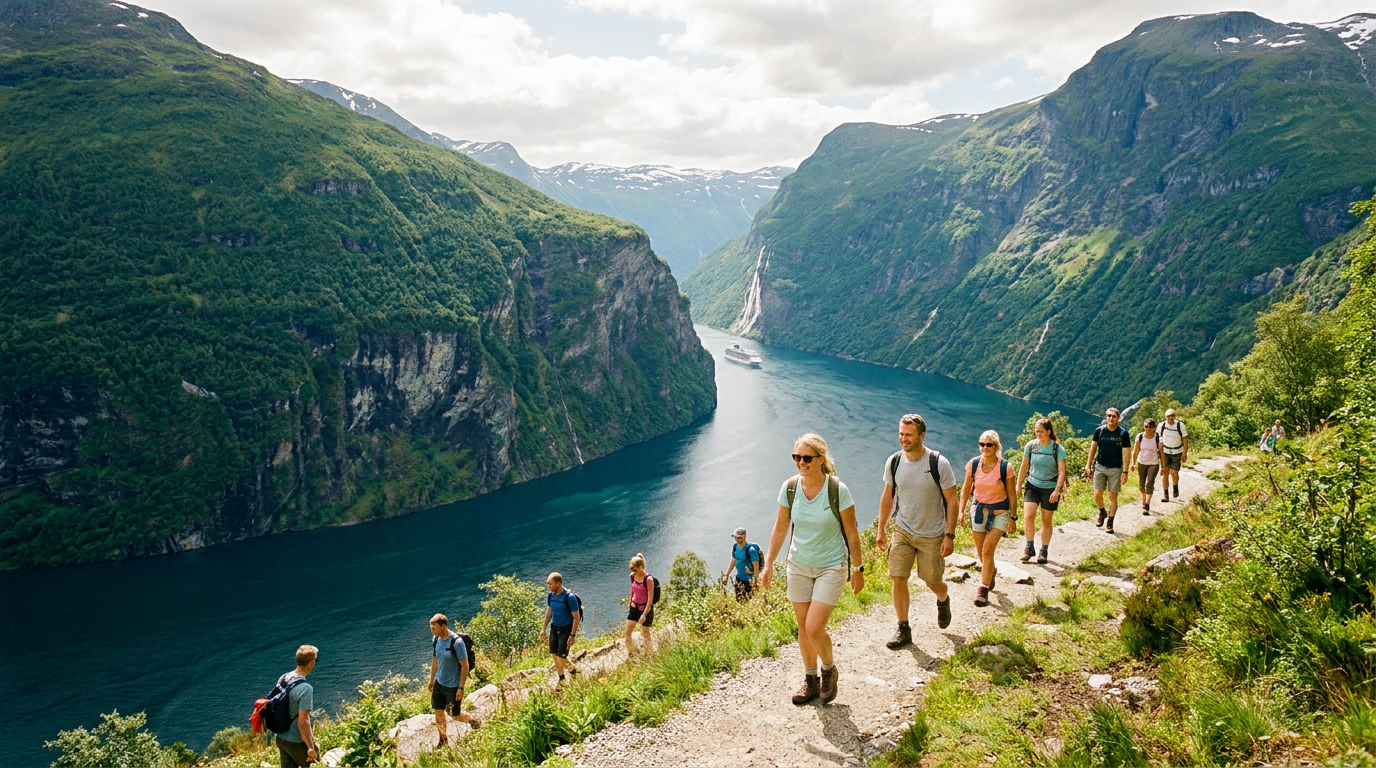
The primary beneficiaries of this climate-driven exodus are the Nordic countries. Sweden, Norway, Finland, and Iceland have transitioned from being viewed primarily as winter sports hubs or niche adventure destinations into prime summer refuges.[5]
The primary beneficiaries of this climate-driven exodus are the Nordic countries.
Tourism boards in these regions are actively leaning into the shift. Visit Sweden, the country's official tourism organization, has launched campaigns explicitly highlighting the nation's "natural air conditioning," promoting its 100,000 lakes, vast shaded forests, and endless summer daylight.[1]

Susanne Andersson, head of Visit Sweden, notes that the appeal of a coolcation extends beyond mere temperature control. It is also a rejection of the crushing overtourism that plagues southern hotspots during July and August. Travelers are seeking physical space, pristine environments, and a slower pace of exploration.[5]
The economic indicators of this northern migration are staggering. Travel industry reports for 2026 show that global booking searches for designated cooler destinations have escalated by 74 percent year-on-year.[7]
Furthermore, luxury travel networks report that upwards of 82 percent of their clients are now actively considering destinations with milder weather for their summer itineraries. Families, in particular, are pivoting toward activity-based coolcations—such as kayaking in Swedish archipelagos or hiking Slovenian alpine trails—as safer alternatives to sweltering beach resorts.[4][7]
For the Mediterranean economies, where tourism accounts for approximately 15 percent of regional GDP, the coolcation trend is forcing a rapid strategic pivot. Southern destinations are increasingly marketing themselves as year-round "city break" locations or focusing on the "shoulder seasons" of spring and autumn.[2][6]
Hoteliers in places like Benidorm, Spain, report that while peak summer days are becoming challenging, the mild winters and extended springs are attracting a new wave of off-season visitors, effectively creating a "never-ending spring" business model.[6]

Yet, the coolcation boom is not without its own set of emerging challenges. As tourist volumes surge in previously quiet northern towns, the specter of overtourism is beginning to creep toward the Arctic Circle.[5]
Norwegian fjord villages, some with populations in the low hundreds, are now regularly navigating the logistical strain of massive cruise ships docking with thousands of passengers. Local municipalities are being forced to implement crowd management strategies that were once the exclusive domain of cities like Venice or Barcelona.[5]
There is also the open question of human acclimatization. While current thermal comfort thresholds are pushing northern Europeans away from the Mediterranean, it remains uncertain whether these thresholds will shift as populations gradually adapt to warmer baseline temperatures at home.[7]
Despite these uncertainties, the fundamental architecture of the summer holiday has been permanently altered. The coolcation is no longer a niche alternative; it is a central pillar of the modern travel economy.[4]
By prioritizing climate resilience, physical comfort, and sustainable engagement with nature, travelers are not just escaping the heat—they are redefining what a restorative vacation looks like in a warming world.[7]
How we got here
2022-2023
Record-breaking summer heatwaves across the Mediterranean trigger a noticeable shift in European travel booking patterns.
2024
The term 'coolcationing' gains mainstream traction as luxury travel networks report massive surges in demand for Nordic destinations.
2025
Southern European destinations begin actively restructuring their marketing to promote 'shoulder season' travel in spring and autumn.
June 2026
Industry reports confirm coolcationing has transitioned from a niche preference into a dominant structural force in the global tourism market.
Viewpoints in depth
Northern Tourism Boards
Embracing the influx of summer travelers by promoting natural cooling and vast outdoor spaces.
For nations like Sweden, Norway, and Finland, the warming climate presents a unique macroeconomic opportunity. Tourism boards are actively rebranding their historically brief summer seasons as the ultimate premium escape. By highlighting their pristine lakes, shaded forests, and midnight sun, these organizations are capturing a highly lucrative demographic that prioritizes physical comfort and sustainability over traditional beach lounging. However, they are also acutely aware of the risks of importing the very overtourism their visitors are trying to escape, leading to a strong emphasis on dispersed, nature-based itineraries.
Southern European Economies
Adapting to extreme heat by restructuring the traditional tourism calendar toward the shoulder seasons.
Mediterranean stakeholders recognize that the peak months of July and August are becoming increasingly hostile to outdoor leisure. Rather than conceding the economic loss, these regions are aggressively pivoting their marketing and infrastructure. The strategy involves extending the tourism season into the 'shoulder' months of spring and autumn, promoting night-time cultural economies, and investing heavily in indoor, climate-controlled attractions. For many southern hoteliers, the goal is to transform the traditional summer slump into a highly profitable, year-round 'never-ending spring' model.
Climate-Conscious Travelers
Prioritizing thermal comfort, sustainability, and crowd avoidance in their vacation planning.
The modern traveler is increasingly treating climate data as a primary variable in their booking decisions. Driven by the physical exhaustion of enduring consecutive heatwaves and the logistical nightmares of overcrowded southern capitals, this demographic is actively seeking out destinations that offer a reliable thermal comfort threshold. This shift is not merely about temperature; it reflects a broader desire for 'quietcations'—vacations that offer genuine relaxation, connection with nature, and a lower environmental footprint, far removed from the frenetic energy of traditional mass tourism.
What we don't know
- Whether northern European infrastructure can scale sustainably to handle the massive influx of summer tourists without degrading the natural environment.
- How quickly southern European economies can fully offset peak-summer revenue losses through expanded shoulder-season tourism.
- If long-term human acclimatization to warmer baseline temperatures will eventually raise the 'thermal comfort threshold' for travelers.
Key terms
- Coolcationing
- A travel trend where vacationers deliberately select northern latitudinal or high-altitude destinations with cooler summer climates to avoid extreme heat.
- Shoulder Season
- The travel period between peak and off-peak seasons, typically spring and autumn, which is becoming the new high season for hotter climates.
- Thermal Comfort Threshold
- The specific temperature and humidity limit beyond which the majority of tourists find outdoor leisure activities unacceptably hot.
- Urban Heat Island Effect
- A phenomenon where densely built urban areas experience significantly higher temperatures than surrounding rural areas, exacerbating summer heatwaves.
Frequently asked
What exactly is a coolcation?
A coolcation is a vacation planned specifically around finding a temperate, comfortable climate—typically between 15°C and 25°C—to escape the extreme summer heat of traditional tourist hotspots.
Are Mediterranean destinations losing all their tourists?
No, but the timing of visits is shifting. Many travelers are now visiting Southern Europe during the 'shoulder seasons' of spring and autumn, while avoiding the peak heat of July and August.
Which countries are the most popular coolcation spots?
Scandinavian nations like Sweden and Norway, along with Iceland, Finland, the Baltics, and Scotland, are currently the primary beneficiaries of the trend.
Sources
Source coverage
7 outlets
3 viewpoints surfaced







[1]Visit SwedenNorthern Tourism Boards
Coolcation is heating up as American travelers turn to Sweden for summer relief
Read on Visit Sweden →[2]McKinsey Global InstituteSouthern European Economies
Climate risk and response: Physical hazards and socioeconomic impacts
Read on McKinsey Global Institute →[3]Rey Juan Carlos UniversitySouthern European Economies
Impact of Heat Waves on the Redistribution of Tourist Flows: The Case of Spain
Read on Rey Juan Carlos University →[4]AS USAClimate-Conscious Travelers
Coolcation? The travel trend that has tourists shifting to cooler locations to avoid the heat
Read on AS USA →[5]The LocalNorthern Tourism Boards
Driven away by heat, tourists flock to Nordic 'coolcations'
Read on The Local →[6]MarketplaceSouthern European Economies
Rising temperatures threaten the Mediterranean’s tourism industry
Read on Marketplace →[7]Factlen Editorial TeamClimate-Conscious Travelers
Synthesis by Factlen editorial team
Read on Factlen Editorial Team →

Every angle. Every day.
Get travel stories with full source coverage and perspective breakdowns delivered to your inbox.