
Open-Weight vs. Proprietary AI Models: Which Architecture Fits Your Needs
As artificial intelligence becomes foundational to modern workflows, the choice between downloading an open-weight model or subscribing to a proprietary API dictates privacy, cost, and capability. This comparison breaks down the trade-offs to help organizations and individuals choose the right path.
By Factlen Editorial Team
- Turnkey Enterprise Adopters
- Prioritize immediate deployment, maximum reasoning capabilities, and managed infrastructure over granular control.
- Open-Source Advocates
- Value transparency, community-driven innovation, and the ability to run models locally without vendor lock-in.
- Privacy-First Organizations
- Require absolute data sovereignty and air-gapped deployments for sensitive medical, legal, or financial data.
What's not represented
- · Hardware Manufacturers
- · Independent AI Researchers
Why this matters
Choosing the right AI architecture determines whether your data remains private, how much your infrastructure will cost at scale, and how deeply you can customize the technology to your specific needs. Understanding these trade-offs prevents costly vendor lock-in and empowers teams to build more secure, efficient tools.
Key points
- Proprietary models offer turnkey access to peak reasoning but require sending data to third-party servers.
- Open-weight models provide absolute data privacy and can run in air-gapped environments.
- Proprietary APIs operate on a pay-per-token OpEx model, which can become expensive at scale.
- Open-weight models require upfront hardware CapEx but offer flat-rate operating costs.
- Open models allow for deep customization and fine-tuning that proprietary APIs restrict.
- Many enterprises are adopting hybrid architectures, routing tasks based on privacy and complexity.
As artificial intelligence transitions from a novel experiment to foundational enterprise infrastructure, organizations and developers face a critical architectural fork in the road. The decision of how to integrate large language models into products and workflows largely boils down to two distinct paradigms: renting access to a proprietary model hosted in the cloud, or downloading an open-weight model to run on privately managed hardware. This choice is no longer just about raw intelligence; it dictates a project's long-term cost structure, data privacy posture, and flexibility. Understanding the inherent trade-offs between these two approaches is essential for anyone building the next generation of digital tools, as the right fit depends entirely on the specific constraints and goals of the deployment.[6]
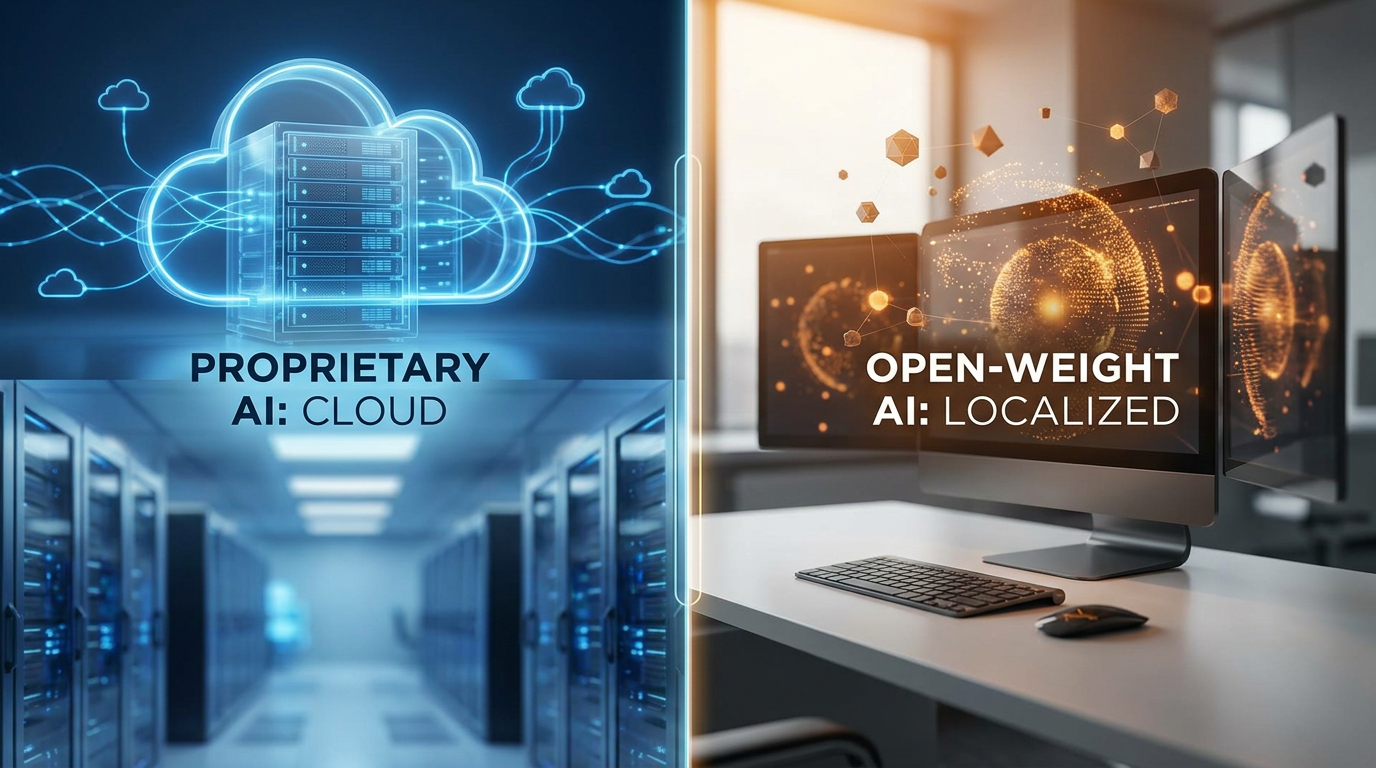
Proprietary models represent the turnkey, software-as-a-service approach to artificial intelligence. Developed by industry heavyweights, these models are hosted on massive, centralized supercomputers and accessed exclusively through Application Programming Interfaces (APIs) or web interfaces. The underlying neural network architecture, the training data, and the model weights remain strictly confidential, guarded as highly valuable intellectual property. For the end user, this means zero setup time and no need to procure expensive graphics processing units (GPUs). Developers simply send a text or image prompt to the provider's server, and the server returns the generated response, billing the user based on the volume of data processed.[4]
In contrast, the open-weight paradigm democratizes access to the core technology itself. Organizations release the fully trained parameters—the weights—of their models to the public, allowing anyone to download the neural network directly. While the original training data is often kept private, possessing the weights means developers can run the model on their own laptops, local servers, or private cloud instances. This approach transforms AI from a metered utility into an owned asset. The open ecosystem has flourished, driven by collaborative research and a shared desire to prevent a few centralized entities from monopolizing foundational intelligence capabilities.[2][5]

When evaluating raw performance and complex reasoning capabilities, proprietary models have historically maintained a noticeable edge, particularly at the absolute frontier of AI research. Because their developers can pour billions of dollars into massive compute clusters and proprietary training techniques, these closed systems often excel at highly nuanced logic puzzles, advanced mathematics, and zero-shot problem solving. Furthermore, proprietary models currently boast massive context windows—sometimes capable of processing millions of tokens simultaneously—allowing users to upload entire codebases or hundreds of documents in a single prompt without the model losing track of the overarching narrative.[1][4]
However, the performance gap has narrowed dramatically over the past two years. Open-weight models have evolved from experimental novelties into enterprise-grade engines capable of matching or exceeding the performance of older proprietary models. For the vast majority of standard business applications—such as drafting emails, summarizing reports, extracting data from structured documents, or powering customer service chatbots—the top-tier open-weight models provide more than enough reasoning capability. The open-source community has also developed highly efficient quantization techniques, allowing these powerful models to run on surprisingly modest hardware without suffering catastrophic drops in output quality.[2][3]
Data privacy and security represent perhaps the most stark divergence between the two architectures. Utilizing a proprietary model inherently requires transmitting data over the internet to a third-party server. While major providers offer strict enterprise agreements guaranteeing that customer data will not be used to train future models, the data still leaves the organization's physical and digital perimeter. For many companies, this level of trust is acceptable, but for highly regulated industries dealing with sensitive information, sending data to an external API introduces unacceptable compliance risks and potential vulnerabilities.[4][6]
Data privacy and security represent perhaps the most stark divergence between the two architectures.
Open-weight models solve this privacy dilemma entirely by enabling complete data sovereignty. Because the model runs on infrastructure controlled by the user, it can be deployed in completely air-gapped environments disconnected from the public internet. Hospitals can process patient records, financial institutions can analyze proprietary trading algorithms, and defense contractors can parse classified intelligence without a single byte of data ever leaving their secure facilities. This absolute control over data flow makes open-weight architectures the mandatory choice for organizations operating under strict regulatory frameworks like HIPAA or GDPR.[3][6]

The financial models for these two approaches are fundamentally different, representing a classic trade-off between operating expenses (OpEx) and capital expenses (CapEx). Proprietary models operate on a pay-as-you-go OpEx model, typically charging fractions of a cent per thousand tokens processed. This structure is incredibly attractive for startups, rapid prototyping, and applications with low or unpredictable usage volumes, as it requires zero upfront investment in hardware. However, as an application scales and processes millions of interactions daily, those recurring API costs can compound rapidly, becoming a significant and permanent line item on the balance sheet.[4][6]
Conversely, open-weight models require a substantial upfront CapEx investment but offer highly predictable, flat-rate operating costs at scale. While the model itself is free to download, running it requires purchasing expensive AI-optimized servers or committing to long-term leases for cloud compute instances. Once that infrastructure is in place, the organization can generate an infinite number of tokens without paying a third-party provider. For high-volume, continuous-use applications, the total cost of ownership for an open-weight deployment often drops to a fraction of what a proprietary API would cost over a multi-year timeline.[1][5]
Customization is another arena where the two paradigms diverge sharply. Proprietary models are largely static from the user's perspective; customization is generally limited to prompt engineering, providing context in the system prompt, or using restricted fine-tuning APIs that only allow superficial adjustments to the model's tone or format. The user cannot alter the fundamental neural pathways or force the model to unlearn specific behaviors. This black-box nature ensures stability and safety for the provider but limits how deeply a developer can integrate the model into highly specialized, niche workflows.[4][6]

Open-weight models, by contrast, offer total architectural freedom. Developers have full access to the neural network and can employ advanced techniques like Low-Rank Adaptation (LoRA) or full fine-tuning to fundamentally alter the model's behavior. An organization can take a general-purpose open model and train it extensively on their internal codebase, proprietary legal contracts, or specialized medical literature. This deep specialization allows a smaller, highly tuned open-weight model to drastically outperform a massive, general-purpose proprietary model on specific, narrow tasks, all while running much faster and cheaper.[3][5]
Vendor lock-in and platform risk are critical considerations for long-term enterprise strategy. Building a core product around a proprietary API means tying the company's fate to the provider's roadmap, pricing changes, and uptime. If the provider experiences an outage, the dependent application goes down. If the provider decides to deprecate a specific model version, developers are forced to migrate and re-test their entire application against a new version, which may behave differently or break carefully crafted prompts. This reliance on an external entity introduces a layer of systemic risk that organizations must carefully manage.[1][4]
Adopting an open-weight strategy eliminates vendor lock-in but replaces it with a significant maintenance burden. When an organization downloads a model, they effectively become their own AI IT department. They are responsible for provisioning the hardware, optimizing the inference engine, managing security patches, and ensuring high availability. There is no customer support hotline to call if the model starts hallucinating or if the server crashes. This requires hiring specialized machine learning engineers and DevOps talent, which can offset some of the cost savings gained by avoiding API fees.[2][6]
Ultimately, the choice between proprietary and open-weight models is rarely a binary, winner-take-all decision. Many sophisticated organizations are adopting hybrid architectures, utilizing proprietary APIs for complex, low-volume reasoning tasks and routing high-volume, specialized, or privacy-sensitive tasks to internal open-weight models. Proprietary models fit perfectly when speed to market, massive context windows, and peak reasoning are paramount. Open-weight models are the clear winner when data sovereignty, deep customization, and predictable costs at massive scale are the defining requirements of the project.[6]
How we got here
2020
GPT-3 introduces the API-driven proprietary model paradigm to the mainstream.
2023
Meta releases Llama 2, sparking widespread enterprise interest in open-weight architectures.
2024
Open models begin matching proprietary models on standard reasoning benchmarks.
2025
Widespread enterprise adoption of hybrid AI architectures becomes the industry standard.
2026
Open-weight models achieve parity in multimodal tasks, solidifying the dual-ecosystem.
Viewpoints in depth
Turnkey Enterprise Adopters
Focus on speed to market, avoiding infrastructure overhead, and leveraging the absolute cutting-edge reasoning capabilities of frontier models.
For organizations prioritizing rapid product development and state-of-the-art capabilities, proprietary models remain the gold standard. This camp argues that the massive capital required to build and maintain AI infrastructure is a distraction from their core business. By relying on APIs from major providers, they instantly benefit from the billions of dollars poured into frontier research, gaining access to massive context windows and complex multi-step reasoning that open models struggle to match out-of-the-box. They view the recurring API costs as a worthwhile premium for avoiding the headaches of server maintenance, security patching, and model optimization.
Open-Source Advocates
Focus on democratization, community research, avoiding monopolies, and the rapid pace of decentralized innovation.
This perspective champions the open-weight movement as a necessary counterbalance to corporate centralization. Advocates argue that foundational intelligence should not be locked behind the walled gardens of a few tech giants. They point to the explosive innovation happening on platforms like Hugging Face, where researchers globally collaborate to optimize, quantize, and fine-tune open models. For this camp, the ability to inspect the weights, run the model locally, and avoid vendor lock-in is paramount. They believe that while proprietary models may win on absolute peak performance today, the collective velocity of the open-source community will inevitably close the gap.
Privacy-First Organizations
Focus on data sovereignty, regulatory compliance, and the necessity of air-gapped deployments for sensitive intellectual property.
For sectors dealing with highly sensitive information—such as healthcare, defense, and finance—the architectural debate begins and ends with data privacy. This camp argues that no enterprise agreement or API privacy pledge is secure enough to justify transmitting classified intelligence or protected health information to a third-party server. They require the ability to deploy AI models in completely air-gapped environments, physically severed from the public internet. Open-weight models are the only viable solution for these organizations, allowing them to leverage advanced AI capabilities while maintaining absolute, verifiable control over their data perimeter.
What we don't know
- Whether open-weight models will ever fully match the reasoning capabilities of the absolute largest proprietary frontier models.
- How future AI regulations might impact the legal liability of releasing open-weight models to the public.
- The long-term sustainability of the open-weight ecosystem if major corporate sponsors reduce their funding.
Key terms
- Open-Weight
- Models where the trained parameters (weights) are publicly available to download and run, though the training data may remain private.
- Proprietary Model
- A closed-source model accessible only via an API or web interface, with weights and architecture hidden by the developer.
- Fine-Tuning
- The process of taking a pre-trained model and training it further on a specific, smaller dataset to specialize its knowledge.
- Context Window
- The maximum amount of text or data a model can process and remember in a single prompt or conversation.
- Air-Gapped
- A computer or network that is physically isolated from unsecured networks, such as the public internet, ensuring maximum security.
Frequently asked
Are open-weight models completely free?
While the model weights are usually free to download, running them requires significant computational hardware or cloud hosting, which incurs costs.
Can I run a proprietary model on my own servers?
No, proprietary models are hosted exclusively on the developer's infrastructure and accessed remotely via an API.
Which option is better for coding assistance?
Proprietary models often have an edge in complex, multi-file coding tasks due to massive context windows, but fine-tuned open models are highly capable for specific languages.
Is my data safe with proprietary APIs?
Most major providers offer enterprise tiers that do not train on customer data, but organizations with strict compliance requirements often prefer open-weight models for absolute control.
Sources
Source coverage
6 outlets
3 viewpoints surfaced






[1]Stanford University (HAI)Turnkey Enterprise Adopters
Artificial Intelligence Index Report 2026
Read on Stanford University (HAI) →[2]Hugging FaceOpen-Source Advocates
Open LLM Leaderboard
Read on Hugging Face →[3]arXivPrivacy-First Organizations
Comparative Analysis of Open-Weight and Proprietary Large Language Models
Read on arXiv →[4]OpenAITurnkey Enterprise Adopters
OpenAI API Pricing and Enterprise Privacy
Read on OpenAI →[5]Meta AIOpen-Source Advocates
Introducing the Llama Family of Models
Read on Meta AI →[6]Factlen Editorial TeamPrivacy-First Organizations
Synthesis by Factlen editorial team
Read on Factlen Editorial Team →

Every angle. Every day.
Get meta stories with full source coverage and perspective breakdowns delivered to your inbox.