
Printed Artificial Neurons Successfully Communicate With Living Brain Cells in Major Breakthrough
Engineers have developed flexible, 3D-printed artificial neurons capable of generating lifelike electrical signals that directly activate biological brain tissue. The breakthrough paves the way for advanced neuroprosthetics and ultra-efficient AI hardware inspired by the human brain.
By Factlen Editorial Team
- Neuroprosthetic Researchers
- Focus on the medical applications, emphasizing how soft, flexible interfaces can overcome the body's rejection of rigid metal implants.
- AI Hardware Engineers
- View the breakthrough as a blueprint for neuromorphic computing that can drastically reduce the massive energy footprint of artificial intelligence.
- Materials Scientists
- Highlight the additive manufacturing techniques and novel conductive inks that make flexible, dynamic electronics possible.
What's not represented
- · Ethicists evaluating the long-term implications of seamless brain-computer integration
- · Patients with neurological conditions awaiting advanced neuroprosthetics
Why this matters
This dual-purpose breakthrough solves a critical hardware bottleneck for both medicine and computing. It offers a path to brain-machine interfaces that won't be rejected by the body, while providing a blueprint for AI chips that operate on a fraction of the energy used by modern data centers.
Key points
- Northwestern University engineers have 3D-printed artificial neurons that generate lifelike electrical signals.
- The flexible devices successfully activated real neural circuits in mouse cerebellum tissue during laboratory tests.
- Printed using a specialized ink of molybdenum disulfide and graphene, the neurons mimic the brain's physical structure.
- The technology offers a bio-compatible alternative to rigid metal probes for future brain-machine interfaces.
- By replicating the brain's complex signaling, the devices could pave the way for ultra-energy-efficient AI hardware.
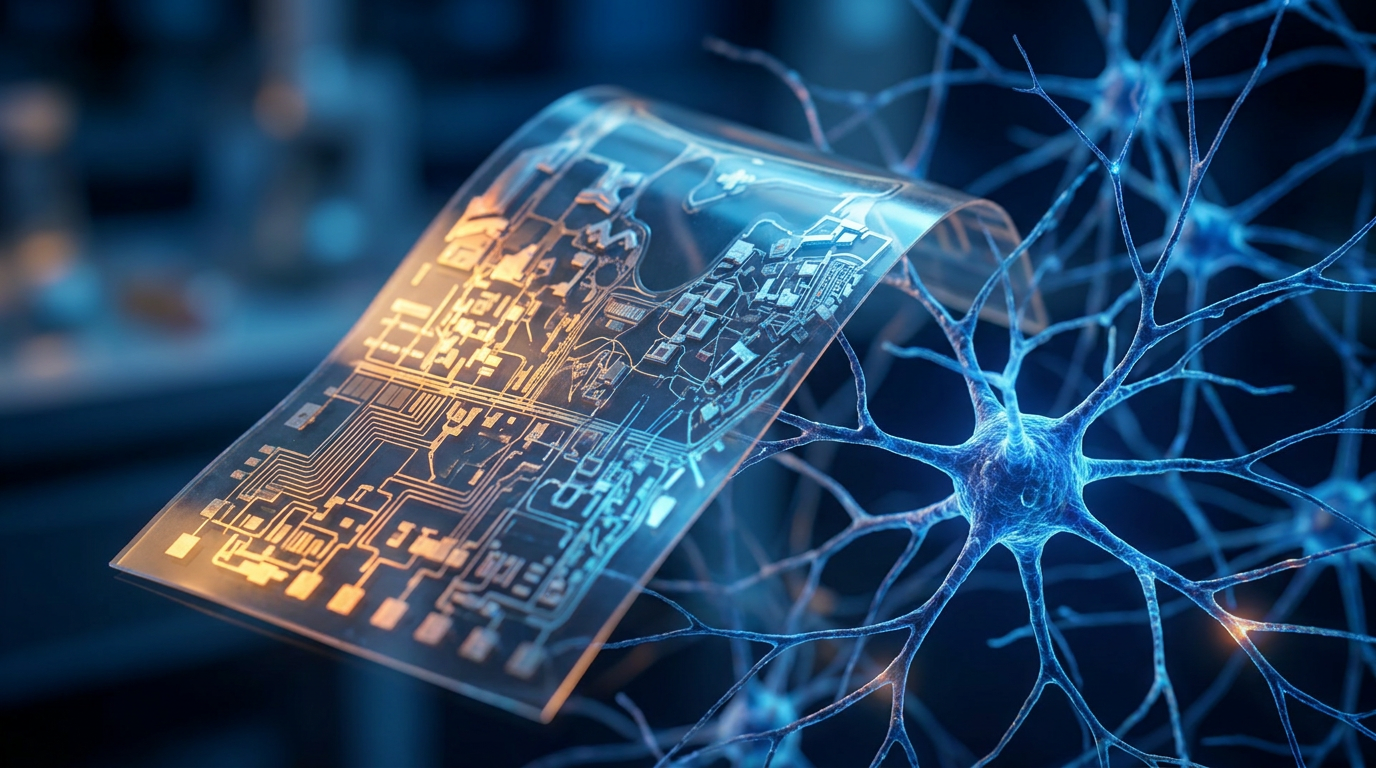
Engineers at Northwestern University have achieved a major milestone in bioelectronics by 3D-printing artificial neurons that can directly communicate with living brain cells. Moving beyond simple imitation, these flexible, low-cost devices generate lifelike electrical signals capable of activating biological neural tissue.[1][2]
The research, recently published in the journal Nature Nanotechnology, bridges a long-standing gap between synthetic electronics and organic biology. For decades, scientists have struggled to connect the rigid, uniform world of silicon chips with the soft, dynamic, and three-dimensional environment of the human nervous system.[1][7]
"Silicon achieves complexity by having billions of identical devices," explained Mark C. Hersam, the Walter P. Murphy Professor of Materials Science and Engineering at Northwestern, who co-led the study. "Everything is the same, rigid and fixed once it's fabricated. The brain is the opposite."[1][4]
To break away from the limitations of silicon, the engineering team turned to soft, printable materials. They developed a specialized electronic ink formulated from nanoscale flakes of molybdenum disulfide, which acts as a semiconductor, and graphene, which serves as an electrical conductor.[1][5]

Using a technique known as aerosol jet printing, the researchers deposited these conductive inks onto flexible polymer substrates. This additive manufacturing approach allows for the creation of customized, heterogeneous structures that more closely resemble the physical properties of biological tissue than traditional computer chips.[3][5]
During the fabrication process, the team made a serendipitous discovery. Typically, the stabilizing polymer used in electronic inks is burned off after printing to prevent it from interfering with electrical currents. By deliberately leaving the polymer partially intact, the researchers introduced structural imperfections that created highly localized conductive pathways.[1][4]
This narrowed pathway switches on and off rapidly, producing sharp voltage spikes that strongly resemble the action potentials of real neurons. Instead of generating simple, uniform pulses, the printed devices can produce isolated spikes, sustained firing, and rhythmic bursting patterns.[1][3]
This narrowed pathway switches on and off rapidly, producing sharp voltage spikes that strongly resemble the action potentials of real neurons.
To test whether these synthetic signals could truly interface with biology, Hersam's team collaborated with Indira M. Raman, a professor of neurobiology at Northwestern. The researchers applied the electrical signals from the printed neurons to ex vivo slices of mouse cerebellum.[1][3]

The results demonstrated an unprecedented level of biocompatibility. The artificial voltage spikes matched the timing, duration, and shape of natural neuron activity. When the synthetic signals were introduced, they reliably triggered responses in the living Purkinje and granule cells, activating real neural circuits.[1][2][5]
"You can see the living neurons respond to our artificial neuron," Hersam noted. The team successfully demonstrated that their devices operate within a temporal range and spike shape that biological cells inherently recognize and respond to as if communicating with a biological peer.[1][5]
The medical implications of this two-way communication are profound. Traditional brain-machine interfaces rely on rigid metal probes, which often degrade over time as the body's immune system recognizes them as foreign objects and forms scar tissue around the electrodes.[6]
Because these new artificial neurons are printed on soft, flexible polymers, they can be customized to match the exact geometry of specific biological tissues. This bio-compatible approach is an engineering prerequisite for reliable, long-term neuroprosthetics that could eventually help restore hearing, vision, or motor control without triggering an immune response.[2][6]

Beyond medicine, the breakthrough offers a radical new blueprint for artificial intelligence hardware. The global AI industry is currently facing a massive power-consumption crisis, relying on data centers that consume gigawatts of electricity to train and run large language models.[3][4]
The human brain, by contrast, is the most energy-efficient computing system known to science, operating on approximately 20 watts of power. It achieves this efficiency because its neurons are highly diverse and capable of complex, multi-layered signaling, whereas traditional neuromorphic chips require millions of uniform artificial neurons to achieve basic functions.[3][4]
Because Northwestern's printed neurons can individually produce a rich variety of signaling patterns, future computing systems would require far fewer components to process the same amount of information. This brings the computational principles of artificial intelligence much closer to the biological efficiency of the human brain.[1][6]
While the technology is currently operating at the scale of individual cells and small circuits, the additive manufacturing process is inherently scalable. The next phase of research will focus on printing larger, interconnected networks of these artificial neurons to handle more complex computational and biological tasks.[1][5]
By successfully translating the language of electronics into the electrochemical dialect of the mind, researchers have opened a new frontier. Whether deployed as a seamless medical implant or as the foundation for ultra-low-power AI, these printed neurons represent a fundamental shift in how machines and biology interact.[2][4]
How we got here
1960s-1970s
Scientists first discover that certain organic polymers can be modified to conduct electricity.
Early 2000s
The concept of neuromorphic computing gains traction as researchers seek to mimic the brain's energy efficiency.
April 2026
Northwestern University researchers publish their breakthrough on printed artificial neurons in Nature Nanotechnology.
June 2026
The technology gains widespread recognition across both the medical and AI hardware industries as a dual-purpose milestone.
Viewpoints in depth
Medical and Neuroprosthetic Researchers
Focus on the biocompatibility of the printed neurons and their potential to revolutionize brain-machine interfaces.
For neurobiologists and medical engineers, the primary value of this breakthrough lies in its physical properties. Traditional brain-machine interfaces rely on rigid silicon and metal electrodes. When implanted, the body's immune system recognizes these materials as foreign, eventually encapsulating them in scar tissue that degrades the electrical signal. Because the new artificial neurons are printed on soft, flexible polymers, they can conform to the natural geometry of brain tissue. This structural mimicry, combined with the ability to send and receive lifelike electrical spikes, clears a major hurdle for developing long-term neuroprosthetics capable of restoring sensory or motor functions without triggering an immune response.
AI Hardware and Energy Analysts
View the technology as a necessary evolution to solve the escalating power consumption crisis in artificial intelligence.
The artificial intelligence sector is increasingly constrained by the physical limitations of power grids and data center cooling. AI hardware engineers view these printed neurons as a foundational step toward true neuromorphic computing. Traditional silicon chips require billions of uniform transistors to process data, consuming massive amounts of electricity. The human brain performs complex reasoning on just 20 watts of power—roughly five orders of magnitude more efficiently than digital computers. Because these printed neurons can individually generate complex, varied signaling patterns (like rhythmic bursting), future AI architectures could process information using a fraction of the components and energy required by today's GPUs.
Materials Science Innovators
Highlight the additive manufacturing techniques and novel conductive inks that make flexible electronics possible.
From a manufacturing perspective, the breakthrough validates the use of aerosol jet printing for advanced bioelectronics. Materials scientists emphasize the ingenuity of the electronic ink formulation, which combines nanoscale molybdenum disulfide as a semiconductor with graphene as a conductor. Crucially, the decision to leave the stabilizing polymer partially intact—turning a traditional manufacturing 'flaw' into a feature that enables complex electrical spiking—demonstrates how additive manufacturing can move beyond simply replicating silicon designs. This low-cost, scalable printing method produces significantly less waste than the subtractive etching processes used in traditional semiconductor fabrication.
What we don't know
- How the printed artificial neurons will perform in long-term, in vivo studies within living organisms.
- Whether the manufacturing process can be scaled to print the millions of interconnected neurons required for advanced AI chips.
- The exact timeline for when this technology might enter clinical trials for human neuroprosthetics.
Key terms
- Neuromorphic Computing
- A method of computer engineering in which elements of a computer are modeled after systems in the human brain and nervous system.
- Molybdenum Disulfide (MoS2)
- A nanoscale compound used in this research as a semiconductor to help generate electrical signals.
- Aerosol Jet Printing
- An additive manufacturing technique that sprays fine mists of electronic ink to print highly precise, flexible circuits.
- Action Potential
- A rapid sequence of changes in the voltage across a biological membrane, serving as the primary electrical signal generated by nerve cells.
- Brain-Machine Interface (BMI)
- A direct communication pathway between an enhanced or wired brain and an external device.
Frequently asked
Are these printed artificial neurons actually alive?
No. They are synthetic electronic devices made from molybdenum disulfide, graphene, and polymers. However, they are designed to generate electrical signals that living cells can recognize and respond to.
How could this technology reduce AI energy consumption?
Modern AI relies on silicon chips with billions of uniform transistors that consume massive amounts of power. These artificial neurons mimic the brain's ability to process complex information using varied signaling patterns, potentially allowing future hardware to run on a fraction of the energy.
When will this be used in human medical implants?
The technology is currently in the laboratory testing phase, having successfully interfaced with mouse brain tissue. It will require years of further development, scaling, and clinical trials before it can be safely used in human neuroprosthetics.
Sources
Source coverage
7 outlets
3 viewpoints surfaced







[1]Northwestern UniversityMaterials Scientists
Printed neurons communicate with living brain cells
Read on Northwestern University →[2]ScienceDailyNeuroprosthetic Researchers
Artificial neurons successfully communicate with living brain cells
Read on ScienceDaily →[3]Neuroscience NewsNeuroprosthetic Researchers
Printable Artificial Neurons That 'Talk' to Living Brain Cells
Read on Neuroscience News →[4]Singularity HubAI Hardware Engineers
Printed Neurons That Mimic Brain Cells Could Slash AI's Energy Bill
Read on Singularity Hub →[5]VoxelMattersMaterials Scientists
Northwestern University researchers print artificial neurons that communicate with living brain cells
Read on VoxelMatters →[6]DevQuill InsightsAI Hardware Engineers
AI News Today - June 20, 2026: 16 Biggest Stories
Read on DevQuill Insights →[7]Nature NanotechnologyMaterials Scientists
Printed artificial neurons with complex signaling dynamics
Read on Nature Nanotechnology →

Every angle. Every day.
Get ai stories with full source coverage and perspective breakdowns delivered to your inbox.