
The Science of Koji: How a Domesticated Mold is Transforming Modern Cooking
For millennia, the fungus Aspergillus oryzae has been the secret behind soy sauce and miso. Now, its powerful enzymes are helping home cooks tenderize meat, accelerate browning, and unlock deep umami flavors.
By Factlen Editorial Team
- Culinary Scientists
- Focus on the precise biochemical mechanisms that make koji an unparalleled flavor enhancer.
- Traditional Fermenters
- Emphasize the millennia-old heritage, precise environmental controls, and cultural reverence for the mold.
- Modern Gastronomy Chefs
- View koji as a versatile, boundary-pushing tool to extract novel flavors from local ingredients.
What's not represented
- · Industrial Enzyme Manufacturers
- · Home Cooks New to Fermentation
Why this matters
Understanding how koji works gives home cooks a scientifically proven, natural method to elevate the flavor and texture of everyday meals. By harnessing this ancient fermentation tool, you can achieve restaurant-quality umami and caramelization in your own kitchen without relying on heavy stocks or artificial additives.
Key points
- Koji is steamed rice or barley inoculated with Aspergillus oryzae, a safe, domesticated mold.
- The mold secretes powerful enzymes, including amylase and protease, which break down starches into sugars and proteins into amino acids.
- These enzymes naturally tenderize meats and create deep, savory umami flavors without artificial additives.
- Shio koji, a simple mixture of koji, salt, and water, acts as a versatile marinade that accelerates the Maillard browning reaction.
- Originally the foundation of sake, miso, and soy sauce, koji is now widely used in Western fine dining and home kitchens.
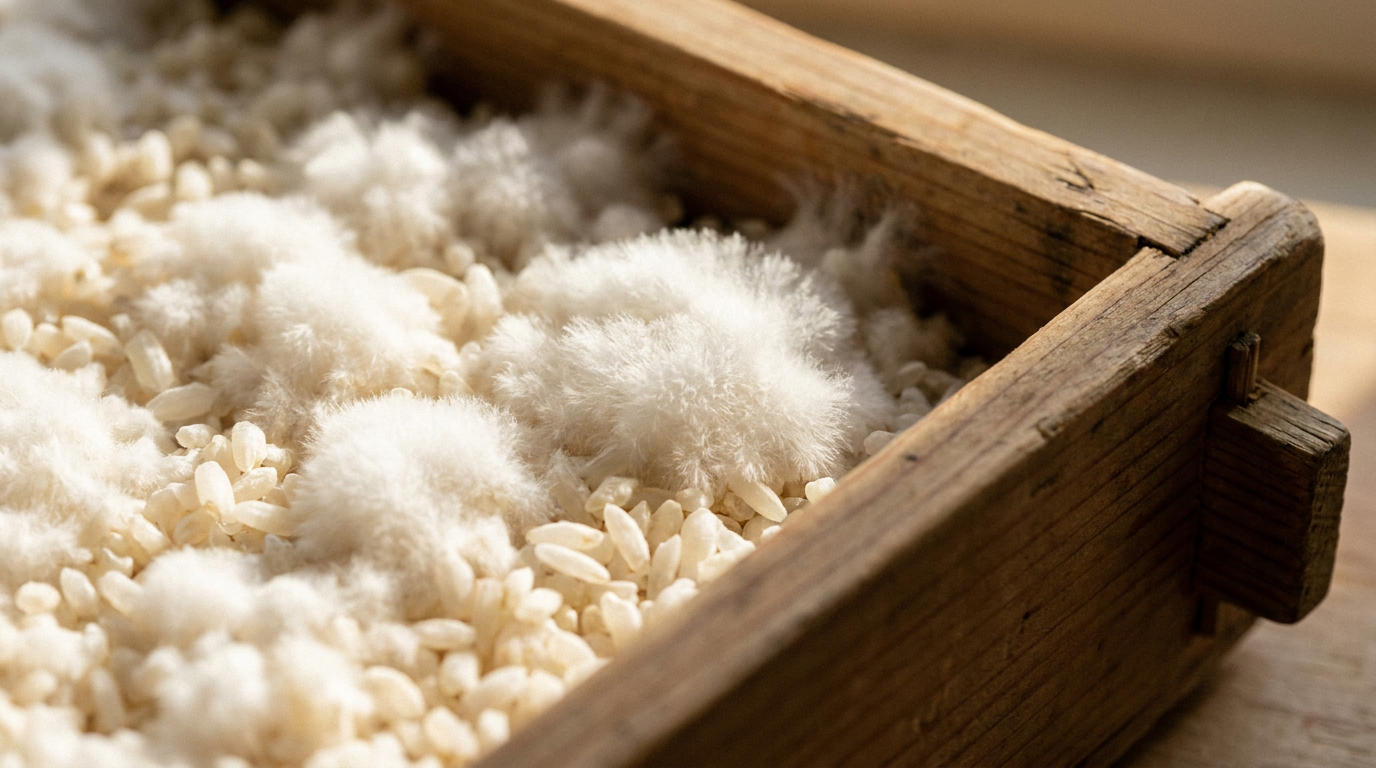
In the pursuit of deeper, more complex flavors, modern home cooks have begun reaching for an ingredient that looks less like a traditional spice and more like a dusting of fresh snow. This secret weapon is Aspergillus oryzae, a domesticated filamentous fungus universally known in culinary circles as koji. For millennia, this microscopic powerhouse has served as the invisible architect behind the foundational flavors of East Asian cuisine, quietly transforming humble soybeans and grains into soy sauce, miso, and sake. Today, however, koji is breaking out of its traditional boundaries. It is no longer just a commercial manufacturing agent; it has become a versatile, accessible tool for everyday cooking, capable of tenderizing meats, accelerating caramelization, and unlocking profound depths of savory flavor in almost any ingredient it touches.[6][7]
To understand why koji is so transformative, one must look past its identity as a mold and view it instead as a biological factory. When spores of Aspergillus oryzae are introduced to a substrate—typically steamed white rice or barley—they begin to grow, sending microscopic root-like threads called hyphae deep into the grains. As the mold colonizes the rice over a period of 40 to 50 hours, it secretes a vast array of powerful enzymes designed to digest its environment. The mold cannot absorb whole starches or proteins, so it deploys these enzymes to break the food down into smaller, manageable molecules. It is this exact digestive process that human cooks harness to manipulate flavor.[1][2]
The magic of koji relies primarily on two specific classes of enzymes: amylases and proteases. Amylase is responsible for breaking down complex, tasteless starches into simple reducing sugars like glucose and maltose. This enzymatic action is what gives koji-based products, such as the Japanese fermented rice drink amazake, their gentle, natural sweetness without the addition of any refined sugar. In the context of sake brewing, this starch-to-sugar conversion is the mandatory first step, as yeast cannot ferment complex starches into alcohol. The koji prepares the feast, and the yeast consumes it.[4][5]
While amylase provides the sweetness, it is the protease enzymes that deliver koji’s most highly prized culinary attribute: umami. Proteases act like microscopic scissors, snipping long, tightly coiled protein chains into individual amino acids. Chief among these liberated molecules is glutamic acid. When glutamic acid hits the receptors on the human tongue, it registers as umami—the rich, deeply satisfying, savory taste found in parmesan cheese, cured meats, and ripe tomatoes. By applying koji to protein-rich foods, cooks can artificially induce this savory breakdown, essentially pre-digesting the food to maximize its inherent flavor profile.[1][5]

The domestication of Aspergillus oryzae is a remarkable chapter in human agricultural history, rivaling the taming of wild crops and livestock. Genetic analysis reveals that koji shares a close evolutionary lineage with Aspergillus flavus, a notorious agricultural pest that produces highly toxic, carcinogenic compounds known as aflatoxins. However, over thousands of years of selective breeding in ancient East Asian fermentation houses, human cultivation steered the mold down a different evolutionary path. In the domesticated A. oryzae, the specific gene cluster responsible for synthesizing aflatoxins mutated and became entirely non-functional. The result is a perfectly safe, highly efficient culinary tool that food safety authorities classify as Generally Recognized as Safe (GRAS).[3][4]
The cultural reverence for this safe, domesticated mold runs incredibly deep. In 2006, recognizing its foundational role in the nation's diet, the Brewing Society of Japan officially designated Aspergillus oryzae as the "kokkin," or national fungus. Eiji Ichishima of Tohoku University championed this designation, arguing that koji is as vital to Japanese heritage as the cherry blossom or the chrysanthemum. Without koji, the defining pillars of Japanese gastronomy—the salty depth of shoyu, the comforting funk of miso, the sweet glaze of mirin, and the crisp bite of sake—would simply cease to exist.[4][5]
The cultural reverence for this safe, domesticated mold runs incredibly deep.
For the modern home cook, the most accessible gateway into the world of koji is a simple, transformative preparation known as shio koji, or salt koji. Shio koji requires only three ingredients: dried rice koji (which is now widely available in specialty grocers and online), water, and salt. When mixed together and left to ferment at room temperature for one to two weeks, the grains of rice break down into a thick, porridge-like paste. The high salt concentration—typically between 8 and 12 percent—creates an inhospitable environment for harmful bacteria, while allowing the koji's resilient enzymes to remain highly active.[1][2]
As a marinade, shio koji borders on the miraculous. When a chicken breast or a piece of fish is coated in shio koji and left in the refrigerator overnight, the active proteases immediately go to work on the muscle fibers. They gently dismantle the structural proteins, which naturally tenderizes the flesh from the inside out. Simultaneously, the enzymes deposit a payload of free glutamic acid directly into the meat. The result is a protein that is not only noticeably softer and juicier upon cooking but also possesses a concentrated, savory depth that salt alone could never achieve.[2][5]

Beyond tenderization and umami generation, shio koji acts as a powerful accelerator for the Maillard reaction—the complex chemical process responsible for the browning and roasted flavors of cooked food. The Maillard reaction requires two primary components to occur: amino acids and reducing sugars. Because shio koji is literally a concentrated paste of free amino acids and simple sugars, coating a piece of meat or a vegetable in it provides the perfect chemical kindling. When the marinated food hits a hot skillet, it develops a deeply caramelized, complex crust in a fraction of the time it would normally take.[2][7]
The global explosion of koji's popularity outside of traditional Asian contexts can be traced directly to the vanguard of modern fine dining. In 2009, the culinary team at Noma—the Copenhagen restaurant repeatedly ranked as the best in the world—began experimenting with Aspergillus oryzae. Under the direction of chef René Redzepi and fermentation expert David Zilber, the restaurant pushed the mold far beyond its traditional boundaries. They used it to ferment local Nordic ingredients, creating novel "misos" out of yellow peas, pumpkin seeds, and stale rye bread.[6][7]
The publication of "The Noma Guide to Fermentation" in 2018 served as a watershed moment, demystifying these high-level techniques and translating them for an eager audience of Western chefs and ambitious home cooks. The book demonstrated that koji was not strictly bound to rice and soybeans; it was a universal biological key that could unlock flavors in almost any carbohydrate or protein. Suddenly, chefs in New York, London, and Paris were building dedicated, climate-controlled koji chambers in their kitchens, treating the mold with the same reverence historically reserved for sourdough starters or mother sauces.[6][7]

Today, the applications for koji continue to expand in highly creative directions. Artisanal butchers and high-end steakhouses have discovered that rubbing koji spores directly onto cuts of beef dramatically accelerates the dry-aging process. The mold's enzymes break down the tough connective tissues and concentrate the beef's flavor in a matter of days rather than weeks. Plant-based chefs are utilizing koji to ferment vegetables like carrots and beets, infusing them with a meaty, savory depth that helps bridge the flavor gap in vegan cuisine. Even pastry chefs are incorporating sweet amazake into ice creams and baked goods to provide complex, refined sweetness.[1][7]
The influence of Aspergillus oryzae extends far beyond the artisanal kitchen; it is a quiet titan of the global food industry. Because of its prolific ability to secrete enzymes, industrial food manufacturers cultivate koji on a massive scale to harvest its amylase and protease. These extracted enzymes are used globally to prevent staling in commercial bread, improve the clarity of mass-market beers, and produce high-fructose corn syrup. Furthermore, emerging nutritional research suggests that foods fermented with koji can support gut health by pre-digesting complex dietary components and promoting a balanced microbiome.[4][7]
Ultimately, the story of koji is one of profound biological partnership. By learning to cultivate and guide this microscopic mold, humans have unlocked a universe of flavor that would otherwise remain trapped within the cellular walls of our food. As koji continues to find its way onto supermarket shelves and into everyday recipes, it represents a beautiful democratization of culinary science. It proves that the most powerful tools in the kitchen are not necessarily the sharpest knives or the hottest stoves, but the invisible, ancient microbes that work quietly alongside us.[5][7]
How we got here
300 BCE
Early records suggest the beginnings of sake brewing in Japan, utilizing early fermentation techniques.
2006
The Brewing Society of Japan officially designates Aspergillus oryzae as the 'kokkin,' or national fungus.
2009
The acclaimed Copenhagen restaurant Noma begins experimenting with koji, applying it to non-traditional Nordic ingredients.
2018
The publication of 'The Noma Guide to Fermentation' brings koji techniques to a mainstream Western culinary audience.
Viewpoints in depth
Culinary Scientists
Focus on the precise biochemical mechanisms that make koji an unparalleled flavor enhancer.
For food scientists and microbiologists, koji is a marvel of enzymatic efficiency. They view the mold not just as a cultural artifact, but as a highly calibrated biological tool. By analyzing the specific action of amylase and protease, scientists can explain exactly why shio koji accelerates the Maillard reaction and tenderizes meat. Their research also highlights the fascinating evolutionary biology of Aspergillus oryzae, tracing its genetic divergence from toxic ancestors into a perfectly safe, domesticated powerhouse that actively shapes the molecular structure of our food.
Traditional Fermenters
Emphasize the millennia-old heritage, precise environmental controls, and cultural reverence for the mold.
Traditional Japanese brewers and miso makers approach koji with a deep sense of historical reverence. To them, cultivating the 'national fungus' is an art form perfected over thousands of years. They emphasize the delicate balance of temperature, humidity, and timing required in the 'muro' (fermentation room) to coax the best possible flavors from the mold. This perspective values the unbroken lineage of craftsmanship that produces authentic sake, shoyu, and miso, viewing modern shortcuts with caution while celebrating the global recognition of their foundational ingredient.
Modern Gastronomy Chefs
View koji as a versatile, boundary-pushing tool to extract novel flavors from local ingredients.
The vanguard of modern fine dining sees koji as a universal biological key rather than an ingredient strictly bound to Asian cuisine. Chefs inspired by the Noma fermentation lab use Aspergillus oryzae to rapidly dry-age steaks, ferment local vegetables, and create entirely new categories of savory pastes from non-traditional legumes and nuts. For this camp, koji is a platform for culinary innovation—a way to build profound, sustainable flavor profiles without relying on heavy meat stocks or artificial additives.
What we don't know
- While the genetic mutation that rendered Aspergillus oryzae non-toxic is understood, the exact timeline and geographic origin of its initial domestication remain debated among historians.
- The full extent of the health benefits associated with consuming koji-fermented foods, particularly regarding specific impacts on the human gut microbiome, is still an active area of clinical research.
Key terms
- Koji
- Steamed rice, barley, or soybeans that have been inoculated with the beneficial mold Aspergillus oryzae.
- Aspergillus oryzae
- A domesticated, non-toxic filamentous fungus used extensively in East Asian fermentation to break down starches and proteins.
- Umami
- The fifth basic taste, characterized by a deep, savory, and rich flavor profile, primarily driven by glutamic acid.
- Shio Koji
- A versatile Japanese marinade and seasoning paste made from fermented rice koji, salt, and water.
- Amylase
- An enzyme secreted by koji that breaks down complex carbohydrates and starches into simple, sweet sugars.
- Protease
- An enzyme that breaks down proteins into smaller peptides and amino acids, creating savory flavors and tenderizing textures.
- Maillard Reaction
- A chemical reaction between amino acids and reducing sugars that gives browned, seared, or roasted food its distinctive complex flavor.
Frequently asked
Is it safe to eat mold?
Yes, Aspergillus oryzae is completely safe. Through thousands of years of domestication, it lost the ability to produce toxins and is classified as Generally Recognized as Safe (GRAS) by food authorities.
What does raw koji smell like?
Raw koji has a sweet, floral, and slightly earthy aroma, often described by microbiologists as a pleasant mix of fresh mushrooms and grapefruit.
Can I make shio koji at home?
Absolutely. By mixing store-bought dried rice koji with salt and water, and letting it sit at room temperature for one to two weeks, you can easily create your own shio koji marinade.
How does koji tenderize meat?
The protease enzymes secreted by the mold act like microscopic scissors, breaking down the complex, tough protein structures in meat into smaller, softer amino acids.
Sources
Source coverage
7 outlets
3 viewpoints surfaced







[1]The House of UmamiTraditional Fermenters
Why is Koji rich in umami?
Read on The House of Umami →[2]Umami ScienceCulinary Scientists
The Science Behind Japan's Most Versatile Fermentation Tool
Read on Umami Science →[3]Knowable MagazineCulinary Scientists
How humans tamed the koji mold
Read on Knowable Magazine →[4]IndoGulf BioAgTraditional Fermenters
Aspergillus oryzae: The Unsung Hero of Fermented Foods
Read on IndoGulf BioAg →[5]WikipediaTraditional Fermenters
Aspergillus oryzae
Read on Wikipedia →[6]Noma ProjectsModern Gastronomy Chefs
The Noma Guide to Fermentation and Koji
Read on Noma Projects →[7]Factlen Editorial TeamModern Gastronomy Chefs
Synthesis by Factlen editorial team
Read on Factlen Editorial Team →
Every angle. Every day.
Get lifestyle stories with full source coverage and perspective breakdowns delivered to your inbox.