
Hardside vs. Softside Luggage: The Complete Trade-Off Analysis
Choosing between hardside and softside luggage comes down to a trade-off between rigid protection and flexible accessibility. This side-by-side analysis breaks down the materials, weight, and travel contexts where each style excels.
By Factlen Editorial Team
- Durability Prioritizers
- Argues that protecting belongings and ensuring long-term structural integrity are the most critical functions of luggage.
- Flexibility Advocates
- Values adaptability, expandability, and the ability to squeeze bags into tight spaces over rigid protection.
- Hybrid & Style Focused
- Focuses on the aesthetic appeal, organizational features, and the balance of form and function in modern travel gear.
What's not represented
- · Airline Baggage Handlers
- · Sustainable Material Scientists
Why this matters
Luggage is a foundational travel investment that dictates how efficiently you pack and how well your belongings survive transit. Choosing the right material prevents damaged valuables, avoids airline weight fees, and reduces travel friction.
Key points
- Hardside luggage offers superior protection for fragile items and is highly water-resistant.
- Softside luggage provides unmatched flexibility, expandability, and quick-access exterior pockets.
- Hardside bags are generally heavier, ranging from 10 to 15 pounds, while softside bags weigh 5 to 10 pounds.
- Air travel and checked baggage scenarios heavily favor the durability of hardside shells.
- Road trips and tight storage spaces are better suited for the pliable nature of softside fabrics.
The modern traveler faces a persistent dilemma before ever reaching the airport: choosing between hardside and softside luggage. As airlines strictly enforce weight limits and overhead bin space becomes a competitive sport, the suitcase you choose dictates how you pack, move, and travel. The debate is no longer just about aesthetics; it is a calculated decision weighing durability against flexibility. Understanding the specific trade-offs between rigid shells and woven fabrics is essential for optimizing any journey.[1][6]
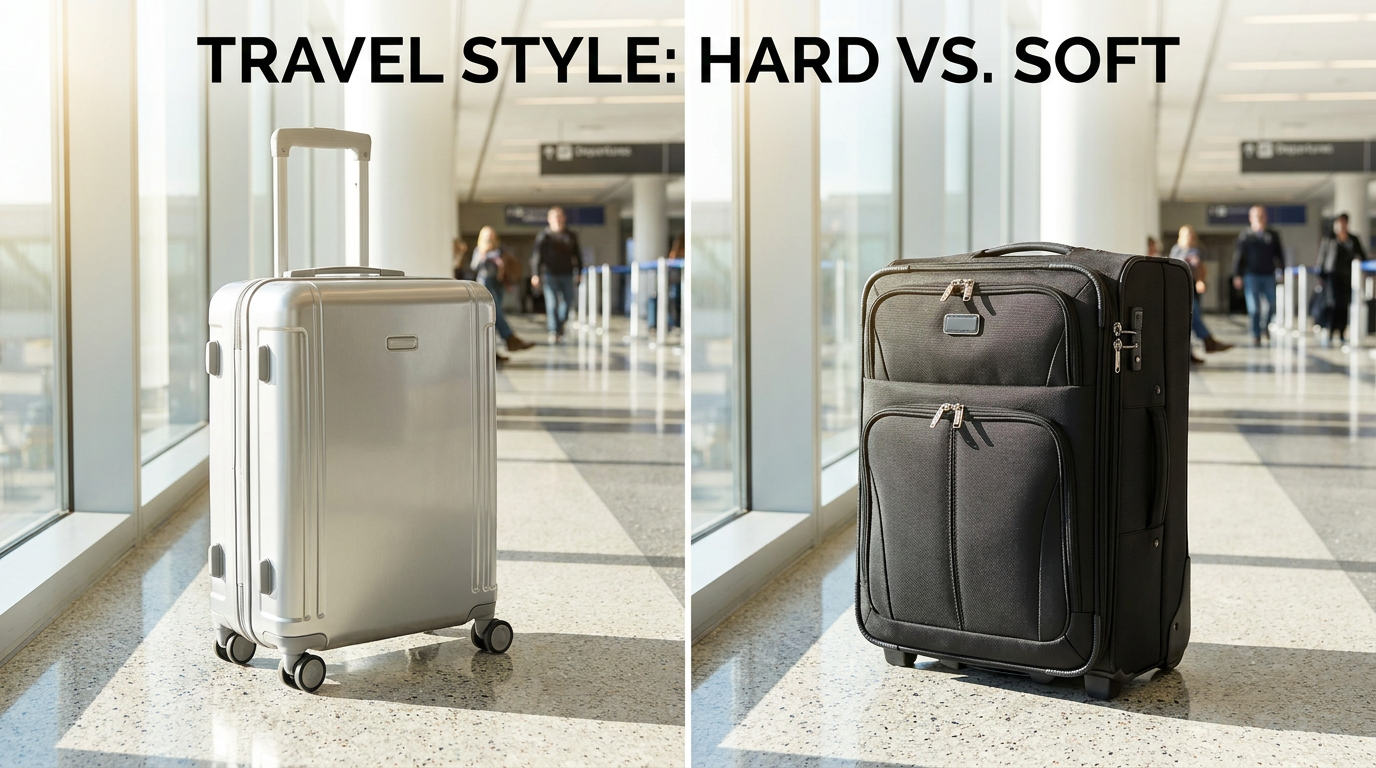
The fundamental divide lies in materials. Hardside suitcases are predominantly crafted from molded plastics like polycarbonate, polypropylene, and ABS (acrylonitrile butadiene styrene), or premium metals like aluminum. Softside luggage, conversely, relies on woven fabrics, primarily high-denier nylon, polyester, or canvas. This material difference dictates every other performance metric, from empty weight to impact resistance. The choice between the two is ultimately a choice between a protective vault and an adaptable pouch.[1][2][4]
When evaluating hardside luggage, the case for it centers on uncompromising protection. The evidence for this advantage is found in the rigid exterior shell, which absorbs impacts and shields fragile items, electronics, and souvenirs from the brutal realities of airport baggage handling. Additionally, hardshells offer superior weather resistance, easily repelling rain, snow, and accidental spills, while integrated TSA-approved locks provide enhanced security against tampering.[2][4]

Conversely, the case against hardside luggage highlights its inherent inflexibility. The evidence is twofold: a lack of exterior pockets means travelers cannot quickly stash a boarding pass or laptop, and the rigid frame cannot be squeezed into tight spaces. Furthermore, while they protect what is inside, the exterior is prone to visible scuffs, scratches, and dents over time. Under extreme pressure, cheaper ABS plastics can even crack, rendering the bag useless.[1][3][4]
Shifting to softside luggage, the case for this style champions flexibility and accessibility. The evidence is clear in the fabric construction, which allows the bag to expand and contract, making it easier to squeeze into tight overhead bins or crowded car trunks. External pockets are standard, providing crucial quick-access storage for travel documents and electronics. For travelers who inevitably return with more than they packed, the forgiving nature of softside fabric is a major asset.[2][4][5]
The case against softside luggage centers on vulnerability. The evidence is seen in the fabric's susceptibility to tearing, fraying, and absorbing moisture or stains, making them harder to clean than a wipe-down polycarbonate shell. Softside bags offer significantly less protection for fragile items. Additionally, exterior zippers and pockets can be more easily breached by opportunistic tampering, reducing overall security.[1][2][4]
Softside bags offer significantly less protection for fragile items.
Weight is a critical metric in this comparison, especially with strict airline baggage allowances. Historically, softside luggage was the undisputed lightweight champion. Today, most softside picks range from five to ten pounds. However, hardside luggage tends to be heavier, typically falling between ten and 15 pounds for checked sizes. Premium aluminum suitcases are the heaviest, with popular high-end models clocking in near 12 pounds empty.[1]

The two styles dictate entirely different packing experiences. Hardside bags universally utilize a clamshell design, splitting the storage volume into two equal halves. This requires opening the bag fully flat, demanding more floor space in cramped hotel rooms. Softside bags typically feature a single, deep main compartment with a top lid, allowing travelers to pack bulkier items and open the bag easily on a luggage rack.[1][6]
The optimal choice heavily depends on the mode of transit. For frequent air travel, especially involving checked baggage, hardside luggage is widely recommended to withstand the mechanized sorting systems and tarmac drops. The rigid frame ensures the bag will always fit the sizer. Conversely, softside luggage is the undisputed winner for road trips, as the pliable bags can be molded and stacked to maximize every inch of a vehicle's trunk space.[2][4][5]

International travel introduces additional variables to the equation. Many international carriers have stricter size and weight limits than domestic airlines, favoring the fixed dimensions of a non-expandable hardside carry-on. The rigid frame prevents the overstuffing that often causes softside bags to exceed size limits and be forced into the cargo hold.[2][6]
When evaluating long-term durability, the metrics diverge based on the type of wear. A high-quality polycarbonate hardside bag will protect its contents indefinitely but will visually age through surface scratches. A high-denier ballistic nylon softside bag will hide wear and tear better and resist scuffs, but its structural integrity relies on zippers and seams that can fail under constant overpacking.[1][3][4]
Ultimately, hardside luggage fits well when your itinerary involves checking bags, transporting fragile items, or traveling to destinations with inclement weather. It is the ideal choice for business travelers who prioritize a sleek, professional aesthetic and need to ensure their bag fits precisely within airline dimension limits without bulging. It does not fit well when you need quick access to items in transit or have limited storage space at home.[2][6]

Softside luggage fits well when you are embarking on road trips, traveling with a family, or tend to buy souvenirs and need the bag to expand. It is perfect for travelers who rely on exterior pockets for organization and prefer packing in one deep compartment. It does not fit well when transporting delicate equipment or when checking bags through airports known for rough baggage handling.[2][4][5]
How we got here
1980s
Softside luggage dominates the consumer market with the introduction of durable nylon rollaboards.
2000s
Polycarbonate hardshells are introduced, making rigid luggage significantly lighter and more flexible than older plastic models.
2010s
The rise of direct-to-consumer travel brands popularizes the sleek, minimalist hardside aesthetic for millennials.
2024–2026
Manufacturers increasingly focus on hybrid designs, blending hard shells with soft exterior pockets for maximum utility.
Viewpoints in depth
Frequent Flyers & Business Travelers
Prioritizes sleek aesthetics, strict dimension compliance, and extreme durability.
For road warriors who spend half their year in airports, luggage is a tool that must perform flawlessly. This camp overwhelmingly favors hardside polycarbonate luggage. The rigid dimensions ensure the bag will never be gate-checked for bulging, while the hard shell protects expensive electronics and maintains a professional appearance. They view the lack of exterior pockets as a feature, not a bug, as it forces streamlined packing and enhances security.
Road Trippers & Families
Values maximum volume, expandability, and the ability to pack irregularly shaped items.
Travelers who primarily use cars, trains, or travel with children lean heavily toward softside luggage. The ability to squish a nylon bag into the last remaining inch of a car trunk is invaluable. Furthermore, families appreciate the exterior pockets for stashing snacks, wet wipes, and tablets for quick access without opening the entire suitcase. For this group, the rigid nature of hardside luggage is an active hindrance to their travel style.
Luggage Manufacturers
Focuses on material innovation to bridge the gap between hard and soft luggage.
The industry perspective is shifting away from a strict binary. Manufacturers are increasingly developing hybrid solutions, such as hardside bags with soft, zippered front pockets for laptops, or softside bags with rigid internal frames for better protection. Their goal is to engineer materials—like lighter polycarbonates and more abrasion-resistant nylons—that minimize the traditional trade-offs, offering consumers the best of both worlds.
What we don't know
- How upcoming airline regulations might further restrict carry-on dimensions, potentially favoring rigid hardside bags.
- Whether emerging hybrid materials will eventually eliminate the distinct boundary between hard and soft luggage.
Key terms
- Polycarbonate
- A durable, flexible plastic used in premium hardside luggage that bends under impact to prevent cracking.
- ABS (Acrylonitrile Butadiene Styrene)
- A rigid, less expensive plastic used in budget hardside luggage that is more prone to cracking under extreme pressure.
- Denier
- A unit of measurement indicating the fiber thickness of fabrics like nylon; higher numbers indicate heavier, more durable fabric.
- Clamshell Design
- A suitcase design that opens in the middle into two equal halves, typical of hardside luggage.
- Ballistic Nylon
- A thick, tough synthetic fabric originally developed for military use, common in high-end softside luggage.
Frequently asked
Can hardside luggage crack?
Yes, especially budget bags made from ABS plastic when subjected to heavy pressure. Premium polycarbonate is more flexible and bends rather than cracking.
Which type of luggage is easier to clean?
Hardside luggage is generally easier to maintain, as the plastic shell can be quickly wiped down with a damp cloth, whereas softside fabric can absorb stains.
Do softside bags fit in overhead bins better?
Yes, their flexible fabric allows them to be squeezed into tight spaces, though overpacking can cause them to bulge and exceed airline size limits.
What is the best material for hardside luggage?
Polycarbonate is widely considered the best material, offering an ideal balance of lightweight flexibility and extreme impact resistance.
Sources
Source coverage
6 outlets
3 viewpoints surfaced





[1]ForbesDurability Prioritizers
Hardside Vs. Softside Luggage: Which Is Better For You?
Read on Forbes →[2]DelseyDurability Prioritizers
Hardside vs Softside Luggage: Which is Right for You?
Read on Delsey →[3]Calpak TravelHybrid & Style Focused
Hard vs. Soft Luggage: Which is Right for You?
Read on Calpak Travel →[4]Luggage On TourFlexibility Advocates
Hardside vs. Softside Luggage
Read on Luggage On Tour →[5]BG BerlinFlexibility Advocates
Hardside vs Softside Luggage | A Comparison
Read on BG Berlin →[6]Factlen Editorial TeamHybrid & Style Focused
Synthesis by Factlen editorial team
Read on Factlen Editorial Team →


Every angle. Every day.
Get shopping stories with full source coverage and perspective breakdowns delivered to your inbox.