
How 120V Heat Pump Water Heaters Are Revolutionizing Home Energy Efficiency
A new generation of plug-in heat pump water heaters is allowing homeowners to cut their energy bills and carbon emissions without the need for expensive electrical panel upgrades.
By Factlen Editorial Team
- Homeowners and Retrofitters
- Focuses on the immediate financial and logistical benefits of avoiding a costly electrical panel upgrade.
- Climate Advocates and Policymakers
- Views the 120V water heater as a critical tool for rapid decarbonization and eliminating residential gas reliance.
- HVAC and Plumbing Contractors
- Approaches the transition with a focus on installation training, new revenue streams, and the technical realities of airflow management.
What's not represented
- · Renters unable to upgrade appliances
- · Electrical panel manufacturers
Why this matters
Water heating accounts for roughly 20% of home energy use, but upgrading to hyper-efficient heat pumps used to require expensive electrical panel overhauls. The new 120-volt plug-in models remove this barrier, allowing homeowners to drastically cut their utility bills and carbon footprint using a standard wall outlet.
Key points
- Traditional water heating accounts for roughly 20% of a home's total energy consumption.
- Heat pump water heaters are 350% to 420% more efficient than standard electric models.
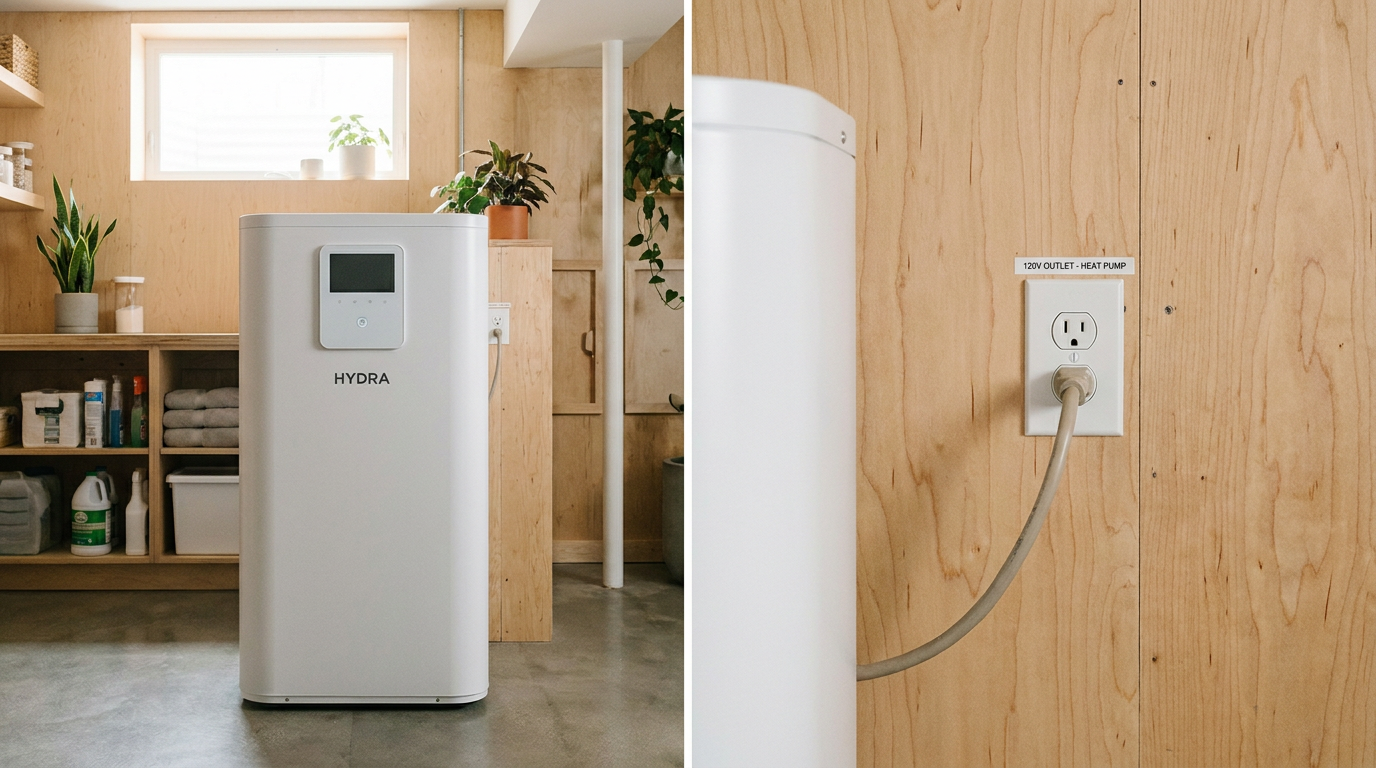
- New 120-volt models plug into standard outlets, bypassing the need for expensive electrical panel upgrades.
- To compensate for lower power, 120V units store water at 140 degrees and mix it with cold water before delivery.
- The Inflation Reduction Act provides a 30% tax credit, up to $2,000, for installing a qualifying heat pump water heater.
Deep in the basements and utility closets of millions of homes sits a silent, energy-hungry appliance that rarely gets a second thought until the shower runs cold. The traditional water heater, whether powered by natural gas combustion or electric resistance elements, works tirelessly around the clock, accounting for roughly 20% of a typical household's total energy consumption. For decades, the underlying technology remained largely unchanged: burn fossil fuels or run high-voltage electricity through a metal element to heat a large tank of water. But as the push to decarbonize residential buildings accelerates across the globe, the humble water heater has suddenly become a primary focal point for climate advocates, policymakers, and energy experts alike.[2][4]
The engineering solution to this massive energy drain has long been the heat pump water heater (HPWH), a technology that is three to five times more efficient than standard models. However, widespread adoption of these hyper-efficient appliances faced a significant logistical bottleneck: traditional heat pump units required a dedicated 240-volt electrical circuit to operate. For homeowners looking to replace an aging gas water heater, this 240-volt requirement often meant hiring an electrician to run new heavy-duty wiring through finished walls, or worse, paying thousands of dollars for a comprehensive electrical panel upgrade. This hidden infrastructure cost routinely killed home electrification projects before they could even begin, leaving homeowners stuck with fossil fuel appliances.[1][2][5]
Enter the 120-volt plug-in heat pump water heater—a breakthrough appliance designed specifically to bypass the electrical panel barrier and democratize home energy efficiency. By operating on a standard household outlet, these new units allow for same-day gas replacements without the need for complex, expensive electrical work. To understand why this is revolutionary, it helps to understand the underlying mechanism. Unlike traditional heaters that generate heat from scratch, a heat pump operates like a refrigerator in reverse. It pulls ambient heat from the surrounding air in the room, compresses a specialized refrigerant to increase its temperature, and then transfers that concentrated heat directly into the water tank.[1][4]

Because they move heat rather than create it, heat pump water heaters achieve staggering efficiency ratings that defy traditional logic. While a standard electric resistance heater maxes out at 100% efficiency—meaning one unit of electricity creates one unit of heat—a heat pump unit can operate at 350% to 420% efficiency. This yields more than three units of heat for every single unit of electricity consumed. But engineering a heat pump to run on a standard 120-volt outlet required a clever compromise from manufacturers. A 120-volt circuit inherently delivers less power than a 240-volt line, meaning the heat pump recovers hot water more slowly after a long shower or a heavy laundry day.[1][3]
Manufacturers solved this recovery speed issue through the clever application of thermal energy storage. Because the 120-volt units heat water more slowly, they are programmed to heat the water to a much higher temperature—often 140 degrees Fahrenheit—storing significantly more thermal energy in the exact same volume of water. Before this scalding water ever reaches the home's faucets or showerheads, an integrated electronic mixing valve automatically blends it with cold water to deliver a safe, consistent 120 degrees. This strategy effectively increases the tank's functional capacity; a 50-gallon tank heated to 140 degrees can provide the same amount of usable hot water as a 65-gallon tank heated to standard temperatures.[1]
Manufacturers solved this recovery speed issue through the clever application of thermal energy storage.
The installation process for a 120-volt heat pump water heater is remarkably straightforward, though it does require a few specific technical adaptations compared to a standard gas unit. The existing gas line must be safely capped off by a professional. Furthermore, because the heat pump naturally dehumidifies the surrounding air as it operates, a condensate drain tube must be routed to a nearby floor drain or a small condensate pump. Once installed, the economics heavily favor the homeowner. Operating a heat pump water heater typically costs between $100 and $150 annually for a family of four, translating to savings of roughly $550 a year compared to electric resistance models, and $200 a year compared to natural gas.[1][2]

While the upfront retail cost of the appliance is undeniably higher—often ranging from $2,100 to $3,200 depending on the tank size and features—federal and local incentives dramatically shorten the financial payback period. Under the Inflation Reduction Act (IRA) passed in 2022, homeowners can claim a generous 30% tax credit, up to $2,000, for purchasing and installing a qualifying heat pump water heater. When combined with state-level rebates and utility company incentives, the initial price premium can often be entirely erased, making the hyper-efficient unit cost-competitive with a standard, inefficient replacement from day one.[1][4]
Beyond the immediate financial savings, the environmental impact of this appliance swap is profound. Replacing a single gas water heater with a heat pump unit saves approximately one ton of carbon dioxide emissions annually. According to energy analysts, a heat pump water heater saves the energy equivalent of seven rooftop solar panels, but at a mere fraction of the installation cost. Furthermore, these smart appliances offer a crucial benefit to the broader electrical grid. Because they act as thermal batteries—storing hot water for hours—they can be programmed to run during off-peak hours when electricity is cheap and renewable generation is high, pausing their operation during peak evening demand.[2][6]

The plumbing and HVAC industries are rapidly adapting to this technological shift, recognizing that the future of their trade lies in high-efficiency electrification. Trade organizations are actively urging contractors to familiarize themselves with the new equipment, emphasizing the importance of understanding airflow requirements, condensate management, and the nuances of hybrid operating modes. Because heat pumps draw air from the room, they require a certain volume of unconfined space to operate efficiently, meaning contractors must carefully evaluate utility closets before installation. As one industry expert noted, the technology itself isn't overly complicated, but it requires a fundamentally new approach to customer education and site assessment.[3][6]
Looking ahead, the residential water heating market is poised for a massive, permanent transformation. New Department of Energy regulations set to take effect in 2029 will require significantly higher efficiency standards for residential water heaters, effectively cementing heat pump technology as the new baseline for American homes. As the electrical grid continues to get cleaner with the addition of wind and solar power, the carbon footprint of these appliances will only shrink further over time. By removing the electrical panel barrier, the 120-volt heat pump water heater has transformed a daunting home renovation project into a simple appliance swap, paving the way for millions of households to quietly join the clean energy transition.[2][3]

How we got here
August 2022
The Inflation Reduction Act passes, introducing a 30% tax credit for heat pump water heaters.
Late 2022
The first 120-volt plug-in heat pump water heaters enter the market, designed to bypass electrical panel upgrades.
February 2024
Major manufacturers expand their 120-volt product lines, increasing availability for residential retrofits.
2029
New Department of Energy efficiency standards will take effect, effectively making heat pump technology the baseline for electric water heaters.
Viewpoints in depth
Homeowners and Retrofitters
Focuses on the immediate financial and logistical benefits of avoiding a costly electrical panel upgrade.
For many homeowners, the desire to electrify their homes has historically been blocked by the hidden costs of infrastructure. Upgrading a home's electrical panel to support a 240-volt appliance can easily add $2,000 to $4,000 to a project's budget. The 120-volt heat pump water heater is viewed by this camp as a vital 'plug and play' solution that makes electrification accessible. While they acknowledge that the 120-volt models recover hot water more slowly than their 240-volt counterparts, the financial savings and the ability to complete a same-day gas replacement far outweigh the minor adjustments required in household water usage habits.
Climate Advocates and Policymakers
Views the 120V water heater as a critical tool for rapid decarbonization and eliminating residential gas reliance.
Environmental organizations and energy policymakers see residential water heating as one of the lowest-hanging fruits in the fight against climate change. Because water heating accounts for a massive share of residential energy use, removing the friction of panel upgrades allows for much faster deployment of clean technology. This camp emphasizes that every gas water heater replaced with a heat pump directly reduces reliance on fossil gas infrastructure while saving the equivalent emissions of seven rooftop solar panels. They are actively pushing for stronger point-of-sale rebates to ensure these appliances reach low- and middle-income households.
HVAC and Plumbing Contractors
Approaches the transition with a focus on installation training, new revenue streams, and the technical realities of airflow management.
The trades responsible for actually installing these units approach the 120-volt revolution with a mix of opportunity and caution. While heat pump water heaters offer higher profit margins and represent a rapidly growing market segment, contractors emphasize the need for specialized, ongoing training. Proper installation requires managing condensate drainage, ensuring adequate unconfined airflow for the heat pump to operate efficiently, and educating customers on how hybrid modes function. This camp stresses that while the technology is excellent, a poorly placed unit in a cramped, unventilated closet will lead to reduced efficiency and frustrated homeowners.
What we don't know
- How quickly the plumbing and HVAC contractor workforce will scale up their training to handle the surge in heat pump installations.
- Whether utility companies will introduce more aggressive point-of-sale rebates to further offset the higher upfront appliance costs.
Key terms
- Heat Pump Water Heater (HPWH)
- An appliance that uses electricity to move heat from the surrounding air into a water tank, rather than generating heat directly.
- Thermal Energy Storage
- The practice of storing excess energy as heat—in this case, by heating water to a higher temperature so it can be used later.
- Mixing Valve
- A plumbing device that blends extremely hot water from the tank with cold water to deliver a safe, consistent temperature to the home's faucets.
- Electric Resistance Heating
- A traditional method of heating water by passing an electric current through a metal element, which is significantly less efficient than a heat pump.
- Condensate Drain
- A tube that safely removes the liquid water that naturally forms when a heat pump extracts moisture from the air.
Frequently asked
Can a 120V heat pump water heater plug into any standard outlet?
Yes, it is designed to plug into a standard 120-volt household outlet, eliminating the need for a dedicated 240-volt circuit or a costly electrical panel upgrade.
Will I run out of hot water faster with a 120V model?
Because 120V models recover heat more slowly, they are programmed to store water at a higher temperature (often 140 degrees) and mix it with cold water upon delivery, effectively increasing the tank's capacity.
How much money can a heat pump water heater save?
Operating a heat pump water heater typically costs between $100 and $150 annually, saving a family of four roughly $550 a year compared to standard electric resistance models.
Do these water heaters qualify for tax credits?
Yes, under the Inflation Reduction Act, homeowners can claim a 30% tax credit, up to $2,000, for purchasing and installing a qualifying heat pump water heater.
Sources
Source coverage
6 outlets
3 viewpoints surfaced






[1]CleanTechnicaHomeowners and Retrofitters
A. O. Smith's New 120V Heat Pump Water Heater Allows You To Plug It Into A Standard Outlet
Read on CleanTechnica →[2]Zarkon GroupClimate Advocates and Policymakers
Propelling electrification through heat pump water heaters
Read on Zarkon Group →[3]SupplyHTHVAC and Plumbing Contractors
Heat pump water heaters: transforming contractor profits with sustainable solutions
Read on SupplyHT →[4]New Buildings InstituteClimate Advocates and Policymakers
Inflation Reduction Act offers credit for HPWH purchases
Read on New Buildings Institute →[5]Climate ExpertsHomeowners and Retrofitters
The Rise of the Smart Electrical Panel
Read on Climate Experts →[6]Factlen Editorial TeamHVAC and Plumbing Contractors
Synthesis by Factlen editorial team
Read on Factlen Editorial Team →

Every angle. Every day.
Get home stories with full source coverage and perspective breakdowns delivered to your inbox.