
Beyond the Blockbuster: How Virtual Production is Democratizing Hollywood
Once a $15 million luxury reserved for massive studio franchises, LED volume technology has scaled down to empower independent filmmakers with real-time, in-camera visual effects.
By Factlen Editorial Team
- Independent Creators & Advocates
- View virtual production as a democratizing force that allows smaller studios to achieve blockbuster visuals.
- Technical & VFX Supervisors
- Focus on the hardware requirements, real-time engine integration, and the steep learning curve required for success.
- Production & Studio Executives
- Prioritize workflow reliability, shifting costs from post-production to pre-production, and eliminating travel logistics.
What's not represented
- · Traditional Set Builders
- · Post-Production VFX Artists
Why this matters
By drastically reducing the cost and complexity of visual effects, virtual production is leveling the playing field in Hollywood. Independent filmmakers can now create blockbuster-quality visuals without massive studio budgets, leading to more original and visually ambitious storytelling.
Key points
- Virtual production uses massive LED screens and game engines to display real-time digital environments during filming.
- The technology provides natural lighting and realistic reflections that traditional green screens cannot match.
- While upfront costs are high, productions save massive amounts of money on travel and post-production visual effects.
- Advances in AI and turnkey rental solutions have made the technology accessible to independent and micro-budget filmmakers.
The era of flying a 100-person film crew to the Sahara Desert for a sunset shot is rapidly coming to a close. In 2026, that same desert is being conjured inside a climate-controlled warehouse on a Tuesday morning. The technology driving this shift—on-set virtual production—has officially moved past its experimental phase and is fundamentally rewriting how movies, television shows, and commercials are made.[3][5][10]
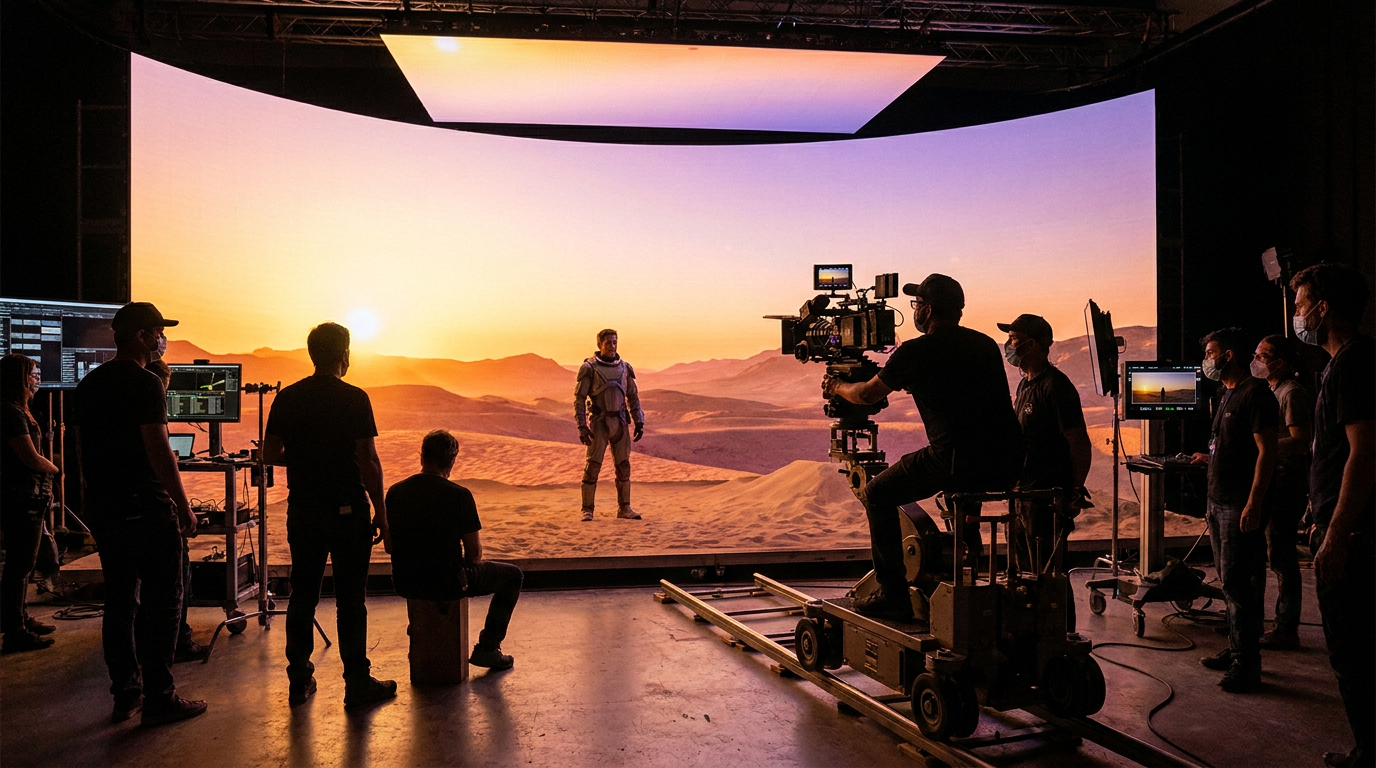
When Disney’s The Mandalorian debuted in 2019, it introduced the wider industry to the "LED volume"—a massive, curved wall of high-resolution screens displaying photorealistic digital environments. At the time, the technology was a luxury reserved for blockbuster budgets, with custom-built stages costing upwards of $15 million. Today, the landscape looks entirely different. Virtual production has democratized, scaling down to fit the budgets of independent filmmakers, commercial directors, and even music video producers.[1][2][6][9]
At the core of this revolution is a methodology known as In-Camera Visual Effects (ICVFX). Instead of shooting actors in front of a blank green screen and adding the background months later, filmmakers display fully rendered 3D environments on LED walls directly behind the cast. These digital worlds are powered by real-time game engines, most notably Epic Games' Unreal Engine, which can generate complex lighting and weather effects on the fly.[2][5][6][8]
The true magic of the LED volume lies in its camera tracking systems. Sensors mounted on the physical cinema camera constantly map its position in 3D space. As the camera operator pans or pushes in on an actor, the game engine instantly recalculates the digital background, shifting the perspective in real time. This creates perfect parallax—the optical illusion of depth that tricks the human eye into believing a flat screen is a sprawling, three-dimensional world.[5][6][8][9]

For cinematographers, the most significant advantage over traditional green screen is lighting. Green screens require actors to imagine their surroundings and often cast a sickly, difficult-to-remove green hue on skin and reflective surfaces. In a virtual production volume, the LED panels act as massive, practical light sources. If the digital scene features a neon-lit cyberpunk city, the screens cast genuine pink and blue ambient light onto the actors' faces, wardrobe, and props.[6][7][8]
This real-time immersion profoundly impacts actor performance. Performers no longer have to stare at a tennis ball on a stick and pretend it is a fire-breathing dragon. They can see the digital environment, react to the virtual sunset, and ground their performances in a visible, tangible space. Directors can also look at their monitors and see a near-final image, eliminating the guesswork that traditionally plagues heavy visual effects shoots.[6][8]
This real-time immersion profoundly impacts actor performance.
While the creative benefits are clear, the rapid adoption of virtual production in 2026 is largely driven by economics. The upfront day rate for an LED volume is undeniably higher than a traditional soundstage. Renting a medium-sized pop-up volume can cost between $50,000 and $100,000 a week, factoring in the screens, the rendering servers, and the specialized technical crew.[5][8][9]
However, producers are finding that these upfront costs are quickly offset by massive savings elsewhere. Shooting in a volume eliminates the need to fly crews around the world, secure location permits, or wait out bad weather. A production can shoot a morning scene in the snowy Himalayas and an afternoon scene in a bustling Tokyo intersection without ever leaving the lot.[5][6][8]

The most dramatic financial shift occurs in post-production. Because the visual effects are captured "in-camera," studios bypass months of expensive rotoscoping, keying, and compositing. The pixels captured on set are often the final pixels that make it into the movie, drastically compressing the post-production timeline and allowing independent studios to punch far above their budget weight.[4][5][6][8]
The democratization of this technology has been further accelerated by the integration of artificial intelligence. In 2025 and 2026, generative AI tools and techniques like Gaussian Splatting have revolutionized the creation of the 3D assets displayed on the walls. What once required a team of digital artists weeks to model can now be generated or scanned from real-world locations in a matter of days, significantly lowering the barrier to entry for smaller productions.[2][7]
Despite its rapid maturation, virtual production is not a magic bullet, and the industry is currently navigating a steep learning curve. Operating an LED volume requires a hybrid crew that blends traditional filmmaking expertise with software engineering and game design. A poorly executed virtual production—often caused by using panels with the wrong pixel pitch or failing to properly calibrate the color pipeline—can result in flat lighting or visible moiré patterns on screen.[2][3][5][7]

Consequently, the role of the Virtual Production Supervisor has become one of the most critical and sought-after positions on a modern film set. These specialists act as translators between the physical camera department and the digital art department, ensuring that the two worlds blend seamlessly. As the pool of experienced technicians grows, the technology is becoming more resilient and scalable for everyday use.[3][7]
Industry experts are quick to note that the green screen is not entirely dead. For simple setups, heavy action sequences where the environment will be entirely destroyed, or projects with extremely tight upfront budgets, traditional compositing remains a practical choice. Virtual production is simply a powerful new tool in the filmmaker's arsenal, rather than a wholesale replacement for every legacy technique.[7][8][9]
As 2026 progresses, the conversation around virtual production has shifted from "what is possible" to "what is reliable and repeatable." By lowering costs, reducing environmental footprints, and empowering creators to visualize their final product on set, LED volumes are leveling the playing field. Independent filmmakers now have the tools to build worlds that were once the exclusive domain of major Hollywood studios, ushering in a new era of boundless visual storytelling.[1][3][4][5][10]
How we got here
1990s–2000s
Early experiments with real-time rendering in films like The Phantom Menace and Avatar.
2019
Industrial Light & Magic debuts the StageCraft LED volume for The Mandalorian, proving the technology's viability.
2020–2022
The pandemic accelerates adoption as travel restrictions force studios to find controlled, indoor filming solutions.
2023
Generative AI and tools like NVIDIA Omniverse begin streamlining the creation of 3D assets for virtual sets.
2026
Virtual production matures into a democratized, repeatable workflow accessible to independent filmmakers.
Viewpoints in depth
Independent Creators' View
Virtual production is a democratizing force that levels the playing field.
For independent filmmakers and micro-budget studios, the LED volume represents unprecedented creative freedom. By utilizing open-source tools like Unreal Engine and renting pop-up LED stages, smaller productions can capture complex, visually stunning environments in-camera. This eliminates the need for expensive location shoots and heavily reduces the post-production VFX budget, allowing indie directors to allocate more resources to talent and storytelling rather than logistics.
Technical Supervisors' View
The technology requires a steep learning curve and specialized hybrid skills.
While the creative benefits are vast, technical directors warn that virtual production is not a plug-and-play solution. Operating an LED volume requires a crew that understands both traditional cinematography and real-time game engine software. Issues like moiré patterns, color space mismatches, and latency in camera tracking can ruin a shoot if not managed by an experienced Virtual Production Supervisor. For this camp, the focus is on standardizing workflows and training the next generation of hybrid technicians.
Studio Executives' View
The primary value lies in budget predictability and logistical efficiency.
From a studio management perspective, the appeal of virtual production is fundamentally economic. Although the upfront capital expenditure to build or rent a volume is significant, it provides absolute control over the shooting schedule. Executives value the elimination of weather delays, travel accommodations, and location permits. By shifting the bulk of the visual effects work into the pre-production phase, studios gain cost certainty earlier in the pipeline, reducing the financial risks associated with endless post-production revisions.
What we don't know
- How quickly traditional film schools will adapt their curriculums to close the growing skills gap for virtual production technicians.
- Whether the rapid advancement of AI text-to-video generation will eventually bypass the need for physical LED volumes entirely.
Key terms
- LED Volume
- A physical stage surrounded by large, high-resolution LED screens that display real-time digital environments.
- In-Camera Visual Effects (ICVFX)
- The process of capturing final visual effects directly on set during filming, rather than adding them in post-production.
- Parallax
- The optical illusion where background objects appear to move slower than foreground objects as the camera moves, creating a sense of depth.
- Pixel Pitch
- The distance between individual pixels on an LED screen; a smaller pitch means higher resolution and allows the camera to get closer.
- Gaussian Splatting
- An AI-driven technique that rapidly generates highly detailed 3D environments from 2D photos or video.
Frequently asked
Does virtual production completely replace green screens?
No. Green screens remain cheaper and more practical for simple shots or heavy action sequences where the entire environment will be replaced anyway.
How does the LED wall know where the camera is?
Sensors track the physical camera's movement in 3D space and feed that data to a real-time game engine, which instantly updates the background's perspective.
Why is virtual production cheaper if the screens cost millions?
While building a volume is expensive, renting one saves money by eliminating travel costs, location permits, weather delays, and months of expensive post-production visual effects work.
Sources
Source coverage
10 outlets
3 viewpoints surfaced










[1]British CinematographerIndependent Creators & Advocates
Virtual production becoming more accessible
Read on British Cinematographer →[2]GrokipediaTechnical & VFX Supervisors
On-set virtual production (OSVP)
Read on Grokipedia →[3]TV TechnologyProduction & Studio Executives
Virtual production is coming of age
Read on TV Technology →[4]University of KentIndependent Creators & Advocates
Democratization of VP technology in micro and small production companies
Read on University of Kent →[5]3Peak StudioProduction & Studio Executives
What virtual production means in 2026
Read on 3Peak Studio →[6]Royal DisplayTechnical & VFX Supervisors
Virtual production LED wall price ranges
Read on Royal Display →[7]VFX VoiceTechnical & VFX Supervisors
Has virtual production revolutionized filmmaking?
Read on VFX Voice →[8]ARwallIndependent Creators & Advocates
LED Wall vs Green Screen: The Technical Breakdown
Read on ARwall →[9]CopilotProduction & Studio Executives
How expensive is virtual production?
Read on Copilot →[10]Factlen Editorial TeamIndependent Creators & Advocates
Synthesis by Factlen editorial team
Read on Factlen Editorial Team →

Every angle. Every day.
Get entertainment stories with full source coverage and perspective breakdowns delivered to your inbox.