
The End of the Tube-and-Wing Era: How Blended-Wing Aircraft Will Reshape Flight
Aerospace manufacturers are moving aggressively toward blended-wing body aircraft, a radical redesign that merges the fuselage and wings to cut fuel consumption by up to 50 percent. With major factory groundbreakings and full-scale test flights scheduled for 2027, the century-old silhouette of commercial aviation is about to change.
By Factlen Editorial Team
- Aerospace Engineers & Innovators
- Manufacturers believe the tube-and-wing design has reached its physical limits and must be replaced.
- Commercial Airlines
- Carriers are eager for the massive reduction in operating costs that blended-wing aircraft promise.
- Defense Sector
- The military values the design for its ability to increase payload and extend aerial refueling range.
- Aviation Regulators
- Safety agencies are focused on the unique challenges of certifying non-cylindrical pressure vessels and ensuring rapid evacuation.
What's not represented
- · Passenger Advocacy Groups
- · Airport Operators
Why this matters
Aviation accounts for a significant and growing share of global carbon emissions. If blended-wing aircraft succeed, they will drastically lower the environmental impact of flying, reduce airline operating costs, and fundamentally change what it feels like to sit inside a passenger cabin.
Key points
- Blended-wing body (BWB) aircraft merge the fuselage and wings into a single lifting surface, eliminating the aerodynamic drag of a traditional cylindrical cabin.
- The design promises to reduce fuel consumption and carbon emissions by up to 50 percent compared to conventional widebody jets.
- California startup JetZero broke ground on a North Carolina factory in June 2026 and plans to fly a full-scale demonstrator in 2027.
- Airbus is also exploring BWB designs for its ZEROe hydrogen-powered aircraft program, citing the need for larger internal fuel storage.
- Challenges remain for the passenger experience, as the wide, flattened cabin design means most travelers will not have access to windows.
For more than a century, commercial aviation has been defined by a single, ubiquitous silhouette: a cylindrical tube carrying passengers, attached to a pair of wings carrying the engines. This "tube-and-wing" architecture has been refined to the absolute limits of physics, achieving remarkable safety and reliability. Yet, as the industry faces mounting pressure to decarbonize, aerospace engineers acknowledge that the traditional design has hit an aerodynamic wall.[6]
The fuselage of a conventional airliner is essentially dead weight. It houses the payload but generates almost no lift, acting instead as a massive source of aerodynamic drag that the engines must constantly fight to pull through the air. To achieve the next massive leap in fuel efficiency, the entire shape of the airplane must change.[1][6]
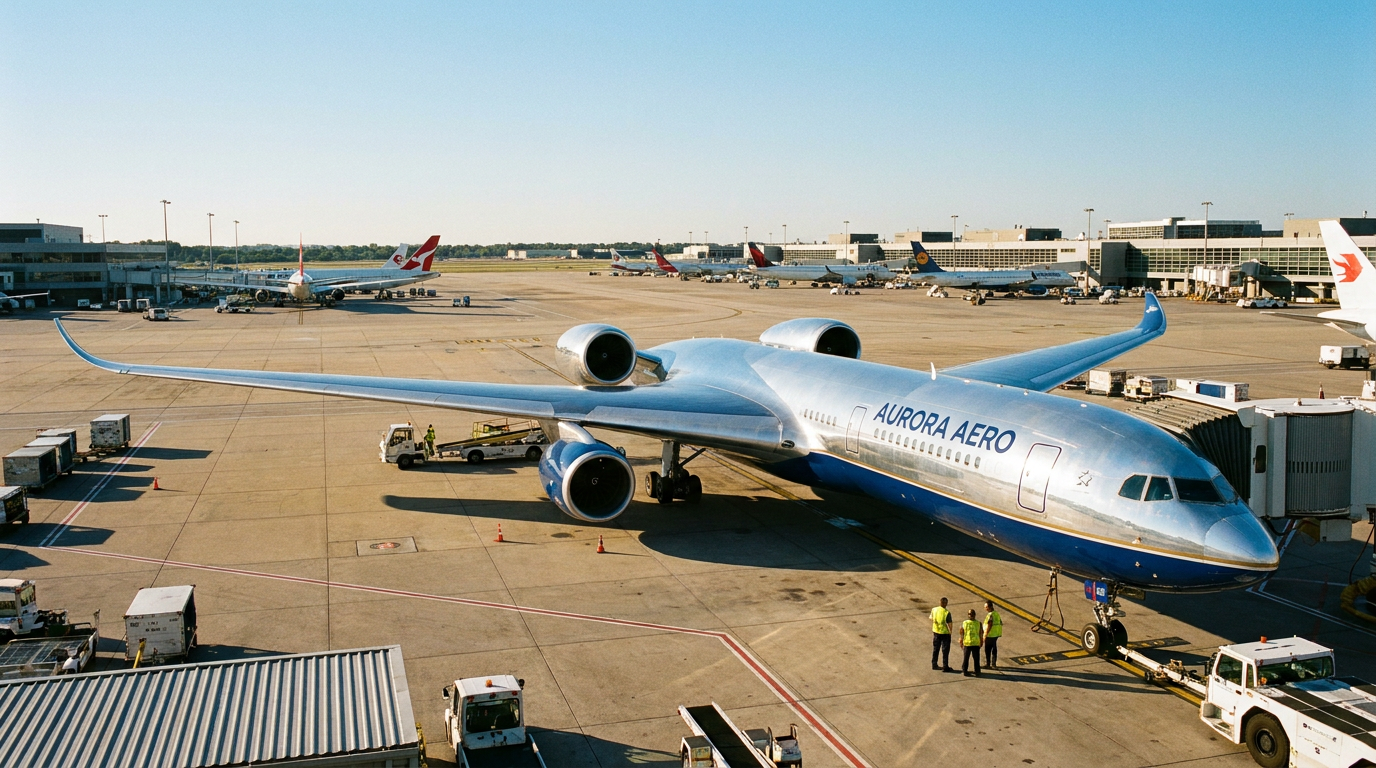
Enter the blended-wing body (BWB). Rather than bolting wings onto a distinct central cylinder, a BWB aircraft seamlessly integrates the fuselage and wings into a single, continuous flying wing. The central body is flattened and thickened to hold passengers and cargo, tapering smoothly into the outer wing sections.[1][6]
The aerodynamic advantages of this organic shape are profound. In a blended-wing design, the entire airframe contributes to generating lift. This allows the aircraft to achieve a significantly higher lift-to-drag ratio. Furthermore, the design minimizes the aircraft's "wetted area"—the total skin surface exposed to the wind—which drastically reduces friction drag.[1]

The resulting efficiency gains are staggering. Aerospace developers project that a BWB airliner could reduce fuel consumption and carbon emissions by up to 50 percent compared to today's conventional widebody jets. Because the airframe glides so efficiently, it can be powered by smaller, quieter engines, reducing noise pollution around airports by an estimated 15 to 42 decibels.[1][2][3]
While the concept has existed in military stealth bombers like the B-2 Spirit for decades, it is now accelerating toward commercial reality. Leading the charge is JetZero, a California-based aerospace startup that has rapidly moved from concept to physical production. The company is developing the Z4, a 250-seat blended-wing airliner designed for the underserved middle-of-the-market segment.[2][3]
JetZero's momentum has surged over the past two years. In early 2024, the Federal Aviation Administration (FAA) granted airworthiness certification to the company's 1:8 scale "Pathfinder" demonstrator, allowing subscale test flights to commence at Edwards Air Force Base. By January 2026, JetZero secured $175 million in Series B funding, drawing heavy investment from major industry players including United Airlines, Delta Air Lines, and RTX.[3][5]
The physical infrastructure for this new era of flight is already being poured. In June 2026, JetZero broke ground on a new manufacturing facility in Greensboro, North Carolina. The company is taking the unusual step of standing up its factory in parallel with its flight testing, utilizing digital twin technology to accelerate the path to mass production.[2]

The physical infrastructure for this new era of flight is already being poured.
The commercial sector is not the only backer. The U.S. Air Force views the blended-wing body as a strategic necessity, awarding JetZero a $235 million contract to build a full-scale demonstrator. For the military, the BWB's efficiency translates to aerial refueling tankers that can fly further, loiter longer, and operate from shorter runways, vastly expanding the operational range of fighter jets.[2][5]
The full-scale demonstrator, currently being assembled by Northrop Grumman subsidiary Scaled Composites, is slated to take to the skies in 2027. If successful, JetZero aims to have the Z4 certified and carrying commercial passengers by 2030.[2][5]
JetZero is not alone in this pursuit. European aerospace giant Airbus has heavily featured blended-wing designs in its ZEROe program, an initiative aimed at bringing a zero-emission, hydrogen-powered commercial aircraft to market. Because hydrogen requires significantly more storage volume than conventional jet fuel, the thick, cavernous central body of a BWB provides the ideal architecture for housing cryogenic hydrogen tanks.[7]

In late 2025, Airbus CEO Guillaume Faury publicly stated that the future of widebody aviation will likely abandon the tube-and-wing layout entirely in favor of BWB designs. However, Faury also acknowledged the significant hurdles that remain, particularly regarding the passenger experience.[4]
The interior of a blended-wing airliner will look nothing like today's cabins. Because the aircraft is wide and flat, seating will resemble a theater or an amphitheater rather than a long, narrow corridor. This allows for wider aisles and more spacious seating configurations, but it comes with a distinct trade-off: the loss of windows.[1][4]
In a BWB, the passenger cabin is buried deep within the thickest part of the wing structure. Only a small fraction of seats at the very front or extreme edges could theoretically have windows. For the vast majority of passengers, the cabin will be entirely enclosed, relying on artificial lighting or digital screens projecting the outside view—a setup that could induce claustrophobia or motion sickness for some travelers.[4]

Structural engineering presents another massive challenge. A cylindrical tube is the perfect shape for holding pressurized air at 35,000 feet, as the stress is distributed evenly across the circular hull. Pressurizing a wide, flattened cabin requires entirely new composite structures and internal tension mechanisms to prevent the aircraft from ballooning outward under pressure.[1]
Regulators are also grappling with how to certify the novel design. The FAA mandates that any commercial airliner must be able to evacuate all passengers within 90 seconds using only half of the available exits. The theater-style seating of a BWB means passengers in the center of the cabin are further from the exit doors, requiring new evacuation modeling and safety protocols.[1][4]
Finally, there is the question of airport infrastructure. While a blended-wing aircraft is shorter nose-to-tail than a conventional jet, its wingspan is considerably wider. JetZero has designed the Z4 to fit within standard gate footprints, but larger BWB variants could require airports to modify taxiways and terminal gates, much like they did for the Airbus A380.[3]
Despite these hurdles, the aerospace industry has reached a consensus: the environmental and economic imperatives of the twenty-first century can no longer be met by tweaking the designs of the twentieth. As factory walls rise in North Carolina and prototypes prepare for the runway, the blended-wing body is poised to become the new standard of the skies.[2][6]
How we got here
1990s
NASA and McDonnell Douglas begin modern research into blended-wing body concepts.
August 2023
The U.S. Air Force awards JetZero $235 million to build a full-scale BWB demonstrator.
Early 2024
JetZero's 1:8 scale 'Pathfinder' model receives FAA airworthiness certification for test flights.
January 2026
JetZero secures $175 million in Series B funding, drawing investment from United Airlines and RTX.
June 2026
JetZero breaks ground on a manufacturing facility in Greensboro, North Carolina.
2027
Expected first flight of the full-scale BWB demonstrator built by Scaled Composites.
Viewpoints in depth
Aerospace Innovators
Manufacturers believe the tube-and-wing design has reached its physical limits and must be replaced.
Companies like JetZero and Airbus argue that the aviation industry cannot meet its 2050 net-zero emissions targets by simply tweaking existing designs. They point to the physics of aerodynamic drag, noting that a conventional fuselage is essentially dead weight that requires massive thrust to move. By adopting a blended-wing body, innovators claim they can unlock a 50 percent reduction in fuel burn, enabling the use of smaller engines, extending range, and providing the necessary internal volume to eventually house zero-emission hydrogen fuel tanks.
Commercial Airlines
Carriers are eager for the massive reduction in operating costs that blended-wing aircraft promise.
For airlines operating on razor-thin margins, fuel is often the single largest expense. Carriers like United Airlines and Delta Air Lines are heavily backing blended-wing startups because a 50 percent reduction in fuel consumption would fundamentally rewrite their unit economics. Beyond fuel savings, airlines are attracted to the potential for faster boarding times permitted by wider cabins and the ability to operate these high-capacity aircraft out of existing airport gates without requiring costly infrastructure upgrades.
Aviation Regulators
Safety agencies face the daunting task of certifying an entirely new paradigm of passenger flight.
The Federal Aviation Administration (FAA) and other global regulators are approaching the blended-wing body with cautious optimism. Their primary concern is passenger safety, specifically regarding emergency evacuations. Current regulations require an aircraft to be fully evacuated in 90 seconds using half the exits. The theater-style seating of a blended-wing aircraft places some passengers much further from the doors than in a traditional tube layout. Regulators are also scrutinizing the structural integrity of the flattened pressure vessel, requiring extensive digital modeling and physical testing before granting commercial certification.
What we don't know
- How passengers will react to sitting in a wide, theater-style cabin without natural light or exterior windows.
- Whether the FAA will require significant changes to the aircraft's interior to meet the 90-second emergency evacuation mandate.
- How easily the widest variants of blended-wing aircraft will integrate into existing airport taxiways and terminal gates.
Key terms
- Blended Wing Body (BWB)
- An aircraft design that seamlessly integrates the fuselage and wings into a single, continuous lifting surface.
- Tube-and-wing
- The conventional aircraft architecture used for the last century, featuring a cylindrical fuselage attached to separate wings.
- Wetted area
- The total surface area of an aircraft that comes into contact with the external airflow, a major factor in friction drag.
- Lift-to-drag ratio
- A measure of aerodynamic efficiency; higher ratios mean an aircraft can glide further and requires less engine thrust.
Frequently asked
Will blended-wing aircraft have windows?
Most passengers will not have windows, as the cabin is located deep within the thick central body of the aircraft. Airlines may use digital screens to project outside views to prevent claustrophobia.
When will I be able to fly on one?
JetZero is targeting 2030 for commercial entry into service, though regulatory certification for such a novel design could extend that timeline.
Do these planes require new airport runways?
Manufacturers are designing them to fit within existing airport infrastructure and standard gate footprints, avoiding the need for wider taxiways.
Sources
Source coverage
7 outlets
4 viewpoints surfaced







[1]WikipediaAerospace Engineers & Innovators
Blended wing body
Read on Wikipedia →[2]Aviation International NewsAviation Regulators
JetZero Breaks Ground on Z4 Factory in North Carolina
Read on Aviation International News →[3]FLYING MagazineCommercial Airlines
United, RTX, Northrop Bet On JetZero's 'All-Wing' Aircraft
Read on FLYING Magazine →[4]Business InsiderAerospace Engineers & Innovators
Airbus CEO Said Future Passenger Jets Could Look Like B-2 Bombers
Read on Business Insider →[5]Air & Space Forces MagazineDefense Sector
JetZero Pitches Blended Wing Body Tanker as 'Game-Changer'
Read on Air & Space Forces Magazine →[6]MTU AEROREPORTAerospace Engineers & Innovators
Blended wing body: The future of passenger aircraft?
Read on MTU AEROREPORT →[7]AirbusAerospace Engineers & Innovators
ZEROe: our hydrogen-powered aircraft
Read on Airbus →
Every angle. Every day.
Get transportation stories with full source coverage and perspective breakdowns delivered to your inbox.