
How Mass Timber is Replacing Concrete and Reshaping Architecture
Cross-laminated timber (CLT) is emerging as a sustainable, fire-resistant alternative to steel and concrete, promising to drastically reduce the construction industry's carbon footprint.
By Factlen Editorial Team
- Sustainable Architects & Builders
- Advocating for mass timber to decarbonize the construction industry and speed up build times.
- Building Code Regulators & Insurers
- Focused on rigorous fire testing, structural integrity, and predictable risk management.
- Policy & Economic Analysts
- Viewing mass timber as a solution to construction productivity stagnation and housing shortages.
What's not represented
- · Traditional concrete and steel manufacturers
- · Local forestry communities
Why this matters
The construction industry is one of the world's largest polluters. Transitioning to engineered wood could turn our future cities from massive carbon emitters into vital carbon sinks, while drastically speeding up how quickly homes and offices are built.
Key points
- Cross-laminated timber (CLT) is an engineered wood product made by gluing layers of lumber at alternating right angles for immense strength.
- Mass timber panels are highly fire-resistant, forming a protective char layer that insulates the structural core from intense heat.
- Replacing concrete and steel with mass timber can reduce a building's embodied carbon footprint by up to 69%.
- Because panels are prefabricated in factories, on-site construction timelines can be accelerated by 20% to 50%.
For over a century, the skylines of the world have been defined by two uncompromising materials: concrete and steel. They are the undisputed heavyweights of modern architecture, prized for their immense strength, durability, and ability to push structures high into the clouds. However, they come with a staggering environmental cost that is becoming impossible to ignore. The production of cement and steel is incredibly energy-intensive, accounting for roughly 11% of all global greenhouse gas emissions. As the construction industry faces mounting pressure to decarbonize and meet aggressive climate targets, architects and engineers are searching for viable alternatives. A radical solution is now taking root across the globe, one that swaps the cold, carbon-heavy gray of concrete for the warmth and sustainability of wood.[2][8]
Enter mass timber, and specifically Cross-Laminated Timber (CLT). Dubbed by some enthusiastic architects as the "cement of the future," CLT is fundamentally transforming how we build everything from single-family homes to towering 18-story high-rises. To understand the appeal of CLT, you have to forget the standard two-by-four stick framing of a typical suburban house. CLT is a highly engineered wood product made by taking layers of solid sawn lumber and gluing them together under immense pressure. The secret to its extraordinary strength lies in its specific geometry. Each layer of wood is oriented at a right angle—perpendicular—to the one immediately below it. By alternating the direction of the wood grain across three, five, or seven plies, the resulting massive panels achieve structural rigidity in multiple directions.[1][8]

This cross-lamination process gives the wood a strength-to-weight ratio that genuinely rivals traditional concrete and steel, allowing it to be used safely for load-bearing walls, expansive floors, and heavy roofs. Because the timber panels are significantly lighter than their concrete counterparts, they require much smaller and less resource-intensive foundations. This weight reduction also translates to exceptional seismic performance. During an earthquake, a lighter building experiences less lateral force, allowing mass timber structures to flex and absorb seismic shocks more effectively than rigid masonry. This unique combination of strength and flexibility is prompting structural engineers in earthquake-prone regions to increasingly specify CLT for major commercial developments.[1][3]
Yet, whenever mass timber is proposed for a major project, the immediate and inevitable question from the public is always the same: doesn't wood burn? It is a perfectly logical fear, but mass timber behaves entirely differently in a fire than the light-frame wood used in traditional residential homebuilding. When exposed to intense heat and open flames, the thick, dense panels of CLT do not easily ignite or rapidly combust. Instead, the outer surface of the wood chars at a highly predictable rate. This thick char layer acts as a natural, built-in insulator, protecting the unburned structural core of the wood from the heat and maintaining the building's load-bearing integrity for hours.[3][4]
Fire tests conducted by independent laboratories have repeatedly proven the reliability of this charring mechanism. The evidence has been so overwhelming that the International Building Code (IBC) recently updated its stringent standards, officially allowing mass timber buildings to reach up to 18 stories tall in the United States. With the fire safety question largely settled for regulators, the insurance industry is also adapting. Major underwriters are increasingly aligning their guidance with recognized fire testing data, offering comprehensive coverage for tall timber structures and easing the path for developers to secure financing.[1][3]
Fire tests conducted by independent laboratories have repeatedly proven the reliability of this charring mechanism.
With regulatory hurdles clearing, the primary driver for mass timber's explosive adoption is its unmatched environmental profile. Unlike concrete, which emits massive amounts of carbon dioxide during its chemical curing process, wood is a renewable resource that actively fights climate change. Trees absorb carbon dioxide from the atmosphere as they grow. When that wood is sustainably harvested and manufactured into a CLT panel, that absorbed carbon is locked away—sequestered—for the entire lifetime of the building. Instead of being a source of emissions, a mass timber building effectively becomes a massive urban carbon sink.[2][6]
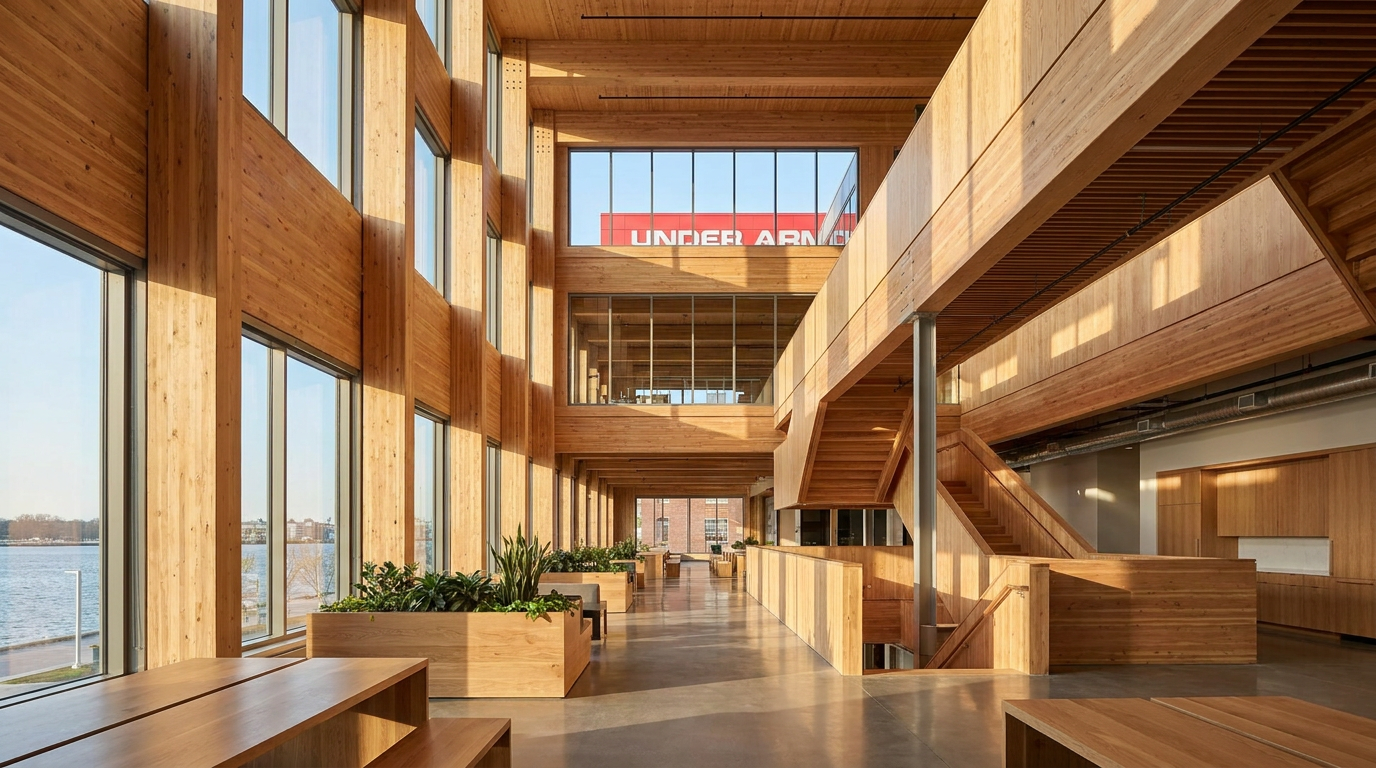
The emissions savings achieved by switching to timber are dramatic and immediate. For example, when the new Under Armour corporate facility was constructed in Baltimore, the design team utilized mass timber to replace traditional steel and concrete structural elements. This single material swap resulted in a staggering 69% reduction in the building's embodied carbon footprint. As corporate entities and municipalities race to meet net-zero emissions pledges, these kinds of reductions are not just nice-to-have environmental bonuses; they are becoming strict requirements for new developments.[2][4]

Beyond its sustainability credentials, CLT is revolutionizing the actual physical process of construction through advanced prefabrication. Instead of pouring concrete into molds or welding steel beams on a dusty, noisy job site, CLT panels are manufactured in highly controlled, clean factory environments. Using computer numerical control (CNC) machines, the massive wooden panels are milled to millimeter precision based on digital architectural models. Window openings, door frames, and even the internal channels required for electrical wiring and plumbing are pre-cut before the wood ever leaves the manufacturing facility.[4][7]
Once the precision-milled panels are complete, they are flat-packed onto trucks and shipped directly to the construction site. Because everything is pre-measured and pre-cut, the on-site assembly process is remarkably quiet and efficient, functioning much like a giant piece of flat-pack furniture. A small crew with a crane can lift and lock the massive panels into place in a matter of minutes. This streamlined method drastically reduces on-site noise pollution, minimizes material waste, and can accelerate overall project timelines by 20% to 50% compared to traditional building methods.[4][7]

While mass timber first gained widespread traction in large-scale commercial offices and multi-family residential towers, the technology is now rapidly filtering down into single-family residential architecture. Boutique design firms are utilizing CLT to build striking, eco-conscious homes that blend modern geometry with natural surroundings. A prime example is the recently completed "CLT House" nestled in New York's Hudson Valley, which was assembled on-site in just a few days. These projects demonstrate how material innovation can produce architecture that is both highly efficient and deeply rooted in its natural environment.[5][8]
For homeowners and office workers alike, the appeal of mass timber isn't just structural or environmental; it is deeply psychological. Because CLT panels are inherently beautiful, architects often choose to leave the wood exposed on the interior walls and ceilings, eliminating the need for drywall and paint. Studies in biophilic design—the concept of connecting indoor environments to nature—suggest that living and working in spaces dominated by natural wood can lower heart rates, reduce stress levels, and improve overall emotional well-being. The tactile warmth and subtle scent of the timber create a uniquely comforting atmosphere.[7][8]

Despite its immense promise, the mass timber revolution still faces notable challenges. The supply chain and manufacturing capacity for CLT are still developing in North America, meaning the upfront material costs can sometimes carry a premium over traditional stick-framing or cheap concrete. However, as domestic manufacturing scales up and builders factor in the massive financial savings associated with reduced labor and faster construction times, the economic equation is rapidly shifting in timber's favor. As cities worldwide look for ways to build denser, faster, and greener, the skyline of the 21st century may not be forged in steel, but grown in a forest.[4][6][8]
How we got here
Early 1990s
Cross-laminated timber is first developed and utilized in Austria and Germany.
2015
Mass timber construction begins to gain serious traction in the United States.
2021
The International Building Code is updated to allow mass timber structures up to 18 stories tall.
2022
A 25-story mass timber tower is completed in Milwaukee, becoming the tallest timber building in the world.
2026
Over 2,500 mass timber projects are built or underway across the United States.
Viewpoints in depth
Sustainable Architects & Builders
Advocating for mass timber to decarbonize the construction industry and speed up build times.
For this camp, the transition away from concrete and steel is an urgent climate necessity. They view mass timber as the only viable structural material that actively sequesters carbon rather than emitting it. Beyond the environmental benefits, architects emphasize the design flexibility and the psychological benefits of biophilic environments, noting that exposed wood interiors create healthier, more inviting spaces for occupants.
Building Code Regulators & Insurers
Focused on rigorous fire testing, structural integrity, and predictable risk management.
Regulators and insurance underwriters approach mass timber with cautious optimism grounded in empirical data. Initially skeptical of wood's fire risks, this group has been won over by extensive testing demonstrating CLT's predictable charring rate and structural resilience. Their primary focus now is ensuring that local municipalities adopt updated building codes and that contractors strictly adhere to encapsulation and moisture-management protocols during construction.
Policy & Economic Analysts
Viewing mass timber as a solution to construction productivity stagnation and housing shortages.
Economic analysts highlight the severe productivity lag in the traditional construction sector. They argue that mass timber's reliance on factory prefabrication and rapid on-site assembly can drastically reduce labor costs and project timelines. For this camp, scaling up domestic CLT manufacturing is a critical policy lever to address chronic housing shortages while simultaneously boosting rural forestry economies.
What we don't know
- How quickly traditional construction supply chains and labor forces can retrain to handle prefabricated timber at a massive global scale.
- The long-term feasibility of repairing, rather than replacing, mass timber structural elements if they are partially damaged in a severe fire.
Key terms
- Mass Timber
- A category of engineered wood products made by binding smaller pieces of wood together to create large, structurally strong panels and beams.
- Cross-Laminated Timber (CLT)
- A specific type of mass timber made by gluing layers of solid lumber at alternating right angles to create incredibly strong, rigid panels.
- Embodied Carbon
- The total greenhouse gas emissions generated by the extraction, manufacturing, transportation, and assembly of building materials.
- Char Layer
- The burned outer surface of a mass timber panel that forms during a fire, acting as a natural insulator to protect the unburned wood inside.
- Prefabrication
- The practice of manufacturing building components in a factory before transporting them to the construction site for rapid assembly.
Frequently asked
Is mass timber safe in a fire?
Yes. Unlike light-frame wood, thick mass timber panels char on the outside when exposed to fire. This char layer insulates the structural core, allowing the building to maintain its integrity for hours.
Is cross-laminated timber the same as plywood?
They share a similar cross-layered concept, but CLT is made from thick, solid boards of lumber rather than thin veneers, making it massive and strong enough to support high-rise buildings.
Does mass timber cause deforestation?
When sourced responsibly, mass timber relies on sustainably managed forests where trees are continuously replanted. In fact, increased demand can incentivize better long-term forest management.
Can mass timber be used for regular houses?
Yes. While initially popular for commercial high-rises, CLT is increasingly being used for single-family homes due to its rapid assembly time and beautiful exposed wood interiors.
Sources
Source coverage
8 outlets
3 viewpoints surfaced








[1]WoodWorksBuilding Code Regulators & Insurers
What is mass timber?
Read on WoodWorks →[2]TrellisPolicy & Economic Analysts
Mass timber usage rises in U.S., European building construction
Read on Trellis →[3]Zurich North AmericaBuilding Code Regulators & Insurers
Mass timber: Insuring the future of sustainable construction
Read on Zurich North America →[4]J.S. HeldBuilding Code Regulators & Insurers
Mass Timber Fire Resistance: Sustainability, Code Compliance, and Fire Safety in Tall Buildings
Read on J.S. Held →[5]Trend HunterSustainable Architects & Builders
Modern Timber Lake Houses
Read on Trend Hunter →[6]Niskanen CenterPolicy & Economic Analysts
Mass timber: unlocking the potential of sustainable building
Read on Niskanen Center →[7]Elle DecorationSustainable Architects & Builders
Why your next big home project should include cross-laminated timber
Read on Elle Decoration →[8]Factlen Editorial TeamPolicy & Economic Analysts
Synthesis by Factlen editorial team
Read on Factlen Editorial Team →
Every angle. Every day.
Get home stories with full source coverage and perspective breakdowns delivered to your inbox.