
Fact-Checking the Evidence Behind Ranked-Choice Voting
As ranked-choice voting expands across the United States, we examine the empirical evidence behind claims of improved campaign civility, voter turnout, and reduced polarization.
By Factlen Editorial Team
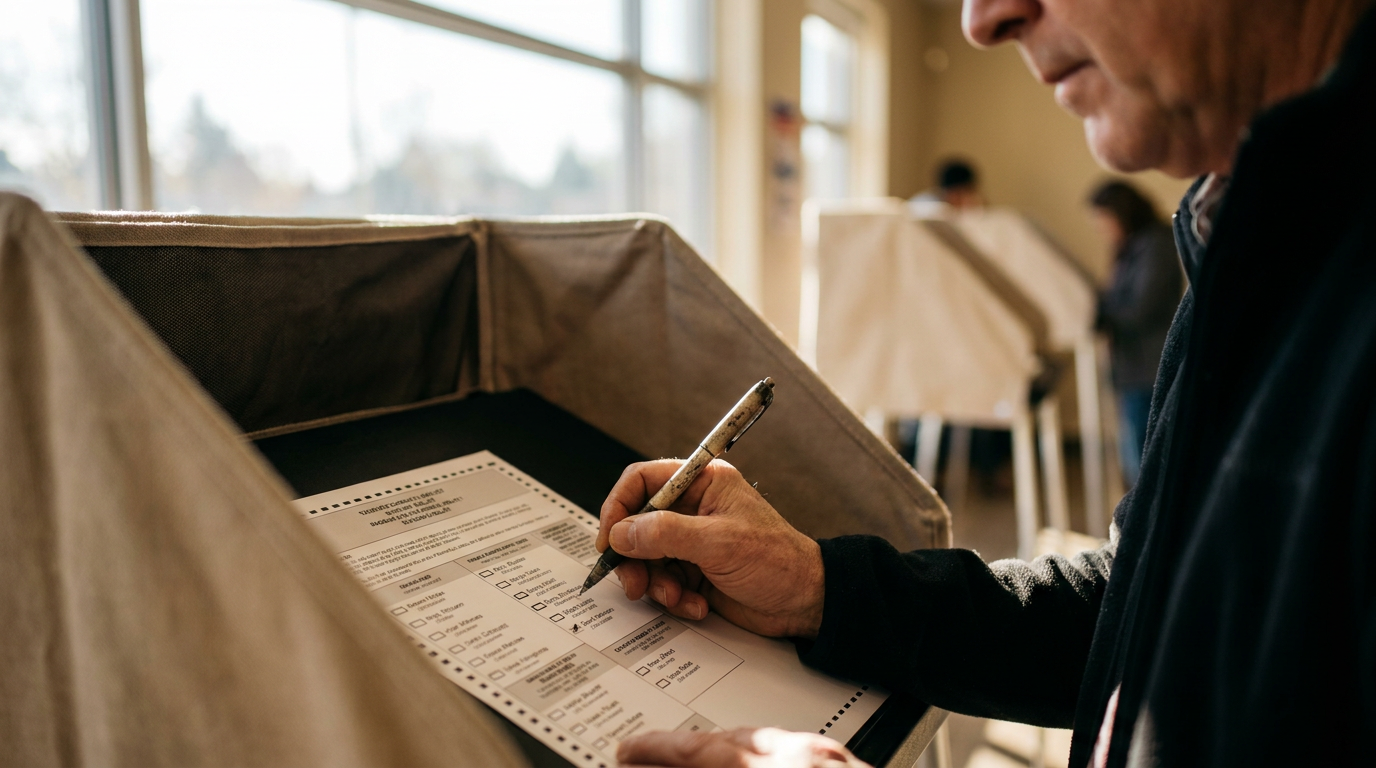
- Electoral Reform Advocates
- Argue that the system reduces toxicity, eliminates the spoiler effect, and ensures majority support.
- Election Administrators
- Highlight concerns about ballot spoilage, voter confusion, and the administrative burden of tabulation.
- Major Political Parties
- Often resist the reform because it threatens the traditional two-party duopoly and empowers independent challengers.
What's not represented
- · Voters whose ballots were spoiled due to confusion
Why this matters
Understanding the actual impact of ranked-choice voting is crucial as more states and cities consider adopting the system. The data reveals how altering the ballot structure can directly influence campaign toxicity, voter participation, and the types of politicians who win office.
Key points
- Ranked-choice voting requires candidates to secure a true majority to win.
- Evidence shows the system modestly improves campaign civility by incentivizing candidates to seek second-choice votes.
- Voter turnout generally remains stable or increases, avoiding the massive drop-offs seen in traditional delayed runoffs.
- The system effectively eliminates the spoiler effect, allowing voters to support third-party candidates without penalty.
The rapid expansion of Ranked-Choice Voting across the United States represents the most significant structural shift in American elections in a century. From statewide implementations in Alaska and Maine to municipal adoptions in New York City and dozens of local jurisdictions, the traditional first-past-the-post system is increasingly being replaced. This momentum has transformed a once-obscure academic concept into a central battleground of democratic reform, prompting intense scrutiny from both major political parties, independent analysts, and voting rights organizations who are closely monitoring its real-world impact.
As the system spreads, so do the sweeping claims about its potential impact on the electorate. Proponents enthusiastically market the ranked ballot as a structural cure for the toxic, hyper-polarized state of American politics, arguing that it naturally filters out extremism. Conversely, critics warn that it is a confusing, overly complex gimmick that disenfranchises vulnerable voters and upends long-standing political norms. The debate has frequently generated more heat than light, leaving voters to navigate a maze of contradictory promises and dire warnings.
To separate political rhetoric from empirical reality, political scientists and election administrators have spent the last decade analyzing voter behavior, campaign tone, and election outcomes in jurisdictions that have made the switch. The resulting data provides a highly nuanced picture of what the system actually delivers in practice. By examining millions of cast ballots and conducting extensive voter surveys across multiple election cycles, researchers are finally able to replace theoretical arguments with concrete evidence regarding campaign civility, voter confusion, and the reduction of political polarization.
Before evaluating the specific claims, it is essential to understand the underlying mechanism of the ballot. In a standard ranked-choice election, voters rank the available candidates by preference—first, second, third, and so on—rather than selecting just one name. When the polls close, all first-choice votes are tallied. If a single candidate secures an outright majority of those first-preference votes, the election is over and that candidate is immediately declared the winner, functioning exactly like a traditional plurality election.[4]
However, if no candidate crosses the fifty percent threshold, an instant runoff is triggered. The candidate with the fewest first-preference votes is eliminated from the race entirely. The ballots of the voters who chose that eliminated candidate are then redistributed to their second choices. This mathematical process of elimination and redistribution repeats in rounds until one candidate finally achieves a true majority. This system simulates a traditional runoff election, but completes the process instantly without the massive expense and logistical burden of hosting a second election day.[4]

The most prominent claim made by advocates is that this mechanism fundamentally changes campaign behavior, specifically by reducing negative campaigning and fostering a culture of civility. The theoretical incentive is straightforward: candidates cannot afford to alienate their opponents' supporters, because they desperately need those voters to rank them second or third. In a traditional race, destroying a rival is a viable path to victory; in a ranked system, scorched-earth tactics risk alienating the backup votes required to survive the later rounds of tabulation.
Empirical evidence largely supports this theory, though with some notable limitations. A comprehensive review published by the American Bar Association found that candidates in these races are indeed incentivized to take a more conciliatory approach in order to build a broader coalition. Because the electoral math punishes candidates who rely solely on a narrow, highly energized base, politicians are forced to engage respectfully with voters who fundamentally disagree with their primary platform, altering the traditional dynamics of a contested primary.[1]
Voter perception strongly aligns with this documented shift in campaign strategy. Extensive surveys conducted across multiple California municipalities found that voters in ranked-choice jurisdictions were significantly more likely to report that local campaigns were less negative compared to voters in cities using traditional plurality rules. Residents consistently noted that candidates spent less time launching personal attacks and more time explaining their policy positions, resulting in an electoral environment that felt substantially less toxic and more focused on substantive community issues.[1][5]
Voter perception strongly aligns with this documented shift in campaign strategy.
Yet, the civilizing effect of the ballot is not absolute. Academic research published by Taylor & Francis indicates that while lower-tier candidates frequently cross-endorse one another and actively ask for backup votes, frontrunners locked in tight races often revert to traditional attack strategies. When two leading candidates recognize that the election will ultimately come down to a binary choice between them, the incentive to play nice evaporates. The system softens the edges of a campaign, but it does not eliminate political combat entirely.[5]
The second major battleground in the debate centers on voter confusion and overall turnout. Critics frequently argue that the ranked ballot is overly complex, potentially depressing participation and leading to higher rates of discarded or spoiled ballots. There is a persistent fear among skeptics that this complexity disproportionately disenfranchises minority and lower-income communities, who might abandon the ballot entirely rather than navigate the unfamiliar process of ranking multiple candidates. These concerns have been central to legislative efforts to ban the practice in several states.
On the question of overall turnout, the catastrophic drop-offs predicted by opponents have simply not materialized in the data. In fact, figures released by the New York City Campaign Finance Board showed a massive twenty-nine percent surge in voter participation during the city's first ranked mayoral primary in 2021. Despite the novelty of the system, nearly ninety percent of participating voters successfully ranked multiple candidates on their ballots, demonstrating that the general public is highly capable of adapting to the new format when provided with adequate instructions.[6]

Furthermore, a detailed study by the University of Missouri-St. Louis found that the system effectively solves the severe turnout drop-off that plagues traditional delayed runoff elections. In conventional systems, voters frequently fail to return to the polls for a runoff held weeks later, meaning the ultimate winner is chosen by a fraction of the original electorate. By consolidating the entire process into a single day, the instant runoff ensures that the decisive round of counting features the highest possible level of voter participation.[3]
However, the administrative concerns regarding ballot errors are not entirely unfounded. Research indicates that the rate of improperly marked ballots—where voters might accidentally rank the same candidate twice or skip rankings—is slightly higher than in traditional races. Some studies have found that these mismarking rates can disproportionately affect voters with lower levels of educational attainment. This data highlights the absolute necessity of robust, well-funded voter education campaigns whenever a municipality transitions to the new system, ensuring that no demographic is left behind by the changing mechanics.[3][4]
The final major claim evaluated by researchers is that the system reduces political polarization by ensuring that only consensus candidates—those with broad, cross-factional appeal—can win office. By eliminating the dreaded spoiler effect, voters are entirely free to support third-party or moderate candidates as their first choice without the fear of inadvertently helping their least preferred option win. This structural freedom is explicitly designed to break the stranglehold of the two-party duopoly and encourage a wider diversity of political thought to flourish in the public square.
The National Conference of State Legislatures notes that while the system has successfully led to broadly appealing candidates emerging from crowded party primaries, its impact on overall national polarization remains modest. The ballot structure is not a magical silver bullet for a deeply divided electorate, and highly partisan candidates can still win if they secure a genuine majority. However, the data confirms that it does structurally reward candidates who are willing to reach beyond their immediate base and build bridges with independent voters.[2]
This dynamic was vividly demonstrated in Alaska's recent congressional races, where the system explicitly rewarded candidates who successfully built bipartisan coalitions. By requiring candidates to appeal to the center to secure crucial second-choice votes, the state produced a congressional delegation that is now frequently ranked among the most bipartisan in the entire nation. This real-world outcome provides the strongest evidence yet that altering the mathematical incentives of an election can directly influence the governing style and legislative priorities of the politicians who ultimately take office.[1][2]

Ultimately, the accumulated evidence suggests that Ranked-Choice Voting is neither the utopian fix promised by its most zealous advocates nor the democratic disaster warned of by its fiercest critics. It is a highly effective structural reform that reliably eliminates the spoiler effect, modestly improves the tone of political campaigns, and guarantees that the ultimate victor possesses true majority support. By forcing candidates to compete for every single vote, it shifts the balance of power away from political extremes and back toward the median voter.[7]
As more states and municipalities weigh the transition, the ultimate success of the system will likely depend less on the mathematical elegance of the algorithm and more on the quality of the civic education that accompanies it. When voters clearly understand how to utilize their ranked preferences, the system delivers on its core promise: producing a government that more accurately and fairly reflects the complex will of the majority. In an era of deep political cynicism, that incremental improvement represents a meaningful victory for democratic participation.[7]
How we got here
2004
San Francisco becomes the first major U.S. city to implement ranked-choice voting for local elections.
2018
Maine becomes the first state to use the system for federal congressional elections.
2021
New York City utilizes the ranked ballot for its mayoral primary, marking the largest deployment in U.S. history.
2022
Alaska holds its first ranked-choice general election, resulting in a highly bipartisan congressional delegation.
2026
The system continues to expand to dozens of municipalities while facing legislative bans in several conservative states.
Viewpoints in depth
Electoral Reform Advocates
Argue that the system reduces toxicity, eliminates the spoiler effect, and ensures majority support.
Advocacy groups argue that the traditional plurality system is fundamentally broken because it allows candidates to win with a fraction of the vote. They champion ranked-choice voting as a necessary evolution that forces politicians to build broad coalitions rather than pandering to extreme bases. By eliminating the fear of wasting a vote on a third-party candidate, they believe the system fosters a more diverse and representative democracy.
Election Administrators & Skeptics
Highlight concerns about ballot spoilage, voter confusion, and the administrative burden of tabulation.
While not necessarily opposed to the concept, many local election officials and political skeptics warn about the practical realities of implementation. They point to data showing slightly higher rates of improperly marked ballots, particularly among demographics with lower educational attainment. Furthermore, they argue that the complex tabulation process can delay election results by days or weeks, potentially fueling conspiracy theories and undermining public trust in the outcome.
Major Political Parties
Often resist the reform because it threatens the traditional two-party duopoly and empowers independent challengers.
Both the Republican and Democratic establishments have frequently opposed the expansion of ranked-choice voting. For entrenched political parties, the system introduces unwanted volatility by lowering the barrier to entry for moderate, independent, or third-party challengers. Party leaders argue that the traditional primary system is better suited for selecting clear ideological standard-bearers, and they view the ranked ballot as a mechanism that dilutes party power and discipline.
What we don't know
- Whether the slightly higher rate of ballot spoilage will decrease naturally as voters become more accustomed to the system.
- How the system will perform in a highly polarized, high-stakes national presidential election.
Key terms
- Ranked-Choice Voting (RCV)
- An electoral system where voters rank candidates by preference rather than selecting just one.
- Instant Runoff
- The mathematical process of eliminating the lowest-performing candidate and redistributing their votes to voters' second choices.
- Plurality Voting
- The traditional system where the candidate with the most votes wins, even if they do not secure a majority.
- Spoiler Effect
- A scenario where a third-party candidate draws votes away from a major candidate with similar views, altering the election outcome.
- Spoiled Ballot
- A ballot that is filled out incorrectly, such as ranking the same candidate twice, and cannot be counted by election officials.
Frequently asked
Does ranked-choice voting benefit one political party over the other?
No conclusive evidence suggests a built-in partisan advantage. It generally benefits moderate or consensus candidates of any affiliation over highly polarizing figures.
What happens if I only want to vote for one candidate?
You can simply select your preferred candidate as your first choice and leave the other rankings blank. Your vote will still be counted exactly as it would in a traditional election.
Does the system delay election results?
It can. Because the instant runoff requires all mail-in and absentee ballots to be collected before the final elimination rounds can be calculated, final results often take longer to certify.
Sources
Source coverage
7 outlets
3 viewpoints surfaced







[1]American Bar AssociationElectoral Reform Advocates
Can ranked choice voting (RCV) enhance American democracy?
Read on American Bar Association →[2]National Conference of State Legislatures
Ranked Choice Voting: Administrative and Policy Considerations
Read on National Conference of State Legislatures →[3]University of Missouri-St. LouisElection Administrators
Voter Participation with Ranked Choice Voting in the United States
Read on University of Missouri-St. Louis →[4]BallotpediaElection Administrators
Ranked-choice voting (RCV)
Read on Ballotpedia →[5]Taylor & Francis Online
Campaign civility under ranked-choice voting
Read on Taylor & Francis Online →[6]American Constitution SocietyMajor Political Parties
The Critics’ Beef with Ranked Choice Voting
Read on American Constitution Society →[7]Factlen Editorial Team
Synthesis by Factlen editorial team
Read on Factlen Editorial Team →

More in news politics
See all 6 stories →U.S.-Iran Talks
Inside the High-Stakes U.S.-Iran Peace Talks in Switzerland
7 sources

U.S.-Iran Talks
U.S. and Iran Open High-Stakes Negotiations in Switzerland Amid Regional Flare-Ups
8 sources

Bolivia Blockades
Bolivian President Declares State of Emergency, Deploys Military to Clear 50-Day Blockades
6 sources

UK Politics
UK Prime Minister Keir Starmer Expected to Resign Amid Historic Labour Rebellion
8 sources

Every angle. Every day.
Get news politics stories with full source coverage and perspective breakdowns delivered to your inbox.