
Deep Carbon Monoxide Detection Confirms Uranus is a True Ice Giant
New observations from the ALMA telescope array have detected carbon monoxide deep in Uranus's atmosphere, providing strong evidence that the planet harbors a massive interior ocean of water ice.
By Factlen Editorial Team
- Planetary Formation Theorists
- Focus on how the chemical composition of the ice giants dictates the history of the early solar system and planetary migration.
- Observational Astronomers
- Prioritize the capabilities of next-generation instruments like ALMA to detect faint chemical signatures across billions of miles.
- Future Mission Advocates
- Argue that while remote observations are valuable, only a dedicated atmospheric probe can provide ground-truth data on the ice giants.
What's not represented
- · Exoplanet Researchers
Why this matters
Understanding the true composition of Uranus solves a decades-old mystery about how our solar system formed and what materials were present in its outer reaches. It also provides a crucial baseline for studying the thousands of similar 'ice giant' exoplanets we are now discovering across the galaxy.
Key points
- Astronomers have detected carbon monoxide deep in the lower atmosphere of Uranus for the first time.
- The discovery was made using the ALMA radio telescope array in Chile between 2022 and 2024.
- Carbon monoxide acts as a chemical proxy for deep-seated water, indicating a massive interior ocean.
- The finding strongly refutes the alternative theory that Uranus is a 'rock giant' depleted of water.
- Confirming Uranus is a true ice giant helps theorists model how the outer solar system formed and migrated.
- Definitive proof of the planet's exact ice-to-rock ratio will still require a future atmospheric probe mission.
Uranus and Neptune sit at the frozen, twilight edges of our solar system, shrouded in thick atmospheres that hide their internal structures. Because humanity has only ever sent one brief flyby mission to these distant worlds, planetary scientists have spent decades relying on indirect measurements and complex models to guess what lies beneath their clouds.[8]
The fundamental question has long been whether these two neighboring planets are actually twins. While Neptune has consistently shown chemical signatures consistent with a massive interior ocean of water ice, Uranus has been stubbornly quiet. This discrepancy led to a controversial hypothesis: perhaps Uranus is not an 'ice giant' at all, but rather a 'rock giant' wrapped in a thick envelope of gas.[5][6]
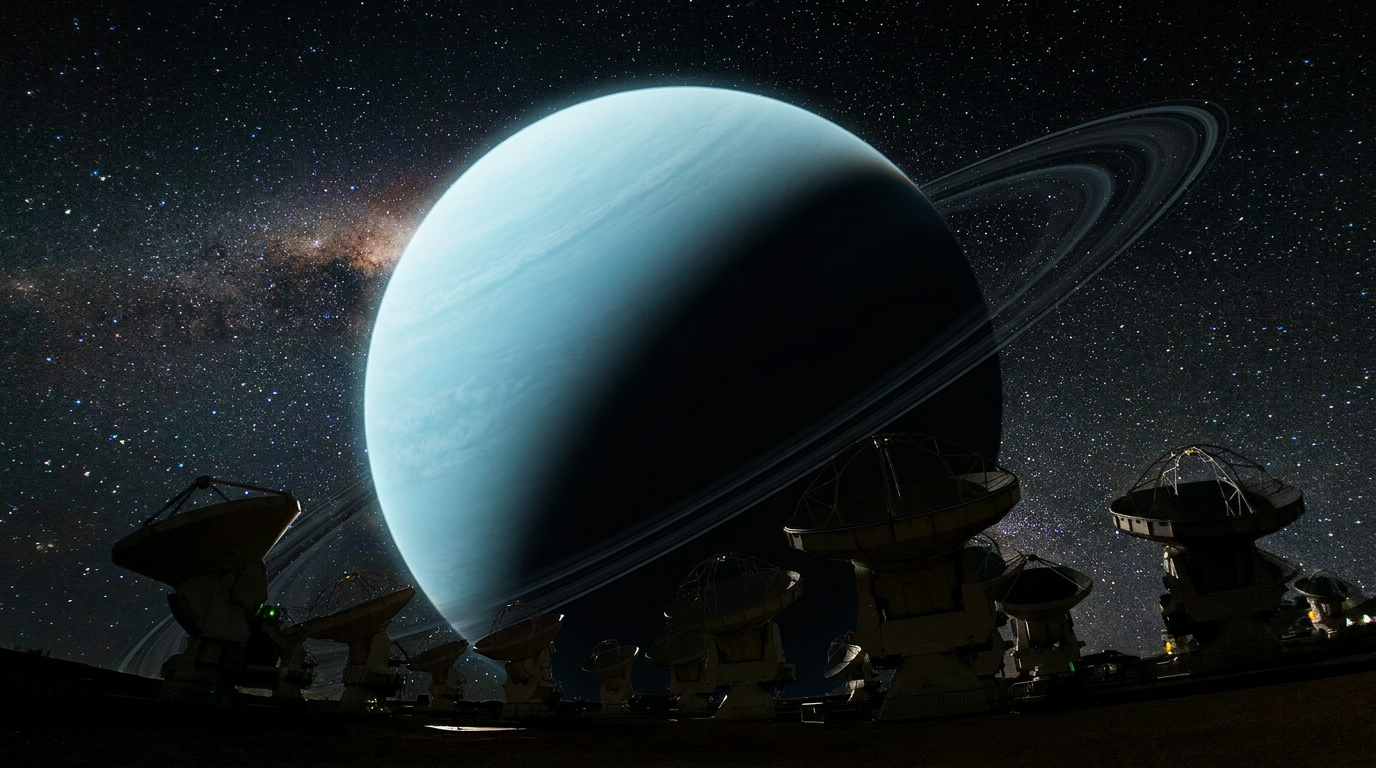
Now, that narrative is shifting decisively. A team of astronomers using the Atacama Large Millimeter/submillimeter Array (ALMA) in the high Chilean desert has detected significant concentrations of carbon monoxide deep within the lower atmosphere of Uranus.[2][3]
This discovery, based on meticulous observations taken between 2022 and 2024, provides the first definitive identification of the gas at such extreme depths. In the study of giant planets, carbon monoxide serves as a crucial proxy for bulk composition, strongly suggesting that Uranus harbors a vast, hidden reservoir of water ice.[3][7]

To understand why a trace gas like carbon monoxide matters so much to planetary scientists, we have to look at the mechanism of deep planetary chemistry. In the immense heat and crushing pressure of a giant planet's interior, chemical reactions reach a delicate equilibrium that dictates what gases form.[1]
If a planet has a massive mantle of water ice—which in planetary science refers to a superionic fluid of water, ammonia, and methane, rather than solid ice cubes—the abundant oxygen from that water reacts with deep carbon to form carbon monoxide.[4][5]
Powerful convection currents then dredge this carbon monoxide up from the deep interior into the troposphere, the lowest layer of the atmosphere where advanced telescopes can potentially spot its spectral signature.[6]
Neptune has long displayed this exact signature. Its atmosphere is rich in carbon monoxide, which theorists easily mapped to a water-rich interior. But previous scans of Uranus found a glaring absence of the gas in its troposphere, with upper limits capping it at a minuscule 2.1 parts per billion.[3][6]
This missing chemical signature forced theorists to build alternative models. If there was no carbon monoxide being dredged up, perhaps there was no vast water ocean to supply the oxygen. Some models proposed that Uranus was composed mostly of rock, making its formation history radically different from Neptune's.[5][7]
This missing chemical signature forced theorists to build alternative models.
Other researchers suggested that Uranus might still be an ice giant, but with a sluggish, stratified interior. If the planet lacked the vigorous convection currents needed to pull the gas upward, the carbon monoxide would remain trapped in the abyss, invisible to our instruments.[6]
The new ALMA data resolves this tension by peering deeper than ever before. By analyzing sub-millimeter wavelengths, researchers led by Thibault Cavalié at the University of Bordeaux cut through the upper cloud decks and identified the faint but unmistakable absorption lines of carbon monoxide in the troposphere.[2][3]
Following the detection, the research team ran a suite of numerical simulations, varying the proportion of rock to ice within the planet's core to see which internal mixture would produce the exact gas levels observed by ALMA.[3][7]

The results were unambiguous. Only the scenarios dominated by a massive fraction of water ice succeeded in replicating the ALMA measurements. Models that assumed a rock-heavy interior consistently fell short of producing enough carbon monoxide.[3][7]
'We find that Uranus is more on the ice-giant side than on the rock-giant side,' Cavalié noted, effectively restoring Uranus to its traditional classification alongside Neptune and validating decades of foundational planetary models.[3][7]
This chemical reconciliation has profound implications for our understanding of how the solar system formed. If Uranus and Neptune share similar bulk compositions, they likely formed in similar environments—accreting material near the carbon monoxide 'ice line' in the primordial solar nebula.[4][5]
It also simplifies the narrative of planetary migration. The prevailing models of solar system evolution, such as the Nice model, suggest the giant planets formed closer to the Sun before migrating outward. A shared composition between the ice giants makes these chaotic orbital dynamics much easier to model.[1][6]

Yet, while the ALMA observations provide a critical piece of the puzzle, they are still indirect. The exact ratio of ice to rock, and the precise nature of the superionic water mantle, remain obscured by thousands of miles of crushing atmospheric pressure.[1][8]
Furthermore, confirming the ice giant model does not explain all of Uranus's anomalies. The planet still exhibits a highly unusual, off-center magnetic field and emits surprisingly little internal heat compared to Neptune—mysteries that a simple compositional match cannot fully resolve.[6][8]
How we got here
1986
NASA's Voyager 2 spacecraft performs the first and only flyby of Uranus, providing baseline data but leaving its deep interior a mystery.
2010s
The lack of detectable carbon monoxide in Uranus's lower atmosphere leads some theorists to propose it might be a 'rock giant' rather than an ice giant.
2022
Planetary scientists designate a dedicated Uranus Orbiter and Probe as the highest-priority flagship mission for the next decade.
2022–2024
Researchers use the ALMA observatory in Chile to conduct deep sub-millimeter scans of Uranus's atmosphere.
June 2026
Scientists announce the definitive detection of deep carbon monoxide, heavily supporting the ice-rich interior model.
Viewpoints in depth
Planetary Formation Theorists
Focus on how the chemical composition of the ice giants dictates the history of the early solar system.
For theorists modeling the birth of the solar system, the composition of Uranus and Neptune is a critical boundary condition. If Uranus were a rock giant, it would imply it formed in a fundamentally different region of the protoplanetary disk than Neptune, complicating models of planetary migration. The confirmation of an ice-rich interior simplifies this narrative, suggesting both planets accreted their mass near the carbon monoxide 'ice line' before migrating to their current distant orbits.
Observational Astronomers
Prioritize the capabilities of next-generation instruments to detect faint chemical signatures.
Observers emphasize the sheer technical triumph of this detection. Uranus is nearly two billion miles away, and its atmosphere is notoriously cold and sluggish. Detecting the faint absorption lines of a trace gas deep in the troposphere requires the unprecedented sensitivity and resolution of the ALMA array. This success proves that ground-based sub-millimeter astronomy can still unlock major planetary mysteries without waiting decades for a space probe.
Future Mission Advocates
Argue that only a dedicated atmospheric probe can provide ground-truth data.
While celebrating the ALMA findings, mission advocates argue that remote sensing has hard limits. Carbon monoxide is only a proxy, and models still require assumptions about the planet's thermal profile and convection rates. To truly understand the ice-to-rock ratio, the superionic water mantle, and Uranus's bizarre off-axis magnetic field, scientists insist that NASA must proceed with the proposed Uranus Orbiter and Probe to drop a physical sensor into the clouds.
What we don't know
- The exact ratio of water ice to rock within Uranus's deep interior remains an estimate based on modeling.
- It is unclear why Uranus emits so much less internal heat than its twin, Neptune, despite their similar compositions.
- The mechanism generating Uranus's highly unusual, off-center magnetic field is still not fully understood.
Key terms
- Ice Giant
- A class of planets composed primarily of elements heavier than hydrogen and helium, such as oxygen, carbon, nitrogen, and sulfur, which exist as superionic fluids in their interiors.
- Troposphere
- The lowest, densest layer of a planet's atmosphere where most weather occurs and where deep interior gases are dredged up by convection.
- Convection
- The movement of fluid caused by heat, where hotter, less dense material rises from the planet's core, carrying chemical signatures upward.
- Sub-millimeter Astronomy
- The observation of the universe using wavelengths of light between infrared and microwave, ideal for detecting cold gas molecules like carbon monoxide.
- Superionic Water
- An exotic phase of water found under extreme pressure and temperature where oxygen crystallizes and hydrogen ions float freely, likely making up the bulk of Uranus and Neptune.
Frequently asked
Why is carbon monoxide important on Uranus?
In giant planets, carbon monoxide acts as a chemical proxy for deep-seated water. Its presence indicates that the planet has a massive interior mantle of water ice rather than just rock.
How did scientists find the gas?
Researchers used the Atacama Large Millimeter/submillimeter Array (ALMA) in Chile to detect the faint sub-millimeter wavelength absorption lines of carbon monoxide deep in the planet's troposphere.
Does this mean Uranus has solid ice cubes inside?
No. In planetary science, 'ice' refers to a superionic fluid of water, ammonia, and methane that exists under extreme heat and crushing pressure deep within the planet.
Will we send a spacecraft to Uranus?
Planetary scientists have highly prioritized a future flagship mission, the Uranus Orbiter and Probe, which could launch in the 2030s and arrive in the 2040s to directly sample the atmosphere.
Sources
Source coverage
8 outlets
3 viewpoints surfaced








[1]Factlen Editorial TeamFuture Mission Advocates
Synthesis by Factlen editorial team
Read on Factlen Editorial Team →[2]New ScientistObservational Astronomers
Gas from Uranus reveals it has an icy centre
Read on New Scientist →[3]BioScienceObservational Astronomers
ALMA Detects Deep Carbon Monoxide on Uranus, Hinting at Ice‑Rich Interior
Read on BioScience →[4]arXivPlanetary Formation Theorists
Uranus and Neptune as methane planets: producing icy giants from refractory planetesimals
Read on arXiv →[5]Royal Society PublishingPlanetary Formation Theorists
Neptune and Uranus: ice or rock giant?
Read on Royal Society Publishing →[6]PMCPlanetary Formation Theorists
The role of ice lines in the formation of Uranus and Neptune
Read on PMC →[7]Space.comObservational Astronomers
Scientists Just Found Evidence That Uranus May Have an Ice-Rich Interior After All
Read on Space.com →[8]NASA Planetary ScienceFuture Mission Advocates
Uranus: In Depth
Read on NASA Planetary Science →


Every angle. Every day.
Get science stories with full source coverage and perspective breakdowns delivered to your inbox.