
The Science of Stretch-Mediated Hypertrophy: Why Mechanical Tension is Changing Bodybuilding
Recent sports science has shifted the bodybuilding consensus, revealing that training muscles in their most stretched, lengthened positions triggers significantly more growth than traditional full-range repetitions.
By Aylin Aksoy

In short
- Sports science has shifted the focus of muscle growth from metabolic stress to mechanical tension.
- Training muscles in their most lengthened, stretched position yields significantly more hypertrophy than shortened positions.
- Passive mechanical tension is generated by titin, a giant elastic protein that resists extreme stretching.
For decades, the prevailing dogma in bodybuilding and recreational fitness was ruled by "the pump"—the intense, burning sensation of metabolic stress achieved through high repetitions, short rest periods, and chasing muscle fatigue. Generations of lifters believed that flooding the muscle with blood and cellular metabolites was the primary key to unlocking new tissue growth. But in recent years, sports science has fundamentally rewritten the consensus on how muscle is actually built.
The new paradigm centers almost entirely on mechanical tension, and specifically, a highly researched phenomenon known as "stretch-mediated hypertrophy." This shift has moved the focus away from how a muscle feels during a workout and toward the precise biomechanical angles at which it is loaded, changing the way elite athletes and everyday gym-goers approach their training routines.[6]
Stretch-mediated hypertrophy occurs when a muscle is placed under heavy resistance while in its most lengthened, stretched position. Historically, bodybuilders focused heavily on the peak contraction—the intense "squeeze" at the top of a bicep curl, leg extension, or cable crossover. However, researchers and elite coaches are now directing athletes to spend significantly more time at the very bottom of the movement, where the muscle fibers are pulled taut under the weight.
By lingering in this deep stretch, lifters expose the muscle to a unique type of stress that cannot be replicated at shorter muscle lengths. This approach challenges the traditional emphasis on a perfectly uniform full range of motion, suggesting instead that the most anabolic and productive portion of any repetition is the exact moment when the muscle is fully elongated and fighting to reverse the load.[1][4][5]
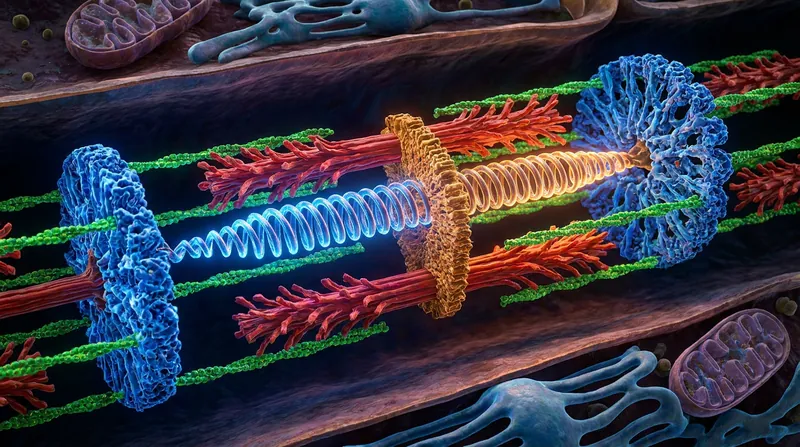
To understand exactly why the stretched position is so profoundly anabolic, one must look closely at the microscopic architecture of the muscle tissue itself. Muscle fibers are made up of thousands of sarcomeres, which are the basic contractile units responsible for generating force. When a muscle actively contracts to lift a weight, the actin and myosin filaments within the sarcomere slide past one another, generating what scientists call "active" mechanical tension.
However, when a muscle is stretched to its absolute limit under load, elastic elements within the tissue resist the pulling force, generating a secondary force known as "passive" mechanical tension. It is the combination of these two forces—active contraction fighting against the weight, and passive resistance fighting against the stretch—that creates an unparalleled hypertrophic stimulus.[3]
The primary driver of this passive mechanical tension is a giant, spring-like structural protein called titin, which spans the length of the sarcomere. As the muscle lengthens during the eccentric, or lowering, phase of an exercise, titin stretches much like a heavy-duty resistance band. When a lifter holds a heavy weight at the bottom of a deep dumbbell fly or the lowest point of a barbell squat, the titin molecules are pulled to their maximum safe length.
The combined force of the active actin-myosin contraction and titin's passive elastic resistance creates an unprecedented level of total mechanical tension across the entire muscle fiber. This structural tension is far greater than what the muscle experiences when it is fully shortened, explaining why the stretch position is uniquely capable of forcing the body to adapt and grow.[3][6]
This extreme mechanical tension does not just physically stress the muscle; it triggers a complex biological cascade known as mechanotransduction. Mechanosensitive structures within the muscle fiber, including costameres, integrins, and stretch-activated ion channels, physically detect the deformation and structural strain caused by the heavy stretch. These sensors then convert the physical mechanical signals into powerful biochemical signals inside the cell.
These signals activate intracellular pathways—most notably the mTORC1 pathway, along with FAK and MAPK—which act as the master regulators of muscle protein synthesis. By essentially translating the physical pull of the weight into a chemical command, mechanotransduction forces the body to synthesize new proteins and build thicker, stronger muscle fibers to survive the applied stress in the future.[2]
The real-world evidence for this stretch-mediated mechanism has completely upended traditional exercise selection and machine design. One landmark comparison in the fitness literature looked at hamstring training, specifically contrasting the lying leg curl machine with the seated leg curl machine. Because the hamstring muscles cross both the knee joint and the hip joint, sitting upright flexes the hip and places the hamstring in a much deeper stretch before the exercise even begins.
Studies consistently show that the seated variation yields significantly more muscle growth—sometimes up to three times as much—simply because the muscle is trained at a longer length. This revelation has prompted gym owners and equipment manufacturers to prioritize seated hamstring machines over their lying counterparts.[5]
The intense focus on the stretched position has also popularized a training technique known as "lengthened partials." In a highly publicized 2021 study, researchers found that subjects who performed only the bottom half of a preacher curl—lowering the weight fully but never bringing it all the way up to the top—experienced nearly three times as much muscle growth as those performing only the top half of the movement.
This data strongly suggests that the hardest, most stretched portion of the range of motion is disproportionately responsible for triggering hypertrophy. Consequently, many evidence-based lifters are now intentionally abandoning the top half of certain exercises, choosing instead to perform partial repetitions exclusively in the lengthened position to maximize mechanical tension and accelerate their muscle growth.[1][5]
The extreme end of this scientific frontier is currently being tested through intense, loaded stretching protocols that do not involve traditional repetitions at all. Drawing inspiration from animal models where high-volume, prolonged stretching induced massive increases in muscle mass, human trials have recently experimented with static stretching under load.
In one notable study, participants wore specially designed weighted "calf boots" that held their ankle in a deep, agonizing stretch for up to an hour a day. Remarkably, these static, loaded stretches produced hypertrophy comparable to, and in some cases exceeding, traditional dynamic resistance training. This proves definitively that mechanical tension derived from stretching alone is a potent growth stimulus, even in the complete absence of concentric muscle contractions.[1][2]
Despite the widespread excitement and rapid adoption by the fitness community, the biomechanics and sports science communities remain divided on the exact definition and physiological limits of stretch-mediated hypertrophy. Some researchers argue that true stretch-mediated hypertrophy only occurs when the body adds new sarcomeres in series—literally lengthening the muscle fascicle itself—a specific biological process called sarcomerogenesis.
Critics of the current hype suggest that this specific adaptation may plateau rapidly after a lifter's novice phase. They argue that advanced bodybuilders experiencing growth from deep stretches might simply be benefiting from standard active mechanical tension applied at longer lengths, rather than a unique, ongoing "stretch" adaptation that continuously adds new sarcomeres.[3]
Furthermore, the fitness industry's rush to optimize every single exercise for the ultimate stretch has led to some glaring misapplications on the gym floor. Not all muscles experience meaningful passive tension, and therefore, not all muscles benefit equally from stretch-focused training.
For a muscle to truly benefit from stretch-mediated hypertrophy, its anatomy must allow it to reach the descending limb of the length-tension curve before the joint's range of motion maxes out or bone hits bone. Trying to force a stretch-mediated response in muscles that anatomically cannot achieve it—such as certain heads of the triceps or the lateral deltoids in specific angles—often just leads to severe joint strain and connective tissue inflammation rather than accelerated muscle growth.[1][3][6]
Nevertheless, the practical applications of this emerging science are making resistance training significantly more efficient for the general public. Everyday lifters are swapping standard flat bench presses for deep deficit pushups or cambered bar presses, prioritizing Romanian deadlifts over standard back extensions, and allowing cable machines to pull them into deeper ranges of motion than ever before.
By integrating deep mobility work with heavy resistance training, athletes are simultaneously building larger, stronger muscles while actively expanding their functional range of motion. This dual benefit eliminates the need for separate, passive stretching routines, allowing lifters to improve their flexibility and their physique in a single, highly optimized training session.[4][5]
Ultimately, the massive shift toward stretch-mediated hypertrophy represents a rare and exciting moment where laboratory biomechanics and gym-floor culture have perfectly aligned to improve human performance. By proving that the most physically uncomfortable part of a repetition—the deep, loaded stretch—is also the most biologically productive, science has given lifters a clear, evidence-based roadmap to maximize their physical potential.
While the exact cellular mechanisms of sarcomerogenesis will continue to be debated in academic journals, the practical takeaway for the athlete is undeniable. Training muscles at long lengths under heavy load is the most efficient path to growth, ensuring that every drop of sweat in the gym translates directly into measurable results.[1][4][6]
Key terms
- Hypertrophy
- The enlargement of an organ or tissue from the increase in size of its cells; in fitness, the growth of muscle mass.
- Mechanical Tension
- The physical force exerted on muscle fibers when they contract against resistance or are stretched under a heavy load.
- Sarcomere
- The basic microscopic contractile unit of a muscle fiber, composed of actin and myosin filaments.
- Titin
- A giant, spring-like structural protein within the sarcomere that provides passive elastic resistance when a muscle is stretched.
- Mechanotransduction
- The biological process by which cells convert physical mechanical stimuli into chemical signals that trigger growth and adaptation.
- Sarcomerogenesis
- The creation of new sarcomeres in series, which physically lengthens the muscle fascicle in response to chronic stretching.
Frequently asked
What is stretch-mediated hypertrophy?
It is the enhanced muscle growth that occurs when a muscle is trained under heavy load in its most lengthened, stretched position.
Should I stop doing full range of motion exercises?
Not necessarily, but evidence suggests that spending more time in the stretched portion of the movement—such as doing lengthened partials—can significantly accelerate muscle growth.
Does this work for every muscle group?
No. Some muscles anatomically cannot reach a deep enough stretch to experience significant passive tension before the joint's range of motion maxes out.
What is the role of titin in muscle growth?
Titin is a giant elastic protein in the muscle that stretches like a rubber band, creating passive mechanical tension that signals the body to build more muscle.
Viewpoints in depth
Biomechanics Researchers
Focuses on the strict cellular mechanisms of muscle growth, specifically titin engagement and sarcomerogenesis.
This camp argues that the term 'stretch-mediated hypertrophy' is often misused by the general public. They maintain that true SMH only occurs when the muscle physically adds new sarcomeres in series to protect itself from extreme stretching. Because this specific adaptation may plateau after a few months of training, researchers caution that advanced lifters might just be experiencing standard mechanical tension rather than a unique stretch adaptation.
Evidence-Based Fitness Coaches
Prioritizes practical gym-floor applications, advocating for lengthened partials and deep stretches to maximize gains.
For evidence-based coaches and trainers, the exact cellular mechanism is less important than the macroscopic results. This camp heavily promotes 'lengthened partials' and redesigning exercise execution to spend maximum time in the stretched position. They point to MRI data and hypertrophy studies showing that the bottom half of a movement consistently outperforms the top half, arguing that traditional full-range-of-motion dogma is outdated and inefficient.
Traditional Bodybuilders
Relies on decades of anecdotal experience, prioritizing the 'pump', mind-muscle connection, and full range of motion.
While acknowledging the importance of a good stretch, traditionalists warn against abandoning the peak contraction entirely. This camp argues that metabolic stress—achieved by squeezing the muscle and flooding it with blood—still plays a crucial role in overall muscle development. They often express concern that hyper-focusing on heavy, lengthened partials increases the risk of joint and tendon injuries compared to smooth, controlled, full-range repetitions.
- Biomechanics Researchers
- Focus on the strict cellular mechanisms of muscle growth, specifically titin engagement and sarcomerogenesis.
- Evidence-Based Fitness Community
- Focus on practical application, advocating for lengthened partials and deep stretches to maximize gains.
- Editorial Synthesis
- Synthesizing the gap between laboratory science and gym-floor application to provide actionable takeaways.
Perspectives this story doesn't cover
- Physical therapists utilizing loaded stretching for injury rehabilitation.
- Casual gym-goers who are unaware of biomechanical optimization.
Sources
Source coverage
6 outlets
3 viewpoints surfaced





- [1]Built With ScienceEvidence-Based Fitness Community
Stretch Mediated Hypertrophy: What Our $40K MRI Study Reveals About Muscle Growth
Read on Built With Science → - [2]Sports Medicine (NIH)Biomechanics Researchers
Stretching-Induced Muscle Hypertrophy and Maximal Strength in Animals and Humans
Read on Sports Medicine (NIH) → - [3]Body Comp AcademyBiomechanics Researchers
Stretch-mediated hypertrophy: the evolution of a controversial term
Read on Body Comp Academy → - [4]Preprints.orgEvidence-Based Fitness Community
Optimizing Hypertrophy and Mobility Through Deep Stretch and Optimal Resistance Angles
Read on Preprints.org → - [5]Bulk NutrientsEvidence-Based Fitness Community
Can stretch-mediated hypertrophy grow me more muscle?
Read on Bulk Nutrients → - [6]Factlen Editorial TeamEditorial Synthesis
Synthesis by Factlen editorial team
Read on Factlen Editorial Team →

More in Fitness
See all →Hypertrophy Science
The New Science of Hypertrophy: Why 'Lengthened Partials' Are Changing How Bodybuilders Train
5 sources

Hypertrophy Science
The Science of Stretch-Mediated Hypertrophy: Why Training at Long Muscle Lengths Drives More Growth
3 sources

Supplement Safety
FDA Warns Bodybuilding Supplements Illegally Contain Steroids, Posing Risk of Severe Liver Injury
7 sources

Muscle Biology
The Molecular Switch for Muscle Growth: How the 'Titin' Protein Validates Stretch-Mediated Hypertrophy
5 sources
Comments
Every angle. Every day.
Get Fitness stories with full source coverage and perspective breakdowns, free every day.