
Open-Source AI Reaches Performance Parity, Unlocking Private, On-Premise Use for Schools and Hospitals
A wave of powerful open-source AI models in mid-2026 has closed the performance gap with proprietary systems, allowing highly regulated sectors to run frontier-level AI locally without compromising data privacy.
By Factlen Editorial Team
- Open-Source Developers
- Argue that open weights drive faster innovation, lower costs, and prevent monopolistic control of artificial intelligence.
- Privacy & Public Sector Leaders
- Focus on the legal and ethical necessity of keeping sensitive data on-premise to comply with regulations like HIPAA and FERPA.
- Commercial AI Providers
- Emphasize that while open-source is catching up in raw benchmarks, closed ecosystems offer better reliability, safety guardrails, and seamless product integration at massive scale.
What's not represented
- · Hardware Manufacturers
- · Cybersecurity Auditors
Why this matters
By running AI directly on local hardware, schools, hospitals, and businesses can now use top-tier artificial intelligence without sending sensitive student or patient data to third-party cloud servers, fundamentally solving the technology's biggest privacy hurdle.
Key points
- Open-source AI models have officially matched the performance of proprietary models on major industry benchmarks.
- Schools and hospitals can now run frontier-level AI locally, ensuring sensitive data never leaves their networks.
- Local deployment solves major compliance hurdles related to privacy laws like HIPAA and FERPA.
- Operating open-source models locally costs significantly less than paying for premium cloud API calls.
- Hardware efficiency improvements allow powerful models to run on standard consumer graphics cards.
In mid-2026, the artificial intelligence industry crossed a threshold that many analysts believed was still years away: open-source and open-weight models have officially closed the performance gap with proprietary giants. For the past three years, the AI landscape was dominated by closed-source models from companies like OpenAI, Google, and Anthropic, which required users to send their data to external cloud servers [2]. However, a flurry of releases in the spring and summer of 2026 has fundamentally altered the balance of power, bringing frontier-level capabilities directly to consumer hardware [4].[2][4]
The shift is being driven by a new generation of highly efficient, publicly available models. Meta’s Llama 3.1 405B flagship model has achieved historic milestones by matching or beating premium closed models on rigorous industry benchmarks [4]. Simultaneously, models like DeepSeek V4 Pro and Qwen 3.7 Max have pushed the boundaries of coding, reasoning, and multilingual processing, proving that open-source development can iterate just as rapidly as heavily funded corporate labs [1]. The gap between open and closed systems on everyday enterprise tasks has shrunk to single-digit percentage points [1].[1][4]
For everyday consumers, this parity means access to cheaper, highly capable tools. But for highly regulated sectors like K-12 education, healthcare, and finance, it represents a profound paradigm shift in data privacy. Every time a student or doctor interacts with a cloud-based AI tool, sensitive data—including the context of the conversation and metadata—leaves the organization's secure network [3]. Under regulations like the Family Educational Rights and Privacy Act (FERPA) and the Health Insurance Portability and Accountability Act (HIPAA), institutions carry the burden of protecting that data once it is transmitted [3].[3]

Open-source models solve this regulatory nightmare through localized deployment. Because the model weights are publicly available, organizations can run the AI entirely on their own internal servers or local workstations [2]. When an AI model runs on district-owned or hospital-owned hardware, data privacy is no longer reliant on a vendor's terms of service; it is guaranteed by the physical architecture of the network [3]. The data simply never leaves the building.[2][3]
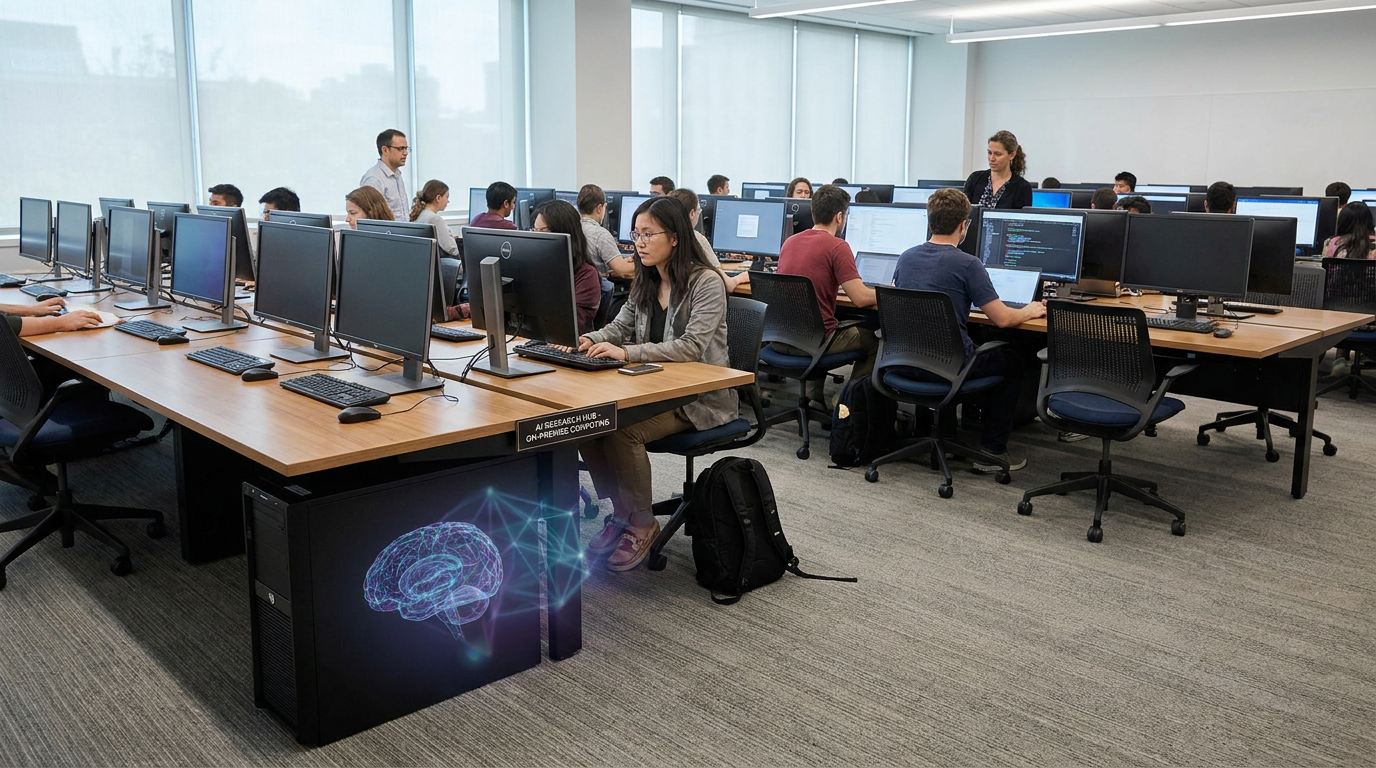
This localized approach is becoming increasingly accessible due to rapid advancements in hardware efficiency. Models that previously required massive, multi-million-dollar server farms can now run on standard enterprise equipment. For example, Google's Gemma 4 12B model can execute complex multimodal tasks on a consumer-grade graphics card with just 8GB of VRAM—the exact type of hardware already present in many school district computer labs and hospital radiology departments [3]. This hardware democratization allows institutions to deploy AI without massive capital expenditures.[3]
This localized approach is becoming increasingly accessible due to rapid advancements in hardware efficiency.
The financial economics of AI have also flipped dramatically in favor of open-source adoption. Operating open-source models locally or through dedicated cloud providers often costs four to ten times less than paying for premium API calls from proprietary vendors [1]. For school districts and public hospitals operating on strict budgets, this cost reduction transforms AI from an expensive, metered luxury into a predictable, flat-rate utility that can be scaled across the entire organization without fear of unpredictable monthly bills [3].[1][3]

The open-source victory extends beyond text generation into voice and multimodal applications. In recent blind tests evaluating AI voice generation, 64 percent of listeners preferred the output of a free, open-source model running on local hardware over a commercial alternative that costs $22 per month [3]. This democratization of multimodal capabilities allows developers to build complex, context-aware systems—such as localized medical transcription tools or personalized tutoring agents—entirely within their own secure infrastructure [5].[3][5]
The developer ecosystem has rapidly adapted to support this transition. Tools like Ollama now allow developers to expose local open-source models through standard API endpoints, meaning applications originally built for proprietary cloud models can be redirected to local, private AI with a single line of code [2]. Furthermore, new hardware accelerators and sparse attention mechanisms are allowing developers to train and fine-tune these models locally, bypassing traditional dependencies on massive cloud providers [5].[2][5]

Commercial AI providers are acutely aware of the shifting landscape. OpenAI CEO Sam Altman recently acknowledged the competitive threat posed by the rapid advancement of alternative models, noting that the company must act quickly when such threats emerge [6]. To maintain their market position, proprietary vendors are increasingly focusing on building superior integrated product ecosystems and deploying massive infrastructure to serve AI at an unprecedented scale, rather than relying solely on the raw capability of their base models [6].[6]
As 2026 progresses, the narrative within the technology sector has decisively shifted. The question is no longer when open-source AI will catch up, but rather how proprietary models will justify their premium pricing and data-collection requirements [2]. For hospitals, schools, and privacy-conscious enterprises, the maturation of open-source AI means the technology is finally becoming a secure, owned asset, paving the way for widespread institutional adoption without the looming specter of data breaches or vendor lock-in.[2]
How we got here
2022
BLOOM is released, marking the first serious community-trained large language model.
2023
Meta's LLaMA weights leak to the public, inadvertently seeding the open-source fine-tuning era.
2024
Mistral and Mixtral prove that smaller, open models can punch above their weight class against larger proprietary systems.
2025
Llama 3 and DeepSeek V3 significantly narrow the gap with frontier models on complex reasoning tasks.
Mid-2026
Open-source models officially achieve benchmark parity, unlocking widespread enterprise and local deployment.
Viewpoints in depth
Open-Source Developers
Argue that open weights drive faster innovation, lower costs, and prevent monopolistic control of artificial intelligence.
The developer community views the 2026 parity milestone as validation that decentralized innovation can outpace closed corporate labs. By making model weights publicly available, developers argue that the entire industry benefits from rapid, community-driven fine-tuning and optimization. They emphasize that open-source AI prevents a future where a handful of massive tech companies act as gatekeepers to the world's most important foundational technology, while simultaneously driving down the cost of compute for startups and independent creators.
Privacy & Public Sector Leaders
Focus on the legal and ethical necessity of keeping sensitive data on-premise to comply with regulations like HIPAA and FERPA.
For administrators in healthcare and education, the appeal of open-source AI is entirely about data sovereignty. Public sector leaders argue that relying on cloud-based AI for patient diagnostics or student tutoring is a regulatory minefield, as it requires trusting third-party vendors with highly sensitive, legally protected information. By deploying AI locally on owned hardware, these leaders can harness the productivity benefits of artificial intelligence without violating strict privacy laws or exposing their institutions to catastrophic data breaches.
Commercial AI Providers
Emphasize that while open-source is catching up in raw benchmarks, closed ecosystems offer better reliability, safety guardrails, and seamless product integration at massive scale.
Proprietary AI companies acknowledge the rapid advancement of open-source models but maintain that raw benchmark scores do not tell the whole story. They argue that closed ecosystems provide superior safety guardrails, enterprise-grade reliability, and seamless integration across massive product suites. Commercial providers emphasize that building and maintaining the infrastructure required to serve AI to hundreds of millions of users simultaneously is a challenge that open-source models alone cannot solve, justifying the premium cost of their managed services.
What we don't know
- How proprietary AI companies will adjust their pricing models to compete with free open-source alternatives.
- Whether future regulatory frameworks will attempt to restrict the distribution of open-weight models.
- How quickly legacy institutions like public schools will actually adopt and implement local AI hardware.
Key terms
- Open-source AI
- Artificial intelligence models whose underlying parameters (weights) are publicly available for anyone to download, modify, and run.
- Local deployment (On-premise)
- Running software or AI models directly on an organization's own physical computers rather than relying on internet-connected cloud servers.
- VRAM (Video RAM)
- Specialized memory on a graphics card that is crucial for loading and running large AI models efficiently.
- Inference
- The process of a trained AI model generating an answer or prediction based on new user input.
- Proprietary models
- Closed-source AI systems owned by a single company, typically accessed only via paid cloud services.
Frequently asked
What does open-source AI mean?
It means the underlying code and mathematical weights of the AI model are publicly available, allowing anyone to download, modify, and run the system on their own hardware.
Why is local AI better for privacy?
When an AI model runs locally on a school or hospital's own computers, the data entered into the system never travels over the internet to a third-party cloud server, ensuring complete data privacy.
Do I need a supercomputer to run these models?
No. Recent efficiency breakthroughs allow highly capable models to run on standard consumer graphics cards with as little as 8GB of VRAM.
Are open-source models as smart as ChatGPT?
As of mid-2026, the top open-source models have achieved performance parity with leading proprietary models on most major industry benchmarks.
Sources
Source coverage
6 outlets
3 viewpoints surfaced






[1]TaskadeOpen-Source Developers
The nine open-source AI LLMs that ship real work in 2026, ranked
Read on Taskade →[2]Towards AIOpen-Source Developers
Beyond GPT: The Rise of Open Source AI
Read on Towards AI →[3]IBL NewsPrivacy & Public Sector Leaders
The Blind Test That Changed Everything: Open-Source AI in K-12
Read on IBL News →[4]AI Automation HacksOpen-Source Developers
Best Open Source AI Models in 2026: Llama, Mistral & Beyond
Read on AI Automation Hacks →[5]DevFlokersOpen-Source Developers
Open Source AI Projects and Releases: June 2026
Read on DevFlokers →[6]Yahoo NewsCommercial AI Providers
OpenAI boss Sam Altman predicts next big AI breakthrough
Read on Yahoo News →




Every angle. Every day.
Get ai stories with full source coverage and perspective breakdowns delivered to your inbox.