
Explainer: How Local AI and NPUs Are Untethering Computing from the Cloud
The era of relying exclusively on cloud servers for artificial intelligence is ending. Thanks to specialized NPU chips and compact models, powerful AI is now running directly on personal laptops—offering unprecedented privacy, zero subscription costs, and offline capabilities.
By Factlen Editorial Team
- Privacy Advocates
- Value keeping sensitive data entirely on-device without third-party cloud exposure.
- Hardware Ecosystems
- Focus on integrating NPUs and proprietary local AI into OS experiences.
- Open-Source Builders
- Champion free, decentralized tools to democratize AI access.
What's not represented
- · Cloud Infrastructure Providers
- · Environmental Sustainability Analysts
Why this matters
Running AI locally gives you complete ownership of your data and eliminates the need for expensive monthly subscriptions. It allows professionals to use AI on sensitive medical, legal, or corporate documents without violating privacy laws by sending data to third-party servers.
Key points
- On-device AI allows laptops and phones to run language models locally without an internet connection.
- Neural Processing Units (NPUs) are specialized chips that process AI math efficiently without draining battery life.
- Small Language Models (SLMs) are compact enough to fit in 8GB to 16GB of laptop memory.
- Local processing ensures sensitive personal and corporate data never leaves the device.
- Open-source tools like Ollama and LM Studio have made running local AI accessible to everyday users.
For the first three years of the generative AI boom, the technology was fundamentally tethered to the cloud. Every time you asked a chatbot to draft an email, summarize a PDF, or write code, your prompt traveled to a massive data center, processed on industrial-grade servers, and beamed back to your screen. But in 2026, a quiet hardware revolution is untethering artificial intelligence from the internet.[7]
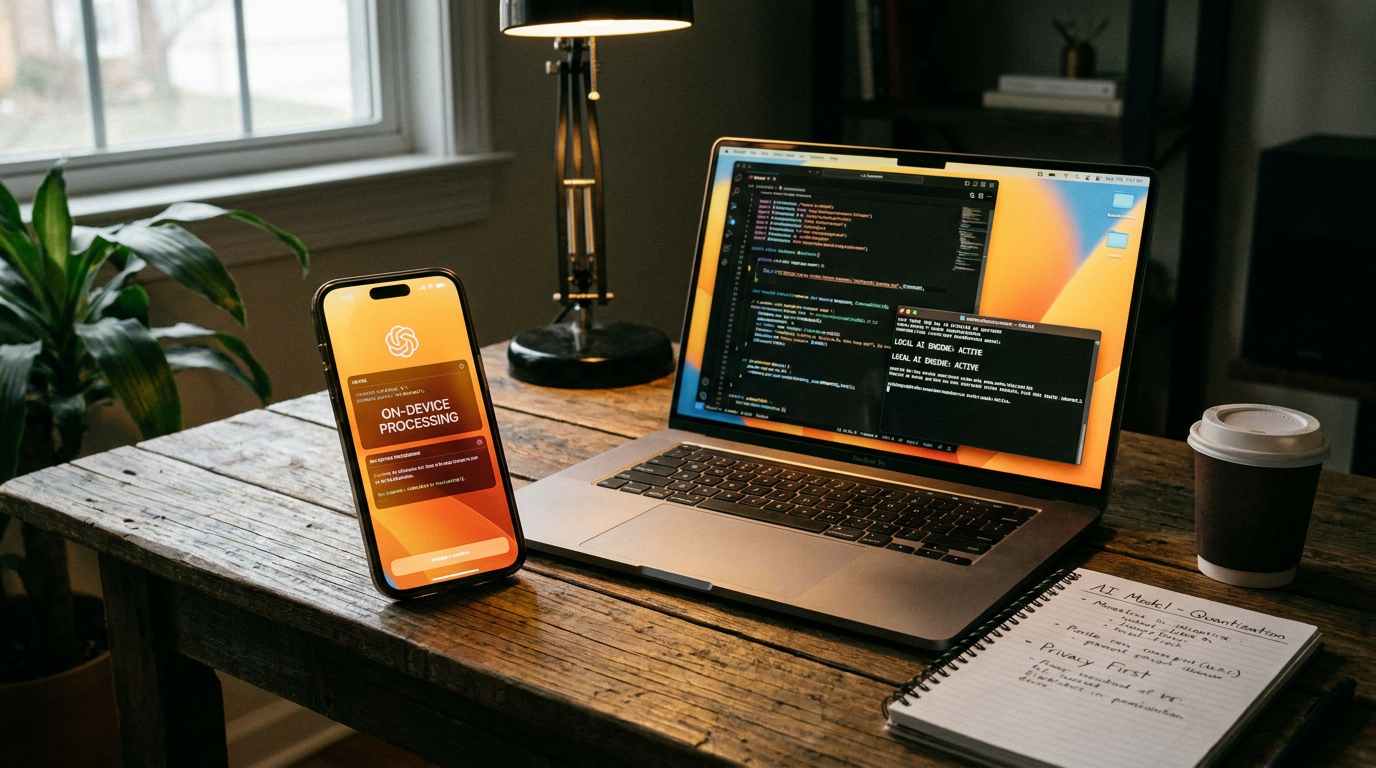
The industry calls it "on-device AI" or "local inference." It is the ability to run highly capable language models directly on your laptop or smartphone's silicon. When AI runs locally, no data leaves the device, no subscription fees are paid to cloud providers, and no internet connection is required. It is a fundamental shift in how computing power is distributed.[1][7]
This transition is being driven by a specialized piece of hardware: the Neural Processing Unit (NPU). For decades, consumer computers relied on a binary system of processors. The CPU handled general, sequential tasks, while the GPU handled graphics and parallel rendering. Today, the NPU has emerged as the third pillar of personal computing.[3]
NPUs are application-specific integrated circuits (ASICs) crafted exclusively for the complex, low-precision mathematics required by neural networks. While a traditional CPU can technically run an AI model, it does so slowly and drains the battery rapidly. An NPU optimizes these specific calculations, allowing a laptop to process AI workloads locally while maintaining all-day battery life.[3]

Microsoft formalized this hardware shift with its "Copilot+ PC" certification. To qualify, a Windows laptop must include an NPU capable of at least 40 TOPS (Trillion Operations Per Second). This high baseline ensures the device has the raw computational throughput to handle real-time AI features—like live translation or semantic search—without stuttering or relying on the cloud.[4]
Apple has taken a parallel approach, having laid the groundwork for years with the Neural Engine built into its M-series Apple Silicon chips. The company's Apple Intelligence platform leverages this hardware to run models locally for everyday tasks, keeping personal context—like reading your messages to summarize your schedule—strictly on the device where it cannot be intercepted.[2]
Apple has taken a parallel approach, having laid the groundwork for years with the Neural Engine built into its M-series Apple Silicon chips.
But hardware is only half the equation. You cannot fit a massive frontier model like GPT-4, which requires clusters of enterprise servers, onto a consumer laptop. The software solution is the Small Language Model (SLM).[1]
SLMs—such as Meta's Llama 3 8B, Google's Gemma, or Microsoft's Phi-3—are highly optimized neural networks. By training on meticulously curated, high-quality data rather than the entire unfiltered internet, these compact models punch far above their weight. They can match the performance of 2023-era cloud models while fitting comfortably within 8GB or 16GB of unified memory.[1][7]

While Apple and Microsoft are building local AI directly into their operating systems, a vibrant open-source ecosystem has democratized access for everyone else. Tools like Ollama and LM Studio have transformed the highly technical process of running local models into an experience as simple as installing a standard desktop application.[6]
Ollama operates as a streamlined tool that downloads and runs open-weight models with a single command, while LM Studio provides a clean graphical interface. Both allow users to swap between different AI models instantly, effectively turning a standard Mac or PC into a private, offline AI server that developers can plug their own applications into.[6]

The greatest catalyst for this local AI adoption is privacy. For medical professionals handling patient records, lawyers reviewing case files, or enterprise developers writing proprietary code, sending sensitive data to a third-party cloud API is often a regulatory or corporate non-starter. On-device AI solves this by ensuring the data never leaves the machine.[1][5]
However, cybersecurity experts warn that "local" does not automatically mean "secure." While prompts stay off external servers, users must still configure their environments properly. This includes disabling telemetry in inference tools, verifying that model files are downloaded from trusted sources, and ensuring local APIs are not accidentally exposed to public networks.[5]
The industry is not abandoning the cloud entirely; rather, it is moving toward a hybrid architecture. Apple's system, for instance, processes standard requests locally but seamlessly routes highly complex queries to "Private Cloud Compute"—a secure, verifiable server environment—when the on-device chip reaches its limits.[2]
Ultimately, the shift from cloud LLMs to edge SLMs is more than just a performance optimization. It represents a transfer of power back to the user. By bringing artificial intelligence processing to the endpoint, consumers and professionals are regaining control over their data, their privacy, and their computing autonomy.[7]
How we got here
Late 2023
Open-source developers begin successfully running compressed AI models on consumer MacBooks using unified memory.
Mid 2024
Microsoft introduces the Copilot+ PC standard, mandating NPUs with at least 40 TOPS for local AI processing.
Late 2024
Apple rolls out Apple Intelligence, utilizing on-device processing for privacy-first AI features.
2025–2026
Highly capable Small Language Models (SLMs) become widely available, matching the performance of earlier cloud models.
Viewpoints in depth
Privacy Advocates
Prioritize data sovereignty and keeping sensitive information off third-party servers.
For privacy advocates and enterprise compliance officers, on-device AI is the only viable path forward for widespread AI adoption. They argue that sending medical records, legal documents, or proprietary corporate code to cloud APIs poses unacceptable security risks. By processing data locally, organizations can leverage generative AI without violating GDPR, HIPAA, or internal data governance policies.
Hardware Ecosystems
Focus on integrating specialized chips into seamless consumer operating systems.
Companies like Apple and Microsoft view local AI as a core OS feature rather than a standalone tool. Their strategy relies on deep vertical integration—pairing proprietary NPUs with built-in small language models to power everyday features like semantic search, live transcription, and text summarization. They argue that the best AI is invisible, working quietly in the background to enhance the user experience without requiring technical setup.
Open-Source Builders
Champion free, decentralized tools to democratize AI access for developers.
The open-source community sees local AI as a rebellion against the subscription models of major tech giants. By building tools like Ollama and LM Studio, they aim to make powerful AI accessible to anyone with a decent consumer laptop. This camp values transparency, model customization, and the ability to run AI entirely offline, ensuring that the future of computing is not gatekept by a few massive cloud providers.
What we don't know
- Whether small local models will ever be able to match the complex reasoning capabilities of massive cloud-based frontier models.
- How quickly software developers will update legacy applications to take full advantage of new NPU hardware.
- The long-term impact of continuous local AI processing on laptop battery degradation.
Key terms
- NPU (Neural Processing Unit)
- A specialized hardware chip designed specifically to accelerate the complex math required for artificial intelligence tasks.
- SLM (Small Language Model)
- A compact AI model optimized to run efficiently on consumer hardware rather than requiring massive data center servers.
- TOPS (Trillion Operations Per Second)
- A metric used to measure the performance and processing power of an NPU.
- Inference
- The process of an AI model generating a response, prediction, or output based on a user's prompt.
- Unified Memory
- A memory architecture where the CPU, GPU, and NPU share the same pool of RAM, which is crucial for loading large AI models efficiently.
Frequently asked
What is an NPU and why do I need one?
An NPU is a specialized chip designed to handle AI tasks. While older laptops can run AI on their CPUs, an NPU does it much faster and uses significantly less battery power.
Can I run local AI on my current laptop?
Yes, if you have enough memory. You generally need at least 8GB to 16GB of RAM to run a small language model, though an NPU will make the experience much smoother.
Is Apple Intelligence fully on-device?
Mostly. It processes everyday tasks locally on your device, but seamlessly routes highly complex requests to Apple's secure Private Cloud Compute servers when more power is needed.
Do I need the internet to use local AI?
No. Once you download the model file and the software (like LM Studio or Ollama) to your device, the AI runs entirely offline.
Sources
Source coverage
7 outlets
3 viewpoints surfaced







[1]Computer WeeklyPrivacy Advocates
The attraction of AI-capable PCs
Read on Computer Weekly →[2]TechTalksHardware Ecosystems
Apple Intelligence vs Copilot+ PCs
Read on TechTalks →[3]MarkTechPost
NPU (Neural Processing Unit): The On-device AI Specialist
Read on MarkTechPost →[4]Signal65Hardware Ecosystems
Copilot+ PCs vs. MacBook Air in the AI Era
Read on Signal65 →[5]PromptQuorumPrivacy Advocates
How to Run Local LLMs on a Laptop Securely
Read on PromptQuorum →[6]DataCampOpen-Source Builders
How to Run Llama 3 Locally With Ollama and LM Studio
Read on DataCamp →[7]Factlen Editorial Team
Synthesis by Factlen editorial team
Read on Factlen Editorial Team →
Every angle. Every day.
Get ai stories with full source coverage and perspective breakdowns delivered to your inbox.