
The Science of Umami: How to Build Deep Flavor in Plant-Based Cooking
Understanding the chemistry of glutamates and nucleotides can transform vegetarian cooking from flat to deeply satisfying. By leveraging specific ingredients and techniques, home cooks can unlock the savory "fifth taste" without relying on meat.
By Factlen Editorial Team
- Plant-Based Chefs
- Emphasize practical techniques like roasting, fermenting, and layering ingredients to create satisfying, meat-free meals.
- Culinary Scientists
- Focus on the chemical reactions, receptor biology, and the synergistic effects of glutamates and nucleotides.
- Public Health Dietitians
- Value umami as a tool to reduce reliance on added sodium and saturated fats while maintaining palatability.
What's not represented
- · Traditional Meat-Centric Chefs
- · Industrial Food Manufacturers
Why this matters
Mastering umami allows home cooks to create deeply satisfying, complex meals without relying on heavy fats, excess salt, or meat. Understanding this flavor science empowers anyone to elevate their everyday cooking and make plant-based eating more sustainable and enjoyable.
Key points
- Umami, the fifth basic taste, is the biological perception of glutamic acid, an amino acid found in many foods.
- Plant-based cooking can achieve deep savory flavors by utilizing ingredients like tomatoes, mushrooms, seaweed, and fermented soy.
- Combining glutamate-rich foods with nucleotide-rich foods creates 'umami synergy,' multiplying the savory sensation exponentially.
- Techniques like roasting, slow-simmering, and fermenting break down proteins into free amino acids, naturally boosting a dish's umami profile.
Plant-based cooking often carries an unfair reputation for tasting "hollow" or feeling like it is missing a crucial element. For decades, home cooks attempted to fill that void by adding more salt, butter, or oil, hoping to replicate the deep satisfaction of a meat-centric dish. But the missing element usually isn't fat or sodium at all—it is umami, the biological signal that tells our brains we are eating something deeply savory and protein-rich.[1]
Discovered in 1908 by Japanese chemist Kikunae Ikeda, umami translates roughly from Japanese to "pleasant savory taste." It is officially recognized as the fifth basic taste, joining sweet, sour, salty, and bitter. Unlike the other four tastes, which announce themselves immediately, umami is characterized by a lingering, mouth-coating sensation that practically demands another bite.[4]
The mechanism behind this sensation is pure chemistry. Umami is the human taste perception of glutamic acid, an amino acid that serves as a fundamental building block of proteins in many foods. When proteins break down—through cooking, aging, or fermentation—they release "free glutamate." This free glutamate binds to specific, specialized receptors on the human tongue, known scientifically as the T1R1 and T1R3 receptor complexes.[3][4]
When these receptors are activated, they send a powerful evolutionary signal to the brain indicating the presence of nutrient-dense food. The brain responds by triggering the release of saliva and digestive juices, which facilitates smooth digestion and creates that characteristic mouthwatering effect. This biological reward system is why humans inherently crave super-savory foods.[4]

The challenge in plant-based cooking is that animal muscle is naturally rich in free glutamates and other umami compounds, which is why a simply seared steak tastes inherently savory with very little effort. To replicate this depth without animal products, cooks cannot rely on a single ingredient; they must intentionally layer plant-based umami sources to build a complex flavor profile from the ground up.[5]
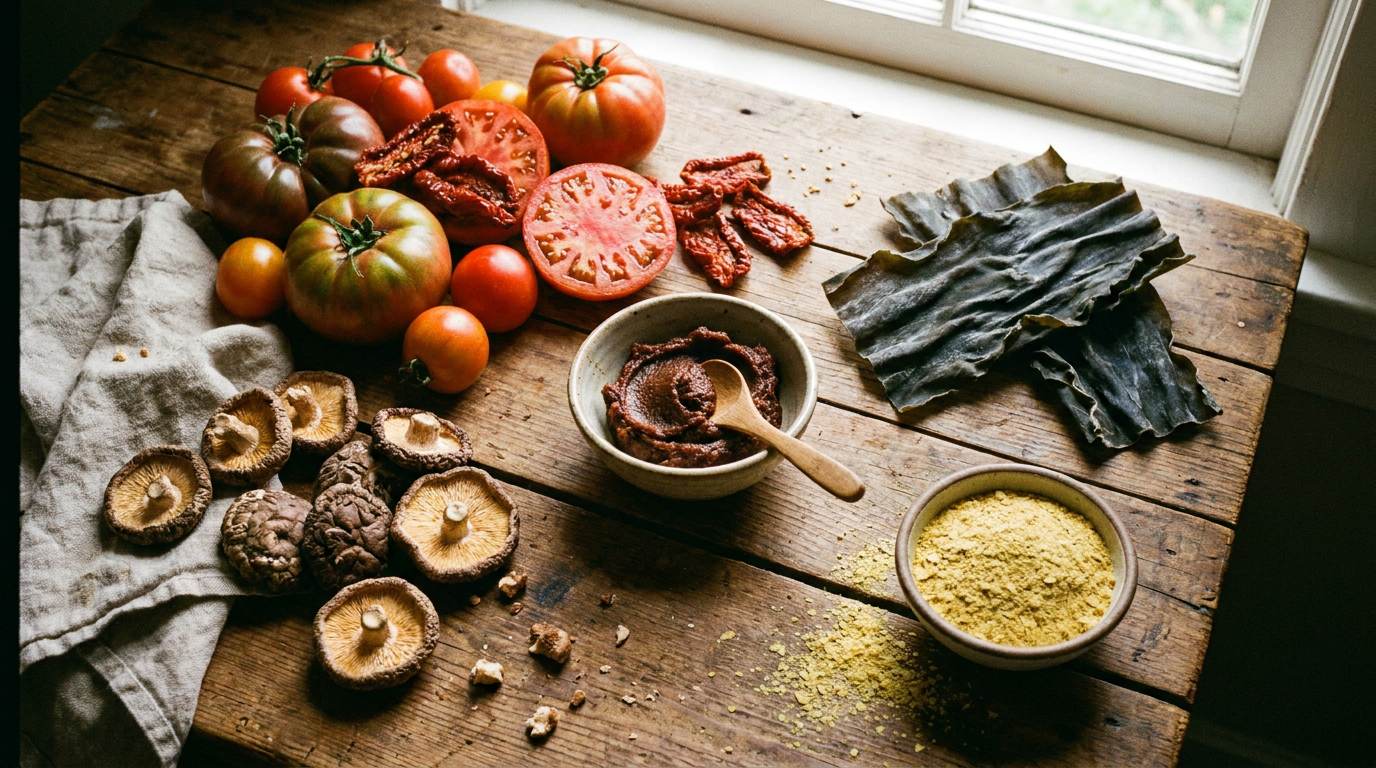
Fortunately, the plant kingdom is abundant in natural glutamates. Tomatoes are a culinary powerhouse in this regard, especially when they are fully ripened, roasted, or concentrated into a dense paste. Mushrooms, particularly varieties like shiitake and porcini, are also incredibly dense in glutamates, making them a foundational ingredient in savory vegetarian broths and stews.[1][2]
Fermentation acts as a natural flavor amplifier. The fermentation process relies on microbes to break down complex proteins into free amino acids, creating a massive, natural source of glutamic acid. This is why fermented soy products like miso paste, tamari, and traditional soy sauce are widely considered "umami bombs" that can instantly elevate a flat-tasting soup or glaze.[2][6]
Other essential pantry staples include nutritional yeast and sea vegetables. Nutritional yeast provides a cheesy, nutty profile that is packed with glutamates, making it a favorite for vegan pastas and sauces. Seaweeds, particularly kombu, are so rich in the compound that they were the original source Professor Ikeda used to isolate and identify umami over a century ago.[1][5]
Other essential pantry staples include nutritional yeast and sea vegetables.
While glutamate alone is powerful, food scientists have discovered a secret weapon: umami synergy. Combining glutamate with specific ribonucleotides—namely inosinate and guanylate—does not just add to the savory sensation; it multiplies it exponentially. This synergistic effect explains why certain classic flavor pairings taste so universally profound.[3][4]
In plant-based cooking, mastering this synergy is transformative. While inosinate is mostly found in meat and fish, guanylate is highly abundant in dried mushrooms. Combining a glutamate-rich ingredient, such as kombu or tomato paste, with a guanylate-rich ingredient, like dried shiitakes, creates a flavor explosion that is biologically far greater than the sum of its individual parts.[5]

Unlocking umami is not just about selecting the right ingredients; it is about applying the right chemistry through cooking techniques. Heat and time are required to denature proteins. Roasting vegetables like tomatoes, onions, or carrots caramelizes their natural sugars, evaporates water to concentrate flavors, and frees up bound glutamates.[2]
Slow cooking and reduction are equally critical. Simmering a vegetable stock slowly allows time for complex flavor compounds to develop. Furthermore, deglazing a pan—using a splash of wine or broth to scrape up the browned, denatured proteins left behind after sautéing—ensures that none of those hard-earned, highly concentrated umami compounds are left behind in the skillet.[2][7]

While umami provides the savory taste, sensory scientists are increasingly studying a related phenomenon called "kokumi." Translating roughly to "mouthfulness" or "richness," kokumi is not a distinct taste itself. Rather, it is a sensation that magnifies and lengthens the experience of umami, sweet, and salty flavors, providing a perception of thickness and depth.[6]
Developing kokumi is essential for making vegan dishes feel truly satisfying. Slow-simmering stocks, aging ingredients, and incorporating fermented products help develop these kokumi compounds. This is what gives a properly executed plant-based ramen broth the rounded, lip-smacking mouthfeel that is traditionally associated with collagen-heavy bone broths.[6]
Beyond culinary pleasure, leveraging umami is a highly effective strategy for public health. Because umami provides a well-seasoned, deeply satisfying sensation, it allows cooks to significantly reduce the amount of added sodium and saturated fat in a recipe. A dish rich in natural glutamates requires far less salt to taste complete.[1][3]

This science also helps dispel the long-standing misconception surrounding MSG. Monosodium glutamate is simply the sodium salt of glutamic acid. Despite facing decades of unwarranted stigma, extensive scientific consensus confirms it is safe. At a molecular level, the glutamate in MSG is biologically indistinguishable from the glutamate found naturally in a ripe tomato or a block of parmesan cheese.[1][3]
While the basic mechanics of the T1R1 and T1R3 receptors are now well understood, the frontier of flavor science continues to expand. Researchers are currently mapping exactly how umami interacts with our olfactory system to create complex aromas, and how umami receptors located in the gut microbiome help signal satiety and regulate human appetite.[3][7]
Ultimately, mastering umami transforms plant-based cooking from a restrictive exercise into a distinct culinary advantage. By understanding the underlying chemistry of glutamates, nucleotides, and heat, any home cook can build deep, resonant flavors that satisfy the human palate on a fundamental, biological level.[7]
How we got here
1908
Japanese chemist Kikunae Ikeda identifies glutamate as the source of the savory taste in kombu broth, naming it 'umami'.
1913
Shintaro Kodama discovers that the ribonucleotide inosinate also contributes to umami flavor.
1957
Akira Kuninaka identifies guanylate in shiitake mushrooms as an umami compound and discovers the phenomenon of umami synergy.
2002
Scientists officially identify the specific taste receptors (T1R1 and T1R3) on the human tongue dedicated to detecting umami.
Viewpoints in depth
The Culinary Science View
Flavor is a chemical equation that can be manipulated and multiplied.
For food scientists and sensory researchers, cooking is applied chemistry. They view umami not just as a subjective experience, but as a measurable interaction between specific amino acids (glutamates), ribonucleotides (inosinate and guanylate), and the T1R1/T1R3 receptors on the tongue. By understanding the exact molecular makeup of ingredients, scientists argue that cooks can mathematically multiply flavor—such as pairing the glutamates in kombu with the guanylates in dried mushrooms to trigger an exponential receptor response known as umami synergy.
The Plant-Based Chef's View
Technique and layering are the keys to replacing the inherent savoriness of meat.
Chefs focused on vegan and vegetarian cuisine approach umami as a structural necessity. Without the naturally occurring glutamates found in animal proteins, plant-based dishes can taste hollow or flat. These culinary professionals emphasize time and technique—roasting, dehydrating, fermenting, and slow-simmering—to break down plant proteins into free amino acids. They advocate for building a 'pantry of umami bombs,' relying heavily on tomato paste, miso, nutritional yeast, and soy sauce to layer depth into every stage of the cooking process.
The Public Health View
Umami is a strategic tool for healthier eating without sacrificing taste.
Dietitians and public health advocates view umami through the lens of nutritional compliance. A major hurdle in transitioning populations to heart-healthy, plant-forward diets is the perception that the food lacks flavor, leading people to overcompensate with salt and saturated fat. Because umami triggers salivation and provides a perception of richness and seasoning, health professionals promote umami-rich ingredients as a way to naturally lower sodium intake and make whole-food, plant-based diets more sustainable and satisfying for the general public.
What we don't know
- The exact biological mechanisms behind 'kokumi'—the sensation of richness and mouthfeel—are still being mapped by sensory scientists.
- How the gut microbiome interacts with umami receptors in the digestive tract to signal satiety and regulate appetite remains an active area of research.
Key terms
- Glutamate
- An amino acid found naturally in many foods that, when freed from its protein structure, triggers the umami taste on the tongue.
- Nucleotides
- Compounds like inosinate and guanylate that, while having little umami flavor on their own, exponentially amplify the savory taste when combined with glutamate.
- Umami Synergy
- The scientific phenomenon where combining glutamate-rich foods with nucleotide-rich foods multiplies the overall savory flavor.
- Kokumi
- A Japanese sensory term translating to 'mouthfulness' or 'richness,' describing a sensation that enhances and prolongs other flavors.
- Denaturation
- The process of altering a protein's natural structure through heat, acid, or fermentation, which helps release free amino acids like glutamate.
Frequently asked
Is umami the same thing as MSG?
MSG (monosodium glutamate) is simply the sodium salt of glutamic acid. It is a pure, isolated form of the exact same umami compound that occurs naturally in tomatoes, mushrooms, and parmesan cheese.
Why do dried mushrooms have more umami than fresh ones?
The drying process breaks down the mushroom's proteins, releasing more free glutamates and guanylate nucleotides, which concentrates and intensifies their savory flavor.
Can you get enough umami without eating meat?
Yes. While meat is naturally high in umami compounds, the plant kingdom is filled with umami-rich ingredients like tomatoes, seaweed, fermented soy products, and nutritional yeast.
Why does roasting vegetables make them taste better?
Roasting removes water to concentrate flavors, caramelizes natural sugars, and breaks down proteins into free amino acids, significantly increasing the vegetable's umami profile.
Sources
Source coverage
7 outlets
3 viewpoints surfaced






[1]Forks Over KnivesPublic Health Dietitians
Why Umami Is Important in WFPB Cooking
Read on Forks Over Knives →[2]Le Cordon BleuPlant-Based Chefs
Mastering Umami Without Meat: Plant-Based Flavour-Building Techniques
Read on Le Cordon Bleu →[3]Academy of Nutrition and DieteticsCulinary Scientists
Umami: The Fifth Basic Taste
Read on Academy of Nutrition and Dietetics →[4]Umami Information CenterCulinary Scientists
What is Umami?
Read on Umami Information Center →[5]Delish KnowledgePlant-Based Chefs
Plant-Based Umami: How to Create Delicious Vegan Recipes
Read on Delish Knowledge →[6]Vegan AcademyPlant-Based Chefs
Umami and Kokumi: The Secret to Satisfying Plant-Based Meals
Read on Vegan Academy →[7]Factlen Editorial TeamPublic Health Dietitians
Synthesis by Factlen editorial team
Read on Factlen Editorial Team →


Every angle. Every day.
Get food drink stories with full source coverage and perspective breakdowns delivered to your inbox.