
The 2026 Guide to Buying a Lab-Grown Diamond: Prices, Processes, and Pitfalls
After an 85% price drop over the last five years, the lab-grown diamond market has stabilized in 2026. Here is how to navigate the new grading rules, growth methods, and pricing realities.
By Factlen Editorial Team
- Value-Conscious Shoppers
- Prioritize maximum visual size, ethical sourcing claims, and budget efficiency over geological rarity.
- Traditional Jewelers
- Emphasize the long-term investment value, resale retention, and inherent geological romance of mined stones.
- Gemological Authorities
- Focus on scientific grading, market disclosure, and establishing distinct evaluation frameworks for manufactured versus natural stones.
- Lab-Grown Manufacturers
- Highlight the technological triumph of CVD and HPHT efficiency, arguing that chemical identity is the only metric that matters.
What's not represented
- · Pawn shops and secondary market buyers
- · Natural diamond mining communities
Why this matters
Lab-grown diamonds now offer identical physical properties to mined diamonds at a fraction of the cost, fundamentally changing how couples budget for engagement rings and fine jewelry. Understanding the 2026 market prevents buyers from overpaying for outdated grading metrics or expecting unrealistic resale values.
Key points
- Lab-grown diamond prices have stabilized in 2026 after an 85% decline over the past five years.
- The GIA now uses a simplified 'Premium' or 'Standard' grading system for lab-grown stones, moving away from granular 4Cs.
- CVD and HPHT are the two primary growth methods, both producing stones chemically identical to mined diamonds.
- The 2026 buying sweet spot is an Excellent cut, VS1-VS2 clarity, and G-E color.
- Lab-grown diamonds should be purchased for immediate beauty and design, as they hold very little resale value.
The lab-grown diamond market in 2026 has reached a fascinating maturity. After years of volatile price drops and technological novelty, the sector has stabilized into a mainstream luxury staple. Buyers are no longer navigating an experimental frontier; they are entering a highly efficient market where transparency and production quality have never been higher.[4][7]
The most critical update for 2026 shoppers is that the historic price crash is effectively over. From 2020 to 2025, retail prices plummeted by roughly 85%, turning what was once a $3,400 one-carat stone into an accessible luxury. Today, the pricing curve has finally flattened, having reached a production-cost floor for premium, certified stones.[3][6]
This stabilization means buyers no longer need to wait for further price collapses before making a purchase. A one-carat lab-grown diamond with an excellent cut and high clarity now reliably sits between $700 and $900, while two-carat stones hover around $1,700. The gap between these prices and those of natural mined diamonds has widened to as much as 80%.[3][6]
But what exactly are buyers purchasing? It is vital to understand that lab-grown diamonds are not cubic zirconia or moissanite; they are optically, chemically, and physically identical to mined diamonds. They are pure crystallized carbon, possessing the exact same Mohs hardness of 10 and the identical refractive index that gives diamonds their signature fire.[5][7]
The creation mechanism relies on two distinct technologies: High Pressure High Temperature (HPHT) and Chemical Vapor Deposition (CVD). HPHT is the older method, originally developed in the 1950s, designed to mimic the crushing geological forces of the Earth's mantle.[5]
In the HPHT process, a small diamond seed is placed in a mechanical press alongside pure carbon and a metal catalyst, such as iron or nickel. Subjected to 1,500 degrees Celsius and 1.5 million pounds of pressure per square inch, the carbon dissolves in the molten metal and crystallizes around the seed over several days.[5]

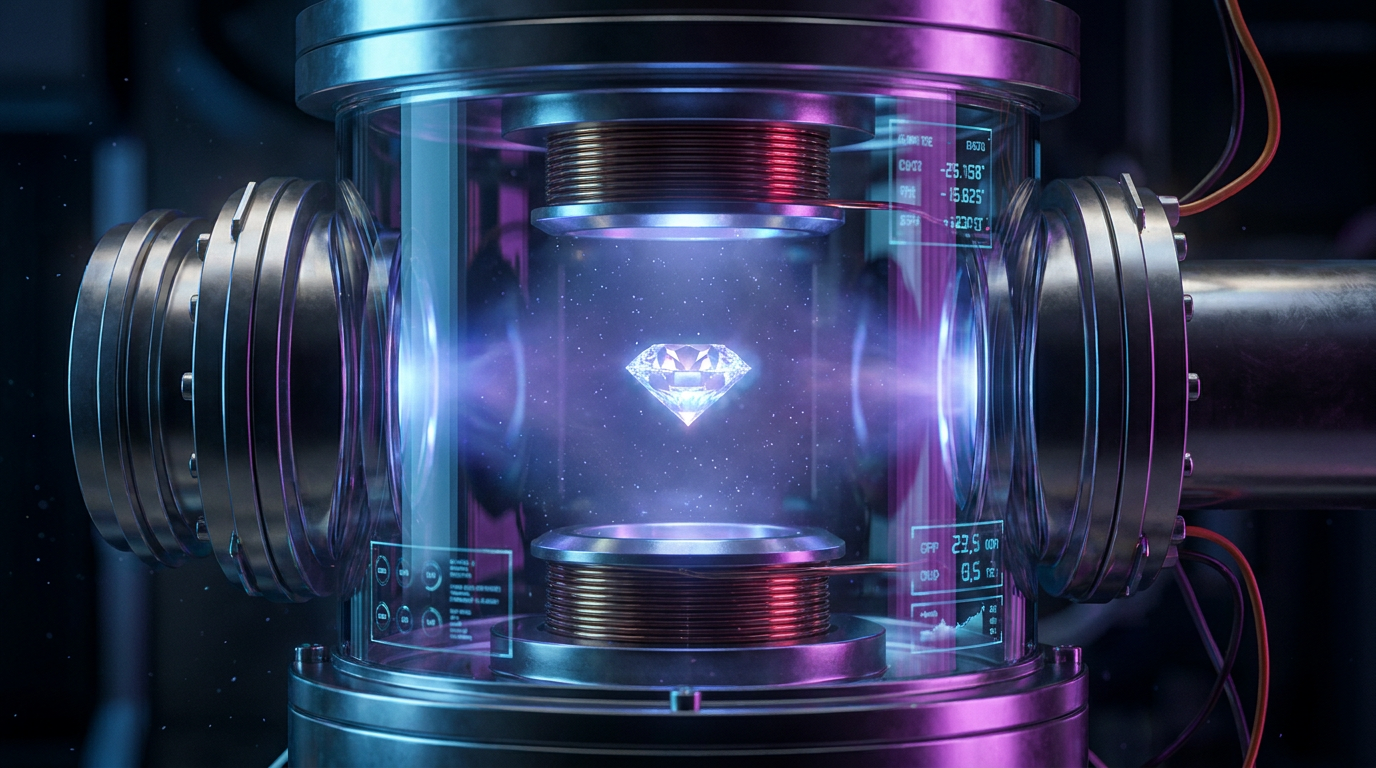
CVD, by contrast, is often compared to 3D printing with light. A diamond seed is placed in a vacuum chamber filled with carbon-rich gases like methane. A microwave beam or plasma torch breaks the molecular bonds of the gas, causing pure carbon atoms to rain down and build the diamond layer by layer.[5]
Neither method is objectively superior, but they serve different market needs. CVD dominates the production of larger, colorless stones—particularly those above two carats—because it operates in a lower-pressure environment that can theoretically run indefinitely without cracking the stone.[5]
Neither method is objectively superior, but they serve different market needs.
HPHT, meanwhile, excels at producing fancy colored diamonds, particularly vibrant yellows and blues, as well as smaller accent stones. However, HPHT stones can occasionally exhibit a faint blue nuance due to boron exposure during growth, while lower-quality CVD stones might show brownish tints if the crystallization process is rushed.[5]
Beyond the growth methods, the most significant shift in the 2026 landscape involves how these stones are graded. For decades, the Gemological Institute of America (GIA) used its famous 4Cs—Cut, Color, Clarity, and Carat—to evaluate all diamonds with granular precision.[1][2]
Recently, the GIA fundamentally altered its approach to lab-grown stones. Instead of issuing specific letter grades for color and clarity (such as "D" color or "VVS1" clarity), the GIA transitioned to a simplified two-tier descriptor system, classifying lab-grown submissions broadly as either "Premium" or "Standard."[1][2]
This move by the world's foremost gemological authority was designed to draw a clear line between natural and man-made stones. It signals to the market that lab-grown diamonds, manufactured in highly controlled environments, generally fall into a compressed, consistently high-quality range where hyper-specific grading is less relevant to the consumer.[2]

Consequently, many lab-grown retailers and buyers have shifted their reliance to the International Gemological Institute (IGI), which continues to provide the traditional, detailed 4Cs grading reports for lab-grown diamonds, allowing for easier side-by-side price comparisons.[4][7]
When shopping in 2026, industry experts advise a specific strategy: prioritize cut above all else. A meticulously cut lab-grown diamond will maximize light return and appear larger and more brilliant than a poorly cut stone of a higher carat weight.[4]
For clarity, the "sweet spot" remains the VS1 to VS2 range. These stones are entirely eye-clean, meaning no inclusions are visible without magnification. Paying a premium for Internally Flawless (IF) or VVS1 grades in a lab-grown stone offers no visual benefit to the naked eye.[4][7]
Color selection depends heavily on the chosen setting. For platinum or white gold rings, G to E color grades offer a crisp, icy appearance without the premium attached to a perfectly colorless D grade. If setting the stone in yellow or rose gold, buyers can safely drop to an H or I color, as the metal will naturally impart a warm tint to the diamond regardless.[4]

Finally, buyers must approach lab-grown diamonds with the correct financial mindset. They are a purchase for beauty, design flexibility, and immediate wear—not a financial investment or a store of wealth.[4]
While natural diamonds retain scarcity value and a higher percentage of their resale price, lab-grown diamonds currently hold only 10% to 15% of their purchase price on the secondary market. They should be viewed similarly to consumer electronics or luxury fashion: valuable for the utility and joy they provide, rather than their future liquidation value.[3][4]
Ultimately, the 2026 market empowers consumers. By understanding the growth methods, navigating the new grading landscape, and accepting the financial realities, buyers can secure spectacular, ethically transparent jewelry at unprecedented value.[4][7]

How we got here
1950s
The first gem-quality HPHT diamonds are successfully synthesized in a laboratory.
1980s
The CVD method is developed, allowing for diamond growth in low-pressure vacuum environments.
2020
Lab-grown diamond retail prices peak before a massive surge in global factory production capacity.
2025
Wholesale prices hit a production-cost floor after an 85% drop, stabilizing the retail market.
2026
The GIA shifts to a simplified 'Premium/Standard' grading system to differentiate lab-grown stones from natural ones.
Viewpoints in depth
Gemological Authorities
Focus on maintaining a clear distinction between natural rarity and manufactured consistency.
Institutions like the GIA argue that applying the exact same granular grading scales to lab-grown diamonds as natural ones is misleading. Because lab-grown stones are manufactured in highly controlled environments, they inherently cluster at the top of the clarity and color scales. By shifting to a 'Premium' and 'Standard' descriptor system, authorities aim to remind consumers that these stones are industrial products, distinct from the geological miracles pulled from the Earth.
Lab-Grown Manufacturers
Argue that chemical identity is the only metric that matters to the end consumer.
Producers of CVD and HPHT stones view the 2026 market as a technological triumph. They emphasize that their products are not imitations, but actual diamonds that simply bypassed the billion-year wait. From their perspective, the massive price drop is a victory for consumer accessibility, democratizing fine jewelry and allowing buyers to purchase larger, higher-quality stones without the ethical baggage or artificial scarcity of the mining industry.
Natural Diamond Advocates
Emphasize the inherent geological romance and long-term value retention of mined stones.
Traditional jewelers and mining advocates point to the collapsed resale value of lab-grown diamonds as proof of their fundamental difference. They argue that a luxury good must possess inherent scarcity to retain its emotional and financial worth. While acknowledging that lab-grown stones are chemically identical, this camp insists that the true value of a diamond lies in its billion-year history and its ability to act as a generational store of wealth, something a factory-printed stone can never replicate.
What we don't know
- Whether the secondary resale market for lab-grown diamonds will ever mature, or if they will remain strictly a sunk-cost consumer good.
- How natural diamond miners will adjust their long-term pricing strategies if lab-grown market share continues to expand past 2030.
Key terms
- CVD (Chemical Vapor Deposition)
- A method of growing diamonds layer by layer using carbon-rich gas in a low-pressure vacuum chamber.
- HPHT (High Pressure High Temperature)
- A diamond growth method that mimics the extreme heat and crushing pressure of the Earth's mantle.
- Eye-Clean
- A diamond whose internal inclusions or external blemishes are too small to be seen by the naked eye without magnification.
- 4Cs
- The traditional grading system for diamonds evaluating Cut, Color, Clarity, and Carat weight.
- Type IIa
- The most chemically pure type of diamond, lacking nitrogen impurities; most CVD diamonds fall into this rare category.
Frequently asked
Are lab-grown diamonds real diamonds?
Yes. They are optically, chemically, and physically identical to mined diamonds, consisting of pure crystallized carbon.
Will lab-grown diamond prices keep dropping?
The massive price crash is largely over. By 2026, prices have hit a production-cost floor, stabilizing at around $700 to $900 for a high-quality one-carat stone.
Can a jeweler tell the difference?
Not with the naked eye or a standard jeweler's loupe. Specialized laboratory equipment is required to detect the distinct growth patterns of CVD or HPHT stones.
What is the difference between CVD and HPHT?
CVD grows diamonds using carbon-rich gas in a low-pressure vacuum, while HPHT mimics the Earth's mantle using extreme heat and mechanical pressure. Both produce authentic diamonds.
Sources
Source coverage
7 outlets
4 viewpoints surfaced






[1]Gemological Institute of America (GIA)Gemological Authorities
Laboratory-Grown Diamond Reports
Read on Gemological Institute of America (GIA) →[2]Natural DiamondsGemological Authorities
GIA Redefines Lab Grown Diamond Grading
Read on Natural Diamonds →[3]Regal StudioTraditional Jewelers
The Short History of a Historic Price Collapse
Read on Regal Studio →[4]Zizov DiamondsValue-Conscious Shoppers
The 2026 Lab-Grown Market
Read on Zizov Diamonds →[5]Liori DiamondsLab-Grown Manufacturers
CVD vs HPHT Lab Grown Diamonds
Read on Liori Diamonds →[6]AccioValue-Conscious Shoppers
Lab Diamond Market Overview 2026
Read on Accio →[7]Factlen Editorial TeamLab-Grown Manufacturers
Synthesis by Factlen editorial team
Read on Factlen Editorial Team →



Every angle. Every day.
Get shopping stories with full source coverage and perspective breakdowns delivered to your inbox.