
How Next-Generation Tech is Revolutionizing Wildlife Documentaries
From autonomous drones that calculate animal stress to deep-water ROVs that can film for 15 hours, new technology is allowing filmmakers to capture unprecedented behaviors without disturbing nature.
By Factlen Editorial Team
- Ethical Filmmakers
- Argue that the primary mandate of a nature documentary is to observe without altering behavior, championing autonomous tech that prioritizes animal welfare.
- Cinematographers
- Value the creative freedom and mobility that compact, high-speed, and low-light cameras provide in extreme, unpredictable field conditions.
- Scientific Researchers
- View the documentary industry's technological leap as a massive data windfall, utilizing the raw footage to study previously unobservable ecosystems.
What's not represented
- · Local guides and indigenous trackers whose traditional knowledge is often paired with this new technology.
- · Independent filmmakers in developing nations who may be priced out of utilizing $100,000+ ROV systems.
Why this matters
The tension between capturing breathtaking nature footage and disturbing the animals being filmed has long plagued documentarians. A new wave of non-invasive technology is solving this ethical dilemma, delivering better visuals for audiences while providing marine biologists and conservationists with unprecedented raw data.
Key points
- Autonomous drone software now calculates safe distances to film wildlife without causing acoustic or visual stress.
- Deep-water ROVs can film continuously for 15 hours, capturing natural fish behaviors that human scuba divers disrupt.
- Low-light sensors allow filmmakers to shoot in near-total darkness without using blinding artificial floodlights.
- Compact high-speed cameras let solo cinematographers capture 1,000-frames-per-second footage in remote environments.
- The raw footage captured by these advanced tools is increasingly being used by marine biologists for ecological research.
For decades, the golden rule of wildlife documentary filmmaking has been a paradox: to capture the natural world, you must introduce unnatural elements into it. Helicopters, scuba divers, blinding floodlights, and heavy camera rigs inherently alter the behavior of the very animals they seek to observe. But in 2026, a quiet revolution is sweeping the industry. A new generation of autonomous drones, deep-water remotely operated vehicles (ROVs), and ultra-sensitive camera sensors is allowing filmmakers to become true flies on the wall.[6]
The shift is fundamentally changing what audiences see on screen. Instead of animals reacting to the presence of a camera crew, viewers are finally witnessing undisturbed, natural behaviors. This technological leap is not just a win for entertainment; it is a triumph for animal welfare and a massive windfall for scientific research, as biologists gain access to hours of footage from environments previously deemed inaccessible.[6]
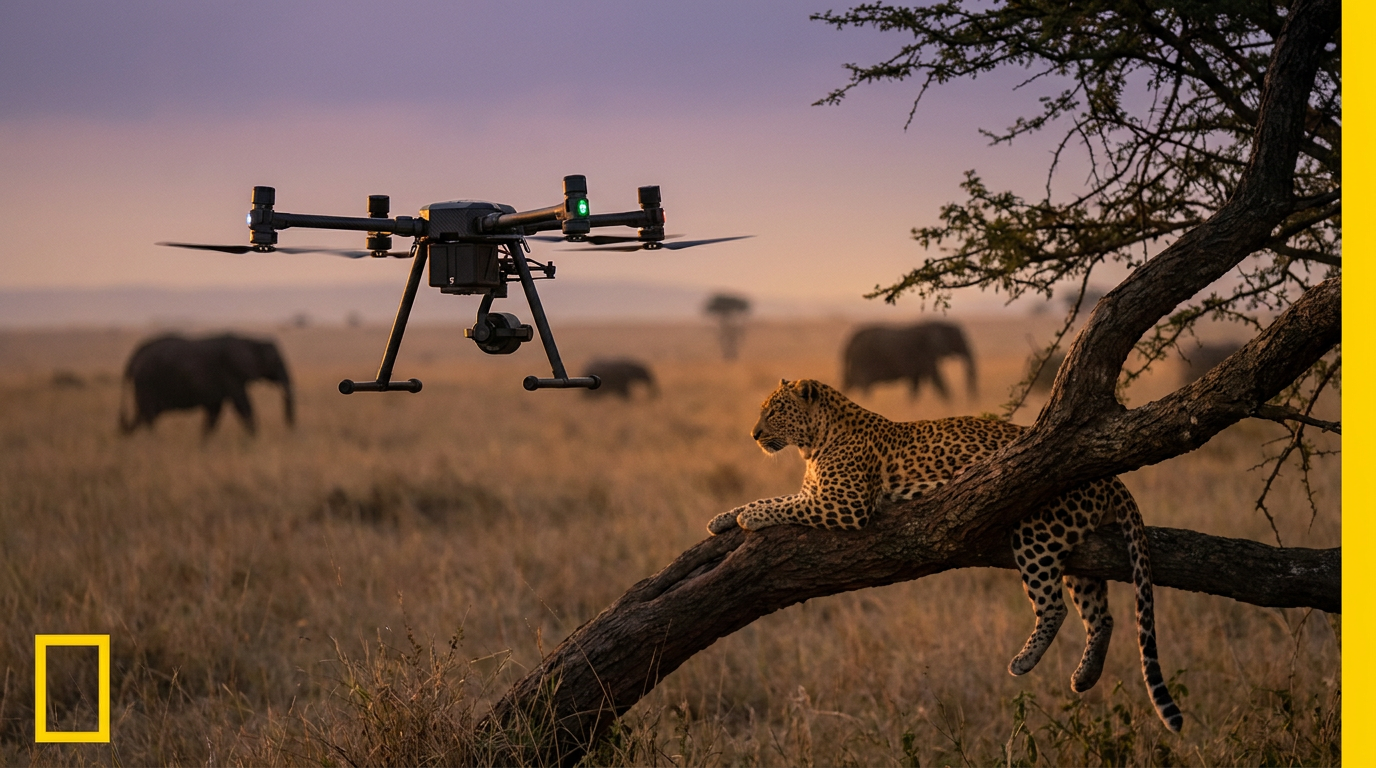
Nowhere is this shift more apparent than in the sky. Drones have been used in filmmaking for years, but traditional unmanned aerial vehicles (UAVs) are notoriously loud and visually intrusive, often causing severe stress to wildlife. To solve this, researchers and engineers have developed autonomous frameworks like "CineWild," which bridges robotics, cinematography, and environmental ethics.[1]
The CineWild system utilizes model predictive control to dynamically adjust a drone's flight path and camera settings in real-time. By calculating acoustic and visual "safe distances," the drone uses adaptive zoom to capture intimate close-ups while remaining entirely outside the animal's field of view. The result is smooth, low-noise maneuvering that balances cinematic quality with strict animal welfare standards.[1]

Beneath the surface, the technological leap is even more dramatic. Historically, underwater documentaries relied on human scuba divers. Divers are limited by oxygen supplies, decompression sickness, and the simple fact that a human blowing bubbles is a terrifying sight to most marine life. Today, independent production companies are deploying advanced ROVs that eliminate these constraints entirely.[4][6]
During the filming of the documentary "All Too Clear: Beneath the Surface of the Great Lakes," filmmakers utilized the Boxfish Luna, a cutting-edge underwater drone designed in New Zealand. Operating with just a two-person surface team and zero divers, the ROV enabled continuous dives lasting up to 15 hours, reaching depths of 500 meters.[2][4]
Operating with just a two-person surface team and zero divers, the ROV enabled continuous dives lasting up to 15 hours, reaching depths of 500 meters.
Because the ROV emits no bubbles and maneuvers silently, fish quickly accept it as part of the environment. This allowed the "All Too Clear" team to capture unprecedented footage, including what is reported to be the first-ever recording of lake whitefish spawning in their natural habitat. The extended dive times also led to the unexpected discovery of the steamer Africa, a shipwreck lost since 1895.[4]

The cameras housed inside these drones are equally revolutionary. The Boxfish Luna integrates a Sony A7SIII sensor, renowned for its low-light capabilities. In the murky depths of the Great Lakes, this allowed filmmakers to see nearly 100 meters in near-total darkness without the need for artificial floodlights, which often blind or scatter deep-water species.[2][6]
This low-light revolution is also transforming terrestrial filmmaking. In the documentary "Mashatu: Land of Leopards," which premiered at the Wildscreen Festival in Botswana, cinematographers used high-sensitivity, low-light cameras paired with drones to track a leopard family over three years. The technology allowed the crew to capture rare, nocturnal behaviors in the Mashatu Game Reserve without relying on disruptive spotlights.[3]
When it comes to capturing the hyper-fast movements of the natural world, the sheer weight of high-speed cameras used to be a major limiting factor. Wildlife cinematographers often work in remote, extreme environments where carrying a heavy rig is physically impossible. The introduction of compact, high-speed cameras like the Phantom VEO4K has fundamentally changed field logistics.[5]

The Phantom VEO4K can shoot highly detailed 4K imaging at a staggering 1,000 frames per second. Unlike its predecessor, the 6.3-kilogram Phantom Flex 4K, the VEO4K is housed in a rugged, compact body that a single operator can grab and run with. This mobility allows cinematographers to be highly reactive, capturing fleeting moments that would otherwise be missed.[5]
This high-speed capability was recently utilized by Humble Bee Films to capture the mechanics of flight for a new series. By shooting at 1,000 frames per second, the crew was able to document the microscopic details of territorial disputes between rival hummingbirds, as well as the impossibly fast wingbeats of dragonflies and mayflies.[2]
The convergence of these technologies—autonomous ethical drones, 15-hour deep-water ROVs, low-light sensors, and compact high-speed cameras—means that the barrier between the observer and the observed has never been thinner. Filmmakers no longer have to choose between getting the perfect shot and protecting the ecosystem.[6]
For the scientific community, this era of documentary filmmaking is providing a treasure trove of data. Because independent production companies can now afford to deploy ROVs and autonomous drones for extended periods, they are inadvertently conducting massive ecological surveys. The raw, unedited footage is frequently shared with marine biologists and conservationists, furthering research long after the credits roll.[4][6]

Viewpoints in depth
Ethical Filmmakers' view
The primary goal of a nature documentary is to observe without altering the subject's behavior.
For decades, the presence of a camera crew inherently changed the environment they were trying to document. Ethical filmmakers argue that if an animal is looking at the camera, the shot is already compromised. They champion the development of autonomous systems like CineWild, which prioritize the animal's welfare over the convenience of the operator. By mathematically calculating stress zones and programming drones to avoid them, these filmmakers ensure that the pursuit of entertainment never comes at the expense of the ecosystem.
Cinematographers' view
New technology provides the creative freedom to capture the 'impossible shot' in extreme conditions.
Wildlife cinematographers operate in some of the most unforgiving environments on Earth, where carrying heavy gear is a logistical nightmare. The shift toward compact, high-performance technology—like the Phantom VEO4K—means a single operator can now sprint through a forest to capture a fleeting moment in ultra-slow motion. For these professionals, the technology isn't just about ethics; it's about agility, extended battery life, and the ability to react instantly to the unpredictable nature of the wild.
Scientific Researchers' view
The documentary industry's technological investments are providing a massive, free data windfall for biologists.
Marine biologists and conservationists rarely have the funding to deploy $100,000 ROVs for 15-hour continuous dives. When independent production companies use this equipment to film documentaries, they inadvertently conduct massive, high-resolution ecological surveys. Researchers view these filmmakers as vital partners, utilizing the raw, unedited footage to study spawning habits, track invasive species, and monitor deep-water environments that would otherwise remain completely unobserved.
What we don't know
- Whether the high cost of these advanced ROVs and autonomous drones will limit their use to heavily funded, blue-chip productions.
- How the rise of AI-generated text-to-video tools might eventually blur the lines of authenticity in wildlife documentaries.
Key terms
- ROV (Remotely Operated Vehicle)
- An unoccupied, highly maneuverable underwater robot operated by a crew on the surface, used to capture deep-water footage without human divers.
- Model Predictive Control
- An advanced algorithm used in autonomous drones to predict future events and adjust flight paths in real-time, ensuring the drone avoids stressing the animal.
- FPS (Frames Per Second)
- A measure of how many individual images a camera captures every second; higher numbers (like 1,000 fps) allow for ultra-smooth slow-motion playback.
Frequently asked
How do drones film animals without scaring them?
New autonomous frameworks use predictive algorithms to calculate acoustic and visual safe distances. The drones adjust their flight paths to stay out of the animal's direct sightline while using adaptive zoom to get the shot.
Why are underwater drones better than human divers?
Human divers are limited by oxygen supplies and their bubbles often scare away marine life. Modern ROVs can dive for up to 15 hours, reach depths of 500 meters, and maneuver silently, allowing fish to act naturally.
What makes the new high-speed cameras different?
Older high-speed cameras capable of shooting 1,000 frames per second in 4K were incredibly heavy and difficult to transport. Newer models are compact and rugged, allowing solo cinematographers to run with them in the field.
Sources
Source coverage
6 outlets
3 viewpoints surfaced






[1]arXivEthical Filmmakers
CineWild: Balancing Art and Robotics for Ethical Wildlife Documentary Filmmaking
Read on arXiv →[2]PlaybackCinematographers
Producers explore new tech for nature documentary production
Read on Playback →[3]WildscreenScientific Researchers
Mashatu: Land of Leopards to premiere at Wildscreen Festival Botswana
Read on Wildscreen →[4]Ocean Science & TechnologyScientific Researchers
Boxfish Luna ROV Captures Underwater Footage for Documentary
Read on Ocean Science & Technology →[5]VMICinematographers
VMI guide to shooting super slow motion on the Phantom VEO 4K camera
Read on VMI →[6]Factlen Editorial Team
Synthesis by Factlen editorial team
Read on Factlen Editorial Team →
More in entertainment
See all 5 stories →Box Office Records
‘Toy Story 5’ Eyes Record-Breaking $170 Million Opening Weekend as Pixar Takes on Tech
6 sources
Celebrity Philanthropy
How Celebrities and Billionaires Are Rewriting the Rules of Philanthropy in 2026
8 sources

Unified Discovery
The End of the Endless Scroll: How 2026 Became the Year Streaming Finally Fixed Discovery
7 sources

Every angle. Every day.
Get entertainment stories with full source coverage and perspective breakdowns delivered to your inbox.