
How Small Language Models Are Bringing AI Offline and Onto Your Devices
A new generation of compact, highly efficient artificial intelligence models is allowing users to run powerful AI directly on their laptops and smartphones. This shift toward local processing promises to drastically reduce costs while keeping personal data entirely private.
By Factlen Editorial Team
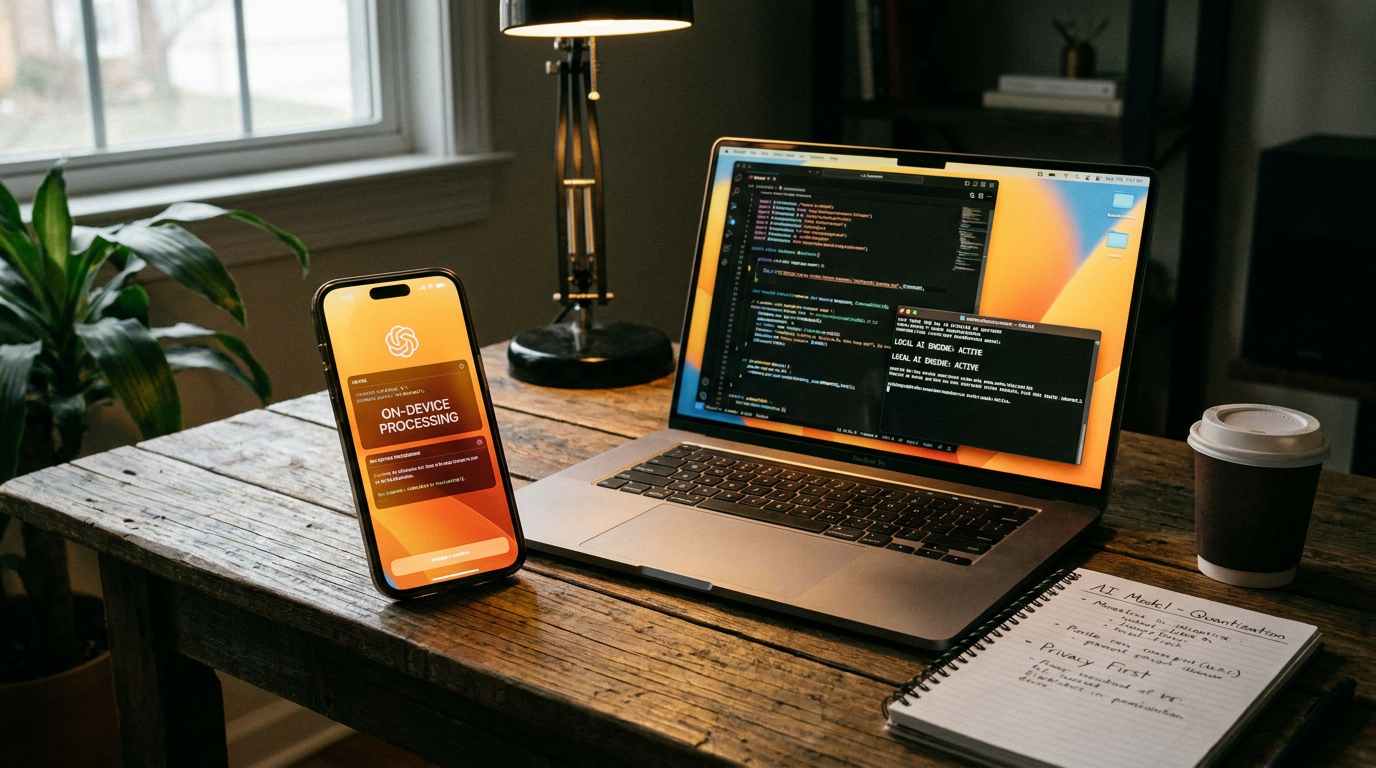
- Open-Source Advocates
- Argue that local AI democratizes technology, prevents vendor lock-in, and allows independent developers to innovate without paying cloud gatekeepers.
- Privacy & Security Experts
- Focus on the critical importance of data sovereignty, ensuring sensitive personal and corporate information never leaves the local device.
- Enterprise AI Developers
- Value SLMs for their predictable latency, significantly lower deployment costs, and the ability to fine-tune models on proprietary domain data.
Why this matters
The shift toward Small Language Models means you no longer have to sacrifice your privacy or pay expensive cloud subscriptions to use top-tier artificial intelligence. By running AI directly on your own laptop or smartphone, you gain faster, offline access to powerful tools while ensuring your personal data never leaves your device.
The era of massive, cloud-bound artificial intelligence is steadily giving way to something much smaller, faster, and far more personal. For the past few years, interacting with a top-tier AI meant accepting a fundamental trade-off: to get smart answers, you had to send every prompt, question, and private document to a remote server farm operated by a major tech giant. This cloud-first approach required constant internet connectivity, incurred ongoing subscription or API costs, and raised significant concerns about data privacy and corporate surveillance. Users were essentially renting intelligence from centralized providers, hoping their sensitive information wouldn't be absorbed into the next iteration of the company's training data.[8]
But in 2026, the technology landscape has shifted dramatically toward Small Language Models (SLMs), fundamentally rewriting the rules of how artificial intelligence is deployed and consumed. These compact, highly optimized neural networks are explicitly designed to run entirely on everyday consumer hardware—standard laptops, smartphones, and embedded edge devices—without requiring a continuous internet connection or a massive data center. By bringing the computation directly to the user's device, SLMs eliminate the latency of sending data back and forth across the web, resulting in near-instantaneous responses that make AI feel like a native, integrated part of the operating system rather than a distant web service.[2][6]
The primary appeal of Small Language Models lies in their remarkable efficiency and their inherent respect for user privacy. While frontier models developed by industry behemoths boast hundreds of billions or even trillions of parameters, SLMs typically operate in the highly optimized range of 1 billion to 14 billion parameters. In the context of neural networks, parameters are the internal numeric values—the weights and biases—that encode everything the model has learned about language, reasoning, and facts. Reducing this parameter count by orders of magnitude translates directly into practical deployment advantages, allowing these models to run on devices with limited memory and battery life without draining system resources.[2][7]
Despite their significantly smaller footprint, these modern models punch well above their weight class, proving that sheer size is not the only path to high performance. Microsoft's Phi-4, for instance, packs a relatively modest 14 billion parameters but routinely outperforms older, massive models on complex graduate-level reasoning, mathematics, and coding benchmarks. This efficiency is achieved through rigorous curation of the data used to train the model; by feeding the AI "textbook quality" data rather than scraping the entire unfiltered internet, researchers have managed to instill deep reasoning capabilities into a much smaller package.[5]

Similarly, Meta's Llama 3 8B and Google's Gemma 3 family have demonstrated that exceptionally high-quality training pipelines can compensate for a smaller parameter count, delivering real-time conversational capabilities directly to the user. These models are instruction-tuned to follow complex human commands naturally, making them behave like highly capable chat assistants that can draft emails, summarize long documents, and write code. Because they are open-weight—meaning the underlying code and parameters are available for anyone to download—they have sparked a massive wave of grassroots innovation, allowing independent developers to build powerful applications without paying gatekeepers.[5][6]
The secret to running these highly capable models on standard laptops and mobile phones is a sophisticated mathematical compression technique known as quantization. Without quantization, running even a small language model would quickly overwhelm the memory capacity of a typical consumer device. It is the critical bridge between theoretical AI research and practical, everyday deployment, allowing complex neural networks to operate within the strict hardware constraints of devices that people already own and carry in their pockets.[1][8]
At its core, an artificial intelligence model is a vast collection of numbers that define exactly how it processes input and generates language. Traditionally, these weights are stored as high-precision 32-bit floating-point numbers, a format that provides extreme mathematical accuracy but consumes enormous amounts of memory and computational bandwidth. When you multiply 8 billion parameters by 32 bits, the storage and active memory requirements balloon to a size that only specialized, expensive graphics processing units (GPUs) can handle, effectively locking out everyday users.[1]
Quantization systematically reduces this precision, converting those bulky 32-bit floats into much smaller 8-bit or even 4-bit integers. It is conceptually similar to compressing a massive, high-resolution RAW image file into a lightweight JPEG; the file size shrinks dramatically, but the user interacting with the AI barely notices any difference in the output quality. The model loses a tiny fraction of its mathematical precision, but its ability to understand context, generate coherent text, and solve problems remains remarkably intact, making the trade-off overwhelmingly worthwhile for local deployment.[1]
Quantization systematically reduces this precision, converting those bulky 32-bit floats into much smaller 8-bit or even 4-bit integers.
This compression has a profound and immediate practical impact on hardware requirements. A 7-billion parameter model that would normally require 28 gigabytes of Video RAM (VRAM) to run at full precision can be squeezed down to operate smoothly on just 4 gigabytes when quantized to 4-bit precision. This massive reduction is the difference between needing a $5,000 specialized workstation and being able to run advanced artificial intelligence on a standard, off-the-shelf laptop or a modern smartphone, completely changing the economics of AI access.[1]

This breakthrough has thoroughly democratized AI access, shifting power away from centralized tech monopolies and into the hands of individual users. Developers, researchers, and everyday hobbyists can now use streamlined, user-friendly tools like Ollama, LM Studio, or Mozilla's Llamafile to download and run powerful models locally in a matter of seconds. These platforms abstract away the complex command-line setups of the past, offering simple interfaces where users can swap between different models, test their capabilities offline, and integrate them into their own workflows without ever paying a subscription fee.[2][4]
Beyond the obvious cost savings and the convenience of offline access, the shift toward local AI is fundamentally about data sovereignty and security. When a language model runs entirely on-device, the user's prompts, proprietary business documents, and sensitive personal information never leave their machine. There is no risk of a data breach in transit, no possibility of a cloud provider logging the conversation, and no chance that a user's private medical or financial questions will be silently absorbed into a future version of a public AI model.[2][7]
Apple has aggressively adopted this privacy-first paradigm with its Apple Intelligence suite, setting a new industry standard for how consumer AI should operate. The system relies heavily on on-device processing, ensuring that everyday tasks like summarizing personal emails, proofreading text messages, or organizing sensitive calendar notifications are handled entirely by the iPhone or Mac's local neural engine. Apple has explicitly designed the architecture so that it provides deeply personalized assistance while remaining completely blind to the actual content of the user's data.[3]
For more complex queries that exceed a smartphone's local compute capacity, Apple routes requests to its Private Cloud Compute infrastructure, a novel approach to secure remote processing. This system cryptographically ensures that data is used exclusively to fulfill the immediate request and is never stored, logged, or used for future model training. Independent security experts can inspect the code running on these servers to verify the privacy claims, creating a verifiable trust model that stands in stark contrast to the opaque data-harvesting practices of traditional cloud AI providers.[3]

The enterprise sector is also rapidly embracing Small Language Models for their predictable latency, cost-effectiveness, and robust security profiles. Companies handling sensitive financial records, legal contracts, or protected health information can deploy local models on their own secure, air-gapped servers, ensuring strict compliance with global data privacy regulations like GDPR. By keeping the intelligence in-house, businesses can automate complex workflows and analyze proprietary data without exposing their intellectual property to third-party vendors or risking regulatory fines.[6][7]
Furthermore, Small Language Models are highly customizable and adaptable to specific industry needs. Because they require a mere fraction of the compute power to train and modify compared to frontier models, organizations can easily fine-tune them on domain-specific data using techniques like Low-Rank Adaptation (LoRA). This allows a hospital to train a lightweight model specifically on medical terminology, or a law firm to create an assistant fluent in contract law, resulting in specialized tools that often outperform generic, massive models in their specific niche.[2][6]
The environmental impact is another significant, though often overlooked, advantage of the shift toward smaller models. Massive cloud-based AI systems require staggering amounts of electricity to train and operate, alongside millions of gallons of water to cool the sprawling data centers that house them. In contrast, Small Language Models running efficiently on edge devices consume a mere fraction of the power, leveraging the energy-efficient neural processing units (NPUs) built into modern consumer electronics to deliver intelligence with a vastly smaller carbon footprint.[2][7]

As consumer hardware continues to improve at a rapid pace—with dedicated AI chips becoming standard in almost all new laptops, tablets, and smartphones—the definition of a "small" model will inevitably shift upward. A model that is considered large today may easily fit into the pocket-sized devices of tomorrow, further blurring the line between local and cloud capabilities. However, the underlying philosophy of edge computing—bringing the processing power directly to where the data is generated—is now a permanent and growing fixture of the technology landscape.[6][8]
Ultimately, the rise of Small Language Models represents a healthy, necessary maturation of artificial intelligence as a practical tool. The industry is moving past the brute-force approach of simply building bigger, more expensive models, focusing instead on efficiency, privacy, and accessibility. By shrinking the technology down to fit on the devices we already own, developers are ensuring that the future of AI is not just powerful, but also deeply personal, secure, and entirely within the user's control.[8]
Viewpoints in depth
Open-Source Advocates
Championing the democratization of AI through accessible, downloadable models.
For the open-source community, Small Language Models represent freedom from corporate gatekeepers. Advocates argue that relying on centralized cloud APIs creates a dangerous dependency on a few massive tech companies, who can change pricing, alter model behavior, or deprecate services at any time. By optimizing models to run locally, developers ensure that AI remains a decentralized tool. They point to the explosive growth of platforms like Hugging Face and Ollama as proof that the community prefers models they can physically download, inspect, and modify without restriction.
Privacy & Security Experts
Prioritizing data sovereignty and the cryptographic protection of user information.
Security professionals view local AI as the only viable solution for handling sensitive data. They argue that no matter how secure a cloud provider claims to be, transmitting unencrypted personal data, medical records, or proprietary code across the internet introduces unacceptable risks. This camp strongly supports architectures like Apple's Private Cloud Compute, which pairs on-device processing with verifiable, ephemeral cloud servers. For these experts, the true value of an SLM is not just its speed, but its ability to guarantee that a user's data remains entirely under their own control.
Enterprise AI Developers
Focusing on cost-efficiency, low latency, and domain-specific fine-tuning.
In the corporate sector, the enthusiasm for SLMs is driven by pure economics and operational efficiency. Enterprise developers note that running massive frontier models for routine tasks like basic customer support or internal document search is financially unsustainable. SLMs offer a fraction of the inference cost and provide the low latency required for real-time applications. Furthermore, businesses value the ability to fine-tune these smaller models on their own proprietary data—creating highly specialized, industry-specific assistants that outperform generic cloud models without exposing trade secrets.
What we don't know
- How quickly hardware manufacturers will scale up the memory bandwidth in standard laptops to support even larger local models.
- Whether the open-source community can maintain its rapid pace of innovation as training costs for frontier models continue to skyrocket.
- How regulatory bodies will adapt to a landscape where powerful, uncensored AI models can be downloaded and run completely offline.
Sources
Source coverage
8 outlets
3 viewpoints surfaced








[1]LocalLLM.inEnterprise AI Developers
The Complete Guide to LLM Quantization
Read on LocalLLM.in →[2]Hugging FaceOpen-Source Advocates
Small Language Models (SLM): A Comprehensive Overview
Read on Hugging Face →[3]ApplePrivacy & Security Experts
Legal - Apple Intelligence & Privacy
Read on Apple →[4]InfoWorldOpen-Source Advocates
5 easy ways to run an LLM locally
Read on InfoWorld →[5]Local AI MasterOpen-Source Advocates
Best Small Language Models 2026: 12 SLMs for 8GB RAM
Read on Local AI Master →[6]CogitXEnterprise AI Developers
Small Language Models (SLMs): Comprehensive Guide 2026
Read on CogitX →[7]Ruh AIEnterprise AI Developers
Small Language Models (SLMs): The Efficient Future of AI in 2026
Read on Ruh AI →[8]Factlen Editorial TeamPrivacy & Security Experts
Synthesis by Factlen editorial team
Read on Factlen Editorial Team →


Every angle. Every day.
Get ai stories with full source coverage and perspective breakdowns delivered to your inbox.