
The Science of the Soil Microbiome: Why 'No-Till' Gardening is Transforming Home Backyards
A quiet revolution in microbiology is proving that undisturbed, fungi-rich soil produces healthier, more drought-resistant plants than traditional tilling.
By Factlen Editorial Team
- Soil Scientists & Ecologists
- Focus on the biological mechanisms of the soil food web, carbon sequestration, and the symbiotic relationships between plants and fungi.
- Regenerative Gardeners
- Advocate for practical, hands-off methods like no-till, cover cropping, and mulching to build natural soil health without synthetic inputs.
- Agricultural Skeptics
- Warn against the commercialization of soil science, noting that many store-bought microbial inoculants are ineffective or misleading.
What's not represented
- · Commercial fertilizer manufacturers
- · Large-scale conventional farmers
Why this matters
Understanding the soil microbiome allows home gardeners to grow healthier, more drought-resistant, and nutrient-dense food with less labor and fewer chemical inputs. It transforms gardening from a battle against nature into a cooperative biological partnership.
Key points
- Tilling destroys the delicate fungal networks that help plants absorb water and nutrients.
- Mycorrhizal fungi act as an extended root system, trading minerals for plant-produced carbon.
- No-till gardening increases the nutrient density of crops and improves drought resilience.
- Most commercial microbial inoculants fail to establish; native fungi are more effective.
- Gardeners can foster native microbes by applying wood chip mulch and leaving roots in the ground.
For generations, the quintessential image of spring gardening has featured a roaring rototiller churning the earth into a fine, powdery seedbed. It feels productive, looking like a clean slate ready for planting. But a quiet revolution rooted in microbiology is transforming how home gardeners and farmers approach their soil.[5]
The shift centers on a concept known as regenerative gardening, which treats the ground not as an inert matrix to hold roots, but as a complex, living ecosystem. At the heart of this movement is the "no-till" philosophy—a method that advocates for leaving the soil structure entirely undisturbed.[5][6]
To understand why tilling is falling out of favor, one must look closely at the soil microbiome. A single handful of healthy earth contains billions of microorganisms, including bacteria, fungi, protozoa, and nematodes. Together, they function as the digestive and immune systems of the garden.[1][5]
Plants cannot easily absorb many of the raw minerals present in dirt. They rely on bacteria and fungi to act as microscopic middlemen, breaking down organic matter and converting nutrients into plant-available forms. If this microbial food web is broken, crops can sit in nutrient-rich soil and still starve.[5]
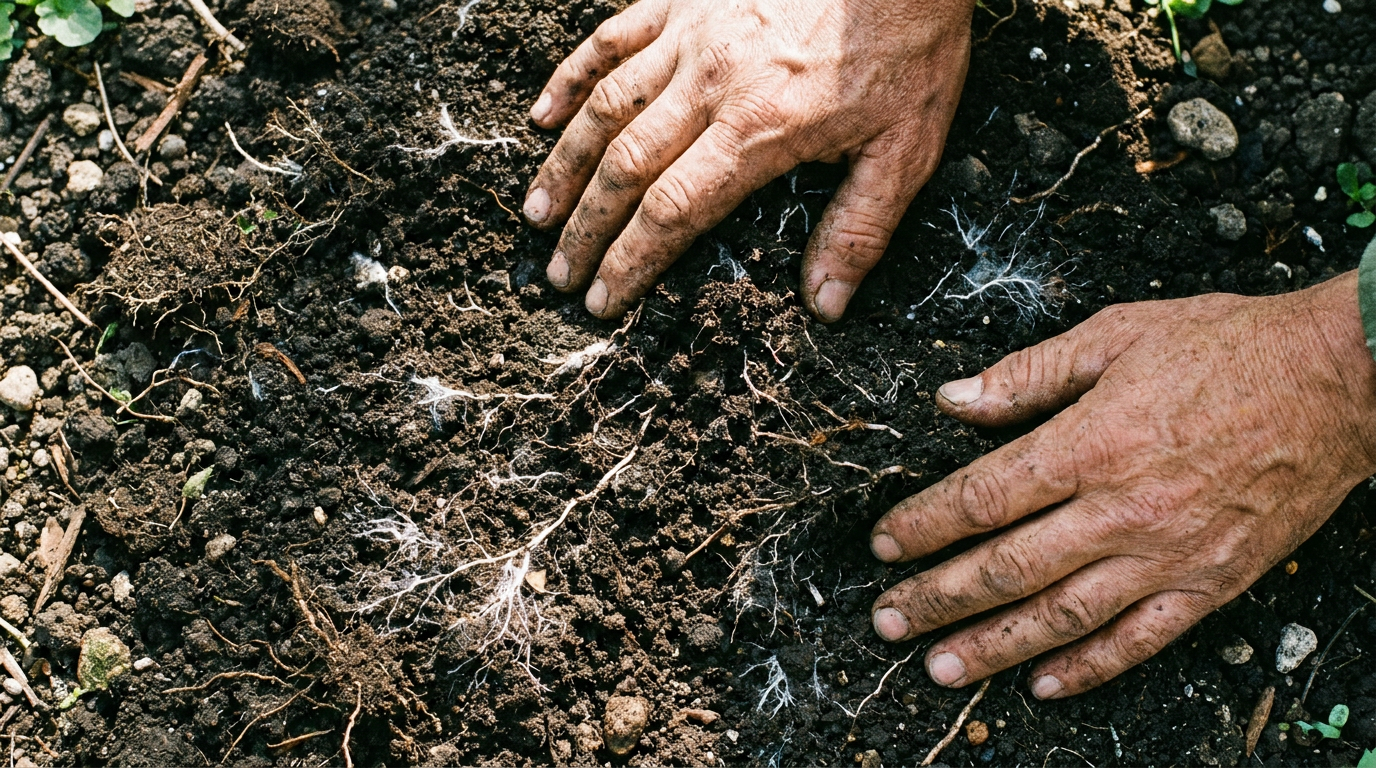
The undisputed star players of this subterranean world are mycorrhizal fungi. These specialized organisms form a mutualistic, symbiotic relationship with over 80 percent of all plant species, acting as a biological extension of the plant itself.[4][6]
The mechanism is an elegant biological trade. Plants use photosynthesis to create carbon-rich sugars, which they pump down into their roots to feed the fungi. In exchange, the fungi grow a vast network of microscopic threads called hyphae, effectively extending the plant's root system far beyond its normal reach.[4][6]

These hyphal networks are incredibly efficient at scavenging water and essential minerals, particularly phosphorus, and transporting them back to the host plant. This fungal extension provides crops with remarkable resilience against drought and environmental stress.[6]
Beyond nutrient delivery, mycorrhizal fungi physically rebuild the earth. As they grow, they excrete a sticky glycoprotein called glomalin. This substance acts like biological glue, binding microscopic soil particles together into larger aggregates.[4]
These aggregates create a porous soil structure that allows oxygen to penetrate deep into the ground and acts like a sponge during heavy rains, preventing erosion and runoff. When a gardener runs a tiller through the dirt, they are essentially running a blender through this delicate, carefully constructed fungal architecture.[5]
When a gardener runs a tiller through the dirt, they are essentially running a blender through this delicate, carefully constructed fungal architecture.
The benefits of preserving this architecture extend all the way to the dinner table. Research indicates that fostering a healthy soil microbiome can directly enhance the nutritional profile of the food we grow.[3]
A study highlighted by agricultural researchers found that oats grown in undisturbed, no-till fields contained 25 percent more ergothioneine—a potent antioxidant—than those grown in conventionally tilled soil. Scientists attribute this nutrient density directly to the intact networks of bacteria and fungi.[3]
Furthermore, healthy soil microbiomes play a critical role in carbon sequestration. Soil organic matter is composed of over 50 percent carbon. By minimizing disturbance and keeping living roots in the ground, gardeners help microbes lock atmospheric carbon safely underground, accelerating soil regeneration far beyond natural rates.[1]
As the science of the soil microbiome has gained mainstream traction, a billion-dollar industry has emerged to sell it back to consumers. Garden centers and online retailers now offer an array of commercial inoculants, promising to deliver beneficial fungi in a bottle or powder.[2]
However, agricultural researchers urge caution before purchasing these packaged microbes. A comprehensive study conducted by the University of Kansas analyzed 250 commercial product trials and found that 88 percent of the time, the promised fungi failed to materialize on plant roots.[2]

Researchers discovered that many commercial products contained dead spores, undisclosed chemical fertilizers, or strains of fungi that simply could not compete with the native microbes already present in the local environment.[2][4]
Horticultural experts emphasize that gardeners do not need to buy microbes to achieve a healthy soil food web. The spores of beneficial fungi are already ubiquitous in the environment, waiting for the right conditions to activate.[4]
The most effective way to cultivate these native populations is through the "build it and they will come" approach. This means covering the soil with natural, carbon-rich mulches like arborist wood chips, which provide the exact woody debris that fungal species evolved to decompose.[4][6]
Practical application in the home garden requires a shift in habits. Instead of pulling spent vegetable plants out by the roots at the end of the season, regenerative gardeners cut them at the base, leaving the root systems in the ground to decay and feed the microbes.[5][6]

How we got here
1990s
The concept of the 'soil food web' begins gaining traction among organic farmers and ecologists.
2015
Researchers demonstrate that adding efficient microbes to soils can significantly enhance carbon sequestration.
2019
Studies link no-till farming practices to higher concentrations of antioxidants in crops like oats.
2024
University of Kansas researchers publish a sweeping review revealing that 88% of commercial fungal inoculant trials fail to show root bonding.
2026
No-till and regenerative practices become standard recommendations for home gardeners seeking drought resilience.
Viewpoints in depth
Soil Scientists & Ecologists
Focus on the biological mechanisms of the soil food web and carbon sequestration.
For researchers, the soil is primarily a carbon sink and a complex biological engine. They emphasize that the microscopic interactions between plant roots and fungal hyphae are foundational to terrestrial life. By studying the exact mechanisms of nutrient exchange and glomalin production, ecologists argue that preserving the soil microbiome is not just about better tomatoes, but about mitigating climate change by locking atmospheric carbon underground.
Regenerative Gardeners
Advocate for practical, hands-off methods to build natural soil health.
Practitioners of regenerative gardening view the soil as a partner rather than a medium to be manipulated. They argue that traditional tilling and synthetic fertilizing create a cycle of dependency, where the soil becomes lifeless dirt that requires constant human input. By adopting 'chop-and-drop' methods, utilizing cover crops, and applying thick mulches, they aim to create self-sustaining ecosystems that require less watering, less weeding, and zero chemical intervention.
Agricultural Skeptics
Warn against the commercialization of soil science and ineffective products.
While agreeing on the importance of the microbiome, agricultural skeptics and university extension researchers are highly critical of the burgeoning 'microbes-in-a-bottle' industry. They point to robust data showing that most commercial inoculants fail to establish in garden soils, either because the spores are dead upon arrival or because native fungi outcompete them. They urge gardeners to save their money on expensive powders and instead focus on creating the right environmental conditions for native microbes to thrive naturally.
What we don't know
- Exactly which native fungal species are most beneficial for specific vegetable crops in different climates.
- The full extent to which the soil microbiome communicates with the human gut microbiome through the food we eat.
- How rapidly severely degraded urban soils can be fully regenerated using only natural biological methods.
Key terms
- Mycorrhizal fungi
- Beneficial fungi that form a symbiotic relationship with plant roots, exchanging water and nutrients for carbon.
- Hyphae
- Microscopic, thread-like structures produced by fungi that act as an extended root system for plants.
- Glomalin
- A sticky protein secreted by fungi that binds soil particles together, improving soil structure and water retention.
- No-till gardening
- A cultivation method that avoids digging or churning the earth to preserve the natural soil ecosystem.
- Inoculant
- A commercial product containing dormant microbes or fungal spores intended to be added to soil or seeds.
Frequently asked
Do I need to buy mycorrhizal fungi for my garden?
Generally, no. Studies show that many commercial inoculants are ineffective, and native fungal spores are already present in most soils waiting for the right conditions.
How do I start a no-till garden bed?
Instead of digging, layer cardboard over the grass or weeds, cover it with a thick layer of compost and mulch, and plant directly into the top layers.
What should I do with old plants at the end of the season?
Cut them off at ground level rather than pulling them up. Leaving the roots in the soil provides food for microbes as they decompose.
Sources
Source coverage
6 outlets
3 viewpoints surfaced






[1]Colorado State UniversitySoil Scientists & Ecologists
Reviving agricultural soils by feeding the microbiome
Read on Colorado State University →[2]University of KansasAgricultural Skeptics
Study finds commercial soil fungi products often fail to deliver
Read on University of Kansas →[3]The Washington PostSoil Scientists & Ecologists
How soil microbes boost the nutrient content of our food
Read on The Washington Post →[4]Garden ProfessorsAgricultural Skeptics
The myth of commercial mycorrhizal inoculants
Read on Garden Professors →[5]Epic GardeningRegenerative Gardeners
The Science-Backed Benefits of No-Till Gardening
Read on Epic Gardening →[6]Factlen Editorial TeamRegenerative Gardeners
Synthesis by Factlen editorial team
Read on Factlen Editorial Team →

Every angle. Every day.
Get home stories with full source coverage and perspective breakdowns delivered to your inbox.