
How AI Moved from the Cloud to Your Pocket: The Rise of On-Device Small Language Models
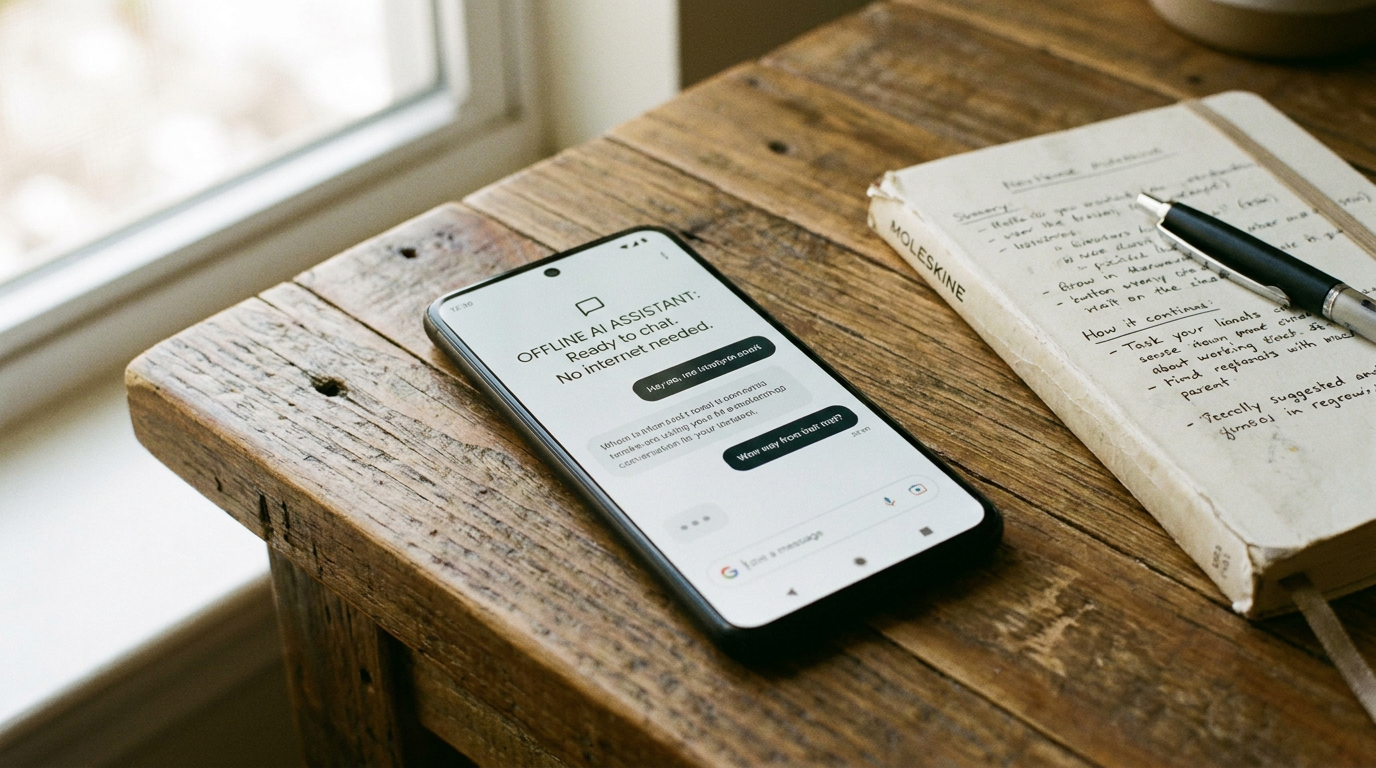
A new generation of highly compressed 'Small Language Models' is allowing smartphones to run powerful AI entirely offline, promising total privacy and zero latency.
By Factlen Editorial Team
- Privacy Advocates
- Argue that on-device AI is essential for protecting user data from corporate surveillance and data breaches.
- Mobile Platform Developers
- View on-device AI as a core operating system feature that enhances user experience through deep hardware integration.
- Open-Source Community
- Champions the democratization of AI, building tools that allow anyone to run raw models locally without gatekeepers.
- Enterprise AI Strategists
- Focus on the cost-saving and efficiency benefits of deploying smaller, localized models for specific business tasks.
What's not represented
- · Environmental researchers studying the net energy impact of edge computing versus centralized cloud computing.
Why this matters
By running AI directly on your device rather than a remote server, you gain the ability to summarize sensitive documents, draft emails, and translate languages without ever exposing your personal data to tech giants or requiring an internet connection.
Key points
- Small Language Models (SLMs) allow smartphones to run AI entirely offline without connecting to a cloud server.
- On-device AI ensures total data privacy, as user prompts and documents never leave the physical hardware.
- Techniques like 'quantization' compress massive AI models to fit within a smartphone's limited RAM.
- Dedicated Neural Processing Units (NPUs) in modern chips enable fast, energy-efficient local AI generation.
- While excellent for summarization and drafting, SLMs lack the deep reasoning capabilities of massive cloud models.
For the past three years, artificial intelligence has been synonymous with massive data centers. When a user asked a chatbot to draft an email or summarize a document, the request traveled from their smartphone to a remote server farm, where models containing over a trillion parameters processed the text and beamed the answer back.[1][2]
But this cloud-dependent architecture comes with inherent compromises. It requires a persistent internet connection, introduces network latency, and forces users to hand over their private data—from medical questions to proprietary business documents—to third-party tech giants.[3][4]
In 2026, the paradigm is shifting dramatically. The AI industry is pivoting toward "Small Language Models" (SLMs)—highly compressed, hyper-efficient neural networks designed to run entirely locally on everyday smartphones and laptops.[1][2]
Rather than relying on the cloud, these models live directly on the device's silicon. They can read, write, translate, and code without ever pinging a remote server, unlocking a new era of "on-device AI" that fundamentally changes how users interact with machine learning.[4][7]

To understand how a model that once required a supercomputer now fits in a pocket, it helps to look at the math. Frontier cloud models like GPT-4 or Claude Opus boast hundreds of billions, or even trillions, of parameters—the internal variables that dictate how the AI understands language.[2][7]
Small Language Models, by contrast, typically range from 1 billion to 8 billion parameters. Models like Meta's Llama 3.2, Microsoft's Phi-4 Mini, and Google's Gemma 3n are trained on highly curated, textbook-quality data, allowing them to punch far above their weight class.[1][3]
Fitting these models onto a smartphone requires a software technique called "quantization." In simple terms, quantization reduces the precision of the model's numbers—compressing 16-bit data down to 8-bit or even 4-bit integers. This drastically shrinks the model's file size and memory footprint, allowing a 3-billion-parameter model to run comfortably on a phone with 6GB to 8GB of RAM.[3][8]
Hardware has also evolved to meet the moment. Modern mobile processors now feature dedicated Neural Processing Units (NPUs), such as Apple's Neural Engine and the AI accelerators inside Google's Tensor chips. These specialized circuits are designed specifically to handle the matrix math required by neural networks, executing tasks with remarkable speed and minimal battery drain.[5][6]

Modern mobile processors now feature dedicated Neural Processing Units (NPUs), such as Apple's Neural Engine and the AI accelerators inside Google's Tensor chips.
The two major mobile operating systems have fully embraced this localized approach. Apple Intelligence, integrated deeply into iOS, utilizes a proprietary 3-billion-parameter on-device model. To handle diverse tasks without bloating the system, Apple uses "adapters"—tiny, specialized software modules that temporarily plug into the base model to optimize it for specific jobs, like proofreading or summarizing notifications.[6]
On the Android side, Google has deployed Gemini Nano. Running inside Android's AICore system service, Nano operates completely offline and is isolated from other apps to ensure data security. It powers features like live translation, message rewriting, and audio transcription without ever sending a byte of audio to the cloud.[5]
Beyond the tech giants, a vibrant open-source ecosystem is putting raw AI power directly into users' hands. Apps like SmolChat, Anything LLM, and Private Mind allow Android and iOS users to download open-weight models directly to their phones.[4][7]
With these apps, a user can download a 2-gigabyte file containing a model like Qwen 2.5 or Mistral, load it into the app, and chat with it on an airplane, in a subway tunnel, or in a remote cabin.[4][7]

The primary driver behind this localized revolution is privacy. Because the inference—the actual computation of the AI's response—happens on the physical device, the user's prompts never traverse the internet. This makes on-device AI uniquely suited for sensitive enterprise tasks, healthcare inquiries, and personal journaling.[4][8]
There are also significant environmental and economic benefits. Massive cloud data centers require unsustainable amounts of electricity and cooling. By offloading inference to billions of individual smartphones, the AI industry can reduce its collective energy footprint while eliminating the per-token API costs that developers currently pay to cloud providers.[2][3]
However, the technology is not without its limitations. While an SLM is excellent at summarizing a meeting or drafting a polite text message, it lacks the vast world knowledge and complex reasoning capabilities of a frontier cloud model. Ask an on-device model to write a complex Python script or analyze a dense legal contract, and it is more likely to hallucinate or lose the thread.[2][8]

Furthermore, running AI locally is computationally intense. Extended use can cause smartphones to heat up and drain their batteries faster than typical applications. The hardware floor is also rising; users with older phones lacking sufficient RAM or dedicated NPUs are largely locked out of the on-device AI experience.[4][7]
How we got here
Early 2023
Large Language Models like GPT-4 dominate the industry, requiring massive cloud infrastructure to operate.
Late 2023
Researchers begin heavily experimenting with 'quantization' to compress models without losing significant accuracy.
Mid 2024
Google introduces Gemini Nano and Apple announces Apple Intelligence, signaling a shift toward mobile-first AI.
2025
Open-weight models like Llama 3 and Phi-3 are released, specifically optimized for edge devices.
2026
A robust ecosystem of third-party apps emerges, allowing users to easily sideload and run AI models completely offline.
Viewpoints in depth
Privacy Advocates
Highlighting the security of localized data processing.
For privacy advocates, the shift to on-device AI represents a critical victory for data sovereignty. By ensuring that sensitive inputs—such as medical symptoms, personal journal entries, or confidential business emails—never leave the physical hardware, SLMs eliminate the risk of cloud data breaches and unauthorized corporate data harvesting. This localized approach also guarantees compliance with strict data regulations like HIPAA and GDPR, making AI viable for highly regulated industries.
Open-Source Developers
Focusing on decentralization and user freedom.
The open-source community views on-device AI as a necessary rebellion against the centralized control of massive tech conglomerates. By developing apps and quantization tools that allow anyone to sideload models like Llama 3.2 or Mistral onto a smartphone, these developers are ensuring that AI remains an accessible utility rather than a gated, subscription-based service. They argue that true AI democratization requires models that users can physically possess and run offline.
Hardware Manufacturers
Leveraging AI to drive the next cycle of device upgrades.
For companies producing smartphones and silicon chips, the rise of Small Language Models is a powerful catalyst for hardware sales. Running AI locally requires significant computational muscle, specifically dedicated Neural Processing Units (NPUs) and expanded RAM. Manufacturers are heavily marketing these on-device capabilities to incentivize consumers to upgrade from older devices, framing the ability to run AI offline as the defining feature of the modern smartphone era.
What we don't know
- How quickly battery technology can evolve to keep up with the intense power demands of continuous on-device AI generation.
- Whether open-source models will eventually match the reasoning capabilities of proprietary cloud models, or if a permanent capability gap will remain.
- How the proliferation of completely private, unmonitored AI models will impact efforts to moderate harmful or malicious AI-generated content.
Key terms
- Small Language Model (SLM)
- A highly compressed artificial intelligence system designed to run efficiently on devices with limited memory and processing power, such as smartphones.
- Quantization
- A mathematical compression technique that reduces the precision of an AI model's internal numbers, shrinking its file size so it can fit on a mobile device.
- Inference
- The actual process of an AI model calculating and generating a response to a user's prompt.
- Neural Processing Unit (NPU)
- A specialized hardware circuit inside modern computer chips designed specifically to accelerate artificial intelligence calculations.
- Parameters
- The internal variables and connections within a neural network that dictate how the AI understands and processes information.
Frequently asked
Can I run an AI on my phone without an internet connection?
Yes. Once a Small Language Model is downloaded to your device, it processes all requests locally, allowing you to use it on airplanes or in areas with no cell service.
Will running an AI locally drain my smartphone's battery?
It can. While modern Neural Processing Units (NPUs) are highly efficient, generating text locally is computationally intensive and can cause battery drain and device heating during prolonged use.
Is a Small Language Model as smart as a cloud-based AI?
Not entirely. While SLMs are excellent at specific tasks like summarizing text, translating languages, and drafting emails, they lack the deep reasoning and vast world knowledge of massive cloud models.
Do I need a new phone to use on-device AI?
Likely yes. Running AI locally requires a modern processor with a dedicated NPU and typically at least 6GB to 8GB of RAM, which excludes many older smartphone models.
Sources
Source coverage
8 outlets
4 viewpoints surfaced








[1]Ruh AIEnterprise AI Strategists
Small Language Models (SLMs): The Efficient Future of AI in 2026
Read on Ruh AI →[2]Hugging Face CommunityOpen-Source Community
Small Language Models (SLM): A Comprehensive Overview
Read on Hugging Face Community →[3]MediumEnterprise AI Strategists
Are Small Language Models the Future of AI?
Read on Medium →[4]DEV CommunityPrivacy Advocates
Local LLMs on mobile are now a reality
Read on DEV Community →[5]Android DevelopersMobile Platform Developers
Gemini Nano | AI | Android Developers
Read on Android Developers →[6]BeehiivMobile Platform Developers
How Apple Intelligence Runs AI Locally On-Device
Read on Beehiiv →[7]Software MansionPrivacy Advocates
Try out local AI models on your phone
Read on Software Mansion →[8]Factlen Editorial TeamEnterprise AI Strategists
Synthesis by Factlen editorial team
Read on Factlen Editorial Team →

More in ai
See all 5 stories →Local AI
Why the Future of AI is Shrinking to Fit in Your Pocket
6 sources
Computational Biology
AI System 'PhenoSeq' Generates Genetic Profiles From Routine Cell Images, Accelerating Cancer Research
8 sources

Animal Intelligence
AI Decodes Sperm Whale 'Alphabet,' Revealing Complex Language Structure
6 sources

Every angle. Every day.
Get ai stories with full source coverage and perspective breakdowns delivered to your inbox.