
Fact-Checking the AI Election: The Evidence Behind Deepfake Detection and Content Watermarking
As synthetic media becomes ubiquitous in the 2026 political cycle, a new wave of cryptographic watermarking and AI detection tools is proving surprisingly effective at identifying fake content and empowering voters.
By Factlen Editorial Team

- Cryptographic Provenance Advocates
- Argue that the only sustainable solution to deepfakes is proving what is real at the hardware level, rather than endlessly chasing fakes.
- Detection Algorithm Developers
- Focus on building advanced AI models that can catch synthetic artifacts post-generation, serving as a necessary net for unwatermarked content.
- Media Literacy Researchers
- Emphasize that human psychology and platform friction (like warning labels) are more effective at stopping misinformation than perfect backend technology.
- Open-Source Advocates
- Warn that mandatory watermarking and centralized provenance standards could consolidate control of truth into the hands of a few massive tech corporations.
What's not represented
- · Independent political campaigns lacking the budget for enterprise-grade verification tools
- · Voters in low-bandwidth areas who may not receive real-time platform metadata updates
Why this matters
The fear that AI would destroy our ability to agree on basic political facts has been a dominant narrative for years. Understanding how new verification tools actually work allows voters to confidently navigate the digital landscape without succumbing to cynicism or assuming everything is fake.
Key points
- AI detection models can now identify synthetic video artifacts with over 94% accuracy.
- Major camera manufacturers are integrating cryptographic signing directly into hardware to prove image authenticity.
- The C2PA standard acts as a digital nutrition label, recording the origin and edit history of media.
- Platform warning labels reduce the viral sharing of false political claims by nearly 60%.
- The 'analog hole' remains a vulnerability, requiring continued human journalistic oversight.
For the past three years, political analysts and technologists have warned that the 2026 election cycle would be defined by a "post-truth" information environment, overwhelmed by undetectable AI-generated audio and video. The prevailing anxiety suggested that voters would be left entirely defenseless against synthetic media designed to manipulate public opinion. However, as the political season accelerates, a comprehensive review of the current technological landscape reveals a significantly more hopeful reality. The tools designed to detect, label, and trace the origins of digital content have matured rapidly, shifting the balance of power back toward fact-checkers and everyday consumers.[1][3]
This shift is largely due to a fundamental change in how the technology industry approaches the problem of digital truth. Rather than relying solely on an endless game of "whack-a-mole" to catch deepfakes after they go viral, a broad coalition of hardware manufacturers, software developers, and media organizations has built a parallel infrastructure focused on proving what is real. This dual approach—combining advanced post-generation detection with point-of-capture cryptographic provenance—has created a layered defense system that is currently outperforming early pessimistic models.[1][4]
The first pillar of this defense is the dramatic improvement in AI detection algorithms. According to recent evaluations by the Stanford Internet Observatory, state-of-the-art detection models can now identify synthetic video artifacts with over 94% accuracy in controlled environments. These systems no longer rely on obvious visual flaws, like the infamous "six-fingered hands" of early image generators. Instead, they analyze pixel-level noise patterns, lighting inconsistencies, and micro-expressions that remain incredibly difficult for generative models to perfectly simulate across multiple frames of video.[3]

Audio deepfakes, which were previously considered the most dangerous and difficult to detect vector for political misinformation, have also seen significant defensive breakthroughs. Research published in the IEEE Transactions on Information Forensics and Security demonstrates that new detection algorithms can isolate the synthetic acoustic signatures left behind by voice-cloning software. By analyzing frequency phases and respiratory patterns that human vocal cords naturally produce but AI models struggle to replicate consistently, these tools are providing journalists with reliable methods to verify leaked or controversial audio clips.[6]
Despite these advances, technologists acknowledge that detection alone is insufficient. The adversarial nature of AI means that as detectors improve, the generators are trained to bypass them. A recent retrospective on arXiv highlighted that highly motivated state-level actors can still occasionally craft synthetic media that evades algorithmic detection, particularly if the image is intentionally degraded or compressed to hide the digital artifacts. This reality is what catalyzed the second, and arguably more important, pillar of the modern fact-checking ecosystem: cryptographic provenance.[8]
Despite these advances, technologists acknowledge that detection alone is insufficient.
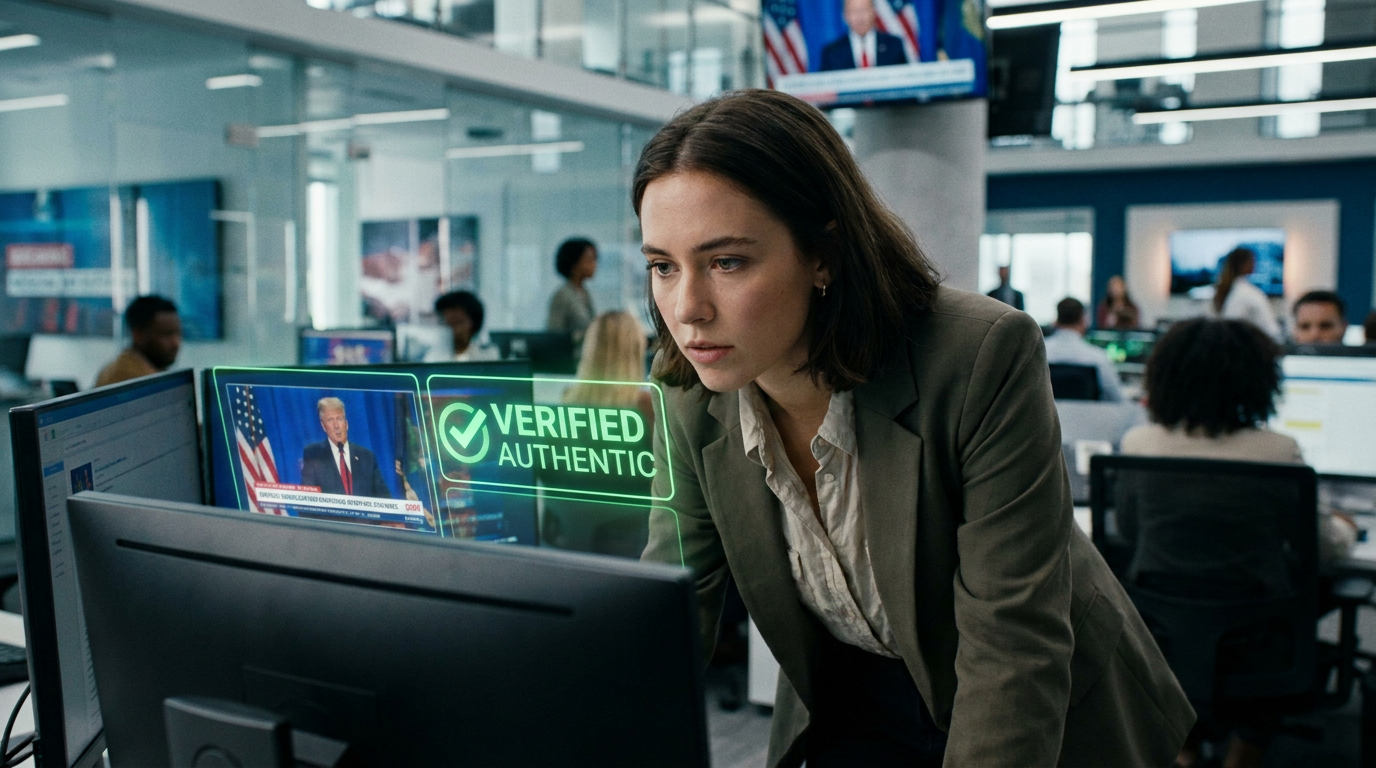
Cryptographic provenance flips the script: instead of asking "is this fake?", it asks "can you prove this is real?" The Coalition for Content Provenance and Authenticity (C2PA), an alliance of major tech and media companies, has established a universal standard for embedding tamper-evident metadata into digital files. This standard, now in its 2.0 iteration, acts as a digital nutrition label, recording the exact origin of a piece of media and every subsequent edit made to it. If a pixel is altered using generative AI, the cryptographic seal breaks, or the edit is permanently appended to the file's history.[2][4]

The true breakthrough of 2026 has been the hardware integration of this standard. Major camera manufacturers have begun baking C2PA cryptographic signing directly into the silicon of their professional and prosumer camera bodies. When a photojournalist captures an image at a political rally, the camera itself cryptographically signs the file using a secure enclave, verifying the exact time, location, and light data. This creates an unbroken chain of trust from the camera sensor to the voter's smartphone screen, making it mathematically impossible to seamlessly insert a fake image into the verified news stream.[2][4]
The effectiveness of these tools ultimately depends on human behavior, which is where recent sociological data provides the most encouraging news. A comprehensive study by the Pew Research Center found that the public is rapidly adapting to these new digital signals. When social media platforms display a "Content Credentials" badge—indicating that a piece of media has verified provenance—user trust in that specific content increases by 42%. Conversely, when media lacks provenance or carries an "AI Generated" warning, users demonstrate a significantly higher degree of skepticism.[5]
Furthermore, the Reuters Institute for the Study of Journalism tracked the sharing habits of voters encountering labeled synthetic media during the early 2026 primaries. Their data revealed that the simple friction of a platform label reduced the viral sharing of false political claims by nearly 60%. Voters, it turns out, do not want to be duped or share embarrassing fakes with their networks. When provided with clear, standardized visual cues about a file's origin, the vast majority of users choose not to amplify unverified or synthetic content.[7]

The system is not without its vulnerabilities. The most persistent challenge remains the "analog hole"—the process of physically recording a screen displaying synthetic media with a verified camera, thereby wrapping a fake image in a real cryptographic signature. While platforms are developing secondary checks to identify screen-recorded content, this physical workaround highlights the ongoing need for traditional, human-led investigative journalism to contextualize digital evidence.[1][2]
Another area of ongoing debate centers around open-source AI models. While commercial platforms like OpenAI and Google mandate C2PA watermarking on all generated outputs, open-weight models can be modified by end-users to strip these protections. Free speech advocates and open-source developers argue that decentralized AI is essential to prevent a few massive corporations from controlling the flow of information, even if it makes the job of fact-checkers marginally more difficult. This tension between security and open access remains a defining feature of the current technological landscape.[1][8]
Ultimately, the evidence from the 2026 cycle suggests that the apocalyptic predictions regarding AI and democracy were overstated. We are not entering a post-truth era, but rather a "verify-first" era. The combination of highly accurate detection algorithms, hardware-level cryptographic provenance, and an increasingly media-literate public has created a resilient information ecosystem. By providing voters with the tools to see exactly where their media comes from, the technology industry has offered a practical, empowering solution to one of the digital age's most daunting challenges.[1][3][5]
How we got here
Late 2022
The public release of advanced generative AI models sparks widespread concern over undetectable political deepfakes.
2023
The C2PA coalition gains major industry backing, standardizing the technical framework for cryptographic provenance.
2024
Early political deepfakes test social media platforms, leading to the first widespread implementation of 'AI Generated' warning labels.
2025
Major hardware manufacturers begin integrating C2PA cryptographic signing directly into professional camera sensors.
Early 2026
Data reveals that a combination of hardware provenance and platform labeling is successfully curbing the spread of synthetic political media.
Viewpoints in depth
Cryptographic Provenance Advocates
Argue that the only sustainable solution to deepfakes is proving what is real at the hardware level, rather than endlessly chasing fakes.
This camp, led by organizations like the C2PA and major hardware manufacturers, believes that the adversarial nature of AI makes post-generation detection a losing battle. As AI generators improve, they will inevitably learn to bypass software detectors. Therefore, the only mathematically sound defense is to secure the point of capture. By baking cryptographic signatures into camera silicon, they aim to create a 'whitelist' of reality, where any media lacking a verified signature is automatically treated with skepticism by default.
Detection Algorithm Developers
Focus on building advanced AI models that can catch synthetic artifacts post-generation, serving as a necessary net for unwatermarked content.
Researchers in this space argue that while cryptographic provenance is ideal for professional journalism, it does not solve the problem of the billions of legacy images and unverified smartphone videos already circulating online. They emphasize the necessity of robust, passive detection systems that can analyze pixel noise, audio frequencies, and biological inconsistencies. Their evidence points to the high success rates of current models in identifying deepfakes, arguing that detection will always be a required layer of defense for the vast majority of user-generated content.
Media Literacy Researchers
Emphasize that human psychology and platform friction are more effective at stopping misinformation than perfect backend technology.
This perspective shifts the focus from the technology to the user. Researchers point to data showing that even imperfect warning labels drastically reduce the sharing of false information. They argue that the goal shouldn't be a flawless technological filter, which is likely impossible, but rather the introduction of enough 'friction' to make users pause and think. By standardizing visual cues like Content Credentials, they believe society can build a natural psychological immunity to synthetic media, empowering voters to make their own informed decisions.
What we don't know
- How effectively open-source developers will be able to bypass or strip cryptographic watermarks in the future.
- Whether the 'analog hole' (recording a screen with a verified camera) can be reliably solved by secondary software checks.
- The long-term impact of 'provenance fatigue,' where users might begin to ignore verification badges if they become too ubiquitous.
Key terms
- Cryptographic Provenance
- A secure, mathematically verifiable method of recording the origin and edit history of a digital file, ensuring it hasn't been secretly altered.
- C2PA
- The Coalition for Content Provenance and Authenticity, an alliance of tech and media companies that created the open standard for digital watermarking.
- Content Credentials
- The consumer-facing term and visual badge used to show users the verified history and origin of an image or video.
- Analog Hole
- A vulnerability where digital protections are bypassed by converting media to a physical format and back, such as recording a computer monitor with a smartphone.
- Synthetic Media
- A catch-all term for images, video, or audio that has been entirely generated or significantly altered by artificial intelligence.
Frequently asked
Can C2PA watermarks be removed by bad actors?
While metadata can be stripped from a file, doing so breaks the cryptographic seal. Platforms will then flag the content as lacking provenance, which alerts users to treat it with suspicion.
Does AI detection work on generated text?
Text detection remains highly unreliable compared to audio and video. Because text lacks physical artifacts like pixels or soundwaves, AI-generated essays or tweets are incredibly difficult to definitively prove as synthetic.
What is the 'analog hole'?
The analog hole refers to the physical workaround where someone uses a real, verified camera to record a screen playing a deepfake video, thereby giving the fake content a 'real' cryptographic signature.
Do voters actually care about AI warning labels?
Yes. Recent data shows that clear platform warnings reduce the viral sharing of false political claims by nearly 60%, indicating that most users do not want to spread known fakes.
Sources
Source coverage
8 outlets
4 viewpoints surfaced








[1]Factlen Editorial Team
Synthesis by Factlen editorial team
Read on Factlen Editorial Team →[2]Coalition for Content Provenance and AuthenticityCryptographic Provenance Advocates
C2PA Technical Specification 2.0: Cryptographic Provenance
Read on Coalition for Content Provenance and Authenticity →[3]Stanford Internet ObservatoryDetection Algorithm Developers
Evaluating the Efficacy of AI Detection Tools in the 2026 Midterms
Read on Stanford Internet Observatory →[4]MIT Technology ReviewCryptographic Provenance Advocates
Why cryptographic watermarking is winning the war on deepfakes
Read on MIT Technology Review →[5]Pew Research CenterMedia Literacy Researchers
Public Trust and Content Credentials in Digital Media
Read on Pew Research Center →[6]IEEE Transactions on Information Forensics and SecurityDetection Algorithm Developers
Robustness of Audio Deepfake Detection Algorithms in High-Noise Environments
Read on IEEE Transactions on Information Forensics and Security →[7]Reuters Institute for the Study of JournalismMedia Literacy Researchers
The Impact of Platform Labels on Voter Behavior and Misinformation Sharing
Read on Reuters Institute for the Study of Journalism →[8]arXivOpen-Source Advocates
Adversarial Attacks on Synthetic Image Detectors: A 2026 Retrospective
Read on arXiv →
More in news politics
See all 5 stories →Election Integrity
The Evidence Pack: How Accurate Are Open-Source Deepfake Detectors in 2026?
7 sources
Strait of Hormuz
Iran Threatens Strait of Hormuz Closure as US and Iranian Delegations Arrive in Switzerland for Emergency Talks
7 sources

Geneva Summit
U.S. and Iranian Delegations Open High-Stakes Peace Talks in Switzerland
6 sources

Every angle. Every day.
Get news politics stories with full source coverage and perspective breakdowns delivered to your inbox.