
SpaceX's $2.1 Trillion IPO Triggers a Historic Scramble Among Index Funds
SpaceX has executed the largest initial public offering in history, raising $75 billion and forcing major stock indexes to rewrite their inclusion rules to absorb the mega-cap giant.
By Factlen Editorial Team
- Passive Fund Managers
- Focused on the mechanical challenges of absorbing a massive company with a tiny public float without distorting market prices.
- Growth Investors
- View the IPO as a generational opportunity to gain public market exposure to the space economy and frontier artificial intelligence.
- Market Skeptics
- Warn that the combination of a $2.1 trillion valuation, low float, and forced index buying will decouple the stock's price from its fundamental earnings.
What's not represented
- · Retail investors who were priced out of the initial allocation
- · Competitors in the aerospace and AI sectors reacting to SpaceX's new public war chest
Why this matters
If you hold a 401(k) or a broad market index fund, you are about to become a SpaceX shareholder whether you actively chose to or not. The sheer size of this listing is forcing the plumbing of the stock market to adapt in real-time, dictating where billions of passive retirement dollars will flow in the coming weeks.
Key points
- SpaceX's $75 billion IPO is the largest in history, valuing the company at $2.1 trillion after its first day of trading.
- The newly public entity includes launch operations, Starlink, and the recently merged xAI subsidiary.
- Only about 4.25% of the company's equity is freely trading, creating a massive 'low float' environment.
- Nasdaq and FTSE Russell have altered their rules to fast-track SpaceX into their indexes within days.
- S&P Dow Jones is refusing to bend its rules, requiring a standard 12-month seasoning period.
- Index inclusion will force passive funds to buy billions in SPCX stock, potentially distorting its price.
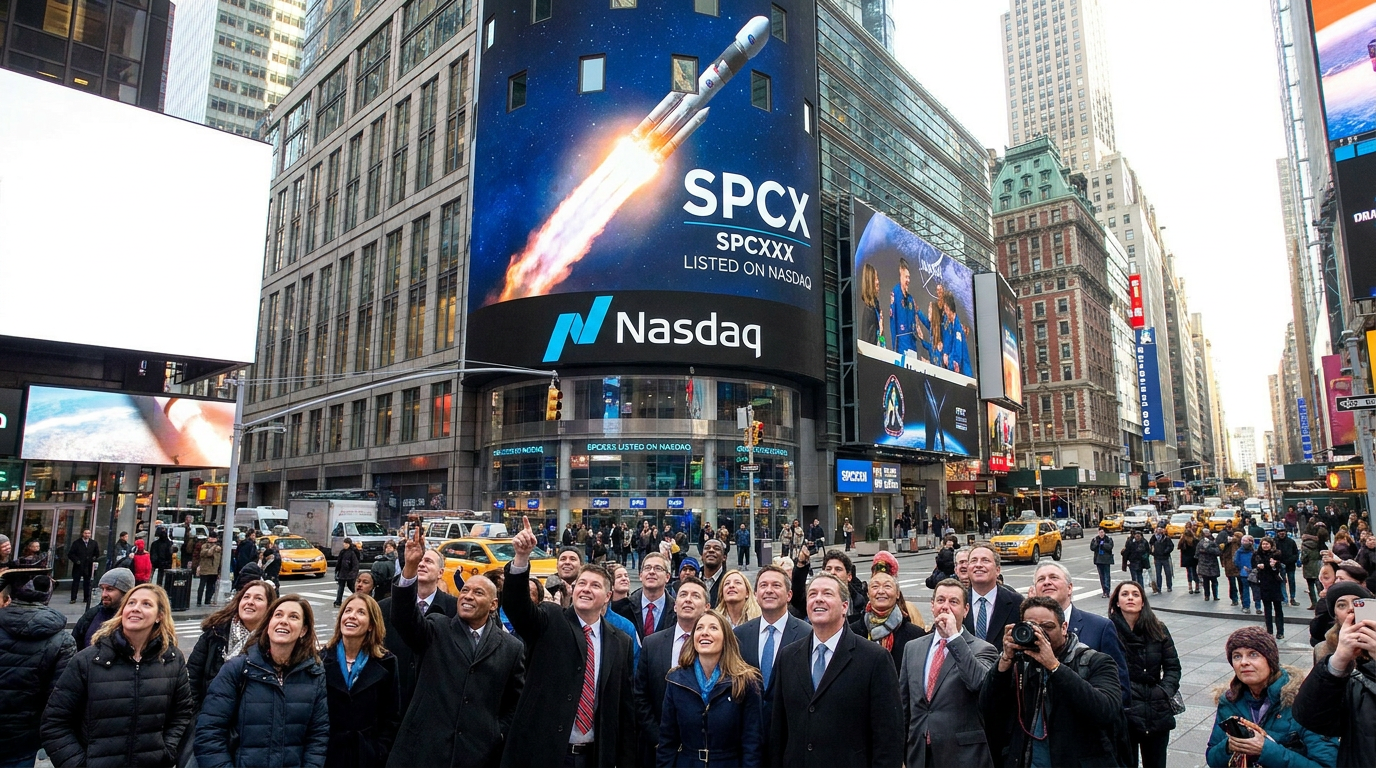
After nearly a quarter-century as a private enterprise, SpaceX has officially entered the public markets, executing an initial public offering that shatters every historical precedent. Trading under the ticker SPCX, the aerospace and artificial intelligence behemoth debuted on the Nasdaq on June 12, 2026, instantly becoming the sixth-largest public company in America.[2][4]
The scale of the offering is difficult to overstate. SpaceX raised $75 billion, roughly three times the previous global record set by Saudi Aramco's $25.6 billion offering in 2019, and dwarfing Alibaba's 2014 technology benchmark of $21.8 billion. By the time the closing bell rang on its first day of trading, the company's valuation had swelled to a staggering $2.1 trillion.[2][4][5]

The mechanics of the debut were as unconventional as the company itself. Rather than offering the customary price range to gauge institutional appetite, SpaceX presented investors with a take-it-or-leave-it pre-open price of $135 per share. The offering was reportedly four times oversubscribed. When public trading commenced, shares immediately popped, reaching an intraday high of $176 before settling at $160—a 19% first-day gain.[2]
Investors buying into SPCX are effectively purchasing three distinct mega-businesses housed under one ticker, following the company's February 2026 merger with the artificial intelligence startup xAI. The foundation is the launch operation, anchored by the workhorse Falcon 9 rocket, which currently commands approximately 90% of the global commercial launch market.[5]
The second pillar is Starlink, the satellite internet constellation that underwriters project will reach 100 million subscribers and $140 billion in annual revenue by 2030. The final, and perhaps most heavily weighted component, is xAI. Underwriters estimate that by the end of the decade, the artificial intelligence subsidiary could represent 70% of SpaceX's total business, requiring up to $300 billion in capital expenditure.[5]

The final, and perhaps most heavily weighted component, is xAI.
But while retail investors celebrated the historic debut, the sheer mass of the $2.1 trillion company has triggered a quiet crisis in the back offices of Wall Street. The core issue is "float"—the percentage of a company's shares that are actually available for public trading. Because insiders retained massive control, the $75 billion raised represents only about 4.25% of the company's total equity.[3]
This tiny float creates a severe headache for passive index funds, which automatically buy stocks to mirror benchmarks like the Nasdaq-100 or the Russell 1000. If an index adds a $2.1 trillion company, passive funds must buy billions of dollars of that stock. But with so few shares actually circulating, a sudden wave of mechanical buying could trigger massive supply-demand imbalances, driving the price up based purely on scarcity rather than fundamentals.[3][4]
Faced with the largest market capitalization shift in modern history, major index providers are fracturing over how to handle the inclusion. The rules of engagement are being rewritten in real-time. FTSE Russell introduced a "fast-entry" rule, allowing mega-IPOs into its portfolios after just five days of trading. Nasdaq similarly tweaked its methodology, eliminating its 10% minimum float requirement and allowing top-40 ranked companies to join the flagship Nasdaq-100 index in just 15 trading days.[3][4]
Conversely, S&P Dow Jones Indices has opted to hold the line. Following a consultation with market participants in late May, the provider announced it would make no exceptions for mega-cap companies. SpaceX will still have to meet the S&P 500's strict criteria: a 12-month public seasoning period, four consecutive quarters of positive earnings, and an investable weight factor of at least 10%.[4]

This divergence means that the initial retail frenzy is only the first chapter of the SPCX trading story. A massive "second wave" of institutional cash is waiting to strike as the fast-track index inclusions take effect. Analysts estimate that index funds could be forced to absorb up to 24% of SpaceX's available public float by day 15, creating intense, price-agnostic liquidity demand.[1][5]
For the broader financial ecosystem, the SpaceX offering is a watershed moment that tests the plumbing of passive investing. It proves that the public markets can digest a multi-trillion-dollar debut, paving the way for a highly anticipated pipeline of other private mega-caps. With AI heavyweights like Anthropic and OpenAI reportedly preparing for their own public offerings, the equity landscape of the late 2020s is being radically reshaped.[4][5]
How we got here
February 2026
SpaceX officially merges with Elon Musk's artificial intelligence startup, xAI, consolidating the businesses under one roof.
May 2026
Index providers Nasdaq and FTSE Russell announce rule changes to allow mega-cap IPOs to enter their benchmarks on accelerated timelines.
June 12, 2026
SpaceX debuts on the Nasdaq at a pre-set price of $135, raising $75 billion in the largest IPO in history.
Late June 2026
SpaceX is scheduled to be mechanically added to the Nasdaq-100 and Russell indexes, triggering a wave of mandatory institutional buying.
Viewpoints in depth
Index Providers & Passive Funds
Focused on the mechanical execution of absorbing a multi-trillion-dollar company without breaking the market.
For the architects of passive investing, the SpaceX IPO is a stress test of market plumbing. Trillions of dollars in retirement accounts are tied to indexes like the Nasdaq-100 and the Russell 1000. When a company debuts at a $2.1 trillion valuation, those indexes must reflect its existence, forcing passive fund managers to buy the stock regardless of its price. Providers like Nasdaq and FTSE Russell argue that fast-tracking inclusion is necessary so their indexes accurately reflect the modern economy. However, managers executing these trades worry that the mechanical buying pressure, combined with SpaceX's tiny 4.25% float, will create a severe supply bottleneck, forcing them to pay artificially inflated prices just to meet their benchmark requirements.
Growth Investors
Viewing the IPO as a rare chance to buy into a monopolistic space business and a leading AI lab simultaneously.
For active growth managers and retail investors, the mechanical headaches of index inclusion are secondary to the fundamental narrative. They view SPCX not just as a rocket company, but as a three-headed monopoly. Falcon 9 already controls 90% of the commercial launch market, Starlink is scaling a high-margin global internet utility, and the recent integration of xAI positions the company at the frontier of artificial intelligence. Bulls argue that while a $2.1 trillion valuation is steep, the combined total addressable market of global telecommunications, space logistics, and enterprise AI justifies the premium, making the stock a mandatory cornerstone for any forward-looking growth portfolio.
Market Traditionalists
Concerned that the sheer size and structure of the offering bypasses traditional price discovery and governance norms.
Skeptics and market traditionalists point to the highly unusual structure of the IPO as a red flag. By offering a take-it-or-leave-it price of $135 and floating less than 5% of the company, insiders have engineered a scenario where scarcity dictates the price rather than fundamental earnings analysis. Traditionalists applaud S&P Dow Jones for refusing to waive its 12-month seasoning rule, arguing that mega-cap private companies should have to prove their financial viability in the public eye before being automatically subsidized by the retirement savings of everyday index fund investors.
What we don't know
- How severely the mechanical buying from passive index funds will distort SpaceX's share price over the next 30 days.
- Whether the successful fast-track inclusion of SpaceX will encourage other massive private companies, like OpenAI or Stripe, to immediately follow suit.
- How the public markets will value the xAI subsidiary's massive projected capital expenditures against the profitable launch business.
Key terms
- Float
- The number of a company's shares that are actually available to be traded by the public, excluding closely held shares owned by insiders or founders.
- Passive Index Fund
- A mutual fund or ETF designed to automatically track the components of a financial market index, such as the S&P 500, rather than relying on a manager to pick stocks.
- Investable Weight Factor (IWF)
- A metric used by index providers to adjust a company's market capitalization based on how many of its shares are actually available to the public.
- Price Discovery
- The process by which the open market determines the fair value of an asset through the continuous interaction of buyers and sellers.
Frequently asked
How much did SpaceX raise in its IPO?
SpaceX raised $75 billion, making it the largest initial public offering in history by a wide margin.
What businesses are included in the SPCX ticker?
The public company includes the Falcon 9 launch operations, the Starlink satellite internet business, and the xAI artificial intelligence subsidiary, which merged with SpaceX in early 2026.
Will SpaceX be added to the S&P 500 immediately?
No. While Nasdaq and FTSE Russell bent their rules to allow fast-track entry, S&P Dow Jones is maintaining its requirement that companies trade publicly for 12 months before inclusion.
Why is the stock's 'float' causing problems?
Only about 4.25% of SpaceX's total equity is available for public trading. When massive index funds are forced to buy the stock to match their benchmarks, this scarcity of available shares could artificially drive up the price.
Sources
Source coverage
6 outlets
3 viewpoints surfaced





[1]MarketWatchMarket Skeptics
The initial SpaceX frenzy is cooling off — but a new wave of cash is waiting to strike
Read on MarketWatch →[2]The GuardianGrowth Investors
SpaceX targets biggest ever stock market debut, putting Musk on course to be trillionaire
Read on The Guardian →[3]MorningstarPassive Fund Managers
The SpaceX IPO: How Index Funds Are Adapting
Read on Morningstar →[4]CME GroupPassive Fund Managers
The SpaceX Mega-IPO: Why Index Choice Matters
Read on CME Group →[5]Neuberger BermanGrowth Investors
The SpaceX IPO is without precedent in scale and structure
Read on Neuberger Berman →[6]BNN BloombergMarket Skeptics
SpaceX shares tumble as post-IPO frenzy loses steam
Read on BNN Bloomberg →

Every angle. Every day.
Get finance stories with full source coverage and perspective breakdowns delivered to your inbox.