
The Infinite Canvas: How Vertical-Scroll Webtoons Conquered the Global Comic Industry
Optimized for smartphones and fueled by micro-transactions, vertical-scrolling webcomics have transformed a niche South Korean format into a multi-billion-dollar global entertainment engine.
By Factlen Editorial Team

- Independent Creators
- Value the democratization of publishing and direct monetization, while navigating the intense pressure of weekly production schedules.
- Digital Platform Operators
- Focus on user acquisition, frictionless mobile reading, and scaling intellectual property into global franchises.
- Traditional Publishers
- Adapting to the digital shift by partnering with webtoon platforms to reach younger, mobile-first audiences.
- Media Theorists
- Analyze the vertical format as the realization of the infinite canvas, fundamentally changing comic pacing and visual storytelling.
What's not represented
- · Traditional comic book retailers
- · Print manufacturers
Why this matters
Vertical-scroll comics have fundamentally rewired how millions of people read, creating a multi-billion-dollar creator economy that bypasses traditional publishers and serves as the new incubator for global film and television franchises.
Key points
- Vertical-scroll comics have replaced traditional page-turning for millions of mobile readers.
- The global webtoon market reached $10.85 billion in 2025 and is growing rapidly.
- The format utilizes an 'infinite canvas' that allows creators to control pacing through vertical space.
- Open-publishing platforms have democratized the industry, allowing independent artists to build massive audiences.
- Top creators earn substantial income through micro-transactions, ad-sharing, and IP adaptations.
- Traditional comic publishers are now partnering with webtoon platforms to reach mobile-first readers.
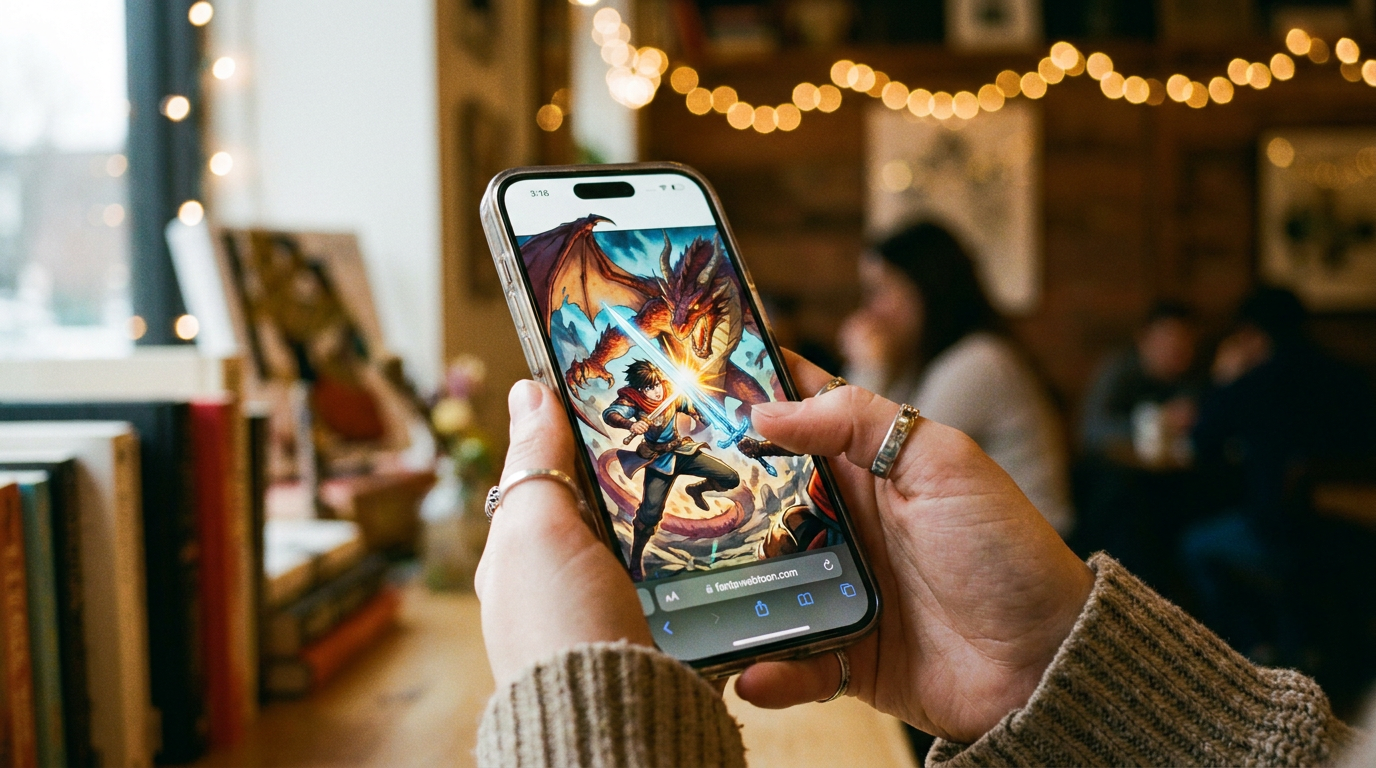
For decades, the comic book industry was defined by the physical dimensions of the printed page. Artists meticulously arranged panels into grids, forcing readers to scan left-to-right, top-to-bottom, and physically turn the page to reveal a cliffhanger. Today, that fundamental architecture has been dismantled by the smartphone. The modern comic reader does not turn pages; they scroll. Vertical-scrolling digital comics, widely known as webtoons, have fundamentally rewired how sequential art is consumed, transforming a niche South Korean digital format into a dominant global entertainment engine.[1][7]
The mechanism behind this shift is elegantly simple but profoundly disruptive. Instead of constraining art to a fixed rectangular page, webtoons utilize an "infinite canvas"—a continuous, borderless vertical strip. Readers simply swipe upward on their mobile devices, pulling the story up from the bottom of the screen. This format dictates a completely different rhythm of reading. Creators can manipulate the physical distance between panels to control pacing, using long stretches of negative space to build suspense or simulate the passage of time before a major reveal.[6][7]
The concept of the infinite canvas was famously predicted in the year 2000 by comic theorist Scott McCloud in his seminal book Reinventing Comics. McCloud argued that digital environments would eventually free artists from the arbitrary constraints of print, allowing stories to flow in any direction. While early Western attempts at infinite canvas comics were often clunky, relying on desktop web browsers and complex clicking mechanics, the true realization of McCloud's vision arrived via South Korea's aggressive adoption of high-speed mobile internet.[6]
In the early 2000s, South Korean tech giants like Daum and Naver launched digital comic portals designed specifically for mobile phones. By abandoning the traditional page layout in favor of a single vertical scroll, they removed the friction of zooming and panning on small screens. The format, dubbed "webtoon," exploded in popularity domestically. Today, Naver Webtoon (operating globally simply as Webtoon) and its rival Kakao Entertainment dominate a market that has expanded far beyond its East Asian origins.[3][4]

The financial scale of this transition is staggering. Industry analysts valued the global webtoon market at approximately $10.85 billion in 2025, with projections suggesting it could surge past $60 billion by 2031. This growth is driven by a compound annual growth rate exceeding 33%, vastly outpacing the traditional print comic and manga sectors. While the Asia-Pacific region still commands roughly 60% of the market share, North America and Europe are experiencing massive surges in readership and revenue per user.[3][4]
What makes the webtoon ecosystem particularly potent is its democratization of publishing. Unlike the traditional comic industry, which relies on editorial gatekeepers and expensive print distribution, webtoon platforms operate on an open-publishing model. Anyone with a digital drawing tablet and an internet connection can upload their work to community portals like Webtoon's Canvas. This frictionless entry has led to a proliferation of diverse genres—particularly romance, fantasy, and slice-of-life—that historically struggled to find shelf space in superhero-dominated Western comic shops.[2][8]
For creators who build an audience, the economics can be life-changing. Professional creators on major platforms are compensated through a multi-tiered revenue-sharing model. The primary engine is paid content, most notably micro-transaction systems like Webtoon's Fast Pass. Readers can read the latest episodes for free, or pay a small fee (typically around 50 to 70 cents) to unlock advanced chapters immediately. This model capitalizes on reader anticipation without erecting a hard paywall.[2][5]

For creators who build an audience, the economics can be life-changing.
Beyond micro-transactions, creators earn money through ad-revenue sharing, direct fan tipping, and subscription models. According to corporate disclosures, the average annual income for a professional creator on Webtoon's English-language platform sits around $48,000, while the top 100 creators average over $1 million annually. Since 2020, the platform has paid out tens of millions of dollars to English-language creators, establishing a robust middle class of working artists that the traditional indie comic scene has rarely been able to sustain.[2][5]
The cultural impact of vertical-scroll comics now extends far beyond the apps themselves. Webtoons have become the premier incubator for global intellectual property. In South Korea, webtoons are the foundational source material for a massive percentage of hit K-dramas and films. This pipeline has now gone global. Titles like Solo Leveling and Tower of God have been adapted into blockbuster anime series, while Western hits like Rachel Smythe's Lore Olympus have topped the New York Times bestseller list as physical graphic novels and entered television development.[2][4]
Traditional comic publishers have recognized the existential threat—and the opportunity—presented by the vertical scroll. Rather than fighting the format, legacy titans are joining it. Marvel, DC Comics, and Archie Comics have all forged partnerships with webtoon platforms to release vertical-scrolling series featuring their iconic characters. These collaborations are explicitly designed to reach the massive, mobile-first, and heavily female-skewing demographic that frequents webtoon apps, a demographic that traditional comic shops have often struggled to attract.[4][5]
The production pipeline for a weekly webtoon is notoriously demanding. Because the format relies on frequent, episodic engagement to maintain reader interest and algorithmic visibility, professional creators are typically expected to deliver a new, fully colored chapter every week. A single vertical episode often contains 40 to 60 panels—the equivalent of a 20-page traditional comic book. This relentless schedule has sparked industry-wide conversations about creator burnout and the physical toll of digital illustration.[1][2]

To meet these deadlines, artists have pioneered new, highly efficient production techniques. The use of 3D modeling software to generate complex backgrounds is now industry standard, allowing creators to drop characters into pre-rendered environments rather than drawing cityscapes from scratch every week. Digital asset libraries for everything from crowd scenes to magical special effects enable solo creators or small teams to produce high-fidelity art at a blistering pace.[7][8]
The transition to digital-first reading has also introduced new multimedia possibilities. Some platforms are experimenting with embedded sound effects, haptic feedback that vibrates the phone during action sequences, and subtle animations that trigger as the reader scrolls past specific panels. While these features remain secondary to the core artwork, they represent the ongoing evolution of the medium as it fully embraces its digital-native environment.[7][8]

As the market matures, the competition between platforms is intensifying. Tech conglomerates are aggressively expanding their localization efforts, translating hit series into dozens of languages simultaneously to capture emerging markets in Latin America and the Middle East. The battle for exclusive creator contracts is driving up advances and revenue splits, mirroring the streaming wars in the television industry.[3][4]
Ultimately, the triumph of the vertical-scroll comic is a testament to the power of user-centric design. By adapting the medium to fit the device that people already carry in their pockets, rather than forcing readers to adapt to a legacy format, webtoons have unlocked a massive new global audience for sequential art. The infinite canvas is no longer a theoretical concept; it is the foundation of the modern comic industry.[1][6]
How we got here
2000
Scott McCloud publishes Reinventing Comics, proposing the infinite canvas concept for digital storytelling.
2004
Naver launches its digital comic portal in South Korea, pioneering the vertical-scroll format.
2014
Line Webtoon launches globally, translating popular Korean titles into English and expanding the market.
2019
Webtoon introduces its US creator-monetization program, establishing a robust creator economy.
2025
The global webtoon market surpasses $10.8 billion in valuation, driven by massive mobile engagement.
Viewpoints in depth
Digital Platform Operators
Focus on user acquisition, frictionless mobile reading, and scaling intellectual property into global franchises.
For tech conglomerates like Naver and Kakao, the vertical scroll is primarily a frictionless delivery mechanism designed to maximize mobile engagement. By removing the need to pinch and zoom, platforms keep readers locked into the app for longer sessions. These operators view webtoons not just as an end product, but as the top of a massive intellectual property funnel. The ultimate goal is to use engagement data to identify hit stories, which are then aggressively licensed into lucrative film, television, and video game adaptations.
Independent Creators
Value the democratization of publishing and direct monetization, while navigating the intense pressure of weekly production schedules.
Independent artists celebrate the webtoon format for bypassing the traditional editorial gatekeepers of the print comic industry. The open-platform model allows creators to find niche audiences and monetize directly through micro-transactions and ad-sharing. However, this democratization comes with severe physical demands. The algorithmic necessity of publishing a full-color, 50-panel episode every week has led to widespread burnout, forcing creators to rely heavily on 3D assets and digital shortcuts to survive the grueling production cycle.
Traditional Publishers
Adapting to the digital shift by partnering with webtoon platforms to reach younger, mobile-first audiences.
Legacy comic publishers initially viewed digital platforms as secondary distribution channels for their print catalogs. However, as the webtoon market eclipsed traditional print sales, titans like Marvel and DC recognized the need to adapt. Rather than forcing mobile readers to navigate clunky digital PDFs of printed pages, these companies are now producing original, vertical-scrolling content. This strategy is explicitly aimed at capturing the massive, diverse, and younger demographic that frequents webtoon apps but rarely visits physical comic shops.
Media Theorists
Analyze the vertical format as the realization of the infinite canvas, fundamentally changing comic pacing and visual storytelling.
Academics and comic theorists view the webtoon as the fulfillment of the 'infinite canvas'—a concept where digital space frees the artist from the physical borders of a page. Theorists note that vertical scrolling fundamentally alters the grammar of sequential art. Instead of reading a grid of panels, the reader controls the flow of time by scrolling. Creators can use vast amounts of empty vertical space to build tension, isolate a character, or simulate a long fall, creating a cinematic pacing that is impossible to replicate in print.
What we don't know
- Whether the rapid growth of the webtoon market will eventually cannibalize the remaining print comic industry.
- How emerging generative AI tools will impact the grueling weekly production schedules of professional creators.
- If Western platforms can successfully challenge the dominance of South Korean tech giants in the global market.
Key terms
- Webtoon
- A digital comic formatted as a continuous vertical scroll, optimized for reading on smartphones.
- Infinite Canvas
- A digital storytelling concept where the reading space is not constrained by the physical dimensions of a printed page.
- Fast Pass
- A micro-transaction model where readers pay a small fee to unlock and read upcoming comic chapters before their free public release.
- IP Adaptation
- The process of taking intellectual property, like a popular webcomic, and turning it into a television show, movie, or video game.
- Manhwa
- The general Korean term for comics and print cartoons, which served as the cultural precursor to modern digital webtoons.
Frequently asked
What exactly is a webtoon?
A webtoon is a digital comic designed specifically for smartphones. Instead of turning pages, readers scroll vertically through a continuous strip of artwork.
How do webtoon creators make money?
Creators earn revenue through a mix of micro-transactions (where readers pay to read chapters early), ad-revenue sharing, direct fan tipping, and licensing their work for film or television adaptations.
What is the 'infinite canvas'?
It is a digital storytelling concept where comics are freed from the physical borders of a printed page, allowing artwork and panels to flow continuously in any direction.
Are webtoons replacing traditional comic books?
While print comics still maintain a dedicated collector market, webtoons have captured the vast majority of digital growth and mobile readership, prompting traditional publishers to adapt.
Sources
Source coverage
8 outlets
4 viewpoints surfaced








[1]Factlen Editorial TeamIndependent Creators
Synthesis by Factlen editorial team
Read on Factlen Editorial Team →[2]ForbesIndependent Creators
How Do Webtoon Creators Make Money? How Much Do They Generally Make?
Read on Forbes →[3]Mordor IntelligenceDigital Platform Operators
Webtoons Market Analysis by Mordor Intelligence
Read on Mordor Intelligence →[4]Fortune Business InsightsDigital Platform Operators
Webcomics Market Size, Share & Industry Analysis
Read on Fortune Business Insights →[5]WebtoonDigital Platform Operators
English-Language WEBTOON Creator Payments Surpass $27 Million Since 2020
Read on Webtoon →[6]Scott McCloudMedia Theorists
The Infinite Canvas
Read on Scott McCloud →[7]ResearchGateMedia Theorists
Digital Comics and Webtoons: Format Innovation
Read on ResearchGate →[8]Coherent Market InsightsTraditional Publishers
Webcomics Market Size and Trends
Read on Coherent Market Insights →


Every angle. Every day.
Get entertainment stories with full source coverage and perspective breakdowns delivered to your inbox.