
OLED vs. Mini-LED in 2026: Which TV Technology Actually Wins?
As Tandem OLED and RGB Mini-LED technologies close the performance gap in 2026, choosing the right TV now depends entirely on room lighting and viewing habits.
By Factlen Editorial Team
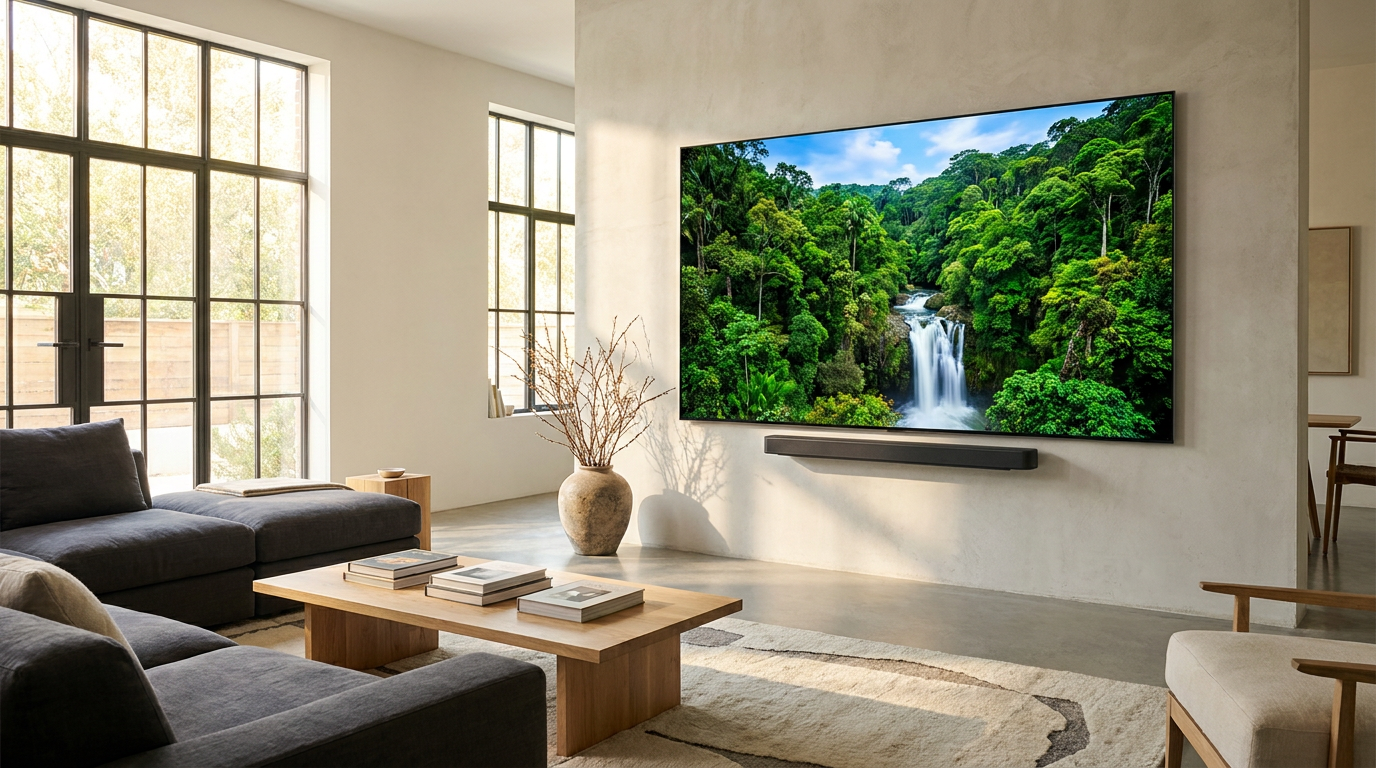
- Cinematic Purists
- Advocates for OLED technology prioritizing absolute black levels and contrast.
- Bright-Room Maximizers
- Advocates for Mini-LED technology focusing on sustained brightness and durability.
- Value & Large-Format Buyers
- Consumers and analysts focused on the price-to-size ratio in the premium TV market.
What's not represented
- · Budget-conscious buyers looking at standard Direct-Lit LED models under $400
Why this matters
A premium TV is a multi-year investment. Understanding the 2026 advancements in panel technology prevents buyers from overspending on the wrong display for their specific room lighting and daily habits.
Key points
- OLED delivers perfect black levels and infinite contrast through self-emissive pixels.
- Mini-LED achieves superior full-screen brightness, making it ideal for sunlit rooms.
- 2026 Tandem OLED technology significantly boosts peak brightness for HDR highlights.
- RGB Mini-LED panels now feature thousands of dimming zones to minimize blooming.
- Mini-LED offers significantly better value at massive screen sizes of 85 inches and above.
The television market in 2026 has reached a golden age of display technology, transforming what was once a simple choice into a complex engineering debate. For years, the dividing line was clear: buyers either paid a premium for the perfect blacks of OLED or settled for the brighter, cheaper, but less precise LCD panels. Today, that landscape has fundamentally shifted. The arrival of Tandem OLED and RGB Mini-LED architectures has blurred the traditional boundaries, creating two distinct heavyweight contenders that excel in entirely different environments.[7]
To understand the trade-offs, one must look at how each technology generates light. OLED, or Organic Light-Emitting Diode, relies on self-emissive pixels. When a scene calls for absolute black, the television's processor cuts the voltage to that specific pixel down to zero, emitting exactly zero nits of light. This pixel-level precision yields a mathematically infinite contrast ratio, ensuring dark cinematic scenes maintain rich depth without the distracting background haze typical of older displays.[3][5]
The case for OLED in 2026 centers on this unparalleled contrast and near-instant response times. Evidence from recent testing shows that in controlled, dark home theater environments, OLED consistently delivers the most impactful High Dynamic Range (HDR) experience. Furthermore, 2026 advancements like Tandem OLED—which stacks multiple light-emitting layers—have pushed peak brightness capabilities to between 1,500 and 2,300 nits in small highlights. For cinematic purists and competitive gamers who demand perfect shadow detail and zero motion blur, OLED remains the reference standard.[1][2][4]

However, the case against OLED involves its inherent thermal limitations and organic degradation. Because organic materials degrade rapidly under sustained heat, these panels utilize an Auto Brightness Limiter (ABL). While an OLED can hit 2,000 nits for a tiny star in a night sky, it cannot sustain that brightness across a full screen. If a bright hockey game or a white web browser fills the display, the ABL aggressively dims the entire panel to roughly 250 to 400 nits to protect the screen. Additionally, while 2026 models feature robust mitigation tools, the risk of permanent burn-in from static elements remains a factor for heavy productivity users.[4][5][6]
On the other side of the aisle sits Mini-LED, the ultimate evolution of traditional liquid crystal displays. Rather than self-emissive pixels, Mini-LED uses an inorganic backlight matrix composed of thousands of microscopic blue gallium-nitride diodes. In 2026, premium Mini-LED panels pack anywhere from 2,000 to over 5,000 individual local dimming zones. By dynamically turning off specific zones behind dark sections of the screen, Mini-LED mimics the deep blacks of OLED while harnessing the massive power of traditional semiconductor illumination.[4][5]
On the other side of the aisle sits Mini-LED, the ultimate evolution of traditional liquid crystal displays.
The case for Mini-LED is built entirely on sovereign-grade brightness and inorganic durability. Current-generation RGB Mini-LED displays routinely achieve peak brightness levels of 2,500 to 3,300 nits. More importantly, they can sustain a full-screen brightness of 800 to 1,200 nits without any ABL throttling. Evidence from display analysts confirms that in sunlit living rooms exceeding 300 lux of ambient light, Mini-LED maintains consistent, punchy visuals where OLED panels wash out or dim defensively. Furthermore, the inorganic nature of the backlight means there is absolutely zero risk of permanent burn-in, making it ideal for static news tickers, sports scorebugs, or PC taskbars.[2][4][5][6]

The primary argument against Mini-LED remains the blooming or halo effect. While 5,000 dimming zones is a massive improvement over older televisions, it still cannot match the 8.3 million individually controlled pixels of a 4K OLED. When displaying bright white text on a pitch-black background, a faint glow can sometimes be seen around the edges of the text as the backlight zones struggle to contain the light perfectly. Additionally, Mini-LED panels often suffer from narrower viewing angles, meaning the picture can degrade slightly for viewers sitting off-center in a wide seating arrangement.[1][2][3]
Pricing dynamics in 2026 also heavily influence the decision, particularly for buyers seeking massive screens. While 55-inch and 65-inch models see aggressive price overlap between the two technologies, a stark divergence occurs at larger sizes. A premium 97-inch OLED television remains a luxury item, often retailing north of $20,000. Conversely, highly capable 100-inch Mini-LED models have dropped below the $3,000 mark, offering nearly 90 percent of the performance for a fraction of the cost.[3][4]

Ultimately, there is no single winner in the 2026 display market; the victor depends entirely on the deployment environment. OLED fits perfectly when the television is placed in a light-controlled room, when the primary content is cinematic movies or dark-mode gaming, and when the buyer prioritizes perfect contrast over raw brightness.[7]
Conversely, Mini-LED fits perfectly when the display lives in a sun-drenched living room, when the household watches hours of bright sports or news programming, or when the screen doubles as a massive productivity monitor. It does not fit well for viewers who are highly sensitive to backlight blooming in dark rooms, just as OLED does not fit well for users who leave static interfaces on screen for twelve hours a day.[6][7]
How we got here
2013
The first commercial OLED TVs launch, establishing a new industry standard for perfect black levels and infinite contrast.
2019
Mini-LED technology enters the consumer market, offering a premium, high-brightness alternative to traditional LCDs.
2022
QD-OLED panels are introduced, combining quantum dot color technology with self-emissive OLED pixels.
2026
Tandem OLED and RGB Mini-LED architectures converge, significantly closing the traditional performance gaps between the two technologies.
Viewpoints in depth
Cinematic Purists
Advocates for OLED technology prioritizing absolute black levels and contrast.
This camp argues that the foundation of picture quality is contrast, not peak brightness. Because OLED pixels emit their own light and can turn off completely, they provide a mathematically infinite contrast ratio. Purists point out that in a dark home theater, the 1,000,000:1 contrast of an OLED creates a three-dimensional 'pop' that no LCD can match, making it the undisputed choice for film enthusiasts and competitive gamers who also benefit from near-instant pixel response times.
Bright-Room Maximizers
Advocates for Mini-LED technology focusing on sustained brightness and durability.
For this group, real-world viewing conditions dictate the technology choice. They argue that most living rooms are flooded with ambient daylight or overhead lighting, conditions where OLED's Auto Brightness Limiter (ABL) aggressively dims the screen. By championing Mini-LED, they emphasize the ability to sustain 800 to 1,200 nits of full-screen brightness without thermal throttling. Furthermore, they value the peace of mind that comes with an inorganic backlight, eliminating the burn-in anxiety associated with static UI elements or news tickers.
Value & Large-Format Buyers
Consumers and analysts focused on the price-to-size ratio in the premium TV market.
This perspective highlights the massive divergence in pricing at screen sizes above 77 inches. While 65-inch OLEDs and Mini-LEDs are competitively priced, scaling organic panels to 97 or 100 inches remains astronomically expensive. This camp argues that Mini-LED has democratized the true home cinema experience, allowing buyers to secure 100-inch premium displays for under $3,000—a fraction of the cost of a comparable OLED, making it the clear winner for massive living room installations.
What we don't know
- How long the new Tandem OLED panels will truly last before showing signs of burn-in under heavy use.
- Whether MicroLED technology will become affordable enough to replace both OLED and Mini-LED before 2030.
Key terms
- Tandem OLED
- A newer display architecture that stacks multiple light-emitting layers to increase peak brightness and extend panel lifespan.
- Local Dimming Zones
- Specific areas of a Mini-LED backlight that can dim or turn off independently to improve contrast and black levels.
- Auto Brightness Limiter (ABL)
- A safety protocol in OLED TVs that automatically dims the entire screen during bright scenes to prevent the organic materials from overheating.
- Blooming
- A visual artifact on LCD and Mini-LED screens where light bleeds from bright objects into surrounding dark areas, creating a faint halo.
Frequently asked
Does OLED still suffer from burn-in in 2026?
While the risk is significantly reduced through better thermal management and Tandem technology, OLEDs can still experience burn-in if heavy, static content is displayed over thousands of hours.
Which TV is better for a bright living room?
Mini-LED is the superior choice for bright rooms. It can sustain high full-screen brightness without dimming, easily overcoming glare and sunlight.
Are Mini-LED TVs good for gaming?
Yes, modern Mini-LEDs offer excellent gaming performance with high refresh rates and bright HDR, though OLED still holds a slight edge in absolute pixel response time.
Sources
Source coverage
7 outlets
3 viewpoints surfaced







[1]RTINGSCinematic Purists
The 7 Best TVs - Summer 2026
Read on RTINGS →[2]What Hi-Fi?Value & Large-Format Buyers
Best TVs 2026: flagship OLEDs and affordable Mini LEDs tested
Read on What Hi-Fi? →[3]TechRadarValue & Large-Format Buyers
OLED vs mini-LED: which TV tech is better?
Read on TechRadar →[4]DisplayMasterBright-Room Maximizers
The 2026 Display Dilemma: Which Tech Reigns Supreme?
Read on DisplayMaster →[5]TechStoryCinematic Purists
A deep structural analysis of OLED vs Mini LED display technology
Read on TechStory →[6]KTC PlayBright-Room Maximizers
The 2026 Prosumer Dilemma: Beyond Just Gaming
Read on KTC Play →[7]Factlen Editorial TeamValue & Large-Format Buyers
Synthesis by Factlen editorial team
Read on Factlen Editorial Team →

More in shopping
See all 7 stories →Luggage Tech
Hardside vs. Softside Luggage: The Complete Trade-Off Analysis
6 sources

Home Tech
How Ventless Heat Pump Combos Are Rewriting the Rules of Laundry
6 sources
Audio Tech
The Solid-State Audio Revolution: How Silicon Chips Are Replacing the 100-Year-Old Speaker
9 sources
Smart Home Tech
Matter over Thread vs. Wi-Fi: Choosing the Right Smart Home Protocol
7 sources
Every angle. Every day.
Get shopping stories with full source coverage and perspective breakdowns delivered to your inbox.