
How Veterans Treatment Courts Are Breaking the Cycle of Incarceration
By replacing adversarial punishment with court-supervised rehabilitation, specialized courts are dramatically lowering recidivism rates for justice-involved veterans.
By Factlen Editorial Team
- Therapeutic Jurisprudence Advocates
- Focus on addressing the root causes of criminal behavior through structured treatment.
- Criminal Justice Reformers
- Push for broader eligibility and the elimination of collateral legal consequences.
- Data & Policy Skeptics
- Demand more rigorous, standardized research to validate long-term outcomes.
What's not represented
- · Victims of crimes committed by veterans
- · Traditional probation officers
Why this matters
With over 600 operational courts nationwide, this model proves that addressing the root causes of crime—such as PTSD and substance abuse—can save lives, reduce taxpayer burdens, and safely reintegrate veterans into society.
Key points
- Veterans Treatment Courts divert former service members from traditional incarceration into court-supervised rehabilitation.
- The model relies on a non-adversarial team, including judges, prosecutors, and VA representatives.
- Volunteer veteran peer mentors provide critical cultural understanding and accountability.
- VTC participants reoffend at significantly lower rates than those processed through traditional courts.
- Critics argue eligibility requirements are often too strict, excluding veterans with severe trauma-induced charges.
The transition from military to civilian life is fraught with invisible hurdles. For thousands of American service members, the psychological toll of combat—manifesting as post-traumatic stress disorder (PTSD), traumatic brain injuries (TBI), or moral injury—can lead to severe readjustment challenges. Without adequate support, some veterans turn to self-medication through drugs or alcohol to cope with their trauma. This downward spiral frequently culminates in entanglement with the criminal justice system, transforming individuals who once served their country into criminal defendants facing incarceration.[3]
Historically, the traditional court system has processed these justice-involved veterans exactly like any other defendants. The standard adversarial model of justice focuses heavily on establishing guilt and administering punishment, often entirely ignoring the underlying service-related traumas that catalyzed the criminal behavior in the first place. Because traditional courts lack the specialized resources to address complex psychological injuries, many veterans find themselves caught in a devastating revolving door. They serve their time, are released without treatment, and quickly reoffend, leading to chronic recidivism, prolonged homelessness, and rapidly worsening mental health.[1]
To break this destructive cycle, the justice system introduced the Veterans Treatment Court (VTC). First established in Buffalo, New York, in 2008 by Judge Robert Russell, the VTC model was born out of a stark realization that traditional courts were fundamentally failing former service members. What began as a single experimental docket has since exploded into a nationwide movement. Today, there are over 600 operational VTCs across the United States, making it one of the fastest-growing and most widely supported specialty court models in the country.[1][3]
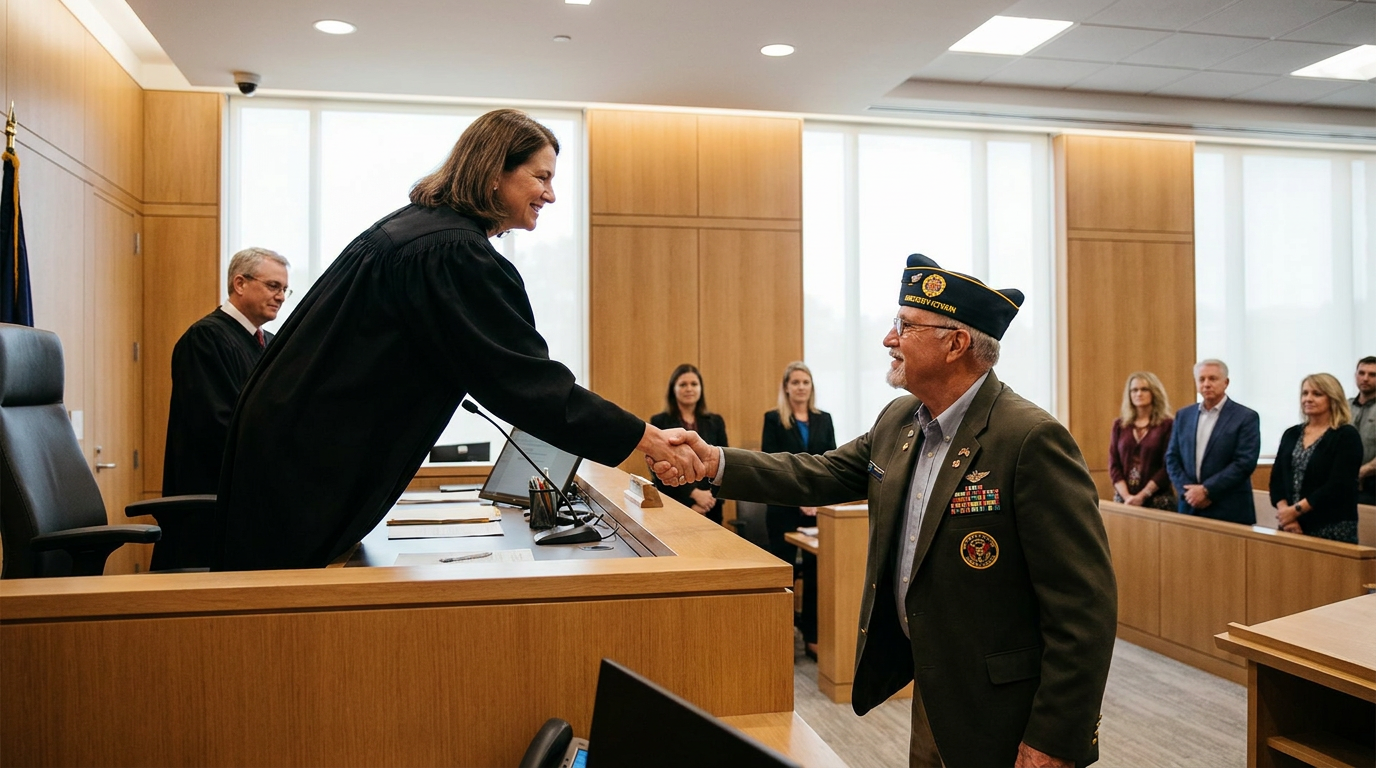
The core mechanism of a Veterans Treatment Court represents a radical departure from standard criminal proceedings. Instead of an adversarial battle where prosecutors and defense attorneys fight over convictions and sentencing, VTCs employ a collaborative, therapeutic approach. The presiding judge, the prosecutor, the defense attorney, probation officers, and mental health professionals all work together as a unified team. Their shared objective is no longer punitive; rather, it is focused entirely on rehabilitating the veteran and addressing the root causes of their legal troubles.[1]

When a veteran is accepted into a VTC program, they are diverted away from the standard incarceration track and placed into a highly structured, court-supervised treatment regimen. This is not a lenient pass; it is an intensive, demanding process. Participants are required to appear before the presiding judge frequently—often every 30 to 45 days—to review their progress in open court. These regular check-ins ensure that the veteran remains accountable to the court and to themselves throughout the duration of the program, which typically lasts from one to two years.[1][2]
During these rigorous check-ins, the court closely monitors treatment attendance, administers frequent and random drug and alcohol tests, and verifies strict compliance with individualized rehabilitation plans. Rather than simply checking boxes on a probation form, the court actively connects veterans directly with the Department of Veterans Affairs (VA) and local community health providers. This ensures that participants receive targeted, evidence-based care for PTSD, substance use disorders, and depression from professionals who understand the specific nuances of military trauma.[2][3]
Perhaps the most unique and effective component of the VTC model is the integration of veteran peer mentors. Every participant in the program is paired with a volunteer mentor who has also served in the United States Armed Forces. This peer-to-peer relationship is designed to bridge the cultural gap that often exists between civilian court staff and military personnel. By pairing a defendant with someone who has worn the uniform, the court provides a level of inherent trust and shared experience that is nearly impossible to establish in a traditional, civilian-run courtroom setting.[1]
Perhaps the most unique and effective component of the VTC model is the integration of veteran peer mentors.
These mentors provide a vital mix of camaraderie, accountability, and tough love. Because they intimately understand the distinct ethos of military service, as well as the deep-seated stigma associated with seeking psychological help, mentors can break through emotional barriers that traditional probation officers simply cannot. They serve as guides, confidants, and role models, helping participants navigate the complex bureaucracy of VA benefits while simultaneously keeping them focused on their sobriety. When a veteran struggles or faces a setback, it is often the peer mentor who steps in to prevent a complete relapse.[1]
The statistical outcomes of this therapeutic, team-based approach are striking, demonstrating a clear public safety benefit. Studies indicate that veterans who successfully participate in VTCs experience a dramatically lower recidivism rate of roughly 14%. In stark contrast, the recidivism rate for defendants processed through traditional courts typically ranges from 23% to 46% within the first few years of release. By treating the underlying trauma rather than merely punishing the resulting behavior, these specialized courts are effectively stopping the cycle of crime, reducing the burden on local jails, and saving taxpayers millions of dollars in long-term incarceration costs.[2]

Beyond keeping veterans out of jail, the programs yield significant quality-of-life improvements that ripple through communities. Data from state-level programs, such as those operating in Pennsylvania, show successful graduation rates hovering around 75%. Graduates of these programs frequently see dramatic improvements in their personal lives, including increased housing stability, higher employment rates, and better access to VA disability benefits. For many, completing the program means reuniting with estranged family members and regaining a sense of purpose that was lost after their discharge.[2][6]
Despite these overwhelming successes, the VTC model is not without its critics and structural challenges. One primary debate centers on the strict eligibility requirements, which vary wildly by jurisdiction and state law. Many VTCs strictly limit participation to non-violent misdemeanor offenders, explicitly barring anyone charged with a violent crime from accessing the court's specialized resources. This creates a patchwork system where a veteran's access to life-saving treatment depends entirely on their zip code and the specific nature of their charges.[2][3]
Criminal justice reformers argue that this restriction is counterproductive and ignores the harsh realities of combat trauma. They point out that service-related psychological injuries, particularly severe PTSD or traumatic brain injuries, can sometimes manifest in violent outbursts, domestic disputes, or felony-level offenses. By categorically excluding these individuals from the program, courts may be denying care to the very veterans who need it most. Reformers stress that if the goal is true rehabilitation, the justice system must be willing to treat the most severe symptoms of military-incurred injuries, rather than just the easiest cases.[3]
Another significant critique involves the long-term legal consequences for graduates. In many jurisdictions, successfully completing a grueling, multi-year VTC program does not automatically expunge the underlying criminal conviction. Legal scholars note that leaving veterans with a permanent criminal record exposes them to severe collateral consequences—such as permanent barriers to securing housing, obtaining professional licenses, and finding stable employment. Critics argue that these lingering records actively undermine the program's rehabilitative goals, keeping veterans tethered to their past mistakes.[4]

Furthermore, some policymakers and academics have called for more rigorous, standardized data collection across the board. Because VTCs operate locally and often rely on ad hoc federal or state grants, comprehensive national studies on long-term outcomes remain frustratingly sparse. Critics argue that without uniform data tracking graduates five or ten years down the line, it is difficult to refine best practices, identify areas for improvement, or justify the intensive resource allocation required to run these highly specialized courts. They emphasize that good intentions must be backed by peer-reviewed evidence to ensure lasting success.[5]
Nevertheless, the overwhelming consensus among judicial experts, military advocates, and public policy analysts is that Veterans Treatment Courts represent a monumental leap forward in therapeutic jurisprudence. By acknowledging the unique sacrifices and complex traumas of military service, these courts offer a proven blueprint for how the broader justice system can prioritize healing over punishment. They demonstrate that when the legal system treats the whole person rather than just the crime, genuine rehabilitation is not only possible, but highly probable. The model proves that accountability and compassion do not have to be mutually exclusive.[1][7]
As the VTC model continues to expand into new counties and states, the focus is increasingly shifting toward standardizing eligibility criteria, securing permanent legislative funding, and ensuring that every justice-involved veteran has access to the specialized care they earned. For thousands of veterans who have stood before these collaborative benches, these courts are not just a second chance at freedom—they are a vital lifeline that restores their dignity and brings them back into the communities they fought to protect.[7]
How we got here
2004
The first specialized docket for veterans is piloted in Anchorage, Alaska, to connect defendants with VA benefits.
Jan 2008
Judge Robert Russell establishes the first official Veterans Treatment Court in Buffalo, New York.
2010
The model begins to scale nationally, with 24 operational courts and dozens more in development.
2025
The number of operational VTCs across the United States surpasses 600, becoming a staple of criminal justice reform.
Viewpoints in depth
Therapeutic Jurisprudence Advocates
Focus on addressing the root causes of criminal behavior through structured treatment.
Proponents of the VTC model argue that traditional courts fail veterans by ignoring the service-related traumas that drive criminal behavior. By shifting the focus from punishment to rehabilitation, these advocates believe the justice system can break the cycle of incarceration. They point to the dramatic drop in recidivism and the high graduation rates as proof that court-supervised treatment, combined with peer mentorship, is both a moral imperative and a practical success.
Criminal Justice Reformers
Push for broader eligibility and the elimination of collateral legal consequences.
While supportive of the VTC framework, legal reformers argue the current system does not go far enough. They criticize the strict eligibility requirements that often exclude veterans charged with violent offenses, arguing that severe PTSD can sometimes manifest violently and these individuals need the most help. Furthermore, they advocate for automatic expungement of criminal records upon graduation, noting that lingering convictions create permanent barriers to housing and employment.
Data & Policy Skeptics
Demand more rigorous, standardized research to validate long-term outcomes.
Academics and policy analysts caution against expanding the VTC model without better empirical data. Because these courts operate locally with varying standards, national data on long-term efficacy remains fragmented. Skeptics argue that jurisdictions are often operating on intuition rather than peer-reviewed evidence, and they call for comprehensive studies to ensure that the high resource costs of these specialized courts are genuinely delivering permanent rehabilitation.
What we don't know
- Whether expanding eligibility to include violent felony charges would maintain the same low recidivism rates.
- The exact long-term (10+ year) outcomes for graduates regarding employment and housing stability across all 50 states.
Key terms
- Veterans Treatment Court (VTC)
- A specialized court docket designed to divert justice-involved veterans from incarceration into supervised treatment programs.
- Therapeutic Jurisprudence
- A legal philosophy that focuses on the law's impact on emotional life and psychological well-being, prioritizing rehabilitation over strict punishment.
- Recidivism
- The tendency of a convicted criminal to reoffend and re-enter the justice system.
- Veterans Justice Outreach (VJO)
- A Department of Veterans Affairs program that connects justice-involved veterans with VA healthcare and services.
- Moral Injury
- The psychological distress that results from actions, or the lack of them, which violate someone's moral or ethical code, often experienced in combat.
Frequently asked
What makes a veteran eligible for a Veterans Treatment Court?
Eligibility varies by state and county, but generally requires a verifiable military service record and a criminal charge linked to a treatable underlying condition, such as PTSD or substance abuse.
Do these courts handle violent crimes?
Most VTCs restrict participation to non-violent misdemeanors or low-level felonies, though a growing number of jurisdictions are beginning to evaluate cases involving violent charges on a case-by-case basis.
What happens if a veteran fails the program?
If a participant repeatedly violates the terms of their treatment plan or drops out, their case is typically transferred back to the traditional criminal court system for standard sentencing.
Does graduating from a VTC clear a criminal record?
Not always. While some jurisdictions dismiss charges upon successful completion, others leave the conviction on the veteran's record, which remains a point of contention among legal reformers.
Sources
Source coverage
7 outlets
3 viewpoints surfaced







[1]National Treatment Court Resource CenterTherapeutic Jurisprudence Advocates
Development of Veterans Treatment Courts: Local and Legislative Initiatives
Read on National Treatment Court Resource Center →[2]National Institutes of HealthData & Policy Skeptics
A National Study of Veterans Treatment Court Participants
Read on National Institutes of Health →[3]Right on CrimeTherapeutic Jurisprudence Advocates
Veterans Treatment Courts: A Rehabilitative Alternative
Read on Right on Crime →[4]Brooklyn Law ReviewCriminal Justice Reformers
Courts' Failure to Dismiss Criminal Charges for Veterans
Read on Brooklyn Law Review →[5]Stanford UniversityData & Policy Skeptics
Do Veterans Treatment Courts Make a Difference?
Read on Stanford University →[6]Unified Judicial System of Pennsylvania
Pennsylvania's Veterans Treatment Courts Make a Difference for Veterans
Read on Unified Judicial System of Pennsylvania →[7]Factlen Editorial TeamCriminal Justice Reformers
Synthesis by Factlen editorial team
Read on Factlen Editorial Team →
Every angle. Every day.
Get law justice stories with full source coverage and perspective breakdowns delivered to your inbox.