
How Bell-to-Bell Smartphone Bans Are Transforming K-12 Schools
As empirical data rolls in from nationwide and international rollouts, strict school cellphone bans are showing significant academic benefits, though their impact on overall teen mental health remains mixed.
By Factlen Editorial Team
- Bell-to-Bell Advocates
- Argue that complete removal of phones during the school day is the only effective way to restore academic focus and alleviate teacher burnout.
- Nuanced Researchers
- Highlight the clear academic benefits of phone bans while cautioning that they are not a cure-all for the broader adolescent mental health crisis.
- Policy Analysts
- Focus on the rapid legislative adoption of these bans and the logistical challenges of implementing them equitably across diverse districts.
What's not represented
- · Students with after-school care coordination needs
- · Parents prioritizing emergency contact access
Why this matters
With over 30 states now restricting phones in classrooms, parents and educators need to understand what these policies actually achieve. The latest data proves that removing devices significantly boosts learning and focus, even if it cannot single-handedly solve the teen mental health crisis.
Key points
- By 2026, at least 34 states have implemented policies restricting or banning cellphones in K-12 classrooms.
- A major study of Florida's ban found test score improvements equivalent to a 10-point SAT gain in schools with previously high phone usage.
- Stanford research in Brazil showed a 25.7 percent greater improvement in math scores for students under strict phone bans.
- While academic and focus benefits are clear, large-scale studies show school bans alone do not significantly reduce overall teen anxiety or depression.
- Students continue to use their phones for four to six hours daily outside of school hours, blunting the mental health impacts of the classroom bans.
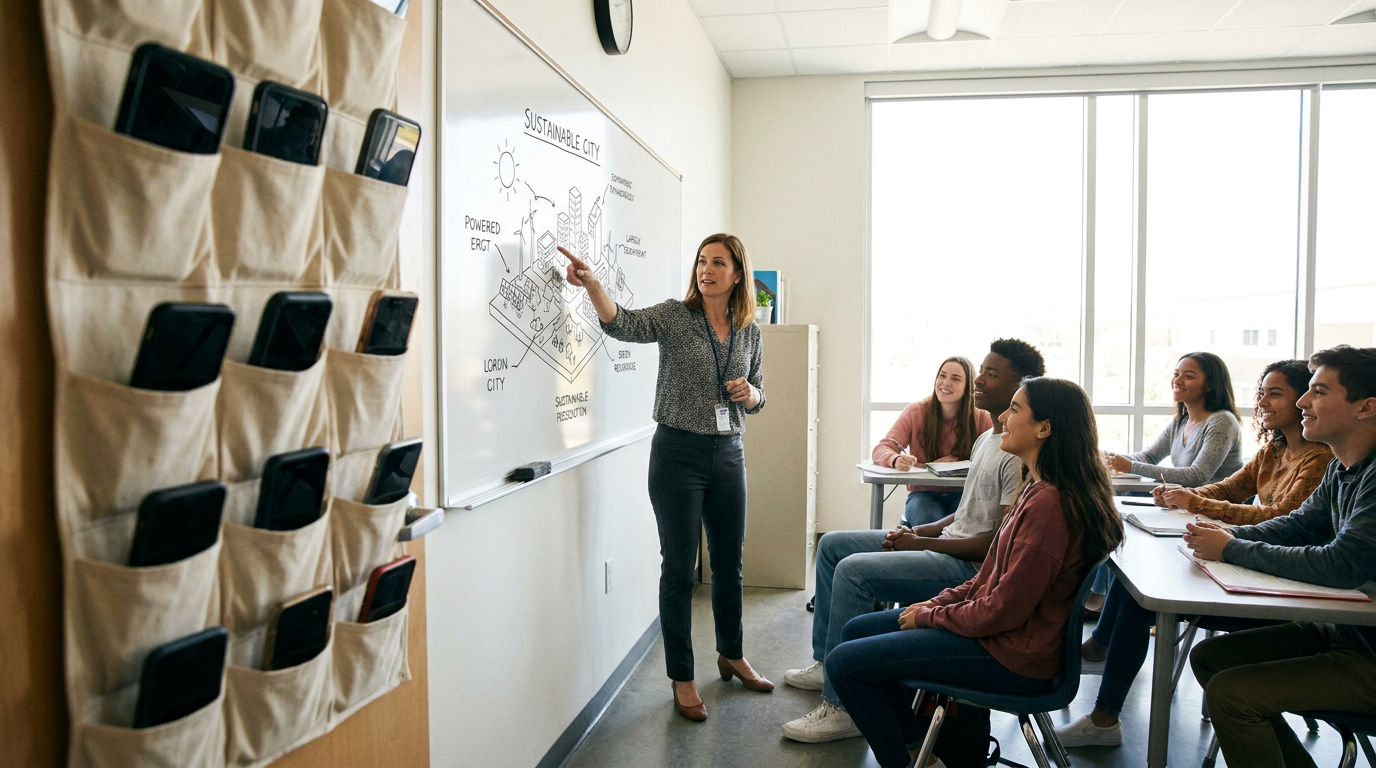
Students sitting in today's K-12 classrooms represent a unique demographic milestone: they are the first generation to have grown up entirely within the smartphone era, never knowing a world without algorithmic feeds, constant notifications, and ubiquitous online access. For years, educators have sounded the alarm about plummeting classroom focus, rising behavioral issues, and the sheer exhaustion of competing with a vibrating screen for a teenager's attention. In response to this mounting crisis, a massive and rapid policy shift has swept across the United States and international school systems. What was once considered a radical intervention—physically separating a student from their device—has rapidly become the new standard for educational environments seeking to reclaim their primary academic mission.[3]
By the spring of 2026, the landscape of digital access in education has been fundamentally redrawn. At least 34 U.S. states, alongside numerous international districts and national ministries of education, have implemented sweeping restrictions or outright bans on student cellphone use during the school day. This represents a dramatic departure from the previous decade's approach, which largely left device management up to the discretion of individual teachers. That fragmented approach often resulted in inconsistent enforcement, endless classroom arguments, and a heavy disciplinary burden placed squarely on the shoulders of frontline educators who were already stretched thin.[5]
Out of this wave of legislation, the "bell-to-bell" ban has emerged as the most prominent and effective model. Unlike permissive policies that allow students to keep their phones in their pockets and check them during lunch, recess, or passing periods, bell-to-bell mandates require devices to be powered off and securely stored away from the moment the first morning bell rings until the final dismissal. Administrators have found that allowing partial access only exacerbates the problem, as students spend instructional time anticipating the next opportunity to check their screens. By completely removing the device from the school day ecosystem, bell-to-bell policies aim to create a clean break from the digital world.[3][5]
For years, the fierce debate over school phone bans relied heavily on anecdotal evidence from frustrated educators and concerned parents. Skeptics argued that bans were unenforceable, technologically regressive, and ignored the reality of modern communication. Now, however, a robust and growing body of empirical research is catching up to the policy trend, providing a much clearer, data-driven picture of how these restrictions actually affect academic performance, classroom behavior, and overall student well-being. The early returns are offering a compelling vindication for the administrators who championed these strict digital boundaries.[1][4]

The strongest and most consistent evidence in favor of strict phone bans centers squarely on academic achievement and cognitive focus. A landmark working paper published by the National Bureau of Economic Research analyzed the sprawling impacts of Florida's statewide mandate, which required all public school students to put away their phones during instructional time starting in the fall of 2023. As one of the first states to implement such a sweeping rule, Florida served as a massive natural experiment, allowing economists and education researchers to track the objective outcomes of digital austerity across hundreds of diverse school districts.[1]
The results of the Florida analysis were striking and unequivocally positive for learning outcomes. Researchers found that students subjected to the ban showed significant positive effects on standardized test scores, particularly in the second year of the policy's implementation after the initial cultural shock had worn off. In schools that had previously struggled with high levels of unmanaged cellphone activity, the average test scores saw an increase equivalent to a 10-point gain on the SAT. The researchers noted that these gains were achieved without any additional funding or curriculum overhauls, simply by removing a persistent environmental distraction.[1][4]
Similar, and in some cases even more dramatic, academic leaps are being documented on a global scale. Following a sweeping national law that banned smartphones in Brazilian schools at the start of 2025, a Stanford University-led research team surveyed over 3,000 students, teachers, and administrators. The researchers discovered that students in schools transitioning from permissive environments to strict bans improved 13.4 percent more in Portuguese and a staggering 25.7 percent more in mathematics compared to their peers in schools that had already enforced pre-existing bans. This provided powerful causal evidence that the physical removal of the phones directly boosted academic mastery.[2]
The underlying mechanism driving these academic gains is deeply rooted in cognitive science and the limits of human working memory. Deep learning, complex problem solving, and reading comprehension all require sustained, uninterrupted cognitive work. This state of flow is easily and frequently derailed by "fragmented attention." When students frequently task-switch between a challenging math equation and a vibrating phone in their pocket—even if they only glance at the screen for a few seconds—their working memory is compromised, and the time required to re-engage with the academic task increases exponentially.[4]
The underlying mechanism driving these academic gains is deeply rooted in cognitive science and the limits of human working memory.
Removing the physical device from the student's immediate environment eliminates the temptation to task-switch, allowing for longer periods of uninterrupted focus and deeper cognitive processing. In the Stanford study of Brazilian schools, a remarkable 83 percent of students self-reported paying more attention in class after the ban was enacted. The highest compliance and focus gains were seen among elementary and middle schoolers, suggesting that intervening before deep-seated digital habits are fully formed yields the most significant educational dividends. Even students who initially resisted the bans admitted that the classroom environment had become vastly more conducive to learning.[2]
Beyond standardized test scores and self-reported focus, schools are also seeing tangible improvements in attendance and the overall social dynamics of the campus. The Florida study noted that the average student had one fewer unexcused absence after the ban took effect, suggesting a stronger engagement with the school community. Furthermore, teachers and administrators consistently report that without the digital barrier of a screen to hide behind, students are forced to interact with their peers face-to-face. This has led to louder, more socially active cafeterias and hallways, reviving a sense of traditional school culture that many feared had been lost to the smartphone era.[1][3]

However, the narrative surrounding phone bans and their impact on the broader teen mental health crisis is far more complicated and less universally triumphant. While many policymakers and child safety advocates championed these bans as a potential silver bullet for rising rates of adolescent anxiety and depression, the empirical data tells a highly nuanced story. Removing phones from the classroom undoubtedly improves the learning environment, but it does not magically erase the complex psychological pressures of modern teenage life.[5][6]
A major 2025 observational study published in The Lancet Regional Health – Europe evaluated the "SMART Schools" initiative in England, providing crucial context to the mental health debate. By comparing a large cohort of students in schools with highly restrictive phone policies to those in schools with permissive rules, the researchers sought to quantify the psychological benefits of the bans. Surprisingly, they found no significant differences in overall student anxiety, depression, or general mental well-being between the two groups, challenging the assumption that school bans alone could reverse the mental health trends.[6]
The primary reason for this muted psychological impact lies in what happens after the final school bell rings. The researchers discovered that irrespective of how strict their school's policies were, the students in the UK study still averaged between four and six hours of daily phone and social media use outside of school hours. The bans did not lead to a reduction in overall daily screen time; they merely compressed that heavy digital consumption into the late afternoon and evening hours, leaving the underlying drivers of social media-induced anxiety fully intact.[6]
Educational researchers and psychologists conclude that while school-based restrictions successfully carve out a vital academic sanctuary for six to seven hours a day, they are simply not sufficient on their own to shift the broader mental health outcomes tied to heavy, algorithm-driven social media consumption. The anxiety, cyberbullying, and fear of missing out linked to digital life simply wait for the students at the school gates. Addressing the mental health crisis will require a much broader societal effort, including parental interventions and stricter regulations on social media platforms themselves.[4][6]
Furthermore, implementing these strict bans has not been without significant friction and growing pains. The transition period often brings a temporary but sharp spike in disciplinary issues as students adjust to the new reality and test the boundaries of the policy. In the Florida study, schools experienced an initial surge in behavioral referrals and confiscations during the first year of the ban, particularly among high school boys. However, administrators emphasize that this is a necessary adjustment phase; by the second year of the ban, disciplinary rates dropped significantly below pre-ban baselines.[1][3]

Pushback also frequently comes from parents, who have grown accustomed over the past decade to having a direct, immediate line of communication with their children at all times. Concerns over school safety, particularly the ability to contact a child during a campus emergency or lockdown, remain the primary obstacle for administrators trying to enforce bell-to-bell storage solutions like locking pouches or dedicated phone lockers. Schools have had to invest heavily in communicating their emergency protocols to reassure parents that their children are safe without a device in their pocket.[2][3]
Additionally, high school students frequently argue that they rely on their devices for legitimate, school-sanctioned academic functions. Many modern educational ecosystems require smartphones for multifactor authentication to access dual-enrollment college courses, scanning QR codes for digital hall passes, or participating in interactive classroom polls. This forces schools to navigate a complex web of technological exceptions and workarounds, which can sometimes undermine the consistency and clarity of a campus-wide ban, requiring a delicate balance between security and digital austerity.[2]
Despite these logistical hurdles and the nuanced mental health data, the consensus among educators, administrators, and educational researchers is rapidly solidifying. The National Education Association recently found that an overwhelming 83 percent of teachers favor banning student phones all day, citing the profound exhaustion of constantly policing device usage and the joy of returning to uninterrupted instruction. For the educators on the front lines, the debate is effectively over; the benefits of a phone-free classroom far outweigh the administrative headaches of enforcing the rule.[1]
As the 2026 academic year approaches, the national conversation has largely shifted from whether schools should restrict smartphones to how they can enforce those restrictions most effectively and equitably. The emerging data provides a clear and empowering mandate: when schools successfully separate students from their screens, the primary beneficiary is the learning process itself. By restoring focus, encouraging face-to-face peer interaction, and protecting working memory, bell-to-bell bans are proving to be one of the most effective educational interventions of the modern era.[1][2][5]
How we got here
2023
Florida becomes the first state to implement a statewide mandate requiring students to put phones away during instructional time.
2024
The National Education Association officially endorses bell-to-bell bans, citing severe teacher burnout from policing devices.
Early 2025
Brazil implements a national law banning the use of smartphones in public and private K-12 schools.
Mid 2026
Over 30 U.S. states have adopted policies limiting or banning cellphones in classrooms, supported by new empirical data on test score gains.
Viewpoints in depth
Educators & Administrators
Argue that bell-to-bell bans restore classroom focus and reduce teacher burnout from policing devices.
For teachers on the front lines, the debate over cellphones is primarily an issue of instructional viability and workplace sustainability. Educators report that competing with algorithmic feeds for a student's attention is an unwinnable battle that leads to profound professional burnout. By instituting bell-to-bell bans, administrators argue they are not just improving test scores, but actively protecting their teaching staff from the exhausting role of being full-time device police.
Skeptical Parents
Express concerns about school safety, emergency communication, and the logistical hurdles of locking up devices.
While many parents support the idea of reduced screen time, the physical removal of devices triggers deep-seated anxieties about school safety. In an era marked by campus lockdowns and emergencies, skeptical parents argue that severing their direct line of communication with their child is an unacceptable risk. They frequently push back against locking pouches, demanding exceptions that allow students to keep phones powered off but physically on their person.
Mental Health Researchers
Caution that while academic benefits are clear, school bans alone cannot solve the adolescent mental health crisis.
Psychologists and public health researchers emphasize that the data on phone bans requires careful interpretation. While they applaud the creation of an "academic sanctuary" that boosts focus and peer interaction, they warn against viewing school bans as a cure for the teen mental health crisis. Because students continue to consume four to six hours of social media outside of school, researchers argue that classroom bans must be paired with broader interventions at home and stricter regulations on tech platforms to truly move the needle on anxiety and depression.
What we don't know
- Whether the academic gains seen in the first two years of these bans will compound over a student's entire K-12 career.
- How schools will adapt their multifactor authentication and digital hall pass systems as physical phones are entirely removed from campuses.
Key terms
- Bell-to-bell ban
- A policy prohibiting student cellphone access from the start of the first class until the end of the school day, including lunch and passing periods.
- Fragmented attention
- The cognitive disruption caused by frequent task-switching, such as glancing at phone notifications during academic work.
- Permissive policy
- A school rule that allows students to keep phones on their person and use them during non-instructional times like lunch or recess.
Frequently asked
Do phone bans actually improve student test scores?
Yes. Recent studies analyzing statewide bans in Florida and national bans in Brazil show significant gains in math and reading scores, equivalent to weeks of extra learning.
Do these bans improve student mental health?
The evidence is mixed. While teachers report calmer classrooms, large studies show no significant drop in overall anxiety or depression, largely because students still use phones heavily at home.
How are schools enforcing these bans?
The most successful schools use physical storage solutions like locking pouches or designated phone lockers, rather than relying on teachers to police pocketed phones.
Sources
Source coverage
6 outlets
3 viewpoints surfaced






[1]The Washington TimesBell-to-Bell Advocates
Smartphone bans in public schools boost test scores, study finds
Read on The Washington Times →[2]Stanford Graduate School of EducationNuanced Researchers
Stanford-led research investigates impact of smartphone bans in Brazil schools
Read on Stanford Graduate School of Education →[3]Education WeekNuanced Researchers
Early research on cellphone bans is promising, with caveats
Read on Education Week →[4]Center for American ProgressPolicy Analysts
The Impact of Cellphone Bans in K-12 Schools
Read on Center for American Progress →[5]Paragon Health InstituteBell-to-Bell Advocates
Smartphone Bans in Schools: Full-Day Bans Associated with Best Outcomes for Students
Read on Paragon Health Institute →[6]The Lancet Regional Health – EuropeNuanced Researchers
School phone policies and their association with mental wellbeing, phone use, and social media use (SMART Schools): a cross-sectional observational study
Read on The Lancet Regional Health – Europe →

Every angle. Every day.
Get education stories with full source coverage and perspective breakdowns delivered to your inbox.