
Honda Partners With QuantumScape to Bring Solid-State EV Batteries to Mass Production
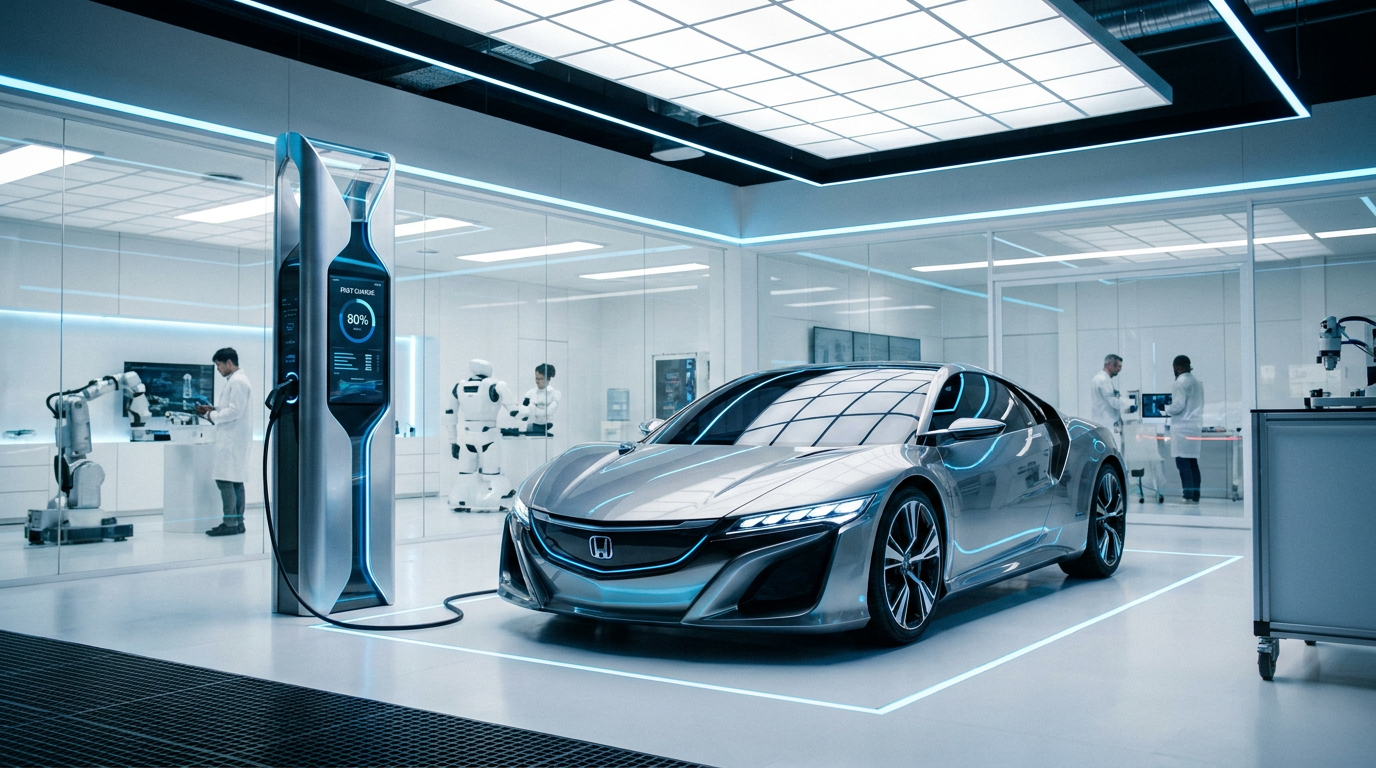
Japanese automaker Honda has entered a multi-year joint research agreement with QuantumScape to develop and manufacture solid-state batteries. The partnership signals a major push to commercialize the next-generation technology, which promises faster charging times, longer range, and improved safety for electric vehicles.
By Factlen Editorial Team
- Automakers & Developers
- View solid-state batteries as the critical next step to unlock mass EV adoption through superior range and safety.
- Industry Analysts
- Caution that while the technology is proven in labs, scaling manufacturing and lowering costs will take years.
- Environmental Advocates
- Highlight the technology's potential to reduce the carbon footprint of EV manufacturing by requiring fewer raw materials.
What's not represented
- · Lithium-ion battery manufacturers defending their established market dominance.
- · Consumers waiting for affordable EV options.
Why this matters
Solid-state batteries are widely considered the key to unlocking mass electric vehicle adoption by eliminating range anxiety and fire risks. If Honda and QuantumScape can successfully scale this technology, it could drastically reduce EV charging times to match gas station fill-ups, fundamentally changing how consumers view electric transportation.
Key points
- Honda has signed a multi-year joint research agreement with QuantumScape to develop solid-state batteries.
- QuantumScape's QSE-5 prototype cells can charge from 10% to 80% in just 12.2 minutes.
- Volkswagen testing showed the cells retain over 95% capacity after 1,000 charging cycles.
- Honda plans to use the technology in electric vehicles, motorcycles, and power equipment.
- Analysts warn that solid-state batteries will initially cost significantly more than lithium-ion batteries.
- Solid-state technology could reduce the carbon footprint of an EV by up to 24%.
Japanese automaker Honda has officially entered into a multi-year joint research agreement with QuantumScape, marking a significant milestone in the race to commercialize solid-state batteries. The partnership, announced this week, aims to develop and manufacture next-generation lithium-metal batteries for electric vehicles and other commercial applications.[1][2]
For years, the automotive industry has viewed solid-state batteries as the "holy grail" of electric vehicle technology. Unlike conventional lithium-ion batteries that use liquid electrolytes to move energy, solid-state cells utilize a solid electrolyte, which promises to drastically improve energy density, reduce charging times, and eliminate the fire risks associated with volatile liquids.[3][5]
Honda’s decision to partner with the San Jose-based battery developer follows an exhaustive technology evaluation agreement. According to Atsushi Ogawa, Chief Operating Officer at Honda’s Research Center of Excellence, QuantumScape’s platform underwent an in-depth, hands-on technical study and competitive benchmarking. Ogawa noted that the technology demonstrated compelling and unique advantages during the rigorous evaluation process.[1][2]
At the center of the partnership is QuantumScape’s QSE-5 cell, which represents the company's first commercial product. The cell features a proprietary solid ceramic separator and a lithium-metal anode, allowing for an exceptionally compact design that packs more power into a smaller physical footprint.[1][4]
The performance metrics of the QSE-5 prototype represent a massive leap over current industry standards. The B-sample cells boast an energy density of 844 watt-hours per liter and can fast-charge from 10% to 80% capacity in just 12.2 minutes, effectively bridging the convenience gap between charging an EV and pumping a tank of gas.[1][4]

Durability testing has also yielded unprecedented results. In a recent evaluation conducted by Volkswagen—QuantumScape’s earliest and largest automotive partner—the battery technology retained over 95% of its original capacity after more than 1,000 charging cycles. This far exceeds the current industry benchmark, which typically targets 80% capacity retention after 700 cycles.[3]
This far exceeds the current industry benchmark, which typically targets 80% capacity retention after 700 cycles.
For Honda, the tie-up comes at a critical strategic juncture. The Japanese automaker recently reported operating losses of $2.6 billion for the 2025/2026 financial year, citing heavy EV-related investments and tariff impacts. While Honda has slightly scaled back its timeline to become a fully electric car company, the QuantumScape partnership signals that the manufacturer is doubling down on the technological breakthroughs required to make EVs profitable and appealing to mass-market consumers.[2]
The scope of the agreement extends far beyond passenger cars. Honda envisions applying QuantumScape’s solid-state technology across its broader product portfolio, including motorcycles, power equipment, and potentially stationary energy storage systems. This multi-platform approach mirrors Volkswagen’s strategy, which is already using the Ducati V21L electric motorcycle as a high-performance testbed for solid-state cells.[1][4]
Transitioning these high-performance cells from the laboratory to mass production remains the industry's most formidable challenge. To bridge this gap, QuantumScape recently inaugurated its "Eagle Line" pilot production facility in California. The highly automated line utilizes a fast-separator production process dubbed "Cobra," which the company claims will enable manufacturing at a gigawatt-hour scale.[1][4]

Despite the manufacturing breakthroughs, cost remains a significant hurdle. Market analysts project that early solid-state batteries will cost between $400 and $800 per kilowatt-hour to produce in 2026. By comparison, conventional lithium-ion battery costs had already fallen to an estimated $132 per kilowatt-hour by 2022, giving them a massive economic advantage in the near term.[5]
Because of this steep price premium, industry experts caution against expecting an immediate consumer rollout. Xin Yen, a new technology analyst at Benchmark Mineral Intelligence, anticipates that the market will see limited pilot deployments and small-scale demonstrations of all-solid-state EVs around 2027, but at a very high cost to early adopters.[3]

Some battery developers are even more conservative about the timeline. StoreDot, an Israeli battery developer working on extreme fast-charging technology, has previously stated that despite bullish claims from competitors, widespread integration of solid-state batteries in affordable production cars is likely still a decade away.[5]
Beyond performance, the shift to solid-state architecture carries substantial environmental implications. A recent European EV study found that solid-state batteries can decrease the overall carbon footprint of a vehicle by up to 24% compared to common lithium-ion batteries, largely due to higher energy density requiring fewer raw materials per mile of range.[5]
As automakers navigate a complex transition period marked by fluctuating consumer demand and high interest rates, technological differentiation is becoming paramount. Honda’s alignment with QuantumScape ensures the automaker has a direct pipeline to next-generation energy storage, positioning it to capitalize when solid-state technology finally achieves commercial scale.[2][6]
How we got here
2010
QuantumScape is founded to research and develop solid-state battery technology.
2012
Volkswagen partners with QuantumScape, becoming its earliest major automotive backer.
2024
Volkswagen testing confirms QuantumScape cells retain 95% capacity after 1,000 charge cycles.
Early 2026
QuantumScape inaugurates its 'Eagle Line' pilot production facility in San Jose, California.
June 2026
Honda signs a multi-year joint research agreement to develop and manufacture QuantumScape's solid-state batteries.
Viewpoints in depth
Automakers & Battery Developers
View solid-state batteries as the critical next step to unlock mass EV adoption through superior range and safety.
For legacy automakers like Honda and Volkswagen, solid-state technology represents the ultimate solution to consumer range anxiety and charging bottlenecks. Battery developers argue that replacing flammable liquid electrolytes with solid ceramics not only makes vehicles inherently safer but allows for a much denser packing of energy. By investing heavily now, these companies aim to secure a dominant position when the technology inevitably replaces lithium-ion as the industry standard.
Industry Analysts
Caution that while the technology is proven in labs, scaling manufacturing and lowering costs will take years.
Financial and supply chain analysts emphasize the massive gulf between building a successful prototype and manufacturing millions of cells profitably. They point out that traditional lithium-ion batteries benefit from decades of optimized, massive-scale global supply chains, driving their costs down to roughly $130 per kilowatt-hour. Until solid-state manufacturing processes like QuantumScape's 'Cobra' line can achieve similar economies of scale, analysts warn the technology will remain confined to premium, low-volume vehicles.
Environmental Advocates
Highlight the technology's potential to reduce the carbon footprint of EV manufacturing by requiring fewer raw materials.
Sustainability researchers focus on the lifecycle emissions of battery production. Because solid-state cells boast significantly higher energy density, vehicles require fewer raw materials to achieve the same driving range. Studies indicate this efficiency could reduce the overall carbon footprint of an electric vehicle by nearly a quarter, easing the environmental burden of mining operations and making the green transition more sustainable.
What we don't know
- The exact year Honda expects to launch its first mass-market vehicle powered by QuantumScape batteries.
- Whether the 'Cobra' manufacturing process can successfully scale to produce millions of cells without high defect rates.
- How quickly the cost per kilowatt-hour for solid-state cells will reach parity with traditional lithium-ion.
Key terms
- Solid-state battery
- A battery technology that uses solid electrodes and a solid electrolyte, instead of the liquid or polymer gel electrolytes found in lithium-ion or lithium polymer batteries.
- Energy density
- The amount of energy a battery contains compared to its volume or weight; higher energy density means a vehicle can travel further without needing a larger, heavier battery pack.
- Lithium-metal anode
- A battery component made of pure lithium metal that replaces the graphite used in traditional batteries, significantly increasing the amount of energy the cell can store.
- Ceramic separator
- A solid, heat-resistant barrier inside the battery that prevents the positive and negative sides from touching while allowing ions to pass through, greatly improving safety.
- Cycle life
- The number of complete charge and discharge cycles a battery can undergo before its capacity falls below a certain percentage of its original capacity.
Frequently asked
What is a solid-state battery?
A solid-state battery uses a solid electrolyte instead of the liquid or polymer gel electrolytes found in conventional lithium-ion batteries. This design allows for higher energy density and eliminates the risk of flammable liquid leaks.
Why are solid-state batteries better than lithium-ion?
They can hold significantly more energy in the same physical space, charge much faster (10% to 80% in about 12 minutes), and are inherently safer because they do not contain volatile liquid components.
When will cars with solid-state batteries be available?
Industry analysts expect small-scale pilot deployments in premium vehicles around 2027. However, widespread mass-market availability is likely still years away due to the current high costs of manufacturing.
Why did Honda partner with QuantumScape?
Honda tested QuantumScape's technology and found it offered compelling advantages. The partnership allows Honda to secure a supply of next-generation batteries to make its future electric vehicles and motorcycles more competitive.
Sources
Source coverage
6 outlets
3 viewpoints surfaced






[1]ElectrekAutomakers & Developers
Honda and QuantumScape (QS) team up to make 'game-changing' solid-state batteries
Read on Electrek →[2]Manufacturing DigitalAutomakers & Developers
Honda partners with QuantumScape for solid-state EV batteries
Read on Manufacturing Digital →[3]EV Infrastructure NewsIndustry Analysts
QuantumScape, Honda in solid-state battery development agreement
Read on EV Infrastructure News →[4]ElectriveAutomakers & Developers
QuantumScape and Honda enter research cooperation
Read on Electrive →[5]Chasing CarsIndustry Analysts
Solid state batteries: the future of EVs?
Read on Chasing Cars →[6]QuantumScapeAutomakers & Developers
QuantumScape Announces Joint Research Agreement with Honda
Read on QuantumScape →

Every angle. Every day.
Get business stories with full source coverage and perspective breakdowns delivered to your inbox.