
How Bidirectional Charging is Turning EVs Into Massive Home Batteries in 2026
New bidirectional charging standards and hardware are allowing electric vehicles to power homes during outages and sell energy back to the grid, transforming cars into critical energy infrastructure.
By Factlen Editorial Team
- Consumer Advocates
- Homeowners prioritize energy independence, outage backup, and lowering their daily electricity bills.
- Grid Operators & Utilities
- Utilities view bidirectional EVs as a massive, untapped virtual power plant that can stabilize the grid.
- Automakers
- Manufacturers are balancing the demand for new features with the financial risks of battery warranty claims.
What's not represented
- · Independent battery repair shops
- · Renters without driveway access
Why this matters
Your electric vehicle likely holds five to ten times more energy than a premium home battery system. Unlocking that stored power can protect your home from multi-day grid outages, significantly lower your daily electricity bills, and even generate passive income.
Key points
- Bidirectional charging allows electric vehicles to send power back to homes (V2H) or the utility grid (V2G).
- A typical EV battery holds five to ten times more energy than a standard stationary home battery.
- V2H systems can power an average home for three to ten days during a grid outage.
- The rollout of the ISO 15118-20 standard in 2026 is making bidirectional charging compatible across major EV brands.
- Grid operators view parked EVs as a massive virtual power plant capable of replacing fossil-fuel peaker plants.
For over a century, the automobile has been a depreciating asset that sits parked and idle for roughly 95 percent of its life. But the transition to electric vehicles is fundamentally altering that equation. A modern EV is no longer just a mode of transportation; it is a massive, mobile energy storage system. In 2026, the automotive and energy sectors are converging around a technology known as bidirectional charging, which allows electricity to flow not just into the car, but back out of it. This capability is transforming driveways into virtual power plants and giving homeowners unprecedented control over their energy resilience.[7]
The sheer scale of the energy stored in a modern EV is difficult to overstate. A standard dedicated home battery, such as a Tesla Powerwall, holds about 13.5 kilowatt-hours (kWh) of electricity. By contrast, a typical electric vehicle carries between 60 and 100 kWh, while larger trucks like the Ford F-150 Lightning house up to 131 kWh. That means a single electric vehicle parked in a garage contains roughly five to ten times the energy capacity of a premium home battery system. Tapping into that reservoir changes the economics of both home energy management and macro-grid stability.[2][5][6]

To understand how this works, it is necessary to look at the mechanism of bidirectional charging. The electricity supplied by the power grid is alternating current (AC), but batteries—whether in a smartphone or an EV—store energy as direct current (DC). Standard EV charging involves an onboard converter that changes the grid's AC power into DC to fill the battery. Bidirectional charging requires an inverter capable of reversing that process, taking the DC power stored in the car and converting it back into AC power that a home or the wider grid can safely use.[3]
The industry categorizes this two-way flow into three distinct applications, starting with the simplest: Vehicle-to-Load (V2L). V2L does not require integration with a home's electrical panel. Instead, the vehicle provides standard 120V or 240V outlets directly on the car itself. Drivers can plug in power tools at a worksite, run a refrigerator during a camping trip, or power a few essential appliances via an extension cord during a blackout. While highly convenient, V2L is limited by the output of the vehicle's onboard inverter, typically capping out between 3.6 and 6.6 kilowatts.[5][6]

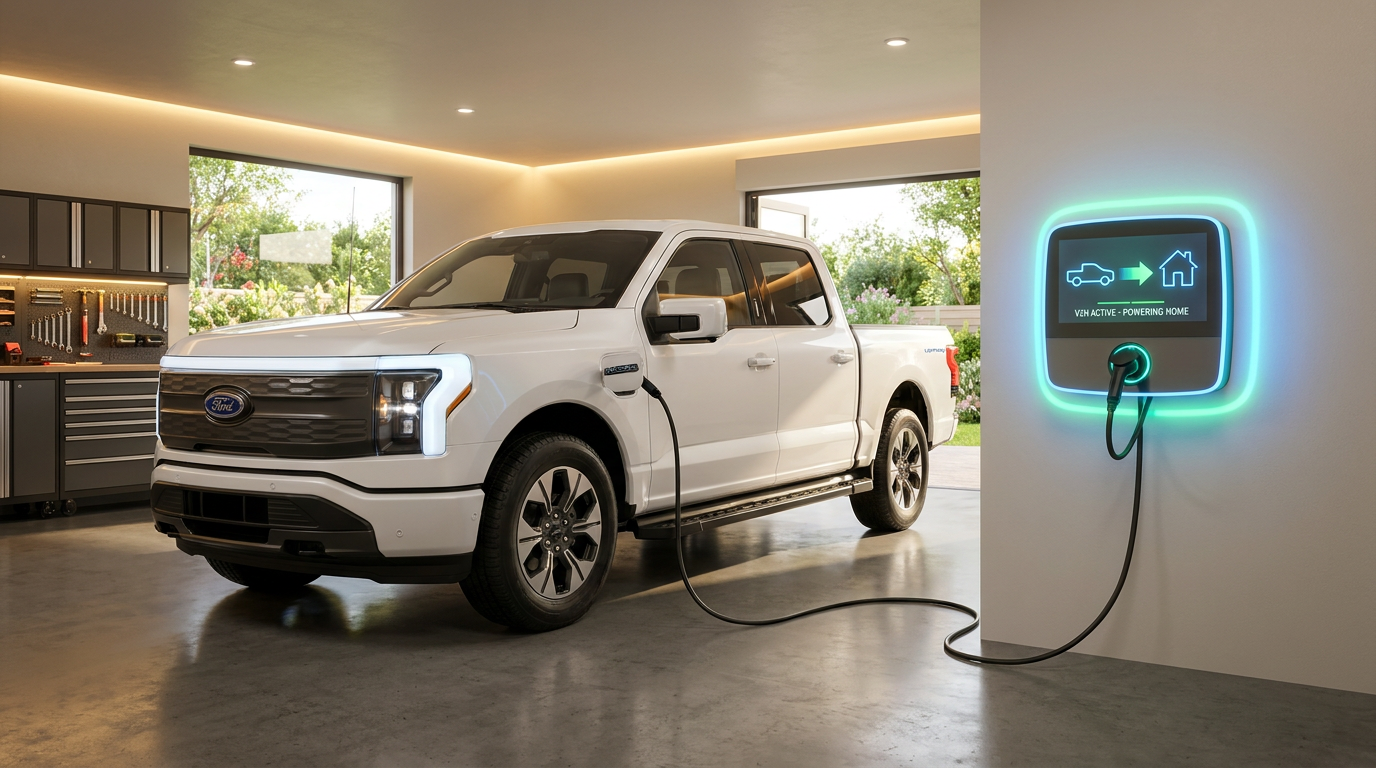
The true paradigm shift for consumers arrives with Vehicle-to-Home (V2H) technology. V2H integrates the vehicle directly into the house's electrical panel through a specialized bidirectional charger and a transfer switch. When the grid goes down, the system automatically isolates the house from the neighborhood grid—a safety requirement known as "islanding"—and signals the car to begin discharging power. A fully charged EV can back up an average home for three to ten days without requiring any lifestyle compromises, effectively eliminating the need for noisy gas generators or expensive stationary batteries.[3][5][6]
Beyond emergency backup, V2H offers compelling daily financial benefits through tariff arbitrage. Many utilities charge significantly higher rates for electricity during peak evening hours when demand spikes. With a V2H setup, a home can draw power from the EV battery during these expensive windows, and then recharge the car overnight when electricity rates plummet. For homes with solar panels, the EV can absorb excess solar generation during the day that would otherwise be exported to the grid for pennies, storing it for evening use and maximizing self-consumption.[4]
While V2H optimizes energy behind the meter, Vehicle-to-Grid (V2G) scales the concept to the macro level. V2G allows utility companies to draw power from thousands of plugged-in EVs simultaneously during moments of extreme grid stress, such as a summer heatwave. Instead of firing up expensive and highly polluting natural gas "peaker plants" to meet the surge in demand, the grid operator can tap into the distributed network of EV batteries. In exchange for providing this critical grid-balancing service, EV owners are compensated financially.[2][3]
While V2H optimizes energy behind the meter, Vehicle-to-Grid (V2G) scales the concept to the macro level.
Early pilot programs in the UK, the Netherlands, and California demonstrate the economic viability of V2G. Depending on the local energy market and the frequency of dispatch events, participating EV owners are currently earning between $420 and $780 annually just for leaving their cars plugged in. The California Energy Commission (CEC) released a comprehensive roadmap in March 2026 highlighting the staggering potential of this resource. The CEC noted that California's EV fleet already represents an estimated 18.5 gigawatts of potential energy storage capacity—surpassing the total capacity of all stationary storage resources in the state.[1][6]

Despite the obvious benefits of turning millions of cars into grid-stabilizing assets, widespread adoption has been historically bottlenecked by competing hardware standards and proprietary software. For years, the only vehicles capable of bidirectional charging used the Japanese CHAdeMO plug standard, most notably the early generations of the Nissan Leaf. However, the vast majority of the modern Western EV market relies on the Combined Charging System (CCS) or the North American Charging Standard (NACS, pioneered by Tesla and recently adopted by the wider industry). Integrating bidirectional communication into these newer, more prevalent standards required complex software protocols that took years for international engineering committees to finalize and test.[3][6][7]
That technical hurdle is finally clearing in 2026 with the rollout of the ISO 15118-20 communication standard. This protocol allows CCS and NACS vehicles to securely communicate with bidirectional chargers and utility networks. As a result, major automakers are rapidly unlocking the feature. General Motors has announced that nearly its entire EV lineup is now bidirectional-capable, while brands like Kia, Hyundai, Volvo, and Ford are offering V2H and V2G compatibility across a wide range of price points.[1][3][4]
The hardware required to facilitate this energy flow is also maturing, though it remains a significant investment. A standard Level 2 home charger costs a few hundred dollars, but a bidirectional DC wallbox—such as the Wallbox Quasar 2 or the GM Energy PowerShift—bypasses the car's onboard equipment to manage the heavy lifting externally. These specialized units, combined with the necessary home panel upgrades and transfer switches, currently range from $3,000 to $8,000 fully installed.[4][5][6]
For many homeowners, the financial math still heavily favors the bidirectional approach over traditional stationary storage. Purchasing a dedicated 13.5 kWh stationary home battery typically costs between $12,500 and $14,500 fully installed, and provides only enough power to keep essential circuits running for a day. Spending half that amount on a bidirectional charger to unlock 100 kWh of storage that already sits in the driveway is an increasingly obvious choice. This calculation is becoming even more attractive as various government incentives and local utility tax credits are introduced specifically to help offset the installation costs of bidirectional hardware.[5]

However, the shift toward V2G and V2H is not without its uncertainties, chief among them being battery degradation. Lithium-ion batteries degrade based on time, temperature, and the number of charge-discharge cycles they endure. Consumers and industry analysts have expressed valid concerns that using a $15,000 car battery to power a house or support the grid could prematurely wear out the vehicle's primary power source.[6]
Automakers and researchers argue that the impact is minimal if managed correctly. V2G and V2H applications typically involve "micro-cycling"—discharging only 5 to 10 percent of the battery's capacity at a relatively low power draw, which is far less stressful on the battery chemistry than the high-amperage demands of highway driving or DC fast charging. To alleviate consumer anxiety, manufacturers are beginning to explicitly cover bidirectional usage under their standard 8-year/100,000-mile battery warranties, provided the energy export stays within specified annual limits.[2][6]
As 2026 progresses, bidirectional charging is transitioning from a niche pilot concept to a foundational pillar of modern energy infrastructure. The convergence of standardized protocols, willing automakers, and utility incentives is turning the electric vehicle into the ultimate multi-tool. By seamlessly bridging the gap between transportation and home energy resilience, EVs are proving that their greatest value might just be unlocked when they are parked.[2][7]
How we got here
2013
The Nissan Leaf becomes the first mass-market EV to support bidirectional charging, utilizing the Japanese CHAdeMO standard.
2022
Ford launches the F-150 Lightning with 'Intelligent Backup Power,' bringing widespread consumer awareness to V2H capabilities.
March 2025
The UK government mandates V2G capability for all new commercial charger installations over 22kW.
March 2026
The California Energy Commission releases a roadmap to harness the state's 18.5 GW of idle EV battery storage.
Mid-2026
The ISO 15118-20 standard sees widespread adoption, unlocking bidirectional capabilities for CCS and NACS vehicles globally.
Viewpoints in depth
Grid Operators & Utilities
Utilities view bidirectional EVs as a massive, untapped virtual power plant that can stabilize the grid.
For grid operators, the transition to renewable energy presents a massive storage problem: solar and wind generate power intermittently. Utilities argue that instead of spending billions on grid-scale battery farms, they can lease the batteries already sitting in customers' driveways. By utilizing Vehicle-to-Grid (V2G) technology, they can draw on gigawatts of distributed power during peak demand events, preventing blackouts and reducing reliance on expensive, carbon-intensive peaker plants.
Consumer Advocates
Homeowners prioritize energy independence, outage backup, and lowering their daily electricity bills.
Consumer groups are primarily focused on Vehicle-to-Home (V2H) applications. They argue that the most immediate value of an EV battery is protecting the household from grid failures and dodging peak-hour electricity rates. While they welcome the idea of earning money through V2G, advocates stress that homeowners must retain ultimate control over their vehicle's state of charge, ensuring they always have enough range for their morning commute regardless of what the utility needs.
Automakers
Manufacturers are balancing the demand for new features with the financial risks of battery warranty claims.
Car manufacturers recognize that bidirectional charging is a powerful selling point, but they remain cautious about battery degradation. Because they warranty EV batteries for 8 to 10 years, automakers are implementing strict software guardrails on how much energy can be exported and at what speed. They argue that while micro-cycling for grid support is safe, unrestricted daily deep-discharging could lead to premature battery failure, leaving the manufacturer liable for expensive replacements.
What we don't know
- How aggressively utility companies will scale their V2G compensation programs outside of pilot areas.
- Whether the long-term data on battery degradation from daily V2H use will force automakers to adjust their warranty terms in the future.
- How quickly the cost of bidirectional home chargers will drop as production scales up.
Key terms
- Bidirectional Charging
- Technology that allows electricity to flow both into an electric vehicle's battery and back out to power external loads, homes, or the utility grid.
- V2H (Vehicle-to-Home)
- A system where an electric vehicle powers a house directly, providing backup during outages or offsetting expensive peak electricity rates.
- V2G (Vehicle-to-Grid)
- A system where an electric vehicle exports stored energy back to the public utility grid, often earning the owner financial compensation.
- V2L (Vehicle-to-Load)
- The simplest form of bidirectional power, allowing users to plug standard 120V or 240V appliances directly into outlets built into the vehicle.
- Inverter
- A device that converts direct current (DC) electricity stored in a battery into alternating current (AC) electricity used by homes and the power grid.
- ISO 15118-20
- A universal software communication standard rolling out in 2026 that allows different brands of EVs and chargers to securely manage bidirectional energy flow.
Frequently asked
Will bidirectional charging degrade my EV battery faster?
While any battery use causes some wear, V2H and V2G applications typically use 'micro-cycling'—discharging small amounts of power at low speeds. Automakers state this has a minimal impact compared to highway driving, and many now cover bidirectional use under their standard warranties.
Do I need a special charger to power my home?
Yes. Standard EV chargers only send power one way. To power your home (V2H), you need a bidirectional DC charger and a transfer switch installed at your electrical panel to safely isolate your house from the grid.
Can any electric vehicle power a house?
Not yet. While almost all new EVs support V2L (plugging appliances into the car), full V2H and V2G capabilities require specific hardware and software. Compatibility is rapidly expanding in 2026 with the adoption of the ISO 15118-20 standard.
What happens if the grid goes down while my car is plugged in?
If you have a V2H setup, the system's transfer switch will automatically disconnect your home from the dead grid (to protect utility workers) and signal your car to begin powering your house's electrical panel.
Sources
Source coverage
7 outlets
3 viewpoints surfaced







[1]California Energy CommissionGrid Operators & Utilities
Bidirectional EV Charging Roadmap
Read on California Energy Commission →[2]V2G NewsGrid Operators & Utilities
If 2025 showed bidirectional charging can scale, 2026 shows the grid cannot succeed without it
Read on V2G News →[3]EV Infrastructure NewsAutomakers
How V2G technology works: Bidirectional charging explained
Read on EV Infrastructure News →[4]Energy MattersConsumer Advocates
Vehicle to Home: The bidirectional upgrade arriving fast
Read on Energy Matters →[5]NuWatt EnergyConsumer Advocates
V2H, V2G, and V2L: What Do They Mean in 2026?
Read on NuWatt Energy →[6]Energy Solutions IntelligenceAutomakers
Bidirectional EV Charging 2026: Which Cars Can Power Your Home and the Grid?
Read on Energy Solutions Intelligence →[7]Factlen Editorial TeamConsumer Advocates
Synthesis by Factlen editorial team
Read on Factlen Editorial Team →
Every angle. Every day.
Get transportation stories with full source coverage and perspective breakdowns delivered to your inbox.