
How Virtual Reality and Smart Sensors Are Revolutionizing Boxing Safety
A new wave of cognitive training tools and impact-tracking wearables is allowing boxers to sharpen their reflexes and monitor biomechanical loads, drastically reducing the brain trauma associated with traditional heavy sparring.
By Factlen Editorial Team
- Sports Scientists & Neurologists
- Advocate for strict biometric monitoring and the reduction of live sparring to prevent long-term neurological damage.
- Tech Developers & Innovators
- Focus on gamifying training and providing real-time biomechanical data to optimize athletic performance.
- Traditional Coaches & Fighters
- Value the new tools for career longevity but emphasize that VR cannot entirely replace the physical conditioning of live sparring.
What's not represented
- · Amateur boxing federations managing the cost of implementing high-tech safety gear.
- · Retired fighters dealing with CTE who advocate for mandatory sensor use.
Why this matters
By shifting the focus from absorbing physical blows to training the brain's processing speed, these technologies are extending athletes' careers and protecting them from the devastating long-term effects of CTE.
Key points
- Virtual reality platforms allow boxers to train elite defensive reflexes and pattern recognition without taking physical blows to the head.
- Biomechanical studies reveal that while traditional headgear prevents cuts, it does not stop the rotational acceleration that causes concussions.
- Smart gloves equipped with inertial sensors track punch velocity and retraction time, helping coaches detect fatigue before a fighter becomes vulnerable.
- Instrumented mouthguards provide highly accurate data on head impacts, enabling gyms to implement strict load management protocols.
The unmistakable sounds of a boxing gym—leather popping against heavy bags, the rhythmic skip of a jump rope, the sharp exhales of fighters shadowboxing—are being joined by a new, quieter hum. In training camps around the world, the whir of virtual reality headsets and the subtle ping of Bluetooth biometric sensors are becoming just as common as hand wraps and mouthguards. For a sport steeped in gritty tradition, this technological invasion represents a profound shift in how athletes prepare for combat.
For over a century, the blueprint for building a champion required thousands of rounds of live, grueling sparring. Fighters traded brain cells for reflexes, accepting sub-concussive blows as the unavoidable cost of mastering their craft and hardening their bodies. The gym was a crucible where toughness was measured by the ability to absorb punishment, often leaving athletes with invisible scars long before they ever stepped under the bright lights of a professional arena.
Today, a technological revolution is reshaping the landscape of combat sports. Driven by a deeper medical understanding of Chronic Traumatic Encephalopathy (CTE) and the devastating long-term effects of traumatic brain injuries, the boxing world is actively seeking alternatives to the old ways. By embracing cognitive conditioning and biometric tracking, modern trainers are finding innovative methods to extend careers, protect athletes, and optimize performance without the heavy physical toll.
The shift began with a sobering realization about the sport's traditional safety equipment. For decades, amateur fighters and sparring partners relied heavily on padded headgear to soften the blow of incoming strikes. It was universally accepted that wrapping the head in thick foam was the best way to prevent concussions and keep fighters safe during the intense weeks of a training camp. However, recent biomechanical studies have completely upended this conventional wisdom.

Research from leading engineering institutes, including a pivotal 2023 biomechanical study on boxing headgear, revealed a troubling reality. While thick padding effectively reduces linear acceleration—thereby preventing superficial cuts, facial bruising, and skull fractures—it does remarkably little to mitigate rotational acceleration.[6]
Rotational acceleration is the violent, twisting motion of the head that causes the brain to sheer against the inside of the skull. Neurologists now understand that this twisting force is the primary mechanism behind concussions and long-term neurological degradation. Because traditional headgear cannot stop the brain from sloshing inside the cerebrospinal fluid, fighters wearing it remain highly susceptible to the exact type of trauma that leads to CTE.
Realizing that the only true way to prevent brain trauma is to avoid getting hit in the first place, sports scientists turned their attention to perceptual-cognitive training. The new goal was ambitious: build elite defensive reflexes, enhance spatial awareness, and improve reaction times without subjecting the athlete to the physical punishment of live sparring. To achieve this, the boxing world looked to technologies already being utilized in aviation and motorsport.
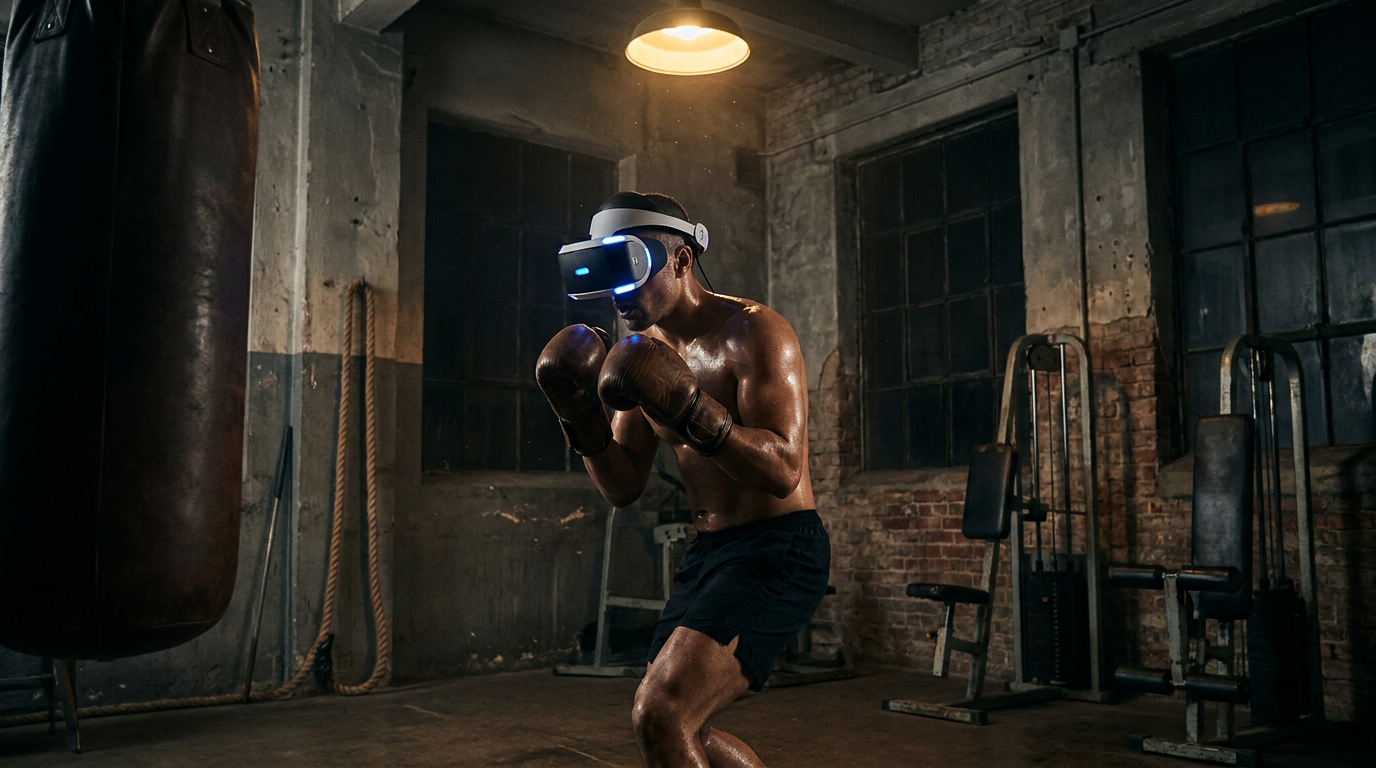
Virtual reality platforms and 3D Multiple Object Tracking (3D-MOT) systems have now been seamlessly adapted for the boxing ring. Fighters strap on high-resolution headsets to face virtual opponents, practicing slips, rolls, and counter-punches against simulated strikes. These immersive environments allow athletes to experience the speed and trajectory of professional-level punches in a completely controlled, zero-impact setting.[4]
These virtual systems are specifically designed to train the brain's visual processing speed and "go/no-go" decision-making capabilities. By repeatedly exposing a fighter to the subtle biomechanical cues of an incoming punch—such as a slightly dropped shoulder, a shift in footwork, or tension in the hips—the software helps rewire the brain's natural, panic-driven flinch response into a calculated defensive maneuver.

These virtual systems are specifically designed to train the brain's visual processing speed and "go/no-go" decision-making capabilities.
The neuroscience backing this high-tech approach is incredibly robust. High-intensity cognitive drills stimulate the release of Brain-Derived Neurotrophic Factor (BDNF), a vital protein that acts like fertilizer for the brain. Increased levels of BDNF encourage neuroplasticity, allowing the brain to rapidly form new neural pathways and strengthen existing connections, which is essential for mastering complex motor skills.[1]
Clinical studies indicate that just a few weeks of dedicated cognitive reflex training can yield up to a 38% improvement in an athlete's reaction time. Fighters who utilize these systems report that they can process visual information significantly faster, making the chaotic environment of a boxing match feel as though it has slowed down. This heightened perception allows them to evade strikes with millimeter precision.
But technology isn't just replacing live sparring; it is making the physical training that remains vastly safer and more measurable. Enter the era of the "smart glove" and the instrumented mouthguard. When fighters do step up to the heavy bag or engage in light technical sparring, they are increasingly doing so while wired to a network of sophisticated biometric sensors.
Wearable sensors, such as the advanced Rise Dynamics Alpha (RD α) prototype and commercially available trackers from brands like Everlast and PIQ, are now embedded directly into hand wraps or the cuffs of boxing gloves. These miniature inertial measurement units track a wealth of data, including punch volume, velocity, peak impact force, and the crucial metric of retraction time.[3][5]
By meticulously analyzing this data stream, coaches can detect the microscopic declines in punch retraction speed that indicate the onset of central nervous system fatigue. When a fighter becomes neurologically fatigued, their defensive guard naturally drops and their reaction times plummet, leaving them highly vulnerable to the exact types of heavy strikes that cause cumulative brain damage.

To accurately measure the impacts that do manage to land during sparring, researchers have developed instrumented mouthguards packed with micro-accelerometers and gyroscopes. Unlike external skin patches or sensors taped to headgear—which can slide and produce noisy data—mouthguards couple directly to the upper jaw, providing highly accurate, real-time data on the forces transmitted directly to the skull.
These instrumented mouthguards boast an impressive 96% positive predictive value in detecting true head impacts. They have recorded staggering metrics in combat sports, revealing that a perfectly placed spinning head kick can generate an average of 130g of force. This granular data provides an unprecedented look into the physical toll of a standard training session.[2][3]
Armed with this precise data, progressive boxing gyms are adopting strict "load management" protocols, akin to the pitch counts used to protect the arms of baseball pitchers. If a fighter absorbs a certain threshold of G-force over a week of sparring, the coaching staff will mandate a switch to non-contact VR training, shadowboxing, or heavy bag work to allow the brain time to recover.

This hybrid approach—blending the gritty, physical conditioning of traditional boxing with the precision of modern neuroscience and biometric tracking—represents a massive paradigm shift. It acknowledges a fundamental truth that the sport has long ignored: a fighter's most valuable asset is not their iron chin or their punching power, but their long-term cognitive health.
While boxing purists argue that nothing can fully replicate the chaotic pressure, adrenaline, and fear of a real opponent breathing down your neck, the consensus among elite trainers is rapidly shifting. The smartest fighters are realizing that longevity in the ring requires evolving outside of it, and that taking unnecessary damage in the gym is a fast track to an early retirement.
As these virtual reality platforms and biometric sensors become more affordable and accessible to grassroots gyms, they promise to democratize elite training methods. By prioritizing brain health alongside physical power, this technological revolution ensures that the next generation of boxers can chase championship glory without sacrificing their minds in the process.
How we got here
Early 2010s
Growing medical awareness of CTE prompts combat sports to reevaluate the safety of frequent, heavy sparring.
2018-2019
Early iterations of smart punch trackers and instrumented mouthguards enter the consumer market.
2023
Biomechanical studies confirm that traditional boxing headgear fails to mitigate the rotational forces responsible for concussions.
2025-2026
Elite boxing gyms begin integrating VR cognitive training and strict 'impact load management' protocols to extend fighter careers.
Viewpoints in depth
Sports Scientists & Neurologists
Advocating for strict biometric monitoring to prevent long-term brain damage.
Medical professionals and biomechanical engineers view the integration of technology into boxing as a long-overdue public health intervention. For decades, neurologists have warned about the cumulative effects of sub-concussive blows sustained during routine sparring. By utilizing instrumented mouthguards to track exact G-forces and proving that traditional headgear fails to stop rotational acceleration, this camp argues that the sport must pivot toward 'load management.' They envision a future where a fighter's weekly brain impact is strictly capped, much like a baseball pitcher's pitch count.
Tech Developers & Innovators
Focusing on gamification and real-time data to optimize athletic performance.
For software developers and hardware engineers, the boxing ring is the ultimate testing ground for human-computer interaction. Companies developing VR platforms and smart gloves are focused on the intersection of cognitive neuroscience and athletic performance. They argue that tools like 3D Multiple Object Tracking don't just protect the brain—they actively enhance it. By stimulating neuroplasticity and providing real-time data on punch velocity and retraction speed, innovators believe technology can build a faster, smarter, and more efficient fighter than traditional methods ever could.
Traditional Coaches & Fighters
Balancing the benefits of career longevity with the irreplaceable grit of live combat.
While many veteran trainers are embracing smart sensors to monitor fatigue, there remains a healthy skepticism about entirely replacing live sparring with virtual reality. Traditionalists argue that boxing is fundamentally a sport of physical and psychological attrition. While VR can improve visual processing and reaction times, it cannot replicate the adrenaline, fear, and physical exhaustion of a real opponent pressing the action. This camp advocates for a hybrid approach: using technology to reduce unnecessary damage while preserving enough live sparring to ensure a fighter is battle-tested.
What we don't know
- Whether amateur and grassroots boxing gyms will be able to afford the high costs of VR platforms and biometric sensors.
- The exact long-term reduction in CTE rates among fighters who exclusively use hybrid VR-and-sensor training methods, as the technology is still relatively new.
Key terms
- Chronic Traumatic Encephalopathy (CTE)
- A progressive brain condition linked to repeated head injuries and sub-concussive blows, often seen in contact sports.
- Rotational Acceleration
- The violent twisting motion of the head upon impact, which causes the brain to sheer against the skull and is the primary cause of concussions.
- Brain-Derived Neurotrophic Factor (BDNF)
- A protein stimulated by intense cognitive and physical training that encourages the growth and survival of neurons in the brain.
- Inertial Measurement Unit (IMU)
- An electronic device containing accelerometers and gyroscopes used in smart gloves to track the specific force and angular rate of a punch.
- Positive Predictive Value
- A statistical measure indicating the probability that a sensor's recorded impact is a true, verified hit rather than a false alarm.
Frequently asked
Does boxing headgear prevent concussions?
No. While headgear is highly effective at preventing cuts, bruises, and skull fractures, biomechanical studies show it does not significantly reduce the rotational acceleration that causes concussions.
How does virtual reality help boxers?
VR platforms allow fighters to practice slipping punches, recognizing opponent patterns, and improving reaction times without taking physical damage to the brain.
What do smart boxing gloves measure?
Embedded sensors measure punch volume, velocity, peak force, and retraction time, allowing coaches to analyze biomechanics and detect early signs of fatigue.
Why are instrumented mouthguards used?
Because they couple directly to the upper jaw, smart mouthguards provide highly accurate data on the G-forces transmitted to the skull, helping gyms monitor a fighter's impact load.
Sources
Source coverage
7 outlets
3 viewpoints surfaced







[1]National Institutes of HealthSports Scientists & Neurologists
Effects of VR training on cognitive functions in sports
Read on National Institutes of Health →[2]Annals of Biomedical EngineeringSports Scientists & Neurologists
Quantifying Head Impacts in Boxing Using Wearable Sensors
Read on Annals of Biomedical Engineering →[3]Sports Technology BlogTech Developers & Innovators
Smart Sensors in Combat Sports
Read on Sports Technology Blog →[4]NeuroTrackerTech Developers & Innovators
Science Behind Brain Training For Combat Sports
Read on NeuroTracker →[5]MDPI SensorsTech Developers & Innovators
Quantifying Boxing Techniques with Smart Gloves
Read on MDPI Sensors →[6]University of Notre Dame EngineeringSports Scientists & Neurologists
Biomechanics of Boxing Headgear
Read on University of Notre Dame Engineering →[7]Factlen Editorial TeamTraditional Coaches & Fighters
Synthesis by Factlen editorial team
Read on Factlen Editorial Team →


Every angle. Every day.
Get sports stories with full source coverage and perspective breakdowns delivered to your inbox.