
How User-Controlled Algorithms Are Rewiring Social Media in 2026
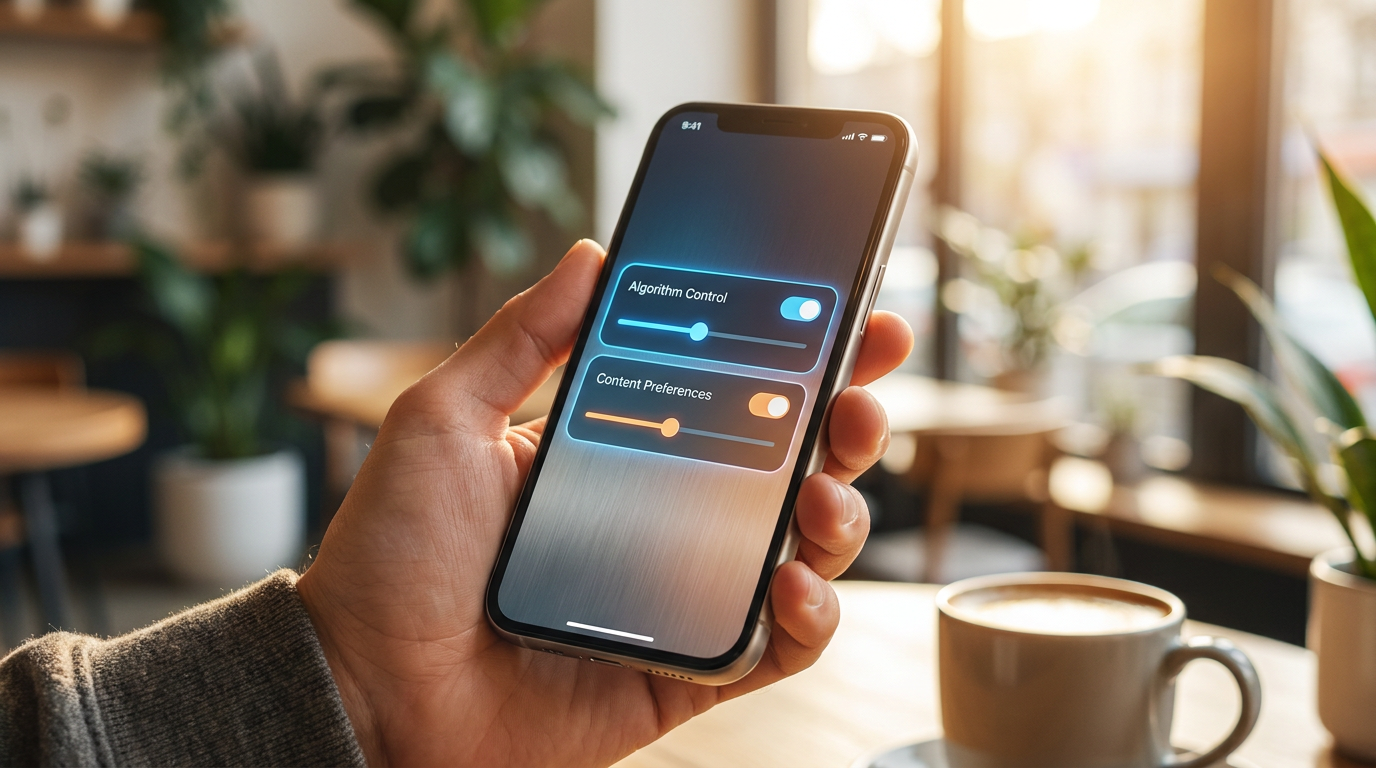
Major platforms like Threads and TikTok, alongside decentralized networks like Bluesky, are deploying AI tools that allow users to explicitly dictate what appears in their feeds.
By Factlen Editorial Team
- Decentralization Advocates
- Advocate for open protocols and a marketplace of entirely interchangeable algorithms.
- Major Platforms
- Focus on improving user retention and satisfying regulators through in-app preference sliders.
- Digital Creators
- Value the shift toward opt-in audiences and the end of exhausting engagement-bait tactics.
What's not represented
- · Advertisers adapting to custom feeds
- · Data privacy regulators
Why this matters
For years, social media users have been passive consumers of opaque, machine-driven feeds that often prioritized outrage to maximize engagement. The shift toward user-controlled algorithms empowers individuals to actively curate their digital environments, protecting their mental health while discovering higher-quality, niche content.
Key points
- Major social media platforms are abandoning opaque recommendation engines in favor of user-controlled algorithms.
- Threads introduced 'Your Algo,' allowing users to adjust topic preferences for one, three, or seven days.
- TikTok deployed AI-driven 'Smart Keyword Filters' that automatically suppress semantically related terms.
- Decentralized network Bluesky launched 'Attie,' an AI tool that lets users build custom feeds via natural language.
- The shift is forcing digital creators to abandon engagement bait in favor of building genuine, opt-in niche audiences.
For the better part of a decade, the defining characteristic of social media was the opaque recommendation engine. Platforms operated like digital slot machines, utilizing hidden signals to determine exactly which videos, posts, and advertisements would populate a user's screen. People could passively influence their feeds by liking or lingering on content, but the underlying mathematical weights remained a closely guarded corporate secret. That era of the black-box feed is now coming to a definitive close. In a sweeping industry shift accelerating through the summer of 2026, the world's largest social networks are fundamentally restructuring how content curation works, handing the algorithmic keys directly over to their users.[1][2]
The transition marks an evolution from a uniform broadcast model—where a central system dictates the programming—to a highly personalized streaming environment. Instead of relying solely on behavioral tracking to guess what a person might want to see, platforms are deploying new artificial intelligence tools that allow users to explicitly state their preferences. Industry analysts note that this is not merely a cosmetic update to the traditional 'Not Interested' button, but a structural change that allows users to actively train and mold their own algorithms in real time.[1][7]
Meta's text-based platform, Threads, which crossed 400 million monthly active users in early 2026, has been at the forefront of this centralized shift. On June 16, 2026, the company rolled out a feature dubbed 'Your Algo,' significantly expanding on a public prompt system it had tested earlier in the year. The new interface allows users to privately dictate their content preferences across specific categories without having to broadcast those desires to their followers.[1][7]
The mechanics of 'Your Algo' reflect a nuanced understanding of how human interests fluctuate. Users can request to see more of a specific niche—such as baseball highlights or local bakery posts—and explicitly ask the system to suppress high-stress political news or specific trending dramas. Crucially, Threads allows users to set temporal parameters for these adjustments, applying the custom algorithmic weights for durations of one, three, or seven days. This means a user can temporarily mute a stressful news cycle for a weekend without permanently altering their long-term feed dynamics.[1][7]

Instagram, another Meta property, executed a parallel rollout in early June. The platform expanded its 'Your Algorithm' tool, initially restricted to its short-form Reels product, across its entire ecosystem, including the main chronological feed and the Explore page. Accessed through the application's settings, the tool provides users with a transparent dashboard showing the exact topics Instagram believes they care about. Users can then manually adjust these assumptions, telling the system exactly where it has miscalculated their interests.[1][7]
TikTok, which arguably pioneered the hyper-optimized algorithmic feed, has also embraced explicit user controls. The company has steadily expanded its 'Manage Topics' interface, which utilizes adjustable sliders to regulate the volume of content across predefined categories like sports, travel, and current affairs. In 2025 and 2026, TikTok augmented this system with AI-driven 'Smart Keyword Filters.' Rather than requiring users to manually block every possible variation of a topic they wish to avoid, the system uses semantic machine learning to automatically suppress related terms.[1][2]
The implementation of these smart filters demonstrates how large language models are being repurposed for user protection rather than just content generation. If a user decides they want to filter out content related to home remodeling, the AI understands the semantic context and will concurrently filter out videos tagged with 'renovation,' 'drywall installation,' or 'interior design updates.' This level of precision allows users to curate a digital environment that protects their mental space without requiring them to play an endless game of keyword whack-a-mole.[1][2]
The implementation of these smart filters demonstrates how large language models are being repurposed for user protection rather than just content generation.
While major platforms are introducing these features partly to appease regulators—such as the United Kingdom's ongoing efforts to restrict algorithmic feeds for users under 16—they are also driven by a stark business reality. Social media executives have realized that giving users control actually improves long-term retention. When people can tune their feeds to match their exact interests, they are less likely to experience algorithmic fatigue and abandon the application entirely.[2]
However, the most radical innovations in algorithmic control are happening outside the walled gardens of Big Tech. Decentralized networks, built on open protocols, are treating the algorithm not as a built-in feature, but as a marketplace of interchangeable lenses. Bluesky, which operates on the open-source AT Protocol and scaled past 42 million users in early 2026, has made algorithmic choice the foundational pillar of its entire architecture.[4][6]

On Bluesky, there is no single, central algorithm deciding what goes viral. Instead, the platform supports 'custom feeds' or 'feed generators.' Developers and community members can build their own algorithms using open APIs, creating feeds that order posts based on highly specific rules. A user can pin a feed that only shows posts containing cat photos, a feed dedicated entirely to peer-reviewed AI research, or a feed that surfaces trending conversations within a specific geographic community.[4][6]
To make this decentralized power accessible to non-technical users, Bluesky introduced an AI application called 'Attie' in March 2026. Unveiled at the Atmosphere conference by Chief Innovation Officer Jay Graber, Attie utilizes Anthropic's Claude technology to allow anyone to build a custom algorithm using simple, natural language commands. Rather than writing code, a user can simply type a prompt describing the exact kind of digital environment they wish to inhabit.[3][4]
The Attie interface operates much like a conversational chatbot. A user can instruct the system to 'create a feed of posts about indoor plants, prioritizing accounts with fewer than a thousand followers, and excluding any posts that mention politics.' The AI translates this natural language request into the necessary code, generating a functional feed via the AT Protocol that the user can immediately browse, pin to their home screen, and even share with the broader community.[3][4]
The philosophical divide between the centralized platforms and the decentralized networks is stark. While Meta and TikTok are using AI to give users a steering wheel within a car the company still owns, Bluesky's leadership views open protocols as a way to fundamentally transfer ownership of the digital experience. As Bluesky executives emphasized during the Attie launch, the goal is to ensure that artificial intelligence serves the individual user's desire to find signal in the noise, rather than serving a corporate mandate to maximize screen time.[3][4]

This paradigm shift is already forcing digital creators and businesses to rewrite their playbooks. For years, the dominant strategy for online growth involved 'tricking' the central algorithm through engagement bait, controversial statements, or hyper-optimized posting schedules. But in an ecosystem where users control their own algorithms, those tactics actively backfire. Users who are empowered to filter out noise will swiftly mute accounts that rely on sensationalism.[5]
Instead, the new era of user-controlled algorithms rewards genuine value and niche authority. Creators who provide high-quality, educational, or deeply entertaining content are finding that they can build highly engaged audiences, even if their overall follower counts are lower than they might have been on legacy platforms. The focus has shifted from trying to go viral across a massive, indifferent network to becoming an indispensable resource within specific, user-curated feeds.[5][7]

The broader integration of the Fediverse—the decentralized network of servers running on protocols like ActivityPub—is further accelerating this trend. With platforms like Threads beginning to offer two-way interoperability with networks like Mastodon, the concept of a portable digital identity is moving from a niche tech concept to a mainstream reality. Users are increasingly able to carry their connections and their algorithmic preferences across different applications.[7]
Ultimately, the transition toward user-controlled algorithms represents a maturation of the social internet. After years of passive consumption dictated by opaque machines, users are being equipped with the tools to actively architect their digital diets. Whether through time-limited sliders on Threads, semantic filters on TikTok, or natural-language feed generation on Bluesky, the result is a more intentional, customizable, and empowering online experience.[1][6][7]
How we got here
2024
TikTok introduces its initial 'Manage Topics' interface, giving users basic sliders to adjust content categories.
Early 2026
Bluesky's user base crosses 42 million, proving the viability of decentralized, custom-feed architectures.
March 2026
Bluesky unveils 'Attie,' an AI tool allowing users to build custom algorithms using natural language.
June 2026
Threads launches 'Your Algo' and Instagram expands 'Your Algorithm,' signaling a major industry shift toward user control.
Viewpoints in depth
Major Platforms
Incumbent social networks view user controls as a way to boost long-term retention and satisfy regulators.
For companies like Meta and TikTok, handing over algorithmic controls is a calculated retention strategy. By allowing users to fine-tune their feeds with tools like 'Your Algo' and 'Manage Topics,' these platforms reduce the algorithmic fatigue that often drives users to delete apps. They argue that AI-powered sliders and time-limited preference adjustments provide the perfect balance: users get a curated, comfortable experience, while the platform maintains the underlying infrastructure and advertising ecosystem.
Decentralization Advocates
Proponents of open protocols argue that true control requires a marketplace of algorithms, not just sliders on a corporate app.
Builders in the Fediverse and the AT Protocol ecosystem argue that tweaking settings within a closed app is merely an illusion of control. True algorithmic freedom, they contend, means the ability to completely swap out the recommendation engine. By championing tools like Bluesky's 'Attie,' this camp envisions a future where algorithms are community-built utilities rather than corporate trade secrets. They believe that separating the hosting of content from the ranking of content is the only way to permanently align social media with human well-being.
Digital Creators
Content creators are adapting to an environment where engagement bait is penalized and niche authority is rewarded.
For the creator economy, the end of the monolithic algorithm is both a challenge and a relief. While it removes the possibility of 'hacking' a central feed for massive viral reach, it also eliminates the exhausting treadmill of chasing opaque algorithmic trends. Creators argue that user-controlled feeds allow them to build deeper, more sustainable relationships with audiences who have actively opted into their specific niche, prioritizing genuine educational or entertainment value over sensationalism.
What we don't know
- How the widespread adoption of custom algorithms will impact the advertising revenue models of major platforms.
- Whether mainstream users will actively manage their algorithmic settings long-term, or default back to passive consumption.
- How effectively these new user controls will combat the spread of coordinated misinformation campaigns.
Key terms
- Algorithm
- A set of mathematical rules used by social media platforms to determine which posts, videos, and ads are shown to a user.
- AT Protocol
- An open-source framework developed by Bluesky that allows different social networks to communicate and share custom algorithms.
- Fediverse
- A decentralized network of independent social media servers that can interact with each other, such as Mastodon.
- Semantic Machine Learning
- Artificial intelligence that understands the meaning and context of words, allowing it to filter out related concepts rather than just exact keywords.
- Feed Generator
- A custom algorithm created by a developer or user on a decentralized network that dictates a specific set of rules for a timeline.
Frequently asked
What is a user-controlled algorithm?
It is a recommendation system that allows users to explicitly dictate what content they see, rather than relying on the platform to guess based on their behavior.
How does Threads' 'Your Algo' feature work?
It allows users to privately request more or less of specific topics in their feed, with the changes lasting for a set duration of one, three, or seven days.
What is Bluesky's Attie tool?
Attie is an AI-powered application that lets Bluesky users create their own custom algorithms by simply typing what they want to see in natural language.
Will this reduce clickbait on social media?
Yes. Because users can now actively filter out sensationalist content, creators are incentivized to produce higher-quality, niche-specific material that users actively opt into.
Sources
Source coverage
7 outlets
3 viewpoints surfaced







[1]TechCrunchMajor Platforms
Social media's next evolution: user-controlled algorithms
Read on TechCrunch →[2]QazinformMajor Platforms
Social media enters the era of user-controlled algorithms
Read on Qazinform →[3]ForkLogDecentralization Advocates
Bluesky Unveils AI App for Custom Social Media Feeds
Read on ForkLog →[4]MLQ NewsDecentralization Advocates
Bluesky Introduces Attie AI Tool for Building Personalized Feeds
Read on MLQ News →[5]Bsky BlogDigital Creators
How to Grow on Bluesky Fast in 2026: The Complete Strategy
Read on Bsky Blog →[6]Distribution AIDecentralization Advocates
How Bluesky Algorithm Works [With Actionable Growth Tactics]
Read on Distribution AI →[7]PostEverywhereMajor Platforms
8 Threads Trends as It Hits 400M Users (2026)
Read on PostEverywhere →
Every angle. Every day.
Get technology stories with full source coverage and perspective breakdowns delivered to your inbox.