
The Trickle-Down of Flagship Safety: Why 2026 is the Safest Year to Buy a Beginner Motorcycle
Inertial Measurement Units (IMUs) and cornering ABS—once exclusive to $20,000 superbikes—are now standard on entry-level motorcycles, dramatically reducing the risk of crashes for new riders.
By Factlen Editorial Team
- Safety Advocates
- Argue that IMU technology is the most significant motorcycle safety leap in decades, forgiving the exact panic-braking mistakes that typically injure new riders.
- Motorcycle Manufacturers
- View advanced electronics as the key to expanding the market, using high-end tech to reassure hesitant buyers that motorcycling is safer than it used to be.
- Riding Purists
- Express concern that an invisible electronic net allows beginners to ride faster than their actual skill level, masking poor technique that will eventually catch up with them.
What's not represented
- · Insurance Actuaries
- · Used Motorcycle Dealerships
Why this matters
For decades, common beginner mistakes like grabbing the brakes in a corner resulted in a guaranteed crash. Now, affordable starter bikes actively intervene to keep riders upright, fundamentally changing the safety math for anyone looking to start riding.
Key points
- Inertial Measurement Units (IMUs) track a motorcycle's lean angle, pitch, and acceleration hundreds of times per second.
- Cornering ABS uses this data to prevent the front tire from locking and washing out when braking in a turn.
- Previously reserved for $20,000 superbikes, this technology is now standard on entry-level 2025 and 2026 models.
- Motorcycles equipped with basic ABS are 37% less likely to be involved in a fatal crash.
- Electronic ride-by-wire throttles also smooth out power delivery, preventing common beginner stalls.
It is the classic beginner mistake. You enter a corner slightly too fast, panic, and grab a handful of front brake. For decades, the result was a guaranteed "low-side" crash as the front tire locked, lost lateral grip, and washed out from under the rider. It was a painful, expensive rite of passage that kept many prospective motorcyclists away from the sport entirely.[3]
Today, that exact same mistake ends differently. The motorcycle's onboard computer detects the lean angle, intervenes in milliseconds to modulate the brake calipers, and keeps the bike upright through the turn. The rider gets a shot of adrenaline and a scare, but they ride home safely instead of waiting for a tow truck.[3][7]
This invisible safety net is powered by the Inertial Measurement Unit (IMU) and Cornering Anti-lock Braking Systems (ABS). Once the exclusive domain of $20,000 flagship superbikes and heavy adventure tourers, this technology has rapidly trickled down to the beginner market for the 2025 and 2026 model years.[1][2]
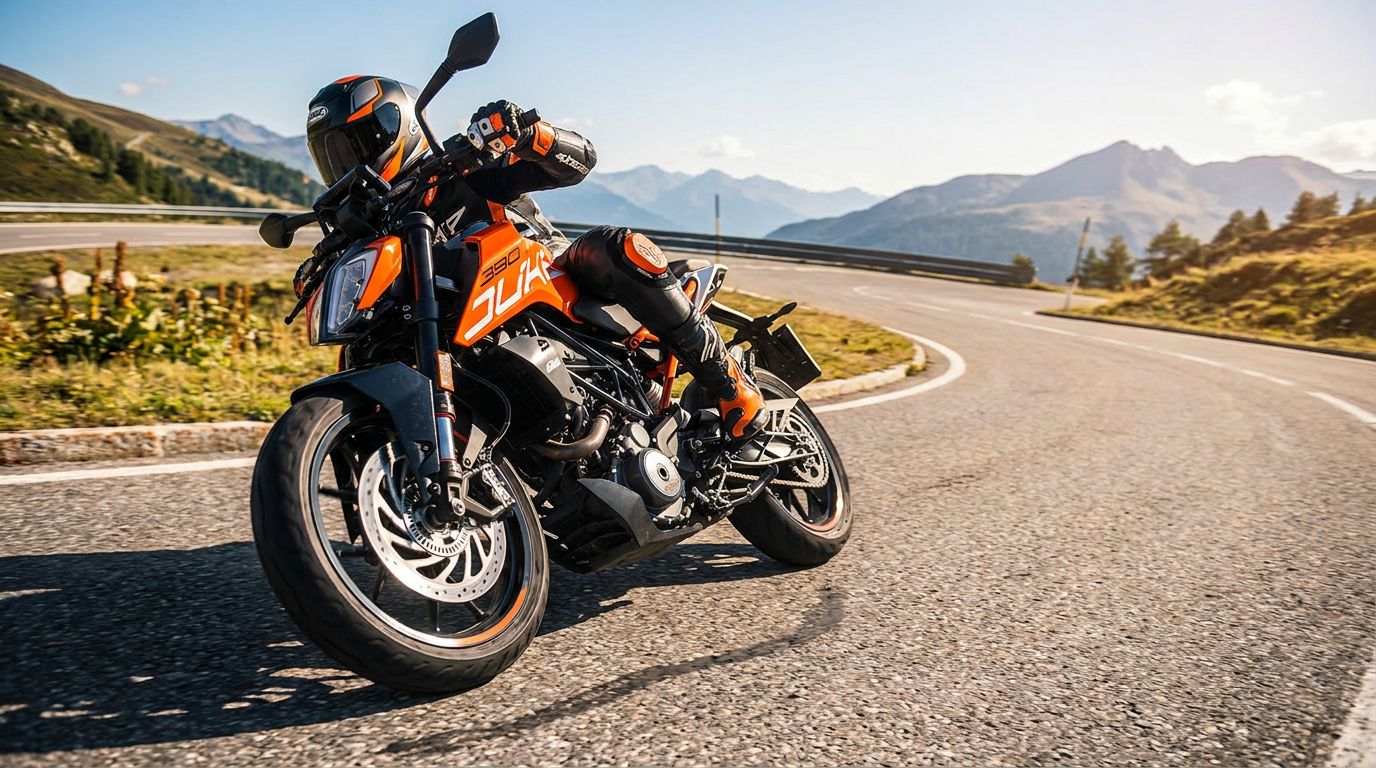
The shift represents a golden era for new riders shopping for their first motorcycle. Entry-level machines like the KTM 390 Duke, Aprilia RS 457, and Triumph Trident 660 now feature electronic brains that were winning MotoGP world championships less than a decade ago, making them the most forgiving starter bikes ever built.[1][4]

To understand the revolution, you have to look inside the IMU. It is a microscopic suite of gyroscopes and accelerometers—often referred to as a "six-axis" system—that measures the motorcycle's pitch (wheelies or stoppies), roll (lean angle), and yaw (sliding). It knows exactly where the bike is in three-dimensional space at all times.[2][5]
Standard ABS, which became mandatory in Europe for new bikes over 125cc in 2017, only works in a straight line. It simply compares front and rear wheel speeds to detect a lock-up. But when a motorcycle leans into a corner, the physics change dramatically, rendering standard ABS largely ineffective.[2][5]
As a bike leans, the effective circumference of the tire changes, and the suspension is already heavily loaded. If you apply standard ABS braking force while leaned over, the tire will simply lose lateral grip. Cornering ABS solves this by using the IMU's lean-angle data to instantly reduce the maximum braking pressure allowed, prioritizing cornering grip over stopping power.[2][3]

As a bike leans, the effective circumference of the tire changes, and the suspension is already heavily loaded.
The proliferation of this tech is largely driven by economies of scale. Suppliers like Bosch have miniaturized their Motorcycle Stability Control (MSC) units, making them cheap enough for manufacturers to install on sub-$7,000 commuter bikes without destroying their profit margins.[5][7]
The IMU doesn't just govern the brakes; it also enables lean-sensitive traction control. If a novice rider aggressively twists the throttle while exiting a wet roundabout, the system detects the slip and cuts engine power before the rear wheel can spin out of control and cause a dangerous "high-side" crash.[3][5]
This is paired with "ride-by-wire" electronic throttles, which replace physical cables with digital sensors. Manufacturers like Honda intentionally map the first 15 percent of the throttle twist on their 500cc beginner bikes to be incredibly gentle, virtually eliminating the jerky starts that cause parking-lot stalls.[2][4]

The data supports the hardware. The U.S. Insurance Institute for Highway Safety (IIHS) found that motorcycles equipped with basic ABS are 37 percent less likely to be involved in a fatal crash. Industry experts expect cornering ABS to push those survival rates even higher by mitigating mid-corner panic braking—one of the most common causes of single-vehicle motorcycle accidents.[3][7]
This technological leap is reshaping the used motorcycle market. While a five-year-old beginner bike might look identical to a 2026 model, the older machine lacks the IMU brain. Dealerships are seeing buyers willingly pay a premium for new or late-model bikes specifically to secure these safety features.[6][7]

However, the rise of the "smart" beginner bike has sparked a philosophical debate within the riding community. Purists argue that relying on a computer to save you prevents the development of fundamental skills, like smooth brake application and throttle control, potentially masking bad habits.[1][7]
How we got here
2014
KTM introduces the first cornering ABS system on the flagship 1190 Adventure.
2017
Standard straight-line ABS becomes mandatory for all new motorcycles over 125cc in Europe.
2021
Mid-capacity sportbikes like the Aprilia RS660 begin featuring 6-axis IMUs as standard equipment.
2025-2026
IMU and cornering ABS technology trickles down to sub-500cc beginner motorcycles across major brands.
Viewpoints in depth
Safety Advocates & Instructors
Believe IMU technology is the most significant motorcycle safety leap in decades.
Riding instructors and safety advocates view cornering ABS as a monumental shift in rider training. For decades, instructors had to drill students on the catastrophic dangers of grabbing the front brake in a corner. Now, they argue that the electronic safety net forgives the exact panic-induced mistakes that typically injure new riders, allowing them to survive their early errors and continue developing their skills safely.
Motorcycle Manufacturers
See advanced electronics as the key to expanding the motorcycle market to hesitant buyers.
For manufacturers, trickling down flagship technology is both a safety initiative and a marketing strategy. By equipping entry-level bikes with the same electronic brains found in MotoGP racers, brands can reassure safety-conscious buyers—and their concerned families—that modern motorcycling is significantly safer than it was in the past. This technological reassurance is seen as vital for attracting a new generation of riders.
Riding Purists
Worry that an invisible electronic net masks poor technique and prevents skill development.
A vocal segment of veteran riders and purists argue that relying on a computer to save you is a dangerous crutch. They express concern that beginners starting on IMU-equipped bikes will ride faster than their actual skill level dictates, never learning the nuanced feel of tire grip and smooth brake modulation. In their view, when the electronics eventually cannot overcome the laws of physics, the resulting crash will be at a much higher speed.
What we don't know
- How much cornering ABS will lower insurance premiums for beginner riders in the long term.
- Whether the increased reliance on electronic aids will lead to a degradation of fundamental riding skills over time.
Key terms
- Inertial Measurement Unit (IMU)
- A suite of gyroscopes and accelerometers that tracks a motorcycle's lean angle, pitch, and acceleration in real-time.
- Cornering ABS
- An advanced braking system that uses IMU data to reduce brake pressure when the bike is leaned over, preventing the tires from washing out.
- Ride-by-Wire
- An electronic throttle system where the twist grip sends a digital signal to the engine computer rather than pulling a physical cable.
- Low-Side Crash
- A crash where the motorcycle loses traction and slides out from under the rider, often caused by braking too hard in a corner.
Frequently asked
Does cornering ABS mean I can't crash in a turn?
No. It provides a safety net against locking the brakes, but it cannot defy physics. If you enter a corner far too fast for the tires to grip the road, you will still crash.
Do I still need to learn proper braking technique?
Yes. Instructors emphasize that electronic aids are a backup for emergencies, not a replacement for smooth, progressive braking and throttle control.
Are older used bikes unsafe for beginners?
Not necessarily. A used bike with standard straight-line ABS is still a good starting point, though 2025-2026 models offer vastly superior protection during cornering.
Sources
Source coverage
7 outlets
3 viewpoints surfaced







[1]MotofomoRiding Purists
Motorcycles with Cornering ABS (2026 Update)
Read on Motofomo →[2]VisordownSafety Advocates
How A Motorcycle IMU Works
Read on Visordown →[3]Kamax GroupMotorcycle Manufacturers
Motorcycle Safety Technology: IMU and ABS
Read on Kamax Group →[4]MotoressRiding Purists
Best Beginner Motorcycles 2026 + How to Choose
Read on Motoress →[5]BennettsSafety Advocates
Motorcycle IMU technology explained
Read on Bennetts →[6]A4 Auto TransportMotorcycle Manufacturers
Best Beginner Motorcycles for 2026
Read on A4 Auto Transport →[7]Factlen Editorial TeamSafety Advocates
Synthesis by Factlen editorial team
Read on Factlen Editorial Team →

More in shopping
See all 7 stories →Wearable Tech
Smart Rings vs. Smartwatches: The 2026 Clinical Evidence on Wearable Accuracy
9 sources

Wearable Tech
Smart Rings vs. Smartwatches: The 2026 Health Tracking Comparison
7 sources

Device Longevity
The 7-Year Smartphone: How Extended Support is Killing the Two-Year Upgrade Cycle
6 sources
E-Bike Tech
How to Choose an E-Bike in 2026: A Complete Buying Guide
7 sources
Every angle. Every day.
Get shopping stories with full source coverage and perspective breakdowns delivered to your inbox.