
The Science of Smoke and Sear: How Heat and Chemistry Actually Flavor Your BBQ
The secret to perfect barbecue isn't just a recipe—it's a complex dance of thermodynamics, the Maillard reaction, and the thermal breakdown of wood lignins.
By Kabir Mehra

In short
- The Maillard reaction, responsible for the savory crust on grilled meat, only begins when surface temperatures exceed 285°F.
- Surface moisture must evaporate before browning can occur, as water cannot exceed its boiling point of 212°F.
- Wood smoke flavor primarily comes from the thermal breakdown of lignin into phenolic compounds like guaiacol and syringol.
Every time you fire up the grill, you are stepping into a backyard laboratory. The intoxicating aroma of a summer barbecue and the deep, savory crust on a perfectly seared steak are not the results of culinary magic, but of precise, applied chemistry. Mastering the grill requires understanding the invisible thermodynamic and molecular reactions happening just above the coals.[4]
The foundation of all great grilled food is the Maillard reaction. First described by French chemist Louis-Camille Maillard in 1912, this process is a form of non-enzymatic browning that fundamentally transforms the flavor profile of food. It is the same chemical mechanism that gives roasted coffee its depth and baked bread its golden crust.
At a molecular level, the Maillard reaction occurs when the heat of the grill causes amino acids—the building blocks of proteins—to react with reducing sugars present in the meat. This initial collision forms a Schiff base, which quickly rearranges into unstable Amadori compounds. These compounds then undergo a massive cascade of thermal rearrangements, producing hundreds of new, complex flavor molecules like pyrazines, furans, and aldehydes.
However, this chemical cascade does not happen at just any temperature. The Maillard reaction only begins in earnest when the surface of the food reaches approximately 285°F (140°C), and it accelerates rapidly as temperatures climb toward 350°F. Below this threshold, meat will simply steam and turn gray, completely missing out on the development of those savory, roasted flavor compounds.
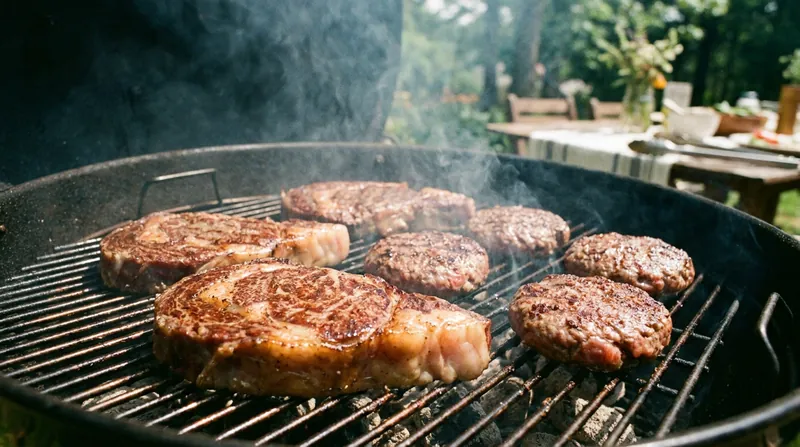
This temperature requirement explains the vital importance of the "sizzle." Meat contains a significant amount of water, and water cannot exceed its boiling point of 212°F (100°C). When you place a steak on a hot grill, the sizzling sound is the surface moisture rapidly evaporating. Only after this surface dehydration is complete can the exterior temperature of the meat rise high enough to trigger the Maillard reaction.
While the Maillard reaction handles the crust, the signature flavor of outdoor cooking comes from the smoke. But smoke is not a single entity; it is a complex mixture of gases, water vapor, and microscopic particles created by the thermal breakdown of wood. To understand smoke flavor, you have to look at what wood is actually made of: cellulose, hemicellulose, and lignin.[3][4]
Cellulose and hemicellulose are carbohydrates that provide the structural framework of the wood. When they burn, they mostly produce sweet, fruity, and slightly tart aromas. But the true star of barbecue chemistry is lignin, the complex polymer that binds wood fibers together.[3]
When lignin undergoes pyrolysis—the chemical decomposition of organic material at elevated temperatures—it breaks down into a crucial class of compounds known as phenols. Among these, two specific molecules are responsible for the quintessential barbecue profile: guaiacol and syringol.[3]
Guaiacol is the primary compound responsible for the distinct, savory taste of wood smoke, while syringol provides the heavy, unmistakable smoky aroma. The ratio of these compounds varies depending on the type of hardwood used, which is why hickory imparts a sharper, more aggressive flavor than the milder, sweeter profile of apple or cherry wood.[3]
The quality of the combustion dictates whether these compounds taste delicious or disastrous. Pitmasters constantly chase "thin blue smoke"—a faint, nearly invisible exhaust that signals a clean, hot fire. This efficient combustion delivers pure guaiacol and syringol. In contrast, thick, billowing white or gray smoke indicates a smoldering fire starved of oxygen, which coats the food in unburned carbon particles and bitter creosote.[2]
The type of fuel you choose fundamentally alters this chemical equation. Traditional lump charcoal burns incredibly hot and is composed almost entirely of pure carbon, having had its lignin and moisture baked out during manufacturing. Because charcoal produces very little wood smoke on its own, its flavor actually comes from fat and meat juices dripping onto the hot coals, vaporizing, and rising back up to coat the food in complex aerosols.[2][4]
Pellet grills, on the other hand, rely on compressed hardwood sawdust fed into a controlled fire pot. Because the combustion is digitally regulated to burn at highly efficient, steady temperatures, pellet grills produce a very clean, mild smoke. They deliver a consistent stream of syringol and guaiacol without the risk of bitter creosote, though the flavor is often less intense than a traditional live-fire offset smoker.[4]
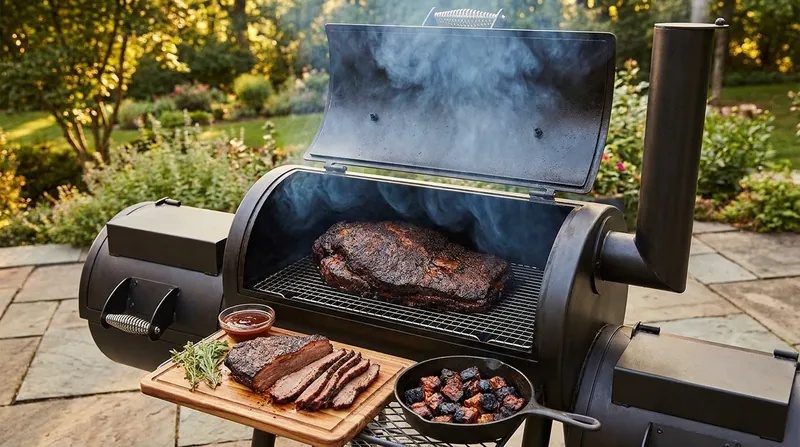
Beyond flavor, wood smoke also triggers one of the most sought-after visual markers in barbecue: the smoke ring. This distinct pink band just beneath the crust of smoked meats is often mistaken for undercooked meat, but it is actually the result of a specific chemical reaction between the smoke and the meat's proteins.[1]
Burning wood produces nitrogen dioxide gas, which dissolves into the moisture on the surface of the meat to form nitrous acid. This acid then penetrates the outer layers of the muscle and reacts with myoglobin—the protein that gives raw meat its red color. The reaction forms a stable pink pigment called nitrosyl hemochromogen, locking in the color even after the meat is fully cooked.[1]
Because this reaction requires the specific nitrogen compounds produced by burning wood or charcoal, a true smoke ring cannot be achieved by cooking meat in a standard indoor gas or electric oven, regardless of the temperature or cooking time.[1]
The final piece of the barbecue puzzle happens deep inside the meat, far away from the smoke and the sear. Tough cuts of meat popular in barbecue, like brisket and pork shoulder, are loaded with a tough connective tissue called collagen. If cooked quickly, these cuts remain unpleasantly chewy and tough.[1]
However, when subjected to low, slow heat, a structural transformation occurs. As the internal temperature of the meat reaches between 185°F and 195°F, the tough collagen begins to unravel and melt, converting into rich, soft gelatin. This is the exact scientific mechanism that turns a tough, working muscle into "fall-apart" tender barbecue.[1]
During this slow climb, pitmasters often encounter "the stall"—a frustrating period where the meat's internal temperature stops rising for hours. This is not a failure of the grill, but the physics of evaporative cooling. As the meat sweats out moisture, the evaporation cools the surface at the exact same rate the fire heats it, halting the temperature rise until the surface finally dries out.[1]
During this slow climb, pitmasters often encounter "the stall"—a frustrating period where the meat's internal temperature stops rising for hours.
Ultimately, great grilling is an exercise in managing these competing scientific forces. It requires balancing the intense, dry heat needed to trigger the Maillard reaction with the controlled, clean combustion required to extract the perfect phenolic compounds from the wood. By understanding the chemistry at play, anyone can transform their backyard grill into an engine of culinary perfection.[4]
Key terms
- Maillard Reaction
- A chemical reaction between amino acids and reducing sugars that gives browned food its distinctive flavor.
- Lignin
- A complex organic polymer found in the cell walls of plants and wood, responsible for producing key smoke flavors when burned.
- Guaiacol
- A phenolic compound produced by burning wood that is primarily responsible for the savory taste of barbecue smoke.
- Syringol
- A phenolic compound produced during the pyrolysis of wood that provides the heavy, unmistakable aroma of smoke.
- Myoglobin
- A protein found in muscle tissue that gives raw meat its red color and reacts with smoke gases to form a smoke ring.
- Pyrolysis
- The chemical decomposition of organic materials, such as wood, through the application of high heat in the absence of sufficient oxygen.
Frequently asked
Why does my meat stall at 160°F?
This is caused by evaporative cooling. As the meat sweats, the evaporating moisture cools the surface at the same rate the grill heats it, pausing the temperature rise.
What causes the pink ring on smoked meat?
Nitrogen dioxide gas from burning wood reacts with myoglobin in the meat to form a stable pink pigment called nitrosyl hemochromogen.
Why is thick white smoke bad for barbecue?
Thick white or gray smoke indicates incomplete combustion, which coats your food in unburned carbon particles and creosote, resulting in a bitter, ashy taste.
Viewpoints in depth
Food Chemists & Researchers
Focuses on the molecular breakdown of food and fuel during the cooking process.
For food scientists, grilling is a study in thermal degradation and molecular rearrangement. They focus on how the Maillard reaction transforms amino acids and sugars into complex flavor compounds like pyrazines and furans. From this perspective, the quality of barbecue is dictated by precise temperature control—ensuring the surface heat is high enough to trigger browning without crossing into the bitter, carbonized territory of burnt food.
Traditional Pitmasters
Prioritizes live-fire management, airflow, and the sensory cues of clean combustion.
Traditional barbecue experts view the craft through the lens of fire management rather than laboratory metrics. They emphasize the importance of 'thin blue smoke'—the visual indicator of a clean, oxygen-rich fire that efficiently breaks down wood lignin into desirable flavor phenols like guaiacol and syringol. For this camp, mastering the grill means mastering the airflow, ensuring the fire never smolders and produces bitter creosote.
Pellet Grill Enthusiasts
Values consistency, automated temperature control, and milder smoke profiles.
Advocates for modern pellet grills prioritize the elimination of human error in the thermodynamic process. By relying on digitally controlled augers to feed compressed sawdust into a fire pot, they ensure a perfectly consistent burn rate. This camp argues that the resulting smoke is cleaner and less likely to overpower the natural flavor of the meat, even if it lacks the aggressive phenolic punch of a traditional offset smoker.
- Food Chemists & Researchers
- Focuses on the molecular breakdown of food and fuel during the cooking process.
- Barbecue Scientists & Educators
- Explores the practical application of thermodynamics, smoke rings, and meat science.
- Live-Fire Pitmasters
- Prioritizes live-fire management, airflow, and the sensory cues of clean combustion.
- Culinary Synthesizers
- Combines scientific principles with practical cooking techniques to optimize flavor.
Perspectives this story doesn't cover
- Vegetarian Grilling Advocates
- Appliance Manufacturers
Sources
Source coverage
4 outlets
4 viewpoints surfaced




- [1]Texas A&M UniversityBarbecue Scientists & Educators
The Science of Barbecuing: Smoke Rings and Collagen
Read on Texas A&M University → - [2]Destination BBQLive-Fire Pitmasters
The Science of Wood Smoke and Clean Combustion
Read on Destination BBQ → - [3]Journal of Agricultural and Food ChemistryFood Chemists & Researchers
Thermal Degradation of Lignin and the Formation of Smoke Flavor Compounds
Read on Journal of Agricultural and Food Chemistry → - [4]Factlen Editorial TeamCulinary Synthesizers
Synthesis by Factlen editorial team
Read on Factlen Editorial Team →

More in Food & Drink
See all →Agricultural Economics
Record Beef Prices Sizzle for Grilling Season as U.S. Cattle Herd Hits 75-Year Low
4 sources
Commodity Markets
How Record Inventories Are Driving Down Propane Prices for the 2026 Grilling Season
5 sources
Supply Chain
Mandatory Global Shipping Rules Reclassify Charcoal as 'Dangerous Goods,' Rewiring the Supply Chain
4 sources

Grilling Science
The Science of Smoke: How Wood Chemistry Transforms Grilled Food
2 sources
Comments
Every angle. Every day.
Get Food & Drink stories with full source coverage and perspective breakdowns, free every day.