
How Fungi Are Being Used to Grow the Next Generation of Building Materials
Architects and engineers are turning to mycelium—the root network of fungi—to bio-fabricate low-carbon insulation, acoustic panels, and bricks from agricultural waste.
By Factlen Editorial Team
- Bio-Architecture Advocates
- Argue that the construction industry must fundamentally transition from extracting finite resources to growing regenerative materials.
- Materials Scientists
- Emphasize the empirical thermal and fire-resistant properties of fungal composites while acknowledging current structural limitations.
- Commercial Developers
- Approach bio-materials through the lens of regulatory compliance, focusing on cost, scalability, and meeting new carbon legislation.
What's not represented
- · Traditional petrochemical insulation manufacturers
- · Municipal building code inspectors
Why this matters
The construction industry is responsible for nearly 40% of global carbon emissions, largely due to energy-intensive materials like concrete and plastic foam. Mycelium bio-composites offer a scalable, circular alternative that could drastically reduce the carbon footprint of our homes while providing safer, non-toxic insulation.
Key points
- Mycelium, the root network of fungi, is being used to grow sustainable building materials like insulation and bricks.
- The bio-fabrication process binds agricultural and construction waste into solid panels in just five to seven days.
- Mycelium composites offer a 91% to 95% reduction in embodied carbon compared to traditional masonry units.
- The material provides excellent thermal insulation, acoustic dampening, and natural fire resistance without toxic chemicals.
- While ideal for interior partitions and insulation, mycelium currently lacks the compressive strength for load-bearing structural use.
The built environment is responsible for nearly 40% of all global carbon emissions, a staggering figure driven largely by the materials we use to construct our homes and cities. Traditional building staples like concrete, steel, and synthetic insulation foams are manufactured in high-heat kilns and chemical baths, locking in massive amounts of embodied carbon before a building is even occupied.[7]
But as the construction industry faces tightening environmental regulations in 2026, a quiet revolution is taking root. Architects and engineers are increasingly swapping extractive manufacturing for biological cultivation, turning to the natural world to "grow" the next generation of building materials.[4][7]
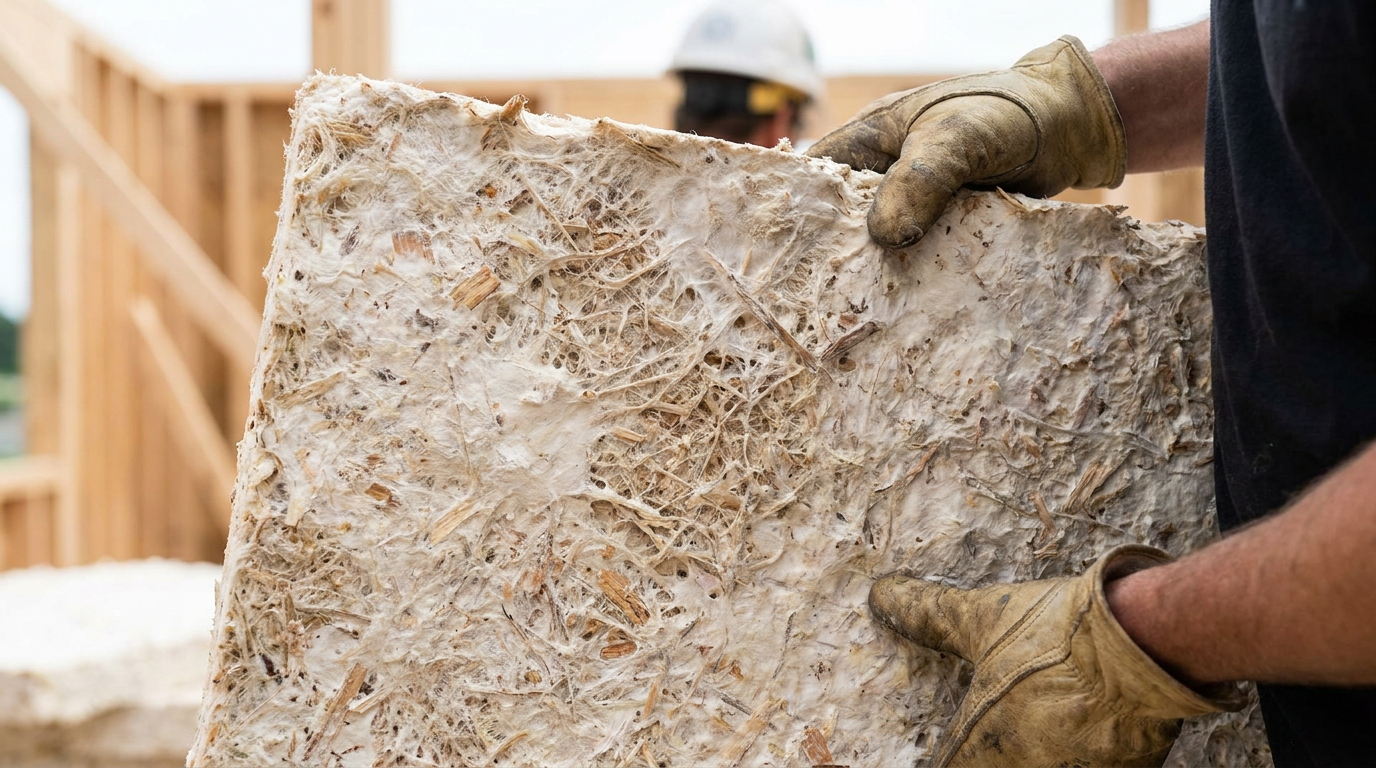
The engine behind this shift is mycelium—the dense, microscopic root-like network of fungi that thrives beneath the forest floor. While mushrooms are the visible fruiting bodies, the subterranean mycelium acts as nature's ultimate binder, capable of breaking down organic matter and weaving it into a resilient, unified structure.[4]
By harnessing this biological process, bio-engineers are now producing commercial-grade insulation panels, acoustic boards, and non-load-bearing bricks. The process is remarkably efficient, requiring a fraction of the water and electricity needed to manufacture conventional petrochemical plastics.[5]

The manufacturing mechanism begins not in a quarry or an oil refinery, but with agricultural or construction waste. Substrates such as hemp hurd, sawdust, rice hulls, or paper industry byproducts are collected and sterilized.[2][5]
This loose waste is then inoculated with specific fungal spores—most commonly robust species like oyster mushrooms or Trametes versicolor, known as turkey tail. The inoculated mixture is packed into custom molds that dictate the final shape of the architectural product, whether that is a flat insulation sheet or an interlocking brick.[1][3][4]
Over the next five to seven days, the material is left in a dark, climate-controlled environment with high humidity. The mycelium rapidly colonizes the substrate, extending microscopic threads called hyphae that digest the organic waste and bind the loose particles into a dense, solid matrix.[3][7]
Once the mycelium has fully formed the desired shape, the bio-composite undergoes a crucial final step: heat treatment. The panels are baked at high temperatures to completely terminate all biological activity, ensuring that the finished building material is inert and will not sprout mushrooms or continue growing inside a home's walls.[3][7]
The resulting material is a structural marvel with a profoundly different environmental footprint. Recent life cycle assessments published in 2026 demonstrate that mycelium-based bio-composites achieve a 91% to 95% reduction in embodied carbon emissions compared to traditional masonry units.[2]

The resulting material is a structural marvel with a profoundly different environmental footprint.
Insulation has emerged as the primary commercial battleground for this technology. Conventional polyurethane and extruded polystyrene foams are derived from fossil fuels, require immense energy to produce, and release toxic volatile organic compounds as they degrade over time.[5]
Mycelium insulation, by contrast, naturally traps air and water vapor within its cellular network, providing thermal and acoustic performance that rivals or exceeds synthetic mineral wool. Because it is vapor-permeable, it also helps regulate indoor humidity and prevents the accumulation of dampness that leads to toxic mold.[5][6]
The technology is also solving adjacent waste crises. In a May 2026 breakthrough, researchers at the University of Bath successfully utilized turkey tail fungi to break down oriented strand board (OSB)—an engineered wood product heavily treated with synthetic resins that is notoriously difficult to recycle and often ends up in landfills.[1]
The fungi effectively digested the toxic adhesives in the OSB waste, transforming a hazardous construction byproduct into high-grade, low-carbon insulation. The resulting biomaterial matched the thermal performance of conventional polystyrene while generating ten times fewer carbon emissions during production.[1]
Commercial applications are rapidly moving from the laboratory to the job site. In the United Kingdom, startups like Mykor are repurposing thousands of tonnes of paper industry waste to bio-assemble their MykoSlab insulation sheets, which are designed as direct, drop-in replacements for standard plastic foams.[5]

The material is also proving its viability in diverse global climates. In Nairobi, the newly developed Mosaic Co-living Residences integrated mushroom-based insulation panels from local manufacturer MycoTile, utilizing regional agricultural waste to naturally regulate indoor temperatures without relying on energy-intensive air conditioning.[6]
Beyond thermal regulation, mycelium composites offer exceptional natural fire resistance. The high silica content found in agricultural substrates like rice hulls, combined with the mycelium's natural tendency to form a protective char layer, allows these panels to meet strict commercial fire codes without the addition of toxic chemical flame retardants.[2][7]
Researchers are now pushing the boundaries of what fungi can build. At the University of British Columbia, biogenic architecture labs are utilizing 3D printers to extrude living mycelium hydrogels, allowing architects to print complex, tunable structures that grow into their final hardened forms.[3]
Despite the rapid advancements, mycelium is not yet ready to replace the steel and concrete skeletons of modern skyscrapers. The material's compressive strength currently ranges from 0.30 to 1.20 megapascals—ideal for interior partitions, acoustic cladding, and insulation, but vastly insufficient for load-bearing structural foundations.[2][7]

Engineers also face ongoing questions regarding the material's long-term moisture resistance in extreme, unprotected outdoor environments. Consequently, most current commercial applications are strictly designated for interior use or require protective exterior sheathing to prevent degradation.[7]
Nevertheless, as global building codes increasingly mandate strict limits on embodied carbon, bio-fabricated materials offer a highly scalable solution. By transforming agricultural and construction waste into high-performance shelter, mycelium is proving that the future of sustainable architecture may be grown rather than built.[4][7]
How we got here
2014
The Hy-Fi tower in New York becomes the first large-scale architectural structure built entirely from mycelium bricks.
2020
Materials scientists publish critical reviews confirming the superior fire-retardant and thermal properties of fungal bio-composites.
2024
University labs successfully utilize 3D printers to extrude living mycelium hydrogels for complex architectural shapes.
May 2026
Researchers at the University of Bath successfully use fungi to break down toxic, unrecyclable OSB waste into high-grade insulation.
Viewpoints in depth
Bio-Architecture Advocates
Argue that the construction industry must fundamentally transition from extracting finite resources to growing regenerative materials.
This camp views mycelium not just as a substitute for plastic foam, but as a paradigm shift toward buildings that actively sequester carbon and safely biodegrade at the end of their lifecycle. They argue that the future of architecture lies in circular bio-fabrication, where buildings are grown from local agricultural waste rather than assembled from globally shipped, energy-intensive materials.
Materials Scientists
Emphasize the empirical performance of fungal composites while cautioning about structural limits.
Researchers point to life-cycle assessments proving massive carbon reductions and highlight the material's natural fire resistance and acoustic dampening properties. However, they caution against overstating mycelium's current capabilities, noting that significant research is still needed to improve flexural strength and long-term moisture resistance before it can be used in exterior, load-bearing applications.
Commercial Developers
Approach bio-materials through the lens of regulatory compliance and economics.
With strict new embodied carbon legislation taking effect globally, developers see mycelium insulation as a highly viable path to meeting tightening building codes. Their primary concern remains the supply chain: they need bio-fabrication facilities to scale up production rapidly enough to ensure these bio-panels can compete on price and availability with entrenched petrochemical insulation.
What we don't know
- How mycelium composites will perform over multiple decades in highly humid or extreme outdoor environments without protective sheathing.
- Whether bio-fabrication facilities can scale production rapidly enough to compete on price with entrenched petrochemical insulation supply chains.
Key terms
- Mycelium
- The vegetative, root-like network of fungi, consisting of microscopic branching threads called hyphae.
- Embodied Carbon
- The total greenhouse gas emissions generated during the extraction, manufacturing, and transportation of building materials.
- Substrate
- The base organic material—such as sawdust, hemp hurd, or agricultural waste—that fungi consume and colonize to create bio-composites.
- Oriented Strand Board (OSB)
- An engineered wood product made by compressing wood flakes with synthetic resins, which is notoriously difficult to recycle.
- Bio-fabrication
- The process of using living organisms, such as bacteria or fungi, to manufacture materials and products.
Frequently asked
Will mycelium building materials grow mushrooms in my walls?
No. The materials are heat-treated at the end of the manufacturing process, which terminates all biological activity and ensures the panel remains completely inert.
Can mycelium bricks replace concrete foundations?
Not currently. Mycelium composites lack the compressive strength of concrete and are primarily used for insulation, acoustic panels, and non-load-bearing interior walls.
How does mycelium insulation handle fire?
Mycelium is naturally fire-resistant. It forms a protective char layer when exposed to high heat, allowing it to meet commercial fire codes without the need for toxic chemical retardants.
What happens to mycelium materials at the end of their life?
Unlike synthetic plastic foams, mycelium composites are 100% biodegradable. They can be composted at the end of their lifecycle, returning nutrients to the soil rather than sitting in a landfill.
Sources
Source coverage
7 outlets
3 viewpoints surfaced







[1]University of BathMaterials Scientists
Fungi transform unrecyclable building waste into low-carbon insulation
Read on University of Bath →[2]ResearchGateMaterials Scientists
Exceptional strength of mycelium-bound composite: A sustainable brick alternative for construction
Read on ResearchGate →[3]CBC NewsMaterials Scientists
A team of Vancouver academics is fusing microbiology and architecture to create living building materials
Read on CBC News →[4]ArchDailyBio-Architecture Advocates
Mycelium in Architecture: How Fungi Can Shape the Future of Construction
Read on ArchDaily →[5]UK Green Building CouncilCommercial Developers
Solution overview: MykoSlab insulation sheet
Read on UK Green Building Council →[6]CrossBoundaryBio-Architecture Advocates
Mycelium: nature's solution for sustainable building insulation at Mosaic Co-living
Read on CrossBoundary →[7]Factlen Editorial TeamCommercial Developers
Synthesis by Factlen editorial team
Read on Factlen Editorial Team →
Every angle. Every day.
Get home stories with full source coverage and perspective breakdowns delivered to your inbox.