
The 2026 Guide to Retrofitting Older Homes with Heat Pumps
Advances in cold-climate technology and new low-GWP refrigerants have made heat pumps the gold standard for historic home renovations. Here is how modern systems bypass old architectural constraints while cutting energy use.
By Factlen Editorial Team
- Building Scientists
- Advocate for a 'fabric first' approach, prioritizing insulation and air sealing before mechanical upgrades.
- HVAC Contractors
- Focus on technical execution, proper sizing, and navigating the 2026 refrigerant transition.
- Homeowners & Consumers
- Prioritize upfront affordability, rebate navigation, and long-term utility savings.
- Historic Preservationists
- Value low-impact installation methods that protect the architectural integrity of older properties.
What's not represented
- · Electric Utility Operators managing grid load during winter peaks
- · Renters who cannot authorize structural upgrades to their homes
Why this matters
Heating and cooling account for the largest share of residential energy use. Understanding how to navigate 2026's new refrigerant standards and rebate programs allows homeowners to dramatically lower utility bills while preserving the architectural integrity of older properties.
Key points
- Modern air-source heat pumps operate at 300% to 400% efficiency by moving heat rather than generating it.
- Cold-climate models can now maintain efficient heating operations in temperatures as low as -35°F.
- The 2026 refrigerant transition to R-290 allows for higher flow temperatures, making it easier to reuse existing radiators.
- Historic homes can utilize high-velocity small duct systems or ductless mini-splits to avoid destroying original architecture.
- While the federal 25C tax credit has expired, HEEHRA point-of-sale rebates offer up to $8,000 for qualifying households.
- The EnerPHit standard recommends upgrading insulation and air sealing before sizing a new heat pump.
Heat pumps are no longer alternative technology; they are the baseline for residential HVAC in 2026. However, retrofitting an older or historic home presents unique architectural and engineering challenges that new builds simply do not face. Navigating these constraints requires a clear understanding of how modern systems have evolved to accommodate legacy infrastructure.[7]
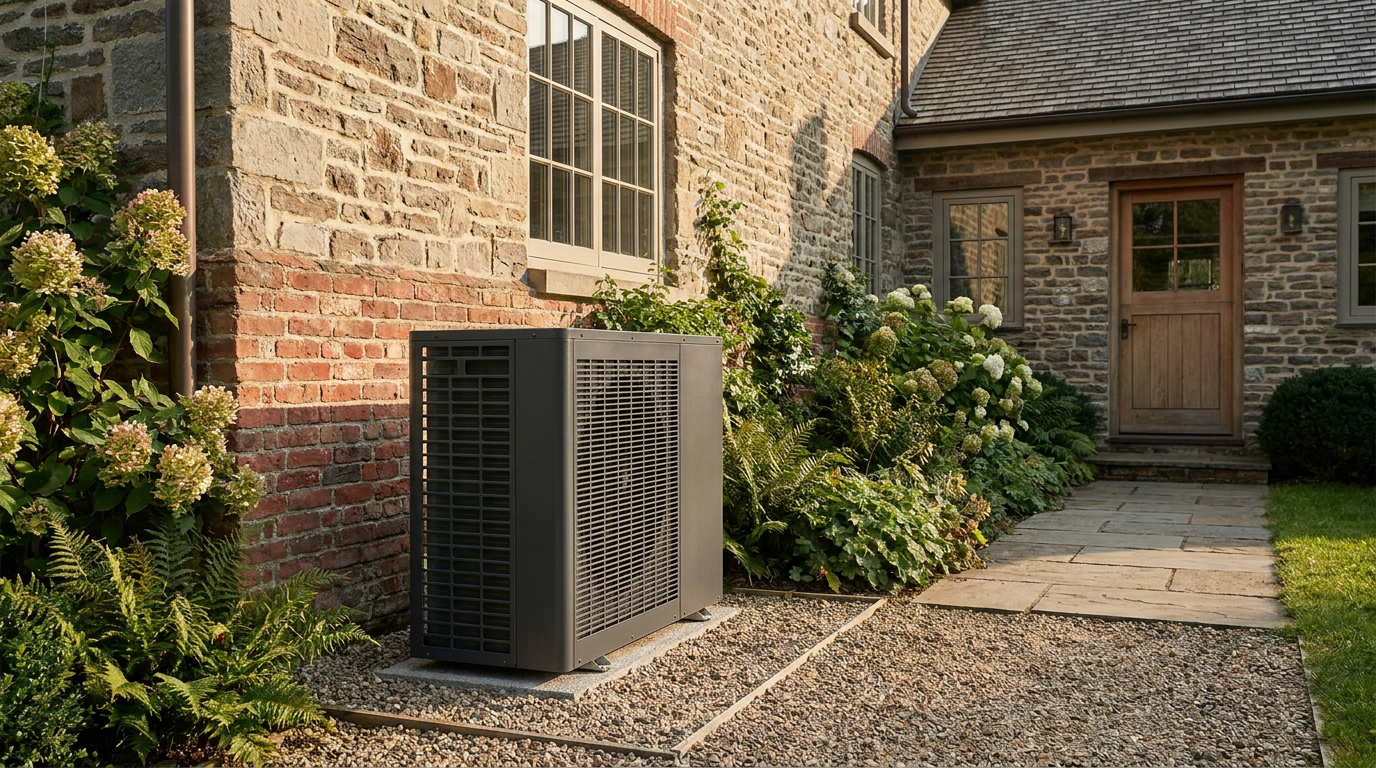
The core mechanism of a heat pump is fundamentally different from traditional heating. Unlike furnaces or boilers that burn fossil fuels to generate heat, heat pumps use electricity to move ambient heat from one place to another. In the summer, they extract heat from indoors and dump it outside. In the winter, they reverse the process, pulling latent heat from the outdoor air and compressing it to warm the home.[4]
Because moving heat requires far less energy than creating it via combustion, modern air-source heat pumps operate at 300% to 400% efficiency. This means that for every single unit of electrical energy consumed, the system delivers three to four units of heat energy into the living space, drastically reducing overall energy consumption.[2][4]

Historically, heat pumps struggled when temperatures dropped below freezing, requiring energy-intensive electric resistance backup heaters to keep homes warm. However, recent advances in inverter-driven, variable-speed compressors have largely solved this limitation, allowing the equipment to adjust its output infinitely to match the exact heating load of the house.[4][5]
Recent field validations conducted by the National Renewable Energy Laboratory (NREL) demonstrated the true capability of these systems. Researchers found that modern cold-climate air-source heat pumps can maintain a Coefficient of Performance (COP) above 1.0 even when outdoor temperatures plunge to -35°F, proving their viability in extreme northern climates.[5]
Beyond hardware improvements, software controls have drastically enhanced cold-weather performance. NREL researchers discovered that optimizing defrost cycles and compressor speeds through software updates yielded a 50% increase in operational efficiency at temperatures below 25°F, preventing the system from wasting energy trying to melt non-existent ice on the outdoor coil.[5]

A major regulatory shift also took effect on January 1, 2026, phasing out the high-Global Warming Potential (GWP) R-410A refrigerant. The HVAC industry has now fully transitioned to low-GWP alternatives, primarily R-32, R-454B, and R-290, which is a highly refined propane.[2]
The shift to R-290 is particularly transformative for historic retrofits. Because it boasts a near-zero GWP and can produce significantly higher flow temperatures than older refrigerants, homeowners can often keep their existing traditional cast-iron radiators rather than ripping them out to install the low-temperature modern emitters previously required by heat pumps.[2]
Another major hurdle in older homes is the plumbing itself. Millions of homes, particularly those updated during the 1970s and 1980s, rely on narrow 8mm or 10mm "microbore" pipework. Traditional heat pumps struggle to push enough water volume through these narrow circuits, leading to stalled systems, collapsed flow rates, and cold rooms.[3]
Millions of homes, particularly those updated during the 1970s and 1980s, rely on narrow 8mm or 10mm "microbore" pipework.
Manufacturers have responded to this bottleneck with specialized equipment. Units like the Panasonic M Series now feature integrated variable-speed circulating pumps rated for high design flow rates, allowing skilled installers to utilize existing microbore pipework without tearing open plaster walls for a full, disruptive repipe.[3]
For historic homes without any existing ductwork, adding central air historically meant destroying original plaster and sacrificing precious closet space for bulky metal trunks. Today, high-velocity "small duct" systems use flexible tubing that snakes behind walls and between joists, preserving the architectural integrity of the property while delivering whole-home comfort.[7]

Alternatively, multi-zone ductless mini-split systems offer targeted heating and cooling without requiring any ductwork at all. These systems use individual wall, floor, or ceiling cassettes connected to a single outdoor unit via small refrigerant lines, offering precise room-by-room temperature control and bypassing structural limitations entirely.[1][2]
Upgrading the HVAC system is only half the battle in a successful retrofit. Building scientists strongly advocate for the EnerPHit standard—a rigorous retrofit framework adapted from Passive House principles. It emphasizes a "fabric first" approach, targeting a 75% to 93% reduction in heating and cooling demand through continuous insulation and extreme airtightness.[6]
Because deep energy retrofits are expensive and highly disruptive, the EnerPHit standard encourages a phased approach. Homeowners are advised to tackle roof insulation and air sealing first, followed by window replacements, and finally, the mechanical heat pump upgrade. Sizing a heat pump before fixing a leaky envelope often results in purchasing an oversized, inefficient unit.[6]
The financial landscape for these upgrades has shifted significantly in 2026. While the popular federal 25C equipment tax credit expired at the end of 2025, state-administered federal rebate programs have taken its place as the primary financial lever for homeowners looking to electrify.[1]
The High-Efficiency Electric Home Rebate Act (HEEHRA) provides point-of-sale discounts up to $8,000 for income-qualifying households. Unlike tax credits that require waiting until filing season, these rebates are applied directly at the time of purchase, immediately lowering the out-of-pocket burden for the consumer.[1][2]
A standard ducted whole-home heat pump in 2026 typically costs between $12,000 and $18,000 before rebates. However, cold-climate models capable of handling sustained sub-freezing winters carry a necessary premium, pushing the installed cost to between $18,500 and $36,500 depending on the home's size and electrical readiness.[1]

Savvy homeowners can stack HEEHRA rebates with local utility incentives and state electrification grants. In states with strong incentive programs, a $20,000 cold-climate installation can often be reduced to between $6,000 and $14,000 out of pocket, drastically shortening the payback period.[1]
To protect this investment, routine maintenance is non-negotiable. Because heat pumps run year-round to provide both heating and cooling, they endure twice the wear of a standalone furnace. Experts warn that failing to change air filters every 60 to 90 days forces the system to work harder, erasing efficiency gains and shortening the equipment's lifespan.[4]
While the upfront logistics of retrofitting an older home require careful engineering and planning, the long-term benefits are undeniable. By pairing modern heat pump technology with targeted envelope improvements, homeowners achieve superior indoor comfort, eliminate on-site fossil fuel combustion, and insulate themselves against volatile winter energy prices.[2][6][7]
How we got here
1970s–1980s
Microbore pipework becomes standard in many home heating renovations, creating future flow-rate bottlenecks.
2023
The Department of Energy updates efficiency testing standards to SEER2 and HSPF2 to better reflect real-world duct resistance.
December 2025
The federal 25C equipment tax credit for heat pumps officially expires.
January 2026
New regulations mandate the phase-out of R-410A refrigerant in favor of low-GWP alternatives like R-32 and R-290.
Spring 2026
State-administered HEEHRA point-of-sale rebate programs become the primary financial incentive for home electrification.
Viewpoints in depth
Building Scientists
Advocate for a 'fabric first' approach, prioritizing insulation and air sealing before mechanical upgrades.
Building scientists and energy auditors argue that installing a high-efficiency heat pump in a drafty, poorly insulated home is a misallocation of resources. They champion the EnerPHit standard, which dictates that homeowners should first invest in continuous insulation, high-performance windows, and rigorous air sealing. By drastically reducing the home's overall heating and cooling demand first, the homeowner can then install a much smaller, less expensive heat pump system that will operate at peak efficiency.
Historic Preservationists
Value low-impact installation methods that protect the architectural integrity of older properties.
For preservationists, the primary concern with HVAC retrofits is the potential destruction of original architectural details like plaster walls, crown molding, and historic woodwork. This camp strongly favors ductless mini-split systems or high-velocity small duct systems that can be snaked through existing wall cavities. They view the advent of high-temperature R-290 heat pumps as a major victory, as it allows historic homes to retain their original cast-iron radiators rather than replacing them with modern baseboards.
HVAC Contractors
Focus on technical execution, proper sizing, and navigating the 2026 refrigerant transition.
Contractors are focused on the practical realities of making these systems work in the field. They emphasize the critical importance of proper Manual J load calculations to ensure heat pumps are not oversized, which leads to short-cycling and premature wear. In 2026, their primary challenge is navigating the industry-wide transition away from R-410A refrigerants, requiring new training, specialized equipment, and careful management of microbore pipework flow rates to prevent system failures.
Homeowners & Consumers
Prioritize upfront affordability, rebate navigation, and long-term utility savings.
For the average homeowner, the decision to electrify hinges primarily on economics and comfort. While they are drawn to the promise of 300% efficiency and lower monthly utility bills, the upfront capital required for a cold-climate system remains a significant barrier. This group is highly focused on navigating the complex landscape of stackable HEEHRA rebates and local utility incentives to bring the out-of-pocket costs down to a manageable level.
What we don't know
- How quickly all 50 states will fully deploy their allocated HEEHRA rebate funds throughout 2026.
- The long-term lifespan of the newest R-290 (propane) compressors under extreme cold-climate loads.
- Whether local utility grids in older neighborhoods will require significant upgrades to handle neighborhood-wide electrification.
Key terms
- Coefficient of Performance (COP)
- A ratio measuring a heat pump's efficiency; a COP of 3.0 means it produces three units of heat for every one unit of electricity consumed.
- EnerPHit Standard
- A rigorous energy retrofit certification adapted from Passive House principles, focusing on extreme airtightness and insulation in existing buildings.
- Inverter-Driven Compressor
- A modern heat pump component that can adjust its speed infinitely to match the exact heating or cooling load, rather than just turning on or off.
- Microbore Pipework
- Narrow heating pipes (typically 8mm or 10mm) common in older homes that can restrict the water flow required by traditional heat pumps.
- R-290 Refrigerant
- A highly efficient, low-global-warming-potential propane refrigerant that allows heat pumps to achieve higher water temperatures.
Frequently asked
Do heat pumps really work in freezing weather?
Yes. Modern cold-climate heat pumps use inverter-driven compressors and optimized software to maintain efficient heating even when outdoor temperatures drop to -35°F.
Are federal tax credits still available in 2026?
The 25C tax credit expired at the end of 2025. However, the federal HEEHRA program now provides point-of-sale rebates up to $8,000 for income-qualifying households.
Do I need to replace my existing radiators?
Not necessarily. New heat pumps utilizing R-290 refrigerant can produce higher flow temperatures, allowing many older homes to keep their traditional cast-iron radiators.
What is the difference between ducted and ductless systems?
Ducted systems use central vents to distribute air, while ductless mini-splits use individual wall or ceiling cassettes connected directly to the outdoor unit, making them ideal for homes without existing ductwork.
Sources
Source coverage
7 outlets
4 viewpoints surfaced







[1]Home Energy BasicsHomeowners & Consumers
Heat Pump Cost in 2026: What You'll Actually Pay (With Rebates)
Read on Home Energy Basics →[2]Eco HomesHVAC Contractors
2026 Heat Pump Guide: Cold-Climate Systems & Rebates
Read on Eco Homes →[3]Retrofit MagazineHVAC Contractors
Spark of 2026 #6: Panasonic M Series 9 kW Heat Pump
Read on Retrofit Magazine →[4]Department of EnergyHomeowners & Consumers
Air-Source Heat Pumps
Read on Department of Energy →[5]National Renewable Energy LaboratoryBuilding Scientists
Cold Climate Air-Source Heat Pump Demonstration and Analysis
Read on National Renewable Energy Laboratory →[6]NeutralXBuilding Scientists
Passive House Retrofit: The EnerPHit Standard and Deep Energy Upgrades
Read on NeutralX →[7]Factlen Editorial TeamHistoric Preservationists
Synthesis by Factlen editorial team
Read on Factlen Editorial Team →
Every angle. Every day.
Get home stories with full source coverage and perspective breakdowns delivered to your inbox.