
Smart Rings vs. Smartwatches: The 2026 Health Tracking Comparison
As the wearable market splits between interactive wrist displays and passive finger sensors, shoppers face a fundamental choice in how they track their health. We break down the evidence on accuracy, comfort, and cost to determine which device fits your lifestyle.
By Factlen Editorial Team
- Active Data Seekers
- Fitness enthusiasts and tech-forward users who demand real-time feedback and comprehensive smartwatch ecosystems.
- Minimalist Trackers
- Users who prioritize passive data collection, sleep comfort, and aesthetics over real-time interactivity.
- Ecosystem Integrators
- Power users who utilize both form factors to capture the strengths of each device.
What's not represented
- · Traditional Watch Enthusiasts
- · Medical Professionals
Why this matters
Choosing the right wearable in 2026 is no longer just about budget; it dictates whether your health tracking becomes a seamless background habit or a daily interactive chore. Picking the wrong form factor often leads to abandoned devices, wasted money, and lost insights into your sleep and cardiovascular health.
Key points
- Smart rings excel at passive sleep tracking, overnight comfort, and multi-day battery life.
- Smartwatches dominate active fitness tracking, offering built-in GPS and real-time screen feedback.
- The finger provides cleaner resting heart rate data, while the wrist is better for tracking heavy movement.
- Smartwatches offer medical-grade features like ECGs and fall detection that rings cannot support.
- Some smart rings require monthly subscriptions, whereas smartwatches typically do not.
- Power users are increasingly wearing both devices to merge daytime activity with overnight recovery.
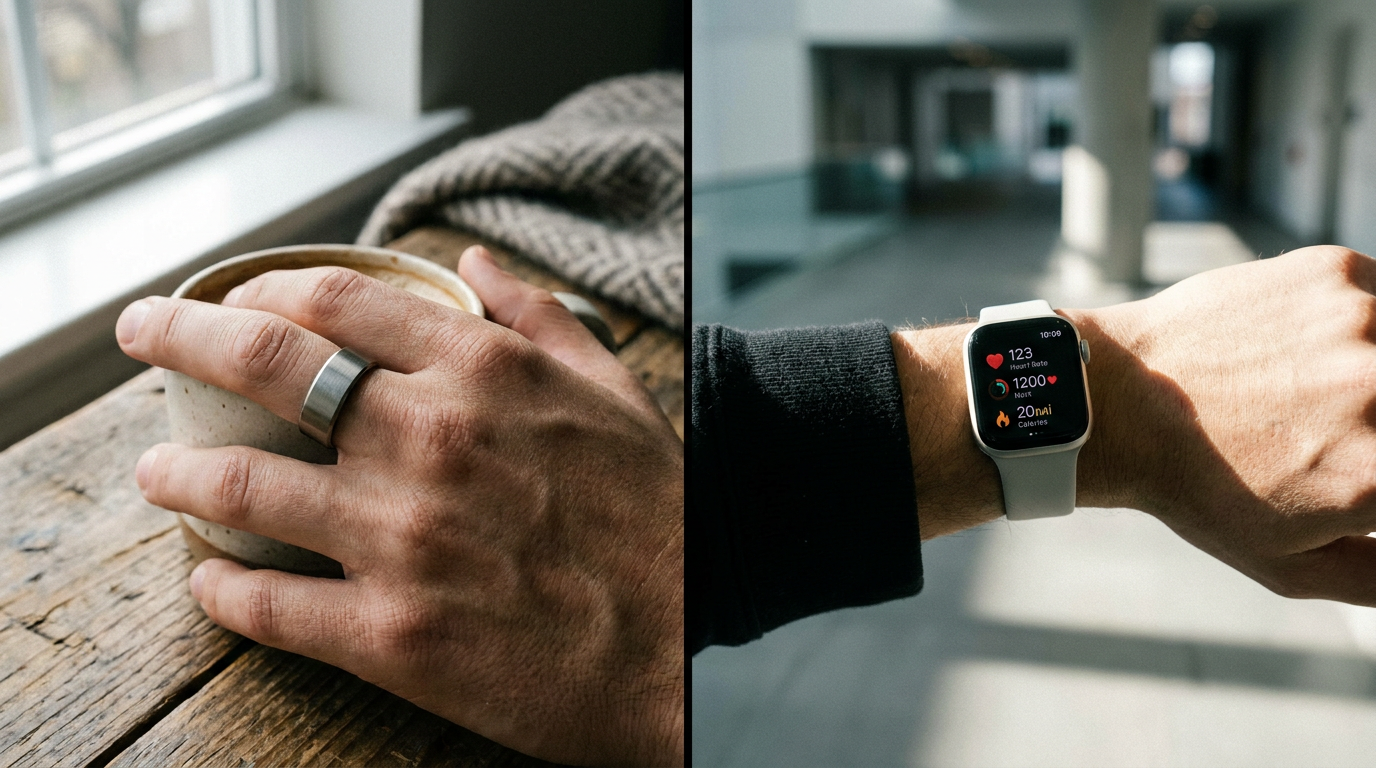
The wearable technology market in 2026 has officially split into two distinct philosophies: the interactive wrist and the passive finger. With the widespread adoption of the Oura Ring 4 and the Samsung Galaxy Ring, consumers are no longer forced to strap a glowing screen to their arm just to gather clinical-grade health data. Instead, shoppers face a fundamental choice between a smartwatch that acts as a miniature smartphone and a smart ring that disappears entirely into the background. Both form factors have matured significantly over the past few years, moving past their early growing pains to offer highly accurate sensors and deep software ecosystems. However, despite tracking many of the exact same metrics—such as heart rate, blood oxygen, and sleep stages—they serve entirely different lifestyles and daily priorities.[1][4]
At its core, the debate between a smart ring and a smartwatch is not about which device is technologically superior, but rather how much friction a user is willing to tolerate. Smartwatches demand attention. They are designed to be looked at, tapped, and interacted with, offering wrist-based notifications, real-time workout metrics, and a suite of interactive apps. Smart rings, conversely, are built entirely around low-friction tracking. They passively collect data without ever buzzing with a text message, lighting up in a dark movie theater, or demanding that the user close a daily activity ring. For many, this screenless approach is a massive relief from digital fatigue.[6][7]
When evaluating health tracking accuracy, the physical location of the sensor dictates the quality of the data. The finger is an anatomically ideal location for measuring resting heart rate, heart rate variability, and blood oxygen levels. Because the blood vessels in the finger are closer to the surface and less prone to the subtle shifts that occur on the wrist, the optical sensors can get a much clearer read. Consequently, smart rings consistently outperform smartwatches in capturing clean, uninterrupted overnight data. The snug, stable fit on the finger ensures that the sensor remains perfectly aligned with the capillaries, providing a highly stable baseline for long-term recovery metrics and readiness scores that users rely on to plan their days.[6][7]
Sleep tracking is the undisputed domain of the smart ring, and the evidence comes down to simple human comfort. Beyond the raw sensor accuracy, the primary advantage is that users actually keep the device on. Many people find smartwatches too bulky and restrictive to wear to bed, and the necessity of daily charging often means the watch is sitting on a nightstand while the user sleeps. Rings, weighing as little as four to six grams, are easily ignored. This "wear it and forget it" nature leads to far more consistent long-term sleep tracking, allowing the software to build a much more accurate picture of a user's true sleep architecture over months and years.[2][3][6]

However, the moment a user transitions from sleeping to active exercise, the smartwatch aggressively reclaims the crown. For dynamic workouts like running, cycling, or high-intensity interval training, smartwatches are vastly superior tools. They feature built-in GPS for mapping outdoor runs without a phone, real-time pacing and heart rate zones displayed on a brightly lit screen, and the ability to manually start, stop, or lap a workout with physical buttons. A smart ring can log that a workout happened and estimate the caloric burn, but it cannot guide a runner through a complex interval session or tell a cyclist their current elevation gain.[1][2][5]
However, the moment a user transitions from sleeping to active exercise, the smartwatch aggressively reclaims the crown.
Furthermore, the evidence shows that wrist-based optical sensors on premium smartwatches have been heavily optimized to filter out the "noise" of arm movement during intense exercise. Rings, while excellent at rest, often struggle to maintain an accurate heart rate lock during activities that involve heavy gripping. When lifting dumbbells, holding bicycle handlebars, or gripping a rowing machine, the flexing of the finger muscles and tendons physically displaces the ring's sensor away from the skin. This temporary gap leads to dropped heart rate readings and inaccurate exertion data. For serious strength athletes or rowers, this makes the smart ring a poor primary tracker, whereas a tightly fastened smartwatch maintains a much more reliable connection to the wrist during heavy flexion.[2][6]

The ecosystem of medical-grade features also heavily favors the smartwatch. Devices like the Apple Watch Series 11 and the Samsung Galaxy Watch 7 offer FDA-cleared electrocardiogram apps capable of detecting atrial fibrillation, as well as life-saving features like hard fall detection and emergency SOS satellite calling. Smart rings simply do not have the physical footprint or the necessary electrical contacts to perform a medical-grade ECG, nor do they have the speakers and cellular radios required to contact emergency services. For users who are specifically monitoring cardiovascular risks, recovering from heart procedures, or seeking the peace of mind that comes with automatic emergency dispatch if they take a hard spill on a trail run, the smartwatch remains the only viable choice.[3][5]
Battery life represents another massive divergence in the daily experience of owning these devices. Because they lack a power-hungry OLED display, haptic vibration motors, and interactive processors, smart rings routinely last between five and eight days on a single charge. This multi-day endurance is a major factor in their superior sleep tracking, as users rarely have to think about battery levels before getting into bed. In stark contrast, most fully-featured smartwatches require charging every 24 to 36 hours. This forces smartwatch owners into a strict daily charging routine, usually requiring them to take the device off while showering or working at a desk just to ensure it survives the night.[4][6]

The financial comparison between the two form factors requires looking well beyond the initial retail price. While smartwatches typically range from $150 to $500 upfront, they rarely require ongoing software subscriptions to access your own health data. Smart rings, which cost between $250 and $400, have historically hidden their most valuable insights behind a paywall. For example, Oura charges a monthly fee that can add over $70 a year to the total cost of ownership. However, the market is shifting in 2026, with competitors like Samsung and RingConn pushing back by offering comprehensive, subscription-free models that make the long-term cost of a ring much more predictable.[2][7]
Interestingly, a growing segment of power users in 2026 is refusing to choose between the two, opting instead to wear both form factors simultaneously. Platforms like Apple Health and Samsung Health have become incredibly adept at merging data from multiple sources without double-counting steps or calories. A user might wear a Galaxy Watch during a morning run to capture precise GPS and pacing data, take it off to shower and head to the office, and rely entirely on their Galaxy Ring to capture continuous daytime stress and overnight sleep metrics. This hybrid approach yields the highest fidelity data possible, seamlessly handing off the tracking duties to whichever device is best suited for the moment, though it obviously requires a significantly higher financial investment upfront.[1][4][6]
Ultimately, the decision comes down to matching the device to the user's specific lifestyle and aesthetic preferences. A smart ring fits perfectly when the primary goals are tracking sleep, monitoring baseline recovery, and gathering health data without the distraction of yet another glowing screen. It is the ideal choice for digital minimalists who want to reduce their notification fatigue, traditional watch enthusiasts who want to wear mechanical timepieces on their wrist during the day without sacrificing health data, and anyone who finds sleeping with a bulky smartwatch physically uncomfortable. For these users, the ring provides all the necessary physiological insights while remaining entirely out of the way, acting as a silent guardian of their daily wellness.[6][7]

Conversely, a smartwatch does not fit well for someone seeking a passive, "set it and forget it" experience, but it remains the undisputed champion for the active data-hound. It fits perfectly when the user needs real-time workout feedback, relies on wrist-based notifications to actively reduce their overall smartphone screen time, or requires advanced safety features like fall detection and ECG monitoring. If the goal is to actively interact with health data mid-stride, control music during a long run, and occasionally leave the smartphone at home entirely, the smartwatch continues to offer a level of dynamic utility that a screenless ring simply cannot match. The choice is no longer about which device is better, but which device better fits the life you actually live.[1][5]
How we got here
2015
The Apple Watch launches, establishing the modern smartwatch as a mainstream health and connectivity tool.
2018
Oura releases its second-generation ring, proving that miniaturized finger sensors can accurately track sleep stages.
2022
Smartwatches begin integrating advanced medical features like temperature sensing and FDA-cleared AFib history.
2024
Samsung enters the smart ring market with the Galaxy Ring, validating the form factor for major tech ecosystems.
2026
The wearable market firmly splits into two distinct categories, with consumers actively choosing between wrist-based interactivity and finger-based passive tracking.
Viewpoints in depth
Minimalist Trackers
Users who prioritize passive data collection, sleep comfort, and aesthetics over real-time interactivity.
This camp argues that the best wearable is the one you forget you are wearing. They point to the five-to-eight day battery life and the superior overnight comfort of smart rings as evidence that rings generate more consistent, long-term health data. For these users, the lack of a screen is a feature, not a bug, protecting them from notification fatigue while still capturing vital recovery metrics.
Active Data Seekers
Fitness enthusiasts and tech-forward users who demand real-time feedback and comprehensive smartwatch ecosystems.
This perspective maintains that a wearable must provide actionable, in-the-moment utility to justify its cost. They cite the necessity of built-in GPS, live pacing screens, and the ability to control music or answer texts mid-run. Furthermore, they highlight that smartwatches offer life-saving medical features like ECGs and fall detection that rings physically cannot support, making the watch a more complete health tool.
Ecosystem Integrators
Power users who utilize both form factors to capture the strengths of each device.
Rather than treating the ring and watch as mutually exclusive, this camp views them as complementary sensors within a unified health platform like Apple Health or Samsung Health. They wear the smartwatch strictly for structured workouts and daytime connectivity, while relying on the smart ring for uninterrupted sleep and recovery tracking, allowing the software backend to seamlessly stitch the data together.
What we don't know
- Whether future smart rings will be able to miniaturize ECG and fall-detection technology.
- If Apple will eventually release its own smart ring to compete directly with Samsung and Oura.
Key terms
- Heart Rate Variability (HRV)
- The variation in time between consecutive heartbeats, used as a key indicator of physical recovery and stress levels.
- SpO2
- A measure of blood oxygen saturation, which helps identify breathing disturbances during sleep.
- Electrocardiogram (ECG)
- A test that records the electrical timing and activity of the heart, used by smartwatches to detect irregular rhythms like atrial fibrillation.
- Optical Heart Rate Sensor
- Technology that uses light to measure blood flow through the skin, standard in both smartwatches and smart rings.
Frequently asked
Can a smart ring track my runs without my phone?
No. Because smart rings lack built-in GPS and a screen, you must carry your smartphone if you want to map your route or see real-time pacing data during a run.
Do smart rings require a monthly subscription?
It depends on the brand. The Oura Ring requires a monthly subscription to access full data insights, while the Samsung Galaxy Ring and RingConn offer their platforms without ongoing fees.
Are smart rings more accurate for heart rate than watches?
Smart rings are generally more accurate for resting heart rate and overnight tracking due to the finger's consistent blood flow. However, smartwatches are significantly more accurate during active workouts, especially those involving gripping.
Can a smart ring take an ECG?
No. Current smart rings do not have the physical footprint or the necessary electrodes to perform a medical-grade electrocardiogram (ECG), a feature commonly found on premium smartwatches.
Sources
Source coverage
7 outlets
3 viewpoints surfaced







[1]ForbesEcosystem Integrators
Oura Ring 4 Vs. Apple Watch Series 11: Which Is Better?
Read on Forbes →[2]TODAYActive Data Seekers
Apple Watch SE vs Oura Ring: A comprehensive comparison
Read on TODAY →[3]Garage Gym ReviewsActive Data Seekers
Oura Ring vs Apple Watch: Which Wearable Wins?
Read on Garage Gym Reviews →[4]Android CentralEcosystem Integrators
Samsung Galaxy Watch 7 vs Galaxy Ring: Choosing Your Wearable
Read on Android Central →[5]XDA DevelopersActive Data Seekers
Samsung Galaxy Ring vs Galaxy Watch 7: Which should you buy?
Read on XDA Developers →[6]SmartRingHQMinimalist Trackers
Smart Ring vs Smartwatch: The Honest 2026 Comparison
Read on SmartRingHQ →[7]RingConnMinimalist Trackers
Smart Ring vs Smartwatch: Which Is Better for Sleep and Health Tracking?
Read on RingConn →
More in shopping
See all 6 stories →Wearable Tech
Smart Rings vs. Smartwatches: The 2026 Health Tracking Comparison
6 sources
Pet Tech
Rotating vs. Raking: Which Automatic Litter Box Mechanism Wins?
6 sources
Pet Tech
The Trade-Offs Between Bluetooth Trackers and Cellular GPS for Pet Safety
7 sources

Display Tech
OLED vs. Mini-LED in 2026: Which TV Technology Actually Wins?
7 sources
Every angle. Every day.
Get shopping stories with full source coverage and perspective breakdowns delivered to your inbox.