
How Open-Source AI Finally Broke the Cloud Monopoly
A new generation of highly efficient open-weight AI models has closed the performance gap with proprietary cloud APIs, driving a massive industry shift toward local inference. By leveraging Mixture of Experts (MoE) architectures, developers are now running frontier-grade intelligence on consumer hardware to cut costs and ensure data privacy.
By Factlen Editorial Team
- Local AI Advocates
- Developers and startups prioritizing cost-efficiency, privacy, and control over their AI stack.
- Enterprise Security Teams
- Infrastructure leaders focused on the vulnerabilities introduced by open-source proliferation.
- Open-Source Maintainers
- The core developers managing the health and sustainability of public code repositories.
- Industry Analysts
- Researchers tracking the licensing, performance, and market share of foundation models.
What's not represented
- · Cloud AI Providers
- · Hardware Manufacturers
Why this matters
As open-source AI models match the capabilities of proprietary cloud giants, developers and enterprises can now run world-class intelligence locally on consumer hardware. This shift eliminates massive API costs, guarantees data privacy, and fundamentally democratizes access to advanced compute.
Key points
- Cloud AI API spending doubled to $8.4 billion in 2025, accelerating the push for local alternatives.
- Open-weight models like MiniMax M3 now outperform proprietary frontier models on rigorous coding benchmarks.
- Mixture of Experts (MoE) architecture allows massive AI models to run efficiently on consumer hardware.
- Local inference guarantees data privacy, making it highly attractive for regulated industries like healthcare.
- The surge in AI code generation has created a flood of low-quality 'AI slop' for open-source maintainers to review.
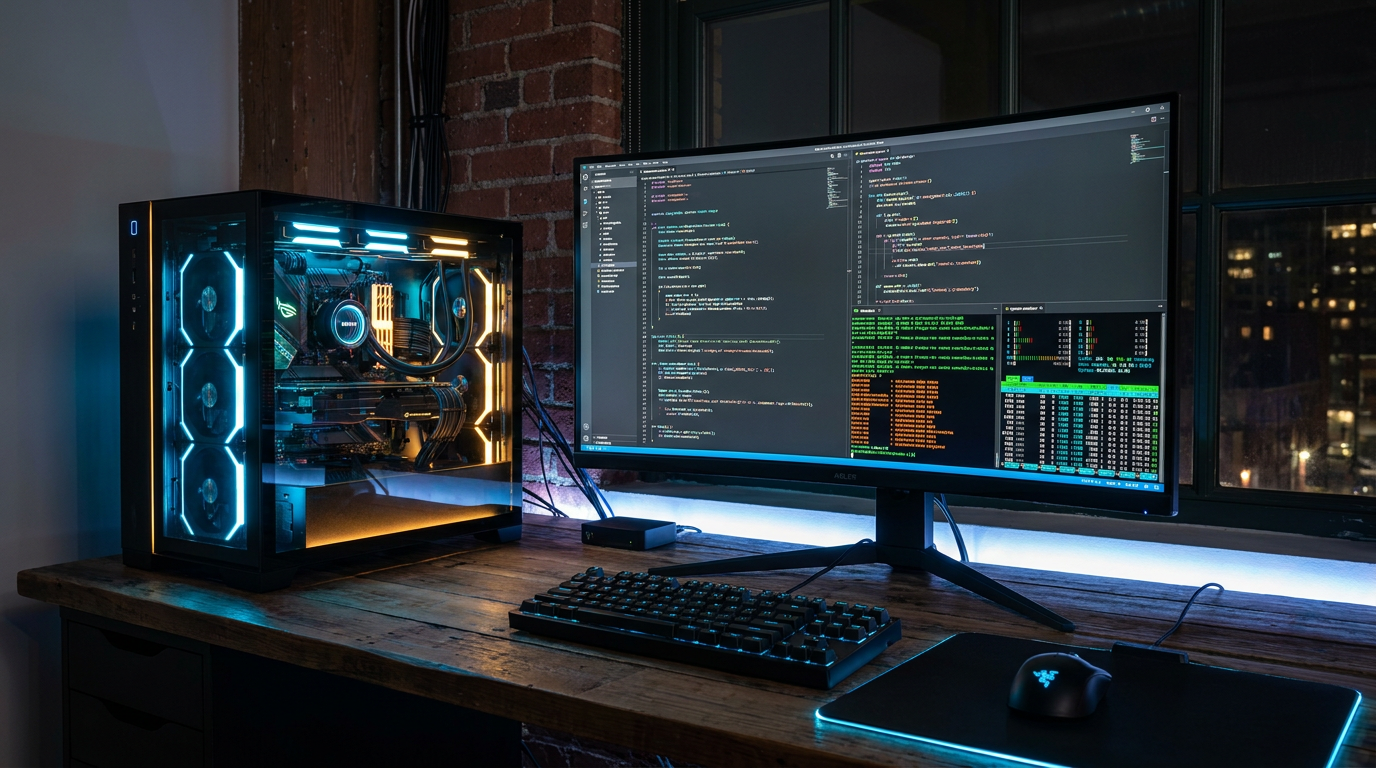
For the past three years, the artificial intelligence industry operated under a centralized assumption: true frontier intelligence required massive cloud infrastructure, and developers would simply rent access to it via APIs. But by mid-2026, that paradigm is fracturing. A new generation of open-source and open-weight models has not only closed the performance gap with proprietary giants but has made it entirely feasible to run world-class AI locally on consumer hardware.[1][4]
The shift is being driven by a combination of staggering cloud costs and rapid architectural breakthroughs. In 2025, enterprise spending on cloud AI APIs doubled to $8.4 billion. Companies realized they were paying a premium for every token generated, leading to a surge in demand for models that could be downloaded, modified, and hosted internally without recurring fees.[1]
The tipping point arrived in June 2026 with the release of MiniMax M3 and Z.ai's GLM-5.1. These open-weight models shattered previous limitations, with MiniMax M3 scoring 59.0% on the rigorous SWE-Bench Pro coding benchmark—edging past proprietary models like GPT-5.5 and Gemini 3.1 Pro. For the first time, the most capable software engineering AI in the world was available as a free download.[2]

This democratization of compute relies heavily on an architectural design known as Mixture of Experts (MoE). In older models, every parameter was activated for every word generated, requiring massive amounts of memory and processing power. MoE models, by contrast, act like a network of highly specialized sub-routines.[1][3]
When a user prompts an MoE model, a routing mechanism only activates the specific "expert" neural pathways relevant to that exact query. For example, Alibaba's Qwen 3 model has a variant with 30 billion total parameters, but it only activates 3 billion parameters per token. This extreme efficiency allows a model that would have previously required a server rack to run smoothly on a Mac Studio with 36GB of unified memory.[1][3]

The tooling ecosystem has evolved in lockstep with the models. Applications like Ollama and LM Studio have transformed local inference from a complex weekend engineering project into a straightforward, one-click installation. Developers can now swap between a coding specialist model like GLM-5.1 and a reasoning engine like DeepSeek V4-Pro in seconds, entirely offline.[1]
Beyond cost savings, the migration to local open-source models is fundamentally about privacy and control. When an enterprise routes its data through a centralized cloud API, it introduces compliance risks and relies on third-party data retention policies. By hosting an open-weight model locally, prompts never leave the machine.[1][4]
Beyond cost savings, the migration to local open-source models is fundamentally about privacy and control.
This local-first approach has proven particularly transformative in highly regulated industries. Telehealth providers and financial institutions can now deploy advanced AI for patient triage or algorithmic trading analysis without triggering HIPAA or SEC compliance nightmares, as the sensitive data remains entirely within their own secure perimeters.[1]
Furthermore, local deployment insulates companies from the whims of cloud providers. Developers no longer have to worry about a proprietary model being deprecated without warning, or a sudden change in API pricing destroying their unit economics. They own the stack, and the model remains frozen and functional for as long as they choose to run it.[1]
However, the open-source AI boom has introduced severe new challenges for the broader software ecosystem. The most pressing issue is the security of the open-source supply chain itself. As AI models become deeply integrated into enterprise infrastructure, vulnerabilities in open-source code can be exploited at an unprecedented scale.[6]
Recognizing this threat, IBM and Red Hat announced "Project Lightwell" in May 2026, a massive $5 billion commitment to secure open-source software. The initiative deploys a global force of 20,000 engineers, augmented by frontier AI, to proactively hunt for vulnerabilities, triage risks, and develop secure patches across the open-source landscape.[6]

Meanwhile, the very tools empowering developers are creating a crisis for open-source maintainers. GitHub's 2026 Octoverse report highlighted the double-edged sword of AI code generation. While it lowers the barrier to entry for new contributors, it has also unleashed a flood of "AI slop"—high volumes of low-quality, AI-generated pull requests that overwhelm human reviewers.[5]
Maintainers of popular open-source projects are increasingly forced to act as editors for machine-generated code that looks plausible but contains subtle architectural flaws. This dynamic is widening the gap between the number of casual contributors and the core maintainers who actually hold a sense of ownership over the project's long-term health.[5]

The licensing landscape also remains a point of friction. While the industry colloquially uses the term "open-source," many of the most powerful new models are technically "open-weight." True open-source models, governed by MIT or Apache 2.0 licenses, release their training data and code without restriction. Open-weight models release the compiled neural network but often include acceptable-use clauses or withhold the underlying training methodology.[4]
Despite these growing pains, the trajectory of the industry is clear. Centralized cloud AI's share of compute workloads is projected to fall significantly by the end of 2026, as local and edge inference rapidly gains ground. The era of renting intelligence is giving way to an era of owning it, fundamentally reshaping the economics and accessibility of artificial intelligence.[1]
How we got here
December 2025
DeepSeek v3.2 launches, demonstrating that high-efficiency reasoning is achievable in open-weight models.
February 2026
GitHub's Octoverse report warns of the growing burden of 'AI slop' overwhelming open-source maintainers.
May 2026
IBM and Red Hat announce Project Lightwell, a $5 billion initiative to secure the open-source software supply chain.
June 2026
MiniMax M3 is released, topping the SWE-Bench Pro coding benchmark and outperforming several proprietary frontier models.
Viewpoints in depth
Local AI Advocates
Developers and startups prioritizing cost-efficiency, privacy, and control over their AI stack.
This camp argues that the era of renting intelligence from centralized cloud providers is fundamentally unsustainable for most businesses. By moving workloads to local, open-weight models, developers eliminate recurring API costs, simplify regulatory compliance by keeping data on-premises, and protect themselves from sudden vendor deprecations. They view the rapid advancement of MoE architectures as the key to democratizing compute, allowing startups to compete with enterprise budgets.
Enterprise Security Teams
Infrastructure leaders focused on the vulnerabilities introduced by open-source proliferation.
For enterprise security professionals, the explosion of open-source AI is a double-edged sword. While it accelerates innovation, it also exponentially increases the attack surface of the software supply chain. This camp emphasizes that open-source adoption must be paired with massive, AI-assisted security investments—like IBM's Project Lightwell—to proactively hunt for vulnerabilities before they can be exploited by malicious actors at scale.
Open-Source Maintainers
The core developers managing the health and sustainability of public code repositories.
Maintainers are sounding the alarm about the operational burden created by AI code generation. While AI lowers the barrier to entry for new contributors, it has resulted in a flood of 'AI slop'—high volumes of low-quality, machine-generated pull requests that require painstaking human review. This camp argues that the open-source community must develop new, durable systems for triage and onboarding to prevent core maintainers from burning out under the sheer volume of automated contributions.
What we don't know
- How proprietary cloud providers will adjust their pricing models to compete with free, local open-weight alternatives.
- Whether the open-source community can develop automated triage systems robust enough to filter out 'AI slop.'
- How future regulations might impact the distribution of powerful open-weight models that lack built-in safety guardrails.
Key terms
- Mixture of Experts (MoE)
- An AI architecture that only activates a small, specialized fraction of its neural network for any given prompt, drastically reducing the computing power required to run it.
- Open-weight model
- An AI model where the compiled neural network is available for download, but the original training data and proprietary code may remain restricted.
- SWE-Bench Pro
- A rigorous industry benchmark that evaluates an AI model's ability to autonomously resolve real-world software engineering issues.
- Local inference
- The process of running an artificial intelligence model directly on a user's own hardware, rather than sending data to a remote cloud server.
- API (Application Programming Interface)
- A set of rules that allows different software applications to communicate, commonly used to send prompts to cloud-based AI models and receive responses.
Frequently asked
What is the difference between open-source and open-weight AI?
True open-source models release their training data, code, and weights under permissive licenses like MIT or Apache 2.0. Open-weight models release the compiled neural network for public use but often withhold the underlying training data or include specific acceptable-use restrictions.
Can I run these advanced AI models on my personal computer?
Yes. Thanks to Mixture of Experts (MoE) architecture, models that once required massive server racks can now run on high-end consumer hardware. For example, a highly capable variant of the Qwen 3 model can run smoothly on a Mac Studio with 36GB of unified memory.
Why are companies moving away from cloud AI APIs?
The primary drivers are cost, privacy, and control. Cloud AI API spending doubled in 2025, prompting companies to seek free, local alternatives. Additionally, local models ensure that sensitive prompts never leave the company's secure network, simplifying regulatory compliance.
What is 'AI slop' in the context of open-source software?
AI slop refers to the high volume of low-quality, machine-generated code contributions submitted to open-source projects. These automated pull requests often look plausible but contain subtle flaws, creating a massive review burden for human maintainers.
Sources
Source coverage
7 outlets
4 viewpoints surfaced







[1]SitePointLocal AI Advocates
The five best local models today
Read on SitePoint →[2]Kilo.aiLocal AI Advocates
Best Open-Source Coding Models Ranked (2026)
Read on Kilo.ai →[3]Fireworks.aiLocal AI Advocates
Top open source LLMs in 2026
Read on Fireworks.ai →[4]OnyxIndustry Analysts
What is the best open-source LLM in 2026?
Read on Onyx →[5]GitHub BlogOpen-Source Maintainers
What to expect for open source in 2026
Read on GitHub Blog →[6]IBM NewsroomEnterprise Security Teams
Project Lightwell establishes a trusted enterprise clearinghouse
Read on IBM Newsroom →[7]Factlen Editorial TeamIndustry Analysts
Synthesis by Factlen editorial team
Read on Factlen Editorial Team →
More in technology
See all 5 stories →


Every angle. Every day.
Get technology stories with full source coverage and perspective breakdowns delivered to your inbox.