
Swords to Saucepans: How 'Cozy Fantasy' is Rewriting the Rules of Publishing
A booming literary subgenre is trading world-ending wars for coffee shops and found families, proving that fantasy doesn't need high stakes to capture millions of readers.
By Factlen Editorial Team
- Cozy Fantasy Authors & Readers
- Value escapism, mental health, and low-stakes narratives that provide a sanctuary from real-world stress.
- The Publishing Industry
- Recognize the massive commercial viability and crossover appeal of comfort-focused storytelling.
- Literary Historians
- Trace the roots of the movement back to post-WWI literature and classic slice-of-life fantasy.
What's not represented
- · Independent bookstore owners curating the trend
- · Screenwriters adapting cozy fantasy for television
Why this matters
The explosion of cozy fantasy reflects a profound shift in what audiences want from entertainment. By proving that stories can be commercially successful without relying on trauma or violence, the genre is reshaping how publishers, studios, and creators approach storytelling in an anxious world.
Key points
- Cozy fantasy is a booming literary subgenre that replaces world-ending wars with low-stakes, comforting narratives.
- The trend gained massive traction during the 2020 pandemic as readers sought escapism from real-world anxieties.
- Travis Baldree's 2022 novel Legends & Lattes, about an orc opening a coffee shop, is widely considered the genre's modern blueprint.
- The genre emphasizes 'found family' dynamics, everyday magic, and detailed descriptions of food and domestic life.
- Traditional publishers are heavily investing in the genre due to its massive crossover appeal with non-fantasy readers.
For decades, the prevailing wisdom in the publishing industry was that fantasy literature required apocalyptic stakes to matter. The standard formula demanded a dark lord, a chosen one, and a world-ending war. But a quiet revolution is currently sweeping through bookstores and bestseller lists, fundamentally flipping the script on what makes a magical world compelling.[7]
Enter 'cozy fantasy,' a booming subgenre that trades epic battlefields for village coffee shops, and world-ending prophecies for the daily challenges of running a small business. In these stories, magic is not a weapon of mass destruction, but a tool for healing, baking, and community building.[1][3]
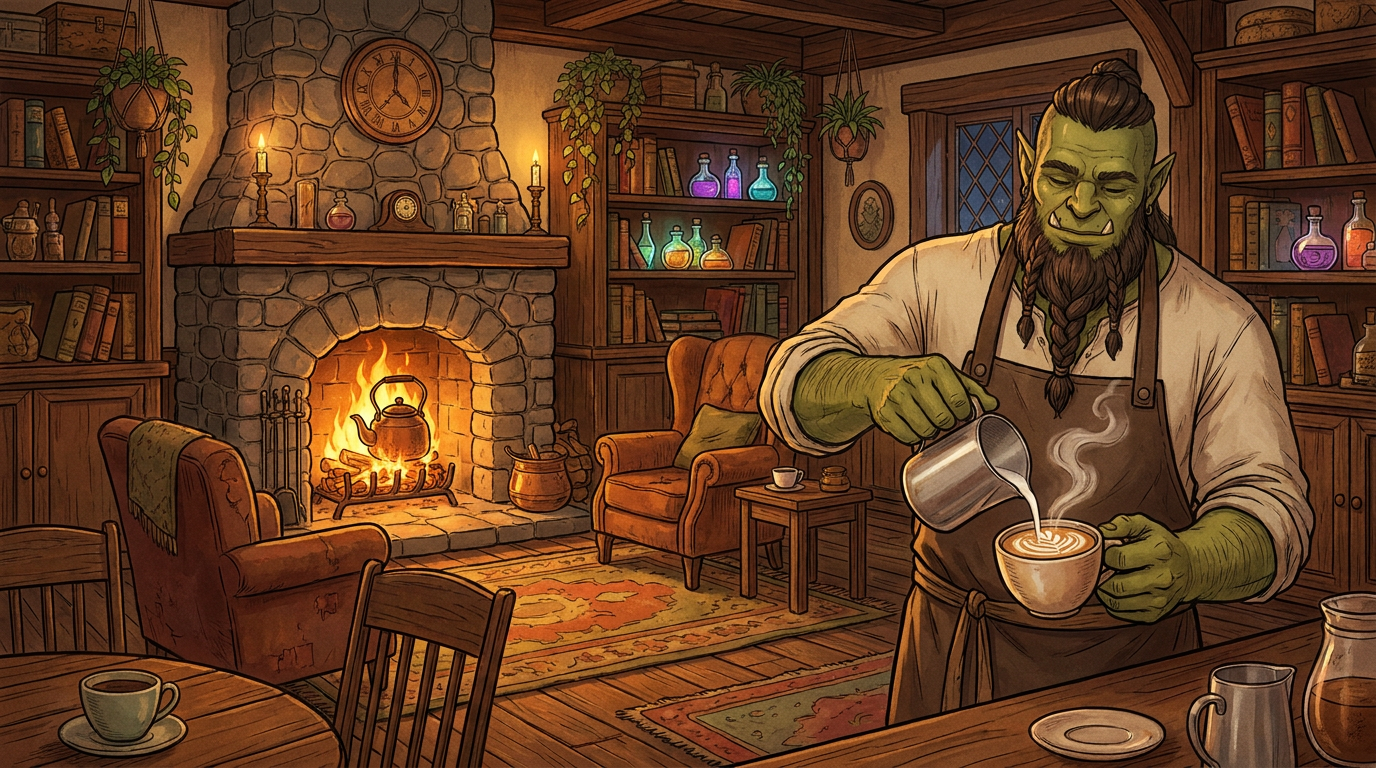
The defining text of this modern movement is widely considered to be Travis Baldree’s 2022 novel Legends & Lattes. The premise perfectly encapsulates the genre: an exhausted orc barbarian decides to hang up her broadsword, retire from a life of bloodshed, and open the first-ever coffee shop in a fantasy city.[4][5]
Baldree’s novel, billed as 'high fantasy and low stakes,' began as a self-published experiment before exploding in popularity on social media platforms like TikTok. It was quickly acquired by traditional publishing powerhouse Tor Books, signaling a major shift in industry appetite.[5]

The timing of this literary shift is not accidental. The label 'cozy fantasy' gained significant prominence in early 2020. As the COVID-19 pandemic disrupted daily life and global anxiety spiked, readers and writers alike sought out escapism that did not involve additional trauma or cruelty.[1][3]
Traditional epic fantasy began to feel less like escape and more like additional stress, notes industry analysis from Novelists, Inc. In response, audiences gravitated toward narratives that offered a sense of safety, predictability, and warmth—a literary equivalent of a warm hug.[2]
Cozy fantasy succeeds by asking a fundamentally different question than its grimdark predecessors: 'How can magic make life better?' instead of 'How can magic win wars?'[6]
Cozy fantasy succeeds by asking a fundamentally different question than its grimdark predecessors: 'How can magic make life better?' instead of 'How can magic win wars?'
The stakes in these novels are deeply personal rather than apocalyptic. A protagonist might struggle to perfect a new pastry recipe, navigate a budding romance, or keep a local inn from going bankrupt. If they fail, a business might close, but the kingdom will not fall.[2][6]

Key characteristics of the genre include a strong emphasis on 'found family' dynamics, where diverse casts of characters build loving communities. Queer protagonists and healthy, slow-burn romances are central staples, alongside detailed, sensory descriptions of comforting food and warm beverages.[1][3]
Aesthetically, the genre leans heavily into 'cottagecore' vibes. Settings are often restricted to a single, welcoming location—a small town, a tea shop, or a magical library—eschewing the sprawling, continent-spanning journeys typical of high fantasy.[1][4]
While the marketing label is new, the DNA of cozy fantasy has existed for nearly a century. Literary historians point to J.R.R. Tolkien’s depiction of the Shire in The Hobbit (1937) as an early precursor. Tolkien, writing after the horrors of World War I, deliberately contrasted the comforts of a quiet, domestic life with the dark, sprawling world outside.[1][7]
Diana Wynne Jones’s 1986 classic Howl’s Moving Castle—later adapted into a beloved Studio Ghibli film—is also frequently cited as a foundational text, proving that domestic magic and character-driven whimsy have long held audience appeal.[1][5]

Today, the commercial viability of the genre is undeniable. Traditional publishers are actively seeking cozy fantasy manuscripts, and advances for authors pivoting into the space are climbing. The genre boasts massive crossover potential, attracting readers who typically avoid fantasy due to its reputation for violence or dense, complex lore.[2][6]
The success of cozy fantasy is also driving expansion into adjacent genres. The publishing world is now seeing a rise in 'cozy sci-fi'—championed by authors like Becky Chambers—and even 'cozy horror,' proving that the desire for emotional safety can be adapted to almost any setting.[2][6]

Ultimately, the rise of cozy fantasy represents a broader cultural shift toward 'aspirational gentleness.' After decades of gritty, cynical storytelling dominating the market, readers are remembering that wonder, empathy, and community are just as vital to the human experience as conflict and conquest.[2][7]
How we got here
1937
J.R.R. Tolkien publishes The Hobbit, introducing the peaceful, domestic Shire as a contrast to the dangerous wider world.
1986
Diana Wynne Jones publishes Howl's Moving Castle, establishing a template for whimsical, character-driven domestic magic.
March 2020
The onset of the COVID-19 pandemic drives a massive surge in reader demand for low-stress, comforting escapism.
February 2022
Travis Baldree self-publishes Legends & Lattes, which quickly goes viral on BookTok and defines the modern parameters of the genre.
2024-2026
Traditional publishers aggressively acquire cozy fantasy titles, expanding the 'cozy' label into sci-fi, mystery, and horror.
Viewpoints in depth
Cozy Fantasy Authors & Readers
Advocates for fiction as a sanctuary for mental health and emotional comfort.
For this camp, the primary purpose of fiction in the modern era is active comfort. They argue that the real world currently provides enough existential dread, and that reading should offer a safe harbor. By focusing on characters who solve problems through empathy, cooperation, and gentle magic, these readers and writers are actively pushing back against the idea that a story must be traumatic or violent to be considered 'serious' literature.
The Publishing Industry
Focused on the commercial viability and expanding demographics of the trend.
Traditional publishers view cozy fantasy as a highly lucrative market expansion. Because the genre relies on emotional resonance rather than dense lore or graphic violence, it has massive crossover appeal. It successfully attracts romance readers, contemporary fiction fans, and young adult audiences who might otherwise avoid the fantasy section. Industry analysts note that publishers are actively seeking these manuscripts to build long-running, reliable series that guarantee a dedicated readership.
Traditional Fantasy Purists
Skeptical of the low-stakes model, preferring epic scope and complex conflict.
While generally a minority in the current market, some traditional fantasy readers and critics argue that the 'cozy' label can sometimes result in narratives that lack forward momentum. For this camp, the core appeal of fantasy has always been the epic struggle between good and evil, complex magic systems, and world-altering consequences. They caution that without sufficient conflict, stories can become overly saccharine or structurally stagnant, though many concede that the best cozy fantasies still maintain strong character-driven tension.
What we don't know
- Whether the cozy fantasy trend will maintain its current explosive growth or settle into a stable, niche subgenre.
- How long the 'cozy' label can be stretched into other genres, like horror and thrillers, before losing its core meaning.
Key terms
- Cozy Fantasy
- A subgenre of fantasy fiction focused on comforting, low-stakes narratives, everyday magic, and community building rather than epic warfare.
- Found Family
- A literary trope where characters who are not biologically related form a tight-knit, supportive family unit.
- Grimdark
- A subgenre of speculative fiction characterized by a tone that is exceptionally dystopian, amoral, or violent—the exact opposite of cozy fantasy.
- Cottagecore
- An aesthetic and cultural movement celebrating an idealized rural life, often featuring baking, gardening, and cozy domesticity.
- BookTok
- A highly influential community on the social media platform TikTok focused on book reviews and recommendations, which helped propel cozy fantasy into the mainstream.
Frequently asked
Does cozy fantasy have any conflict at all?
Yes, but the stakes are personal rather than apocalyptic. Characters might face business failures, interpersonal misunderstandings, or minor magical mishaps, but the fate of the world is never at risk.
What was the first cozy fantasy book?
While the term became popular in 2020, earlier works like J.R.R. Tolkien's The Hobbit (1937) and Diana Wynne Jones's Howl's Moving Castle (1986) are considered foundational precursors to the genre.
Why did the genre become so popular recently?
The genre saw a massive spike in popularity during the COVID-19 pandemic in 2020, as readers sought out comforting, low-stress escapism to cope with real-world anxieties.
Is cozy fantasy only for young adults?
No, the genre spans all age groups. Many of the most popular titles, such as Legends & Lattes, are written for adult audiences but maintain a gentle, comforting tone.
Sources
Source coverage
7 outlets
3 viewpoints surfaced







[1]WikipediaLiterary Historians
Cozy fantasy
Read on Wikipedia →[2]Novelists, Inc.The Publishing Industry
The Rise of Cozy Fantasy
Read on Novelists, Inc. →[3]Paste MagazineCozy Fantasy Authors & Readers
Why Cozy Fantasy is the Publishing Trend We Need Right Now
Read on Paste Magazine →[4]ViceCozy Fantasy Authors & Readers
4 Cozy Fantasy Novels That BookTok Loves
Read on Vice →[5]Winter Is ComingCozy Fantasy Authors & Readers
Why cozy fantasy is taking over the genre (and 5 books to try)
Read on Winter Is Coming →[6]Lynn's Author StudioThe Publishing Industry
The Cozy Fiction Revolution
Read on Lynn's Author Studio →[7]Factlen Editorial TeamLiterary Historians
Synthesis by Factlen editorial team
Read on Factlen Editorial Team →

Every angle. Every day.
Get entertainment stories with full source coverage and perspective breakdowns delivered to your inbox.