
Specialized AI Models Achieve Major Breakthroughs in Cancer Research and Clinical Diagnostics
A new wave of highly specialized artificial intelligence models is transforming medical science, from Oxford's 'PhenoSeq' bypassing costly genetic sequencing to open-source diagnostic tools empowering global hospitals.
By Factlen Editorial Team
- Academic Medical Researchers
- Focused on extracting deeper biological insights from existing experimental data.
- Commercial AI Developers
- Focused on scaling specialized models to optimize clinical workflows and drug pipelines.
- Open-Source Advocates
- Focused on democratizing access to advanced diagnostic tools for global health equity.
- Industry Observers
- Focused on the macroeconomic and systemic shifts caused by the maturation of medical AI.
What's not represented
- · Frontline Nurses and Technicians
- · Patient Privacy Advocates
Why this matters
By dramatically reducing the time and cost required to discover new drugs and diagnose rare diseases, these specialized AI models are poised to bring life-saving treatments to patients years faster than traditional medical timelines allowed.
Key points
- Oxford University and The Alan Turing Institute launched PhenoSeq, an AI that extracts molecular data from standard cell images.
- The breakthrough bypasses expensive RNA sequencing, dramatically accelerating the early stages of cancer drug discovery.
- Commercial firms like OpenAI and GATC Health are deploying specialized medical models that simulate human biology and outperform general AI.
- A parallel open-source movement is releasing advanced diagnostic models for free, aiming to equip under-resourced global hospitals with top-tier tools.
The landscape of artificial intelligence is undergoing a profound shift in the summer of 2026, pivoting from generalized chatbots to highly specialized "biological intelligence." Across academic institutions and commercial laboratories, a new generation of AI models is demonstrating the ability to understand, simulate, and predict human biology with unprecedented accuracy. This transition marks a critical milestone in medical science, promising to fundamentally accelerate how diseases are diagnosed and how novel therapeutics are brought to market.[6]
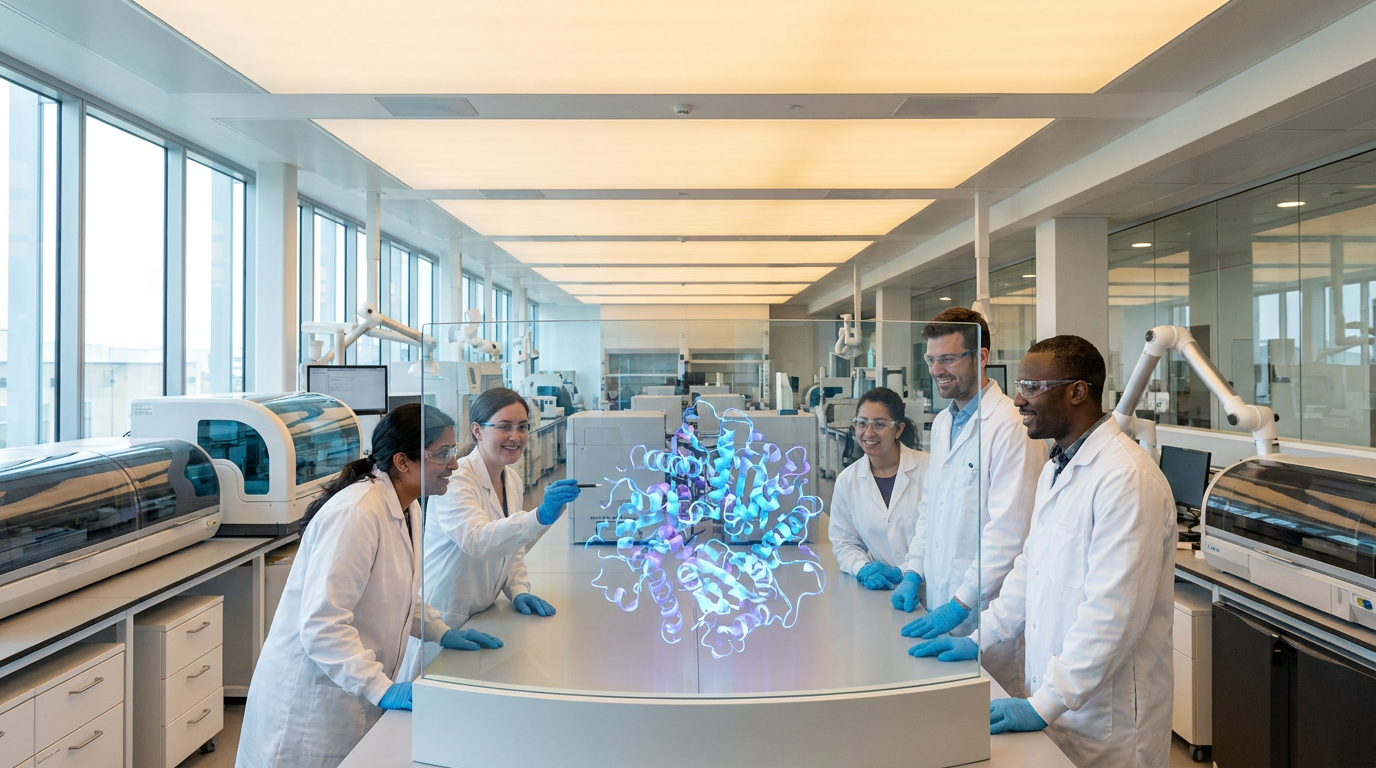
The most striking breakthrough emerged this month from a collaborative effort between Oxford University and The Alan Turing Institute. Researchers unveiled a novel artificial intelligence framework named "PhenoSeq," which solves one of the most persistent bottlenecks in cellular biology. The system is capable of generating complex molecular information directly from standard cellular imaging data, effectively translating visual biological structures into deep genetic insights.[1][5]
Traditionally, obtaining this level of molecular detail required a process known as RNA sequencing—a highly accurate but notoriously slow and expensive procedure. PhenoSeq bypasses this physical limitation by employing advanced conditional diffusion models. By analyzing high-content images of cells, the AI can accurately predict the underlying "transcriptomic profile," revealing how those cells are reacting to various chemical treatments without the need for physical sequencing.[1][5]

The implications for oncology and drug discovery are immediate and vast. Researchers can now screen tens of thousands of experimental compounds against cancer cells using standard imaging equipment, relying on AI to instantly map the molecular efficacy of each drug. This capability allows scientists to extract vastly more biological insight from existing imaging datasets, dramatically accelerating the early stages of the drug-screening pipeline.[1]
While academia pushes the boundaries of biological data extraction, the commercial sector is rapidly scaling AI for direct clinical application. OpenAI recently announced a major expansion of its healthcare initiatives, revealing a suite of specialized medical AI models. Unlike their general-purpose predecessors, these systems have been rigorously trained on clinical data, medical literature, and specialized healthcare use cases.[3]
While academia pushes the boundaries of biological data extraction, the commercial sector is rapidly scaling AI for direct clinical application.
The results of this specialized training are already materializing in clinical benchmarks. These healthcare-focused models are demonstrating improved medical reasoning capabilities, with some systems outperforming human physicians on specific diagnostic evaluations. Furthermore, the specialized architecture significantly reduces the rate of inaccurate medical responses—a critical requirement for any tool deployed in a high-stakes clinical environment.[3][6]

This commercial push is also transforming the later stages of pharmaceutical development. Biotech companies are deploying AI platforms designed to simulate complex human biology, aiming to predict how a drug will behave in the body before it ever reaches a human trial. This approach, often referred to as a "biological intelligence layer," represents a paradigm shift away from traditional, slow-moving laboratory testing.[4][6]
GATC Health's newly detailed "Operon" platform exemplifies this shift, utilizing predictive modeling to assess drug candidate safety and efficacy. By simulating human biological responses, the system achieves a remarkable 91 percent specificity and 86 percent sensitivity in predicting non-obvious side effects. Crucially, this technology is actively replacing slow and ethically fraught animal testing with rapid, human-biology-driven results, saving both capital and time.[4]

Crucially, the benefits of this AI revolution are not being exclusively hoarded by elite universities and well-funded tech giants. A parallel open-source movement is ensuring that advanced diagnostic capabilities reach the communities that need them most. This month, researchers released a powerful new open-source AI model designed specifically to assist in medical diagnostics, demonstrating remarkable accuracy in identifying early signs of rare diseases from standard medical imaging.[2]
The explicit goal of this open-source release is to democratize healthcare innovation. By making the model freely available, developers are providing critical diagnostic tools to under-resourced hospitals worldwide, allowing clinics in developing nations to leverage the same high-fidelity diagnostic reasoning available at premier research institutions.[2][6]

The convergence of these three tracks—academic breakthroughs in molecular imaging, commercial scaling of clinical assistants, and the open-source democratization of diagnostics—signals that medical AI has officially matured. The technology is no longer a speculative future concept; it is an active participant in the laboratory and the clinic, fundamentally altering the economics and timelines of medical research.[6]
Looking forward, the integration of these specialized models is expected to alleviate the severe administrative and diagnostic burdens currently driving physician burnout globally. More importantly, for patients awaiting breakthroughs in oncology, rare diseases, and antibiotic resistance, the timeline from discovery to treatment is poised to shrink from decades to mere years, marking one of the most uplifting technological transitions of the modern era.[6]
How we got here
August 2024
The EU Artificial Intelligence Act enters into force, establishing the first comprehensive regulatory framework for high-risk AI, including medical devices.
Early 2025
General-purpose AI models begin showing unexpected proficiency in passing medical licensing exams, sparking interest in specialized clinical training.
January 2026
Biotech firms announce major partnerships to develop 'agentic AI' systems tailored specifically for pharmaceutical research workflows.
June 2026
Oxford University unveils PhenoSeq, while commercial and open-source coalitions simultaneously release highly specialized medical AI models.
Viewpoints in depth
Academic Medical Researchers
Focused on extracting deeper biological insights from existing experimental data.
For institutions like Oxford and The Alan Turing Institute, the value of AI lies in its ability to reveal hidden patterns in data they already possess. By translating standard cellular images into complex transcriptomic profiles, researchers can bypass the financial and temporal bottlenecks of traditional sequencing. Their primary goal is to accelerate the fundamental understanding of diseases like cancer, prioritizing open scientific discovery over immediate commercialization.
Commercial AI Developers
Focused on scaling specialized models to optimize clinical workflows and drug pipelines.
Companies like OpenAI and GATC Health view medical AI as a massive optimization problem. Their objective is to build 'biological intelligence' layers that can ingest vast amounts of clinical data to predict drug efficacy, reduce late-stage trial failures, and assist physicians in real-time. For this camp, success is measured by clinical benchmark outperformance, reduced reliance on animal testing, and the successful integration of AI into hospital enterprise systems.
Open-Source Advocates
Focused on democratizing access to advanced diagnostic tools for global health equity.
This coalition argues that the most powerful medical AI models should not be locked behind corporate paywalls. By releasing open-source diagnostic models capable of identifying rare diseases, they aim to equip under-resourced hospitals in developing nations with the same diagnostic fidelity available at top-tier research hospitals. Their priority is immediate, equitable patient impact rather than proprietary intellectual property.
What we don't know
- How quickly regulatory bodies like the FDA and EMA will approve fully AI-simulated drug candidates for human trials.
- The long-term financial impact on traditional genetic sequencing companies as AI models learn to infer molecular data from basic imaging.
- How patient data privacy will be managed as these specialized models require vast amounts of clinical data for continuous training.
Key terms
- Transcriptomics
- The study of the complete set of RNA transcripts produced by the genome, crucial for understanding how cells respond to experimental drugs.
- Conditional Diffusion Model
- A type of generative artificial intelligence that creates specific outputs, such as molecular profiles, based on given inputs like cellular images.
- Biological Intelligence
- A specialized branch of AI focused on simulating and understanding complex biological systems, moving beyond the text-based reasoning of standard chatbots.
- Specificity and Sensitivity
- Statistical measures of a test's accuracy; specificity measures the ability to correctly identify negatives, while sensitivity measures the ability to correctly identify positives.
Frequently asked
What is the PhenoSeq AI system?
PhenoSeq is an artificial intelligence framework developed by Oxford University that generates detailed molecular information directly from standard cell images, bypassing the need for expensive genetic sequencing.
How is AI replacing animal testing?
Platforms like GATC Health's Operon simulate complex human biology to predict drug safety and efficacy with high accuracy, reducing the reliance on slow and costly animal trials.
Are these AI models available to regular hospitals?
Yes. Alongside commercial models, researchers are releasing powerful open-source diagnostic AIs designed specifically to assist under-resourced clinics globally without expensive licensing fees.
Sources
Source coverage
6 outlets
4 viewpoints surfaced






[1]Oxford UniversityAcademic Medical Researchers
AI breakthrough shows potential to accelerate cancer drug discovery
Read on Oxford University →[2]The Guardian ChronicleOpen-Source Advocates
New Open-Source AI Model Revolutionizes Medical Research
Read on The Guardian Chronicle →[3]Business InsiderCommercial AI Developers
OpenAI Expands Healthcare Efforts with Specialized Medical AI Models
Read on Business Insider →[4]GATC HealthCommercial AI Developers
CTO Jayson Uffens Explains GATC Health's AI Breakthrough
Read on GATC Health →[5]The Alan Turing InstituteAcademic Medical Researchers
PhenoSeq Generates Single-Cell Transcriptomics via Conditional Diffusion
Read on The Alan Turing Institute →[6]Factlen Editorial TeamIndustry Observers
Synthesis by Factlen editorial team
Read on Factlen Editorial Team →

More in ai
See all 6 stories →Medical AI
AI Discovers New Class of Antibiotics Hidden Inside Disease-Causing Prions
8 sources

Optical Computing
Penn Physicists Create Light-Matter Particle to Slash AI Energy Consumption
7 sources

EU AI Act
The EU AI Act's Enforcement Phase: Compliance Costs, Timelines, and the Digital Omnibus Delay
9 sources

Open-Source AI
Open-Source AI Reaches Performance Parity, Unlocking Private, On-Premise Use for Schools and Hospitals
6 sources

Every angle. Every day.
Get ai stories with full source coverage and perspective breakdowns delivered to your inbox.