
The Evidence on Red Light Therapy Masks: What Clinical Trials Actually Show
At-home LED face masks are dominating the skincare market with promises of anti-aging and acne reduction. We reviewed the clinical data to separate the proven dermatological benefits from the marketing hype.
By Factlen Editorial Team
- Clinical Dermatologists
- Medical professionals focused on evidence-based efficacy and safety.
- Consumer Reviewers
- Beauty and tech journalists evaluating real-world usability and results.
- Scientific Researchers
- Academics conducting controlled trials on photobiomodulation mechanisms.
What's not represented
- · Aestheticians who offer professional LED treatments and may view at-home devices as competition.
- · Budget-conscious consumers who rely on cheaper, unverified devices purchased from third-party marketplaces.
Why this matters
Consumers are spending hundreds of dollars on at-home LED devices. Understanding which wavelengths and treatment protocols are backed by peer-reviewed science ensures you invest in tools that actually work—and use them safely.
Key points
- Red light therapy (photobiomodulation) uses specific light wavelengths to stimulate cellular repair and collagen production.
- Clinical trials show red and near-infrared light can effectively reduce fine lines and improve skin texture.
- At-home devices are less powerful than clinical tools and require strict consistency to achieve results.
- Optimal anti-aging results require red light (630–660nm) and near-infrared light (830–850nm).
- Visible improvements typically take six to eight weeks of regular use.
- Eye protection is recommended, and those on photosensitizing medications should avoid use.
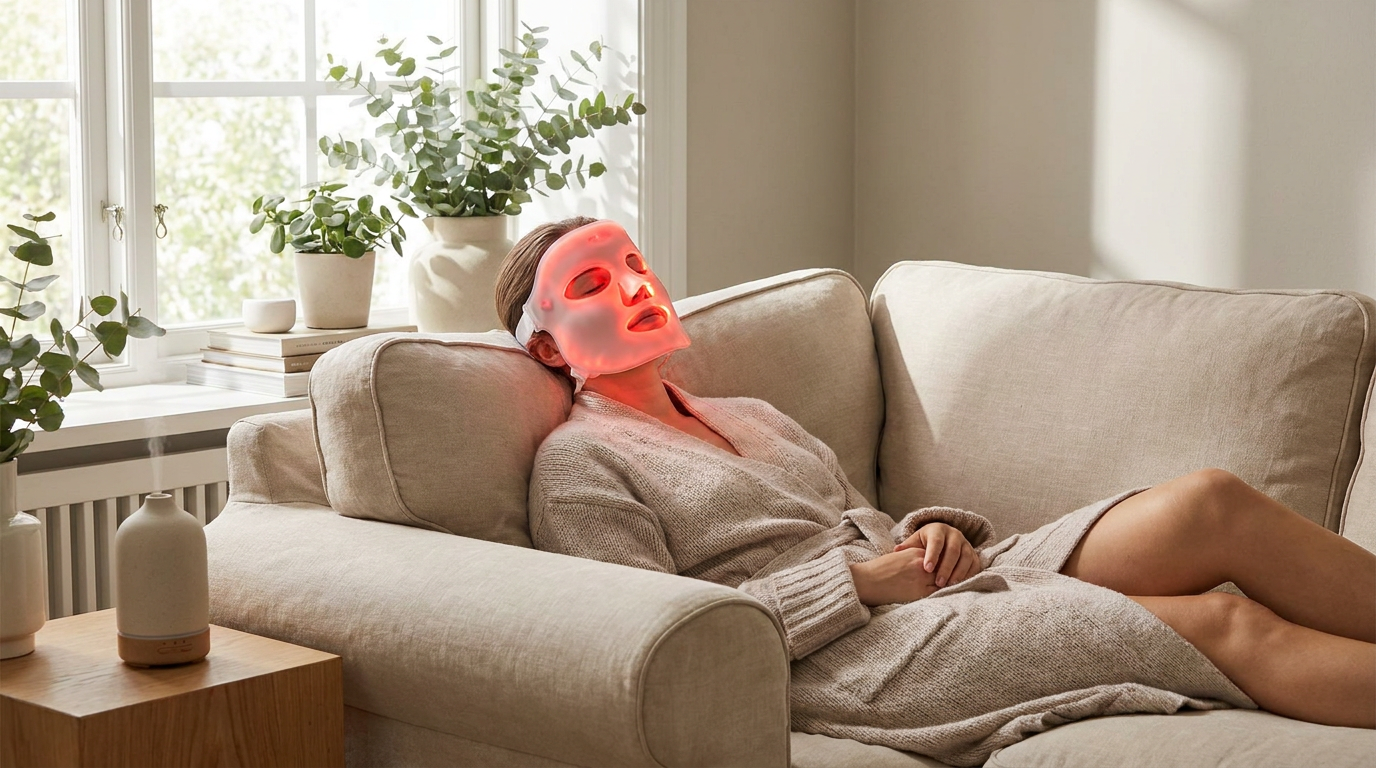
Over the past few years, glowing, futuristic masks have become a ubiquitous presence on social media and in evening skincare routines. Red light therapy, clinically known as photobiomodulation, has transitioned from a specialized treatment offered exclusively in dermatology clinics to a booming at-home consumer market. Promising to reduce wrinkles, clear acne, and improve overall skin texture, these devices often carry price tags ranging from $300 to over $500. But as the market floods with options, consumers are left wondering whether these masks are a genuine medical breakthrough or simply expensive flashlights.[8]
To understand the evidence, it is necessary to look at how light interacts with human biology. Photobiomodulation utilizes specific wavelengths of light to penetrate the skin and alter cellular function. According to experts at Stanford Medicine, when red light is applied at the correct wavelength, it is absorbed by the mitochondria—the powerhouses of the cells. This absorption stimulates the release of adenosine triphosphate (ATP) and activates fibroblasts, the cells primarily responsible for producing collagen and repairing tissue.[2][4]
The clinical evidence supporting these mechanisms is substantial, though nuanced. The American Academy of Dermatology notes that red-light LED devices can produce subtle to noticeable results on the face, particularly for fine lines, dark spots, and rough skin. In clinical trials published by the National Institutes of Health, researchers observed a marked increase in the amount of collagen and elastic fibers in patients treated with LED phototherapy. One study demonstrated a 15.6% decrease in the depth of crow's feet wrinkles after just one month of consistent use.[1][3]
However, the efficacy of any device depends entirely on its technical specifications. Dermatologists emphasize that not all light is created equal. For anti-aging and skin rejuvenation, the most robust clinical data supports red light at wavelengths between 630 and 660 nanometers, and near-infrared light between 830 and 850 nanometers. Red light targets the surface layers to improve tone and texture, while near-infrared light penetrates deeper to stimulate collagen production and reduce inflammation.[4][6]

For consumers targeting acne, the evidence points to a different spectrum entirely. Blue light, typically around 415 nanometers, has been shown to have antibacterial properties that target acne-causing bacteria on the skin's surface. Many high-end masks now offer a combination of red, near-infrared, and blue light modes to address multiple concerns simultaneously, though experts caution that blue light can sometimes worsen hyperpigmentation in darker skin tones.[6][7]
For consumers targeting acne, the evidence points to a different spectrum entirely.
The primary point of contention among medical professionals is the power disparity between in-office treatments and at-home devices. Dermatologists warn that while at-home masks are generally safe, they are significantly less powerful than the clinical-grade panels used in medical settings. Because of this lower power output, the results from at-home devices are often described as "modest" and require a high degree of user compliance. A mask sitting in a drawer yields no benefits; consistent use of 10 to 15 minutes, three to five times a week, is universally recommended.[2][4]

Patience is another critical factor. Unlike a chemical peel or an ablative laser treatment that produces immediate (albeit initially raw) results, photobiomodulation is a slow, cumulative process. Clinical trials and product reviewers alike note that it typically takes six to eight weeks of continuous use before significant improvements in skin plumpness or wrinkle reduction become visible. For this reason, dermatologists often recommend red light therapy as a complementary treatment alongside a robust skincare routine featuring sunscreen and retinoids, rather than a standalone miracle cure.[1][5]
When evaluating the consumer landscape, independent testing by outlets like Forbes and The Guardian consistently highlight a few standout devices that meet clinical specifications. The Omnilux Contour Face and the CurrentBody Series 2 are frequently cited as top performers due to their flexible silicone designs, which allow the LEDs to sit close to the skin, and their adherence to the clinically proven 633nm and 830nm wavelengths. For those seeking shorter treatment times, the Dr. Dennis Gross SpectraLite Facewear Pro offers a three-minute daily session, making it easier for users to maintain the necessary consistency.[5][6][7]

Safety remains a paramount consideration. While the FDA has cleared numerous LED masks for home use, they are not universally suitable. Individuals taking photosensitizing medications, such as isotretinoin, or those with active inflammatory skin conditions should avoid these devices. Furthermore, eye protection is strongly advised. Prolonged exposure to bright LEDs, particularly blue light, can cause eye irritation or potential damage, prompting many manufacturers to include blackout goggles with their products.[4][8]
Ultimately, the evidence suggests that red light therapy masks are a scientifically valid investment for those willing to commit to the routine. They represent a non-invasive, painless method to support cellular health and collagen production. By choosing a device with the correct wavelengths and maintaining realistic expectations about the timeline for results, consumers can effectively harness the power of photobiomodulation from the comfort of their own homes.[1][2][8]
How we got here
1990s
NASA begins experimenting with red light therapy to promote plant growth and heal wounds in astronauts.
Early 2000s
Dermatologists adopt powerful LED panels for in-office treatments targeting photoaging and acne.
2010s
The first wave of FDA-cleared, at-home LED devices hits the consumer market, mostly as rigid, hard-shell masks.
2020s
Flexible silicone masks become the industry standard, making treatments more comfortable and improving light penetration.
2026
Multi-wavelength masks combining red, deep near-infrared, and blue light dominate the premium skincare market.
Viewpoints in depth
Clinical Dermatologists
Medical professionals who emphasize evidence-based treatments and manage patient expectations.
Dermatologists generally acknowledge the science behind photobiomodulation but often caution against viewing at-home masks as a panacea. They stress that while clinical trials show genuine benefits in collagen production and wound healing, the devices sold to consumers are significantly less powerful than clinic equipment. Their primary advice is to use these masks as a complementary therapy alongside proven topical treatments like retinoids and sunscreen, rather than a replacement for them.
Skincare Consumers & Reviewers
Users and beauty testers focused on accessibility, convenience, and visible cosmetic results.
For the consumer market, the appeal of LED masks lies in their non-invasive nature and ease of use. Reviewers frequently highlight the "spa-like" experience and the lack of downtime compared to chemical peels or microneedling. While they acknowledge the high upfront cost, many users report that the long-term benefits—such as reduced redness, improved skin tone, and a subtle plumping effect—make the investment worthwhile, provided they can stick to the daily routine.
Device Manufacturers
Companies developing and marketing at-home phototherapy technology.
Manufacturers focus on bridging the gap between clinical efficacy and consumer safety. They heavily cite independent clinical trials and FDA clearances to validate their products' claims. The industry is currently driving innovation toward more comfortable, flexible silicone designs and combining multiple wavelengths (red, blue, and near-infrared) into single devices to offer comprehensive, multi-targeted skincare solutions.
What we don't know
- The long-term safety and efficacy of using at-home LED masks daily for several years remains under-researched.
- It is difficult to quantify exactly how much of the observed skin improvement is due to the mask versus the user's overall skincare routine.
- The exact threshold at which increased treatment time stops yielding additional benefits and begins causing skin irritation is not universally defined.
Key terms
- Photobiomodulation
- The scientific term for light therapy; the use of specific wavelengths of light to alter biological activity and stimulate cellular repair.
- Fibroblasts
- Cells within the skin's dermal layer that are responsible for producing collagen and elastin.
- Wavelength
- The distance between successive crests of a light wave, measured in nanometers (nm), which determines the light's color and how deeply it penetrates the skin.
- Near-Infrared Light
- Invisible light (typically 830-850nm) that penetrates deeper into the skin than visible red light to target deep tissue and reduce inflammation.
- ATP (Adenosine Triphosphate)
- The primary energy carrier in all living organisms; its production is boosted by red light therapy to fuel cellular repair.
Frequently asked
Can I use a red light mask every day?
Most manufacturers and dermatologists recommend using at-home masks three to five times a week for 10 to 15 minutes. Daily use is generally safe, but exceeding the recommended time won't speed up results and could cause mild irritation.
Do I need to wear eye protection?
Yes. While many masks are FDA-cleared, prolonged exposure to bright LEDs can cause eye strain or irritation. Using the provided blackout goggles or keeping your eyes closed during treatment is highly recommended.
Should I apply skincare products before or after using the mask?
Masks should be used on clean, dry skin. Applying serums or moisturizers beforehand can block the light from penetrating effectively. Apply your skincare products immediately after the treatment.
Does red light therapy help with acne?
Red light primarily targets inflammation and aging. For active acne breakouts, blue light (around 415nm) is more effective as it specifically targets and kills acne-causing bacteria.
Sources
Source coverage
8 outlets
3 viewpoints surfaced








[1]American Academy of DermatologyClinical Dermatologists
Is red light therapy safe and effective?
Read on American Academy of Dermatology →[2]Stanford MedicineClinical Dermatologists
Photobiomodulation: What the science says and doesn't say
Read on Stanford Medicine →[3]National Institutes of HealthScientific Researchers
Clinical trial of a novel non-thermal LED array for reversal of photoaging
Read on National Institutes of Health →[4]MedPage TodayClinical Dermatologists
Are Red Light Therapy Masks More Hype Than Helpful?
Read on MedPage Today →[5]ForbesConsumer Reviewers
The 7 Best LED Face Masks, According To Rigorous Testing
Read on Forbes →[6]The GuardianConsumer Reviewers
Are LED face masks worth it? The best light therapy devices tried and tested
Read on The Guardian →[7]CNETConsumer Reviewers
Best LED Face Masks of 2026
Read on CNET →[8]Factlen Editorial TeamScientific Researchers
Synthesis by Factlen editorial team
Read on Factlen Editorial Team →



Every angle. Every day.
Get shopping stories with full source coverage and perspective breakdowns delivered to your inbox.