
California's Battery Storage Boom Stabilizes Grid as Solar Surpasses Natural Gas
A massive expansion in battery storage capacity has allowed California's power grid to run increasingly on renewable energy, tripling battery discharge rates and helping solar generation outpace natural gas for the first time.
By Factlen Editorial Team
- Grid Operators & Planners
- Focused on maintaining grid reliability and balancing supply with demand.
- Clean Energy Advocates
- Focused on the environmental milestones and the phase-out of fossil fuels.
- Energy Market Analysts
- Focused on investment signals, project pipelines, and wholesale price dynamics.
What's not represented
- · Natural gas plant operators facing reduced run-times and revenues.
- · Residential ratepayers waiting to see if wholesale savings translate to lower monthly utility bills.
Why this matters
By successfully integrating massive amounts of battery storage, California is proving that a power grid can run reliably on renewable energy without constant fossil-fuel backup, paving the way for cheaper, cleaner electricity worldwide.
Key points
- Utility-scale solar generated more electricity than natural gas in California during the first five months of 2026.
- CAISO's net battery storage capacity increased by 79% to 16 gigawatts over the past two years.
- Battery discharge into the grid tripled compared to 2024, absorbing midday solar and releasing it at night.
- Natural gas generation in the state plummeted by 60% as renewables took over the load.
- Over 400 planned battery storage projects are currently in development across the CAISO region.
California’s electricity grid has crossed a historic threshold in the first half of 2026, fundamentally reshaping how the world's fifth-largest economy powers itself. For the first time, utility-scale solar generation has consistently surpassed natural gas as the primary source of electricity within the state's main grid network.[1][2]
This transition is not merely the result of adding more solar panels to the desert landscape. Instead, the milestone has been unlocked by a massive, unprecedented expansion in grid-scale battery storage, which has solved the long-standing problem of intermittent renewable generation.[2][4]
According to the U.S. Energy Information Administration, the net battery storage capacity within the California Independent System Operator (CAISO) footprint surged by 79% between April 2024 and April 2026. The grid now boasts 16 gigawatts of battery capacity, seamlessly integrated alongside 25 gigawatts of utility-scale solar.[1][2]

The impact of this storage fleet on daily grid operations has been transformative. Batteries act as a massive sponge, soaking up excess solar power during the midday hours when the sun is brightest and electricity demand is relatively moderate.[1][2]
As the sun sets and solar generation drops off—precisely when residential electricity demand peaks as people return home and turn on appliances—these batteries discharge their stored power back into the grid. In the first five months of 2026, battery discharge into the CAISO grid tripled compared to the same period in 2024.[1][2]
In the first five months of 2026, battery discharge into the CAISO grid tripled compared to the same period in 2024.
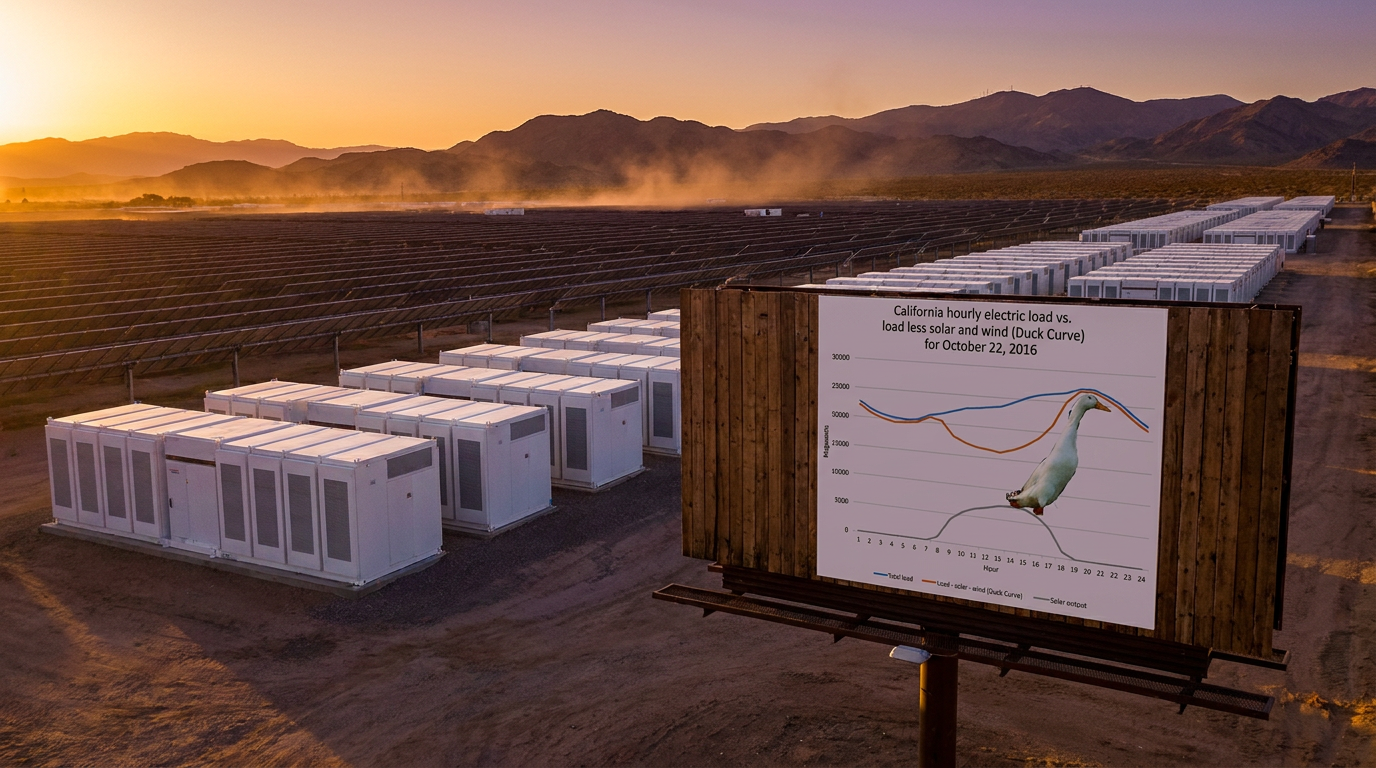
This dynamic has effectively flattened the infamous "duck curve," a long-feared grid management challenge where solar overproduction during the day is followed by a steep, difficult-to-manage ramp-up in demand at dusk.[3][6]

The real-world capability of this system was dramatically demonstrated on February 1, 2026. On that day, California's battery fleet discharged continuously through the night until sunrise, effectively sustaining the state on direct and stored solar energy for a full 24-hour cycle without relying on fossil fuel baseload generation.[3]
The economic and environmental ripple effects are already visible in wholesale energy markets. With batteries and solar handling the heavy lifting, natural gas generation in CAISO plummeted by 60% in the first five months of 2026 compared to 2024.[1][2][4]
This stabilization is part of a broader global trend. Just as the International Energy Agency noted California's success in reducing negatively priced hours by absorbing excess generation, energy think tank Ember reports that battery deployment is accelerating across Europe to manage similar solar gluts and reduce reliance on expensive gas during peak hours.[6][7]

The momentum in the United States shows no signs of slowing. Industry trackers report over $49 billion worth of active and proposed utility-scale solar projects across California, with developers aggressively pairing new solar farms with high-capacity storage systems.[4]
Looking ahead, the pipeline for standalone and co-located storage remains robust. Data from Cleanview indicates there are currently over 400 planned battery storage projects in development within the CAISO region, representing a staggering 125 gigawatts of proposed future capacity.[5]
As California heads into the peak summer demand season of 2026, this expanded battery fleet provides a crucial buffer against extreme heat waves. The state's success offers a powerful proof-of-concept for grid operators worldwide, demonstrating that a high-renewable energy system can maintain stability, lower emissions, and keep the lights on.[2][3][6]
How we got here
April 2024
CAISO net battery storage capacity stands at roughly 9 gigawatts.
January 2025
A 300 MW battery facility is temporarily taken offline after a fire, highlighting early operational hurdles.
February 2026
California's grid runs effectively on direct and stored solar power for a full 24-hour cycle.
April 2026
Battery storage capacity reaches 16 gigawatts, a 79% increase over two years.
June 2026
Data confirms utility-scale solar has officially surpassed natural gas generation for the first five months of the year.
Viewpoints in depth
Grid Operators & Planners
Focused on maintaining grid reliability and balancing supply with demand.
For system operators, the primary value of battery storage is flexibility. Historically, the 'duck curve' forced operators to rapidly spin up expensive natural gas plants as the sun set. Now, batteries provide a highly responsive buffer that can instantly inject power into the grid, smoothing out frequency fluctuations and preventing blackouts during evening demand peaks.
Clean Energy Advocates
Focused on the environmental milestones and the phase-out of fossil fuels.
Environmental groups view the 2026 data as a definitive victory and a proof-of-concept for the global energy transition. By demonstrating that a major economy can run for 24-hour cycles on solar and stored energy, advocates argue that the long-standing critique of renewables—that they only work when the sun shines—has been technologically and economically solved.
Energy Market Analysts
Focused on investment signals, project pipelines, and wholesale price dynamics.
Market analysts highlight the lucrative arbitrage opportunities that have driven this infrastructure boom. Batteries buy power when it is cheap (or even negatively priced) during midday solar gluts and sell it during lucrative evening peaks. This economic engine has spurred over $49 billion in active and proposed solar and storage projects across the state, fundamentally altering the business model of power generation.
What we don't know
- How the expanded battery fleet will perform during an unprecedented, multi-day extreme heat wave when solar panels are less efficient.
- Whether supply chain constraints for raw battery materials might slow the deployment of the 125 gigawatts of proposed future projects.
Key terms
- Utility-scale solar
- Large solar power facilities that generate and feed electricity directly into the transmission grid, rather than powering individual homes.
- Duck curve
- A graph of power production that shows the timing imbalance between peak renewable energy generation at midday and peak electricity demand in the evening.
- Gigawatt (GW)
- A unit of power equal to one billion watts, typically used to measure the capacity of large power plants or entire electrical grids.
- Wholesale electricity market
- The market where electricity is bought and sold by generators and utility companies before it is distributed to everyday consumers.
Frequently asked
What is the California Independent System Operator (CAISO)?
CAISO is the non-profit entity that oversees the operation of California's bulk electric power system, managing the high-voltage grid for about 80% of the state.
How do batteries help solar power?
Solar panels only generate electricity when the sun is shining. Batteries store the excess power generated during the day and release it at night when demand is highest.
Are fossil fuels still used in California?
Yes, natural gas is still used, but its role is rapidly shrinking. In early 2026, natural gas generation dropped by 60% as solar and batteries took over more of the daily load.
Sources
Source coverage
7 outlets
3 viewpoints surfaced







[1]U.S. Energy Information AdministrationGrid Operators & Planners
In the first five months of 2026, utility-scale solar generation surpassed natural gas generation in CAISO
Read on U.S. Energy Information Administration →[2]SolarQuarterClean Energy Advocates
California's electricity sector is witnessing a major transformation as solar energy has surpassed natural gas
Read on SolarQuarter →[3]ESS NewsClean Energy Advocates
California batteries power grid through the night
Read on ESS News →[4]Industrial Info ResourcesEnergy Market Analysts
California's years-long investment in solar energy is starting to pay off
Read on Industrial Info Resources →[5]CleanviewEnergy Market Analysts
Planned Battery Storage Projects in CAISO
Read on Cleanview →[6]International Energy AgencyGrid Operators & Planners
Wholesale prices continue to differ across regions
Read on International Energy Agency →[7]EmberClean Energy Advocates
Battery deployment accelerated significantly in 2025
Read on Ember →
Every angle. Every day.
Get energy stories with full source coverage and perspective breakdowns delivered to your inbox.