
Archaeologists Uncover 5,000-Year-Old 'Prototype' for Stonehenge's Solstice Alignment
A newly analyzed site three miles from Stonehenge reveals that prehistoric Britons were engineering precise solar observatories 500 years before raising the monument's iconic giant stones.
By Factlen Editorial Team
- Excavation Team
- Argues the site is a deliberate solstice prototype and early builder campsite.
- Archaeoastronomers
- Validates the mathematical precision of the alignment against the 3000 B.C. sky.
- Archaeological Skeptics
- Cautions that two postholes are insufficient to definitively prove an astronomical alignment.
What's not represented
- · Local Bulford residents
- · Modern pagan and druid practitioners
Why this matters
This discovery rewrites the timeline of one of the world's most famous ancient landscapes, proving that prehistoric Britons were engineering precise astronomical observatories long before they began working with megalithic stone. It offers a rare, tangible glimpse into the trial-and-error process behind human architectural and scientific breakthroughs.
Key points
- Archaeologists have discovered a 5,000-year-old structure in Bulford, three miles from Stonehenge, that perfectly aligns with the summer solstice.
- The site consists of two massive postholes spaced 120 meters apart, predating Stonehenge's iconic giant stones by 500 years.
- Researchers believe the site served as a 'prototype' solar observatory and a temporary camp for the builders of Stonehenge's first earthworks.
- The discovery proves that the region's inhabitants were practicing precise astronomical engineering long before they began working with megalithic stone.
Every year, thousands of people gather on the flat expanse of Salisbury Plain to watch the midsummer sun rise over the heel stone of Stonehenge. The 4,500-year-old monument is globally recognized as a masterpiece of prehistoric astronomical engineering. But new evidence suggests that the obsession with the solstice in this corner of England predates the famous giant stones. Half a millennium before the iconic trilithons were raised, someone was already measuring the sun just three miles away.
On June 18, 2026, the British firm Wessex Archaeology announced the discovery of a 5,000-year-old structure in the nearby village of Bulford. Radiocarbon dating places the site at roughly 2950 B.C., making it contemporary with the very earliest, simplest earthworks at Stonehenge, but predating the arrival of the massive sarsen boulders by 500 years.[1]
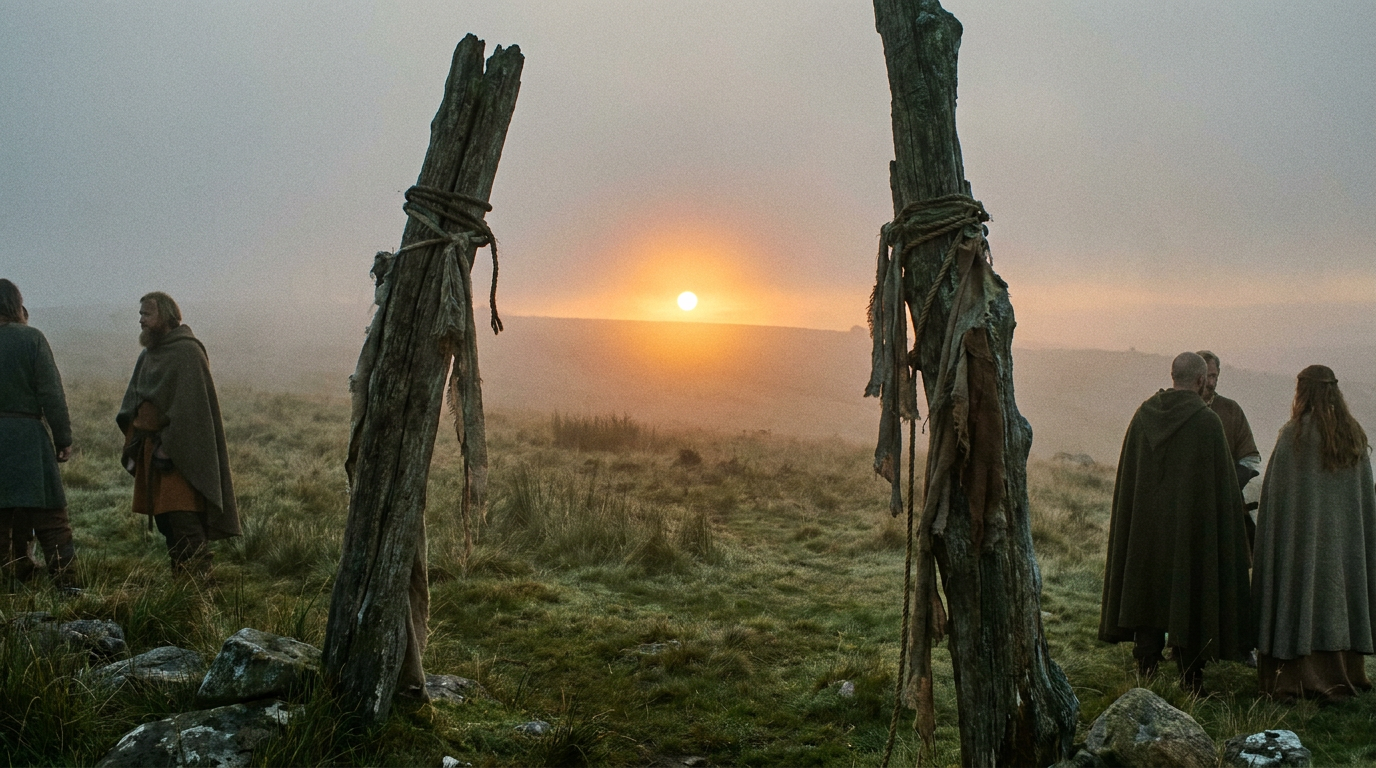
Researchers believe the Bulford site served as an early "prototype" or viewing station for the solar alignment that would later define Stonehenge. The discovery provides the earliest known evidence of deliberate solstice alignment in the wider Stonehenge landscape, fundamentally shifting the timeline of when ancient Britons began formally tracking the cosmos.[1][4]
The path to the discovery was unusually long. The original excavations took place between 2015 and 2017, commissioned to survey a 32-acre plot ahead of a Ministry of Defence housing project for troops returning from Germany. Because the wooden structure had rotted away millennia ago, the true significance of the site remained hidden in the data, requiring nearly a decade of laboratory analysis and spatial mapping to fully understand.[2][4]

The physical evidence consists of 48 pits scattered across the chalk hillside. Among the refuse and debris, archaeologists identified two massive postholes separated by exactly 120 meters (394 feet).[1][5]
Unlike the pits used for discarding waste, these two specific holes were packed with crushed chalk, a Neolithic engineering technique used to firmly anchor massive upright timbers. Researchers estimate the wooden poles would have stood between two and four meters high, dominating the local sightline.[5]
The breakthrough came when Phil Harding, a veteran archaeologist and former presenter on the television series Time Team, began mapping the site's geometry. Drawing a line between the two massive postholes, he realized the axis sat exactly 50 degrees off true north. This angle is perfectly parallel to the famous midsummer sunrise alignment at Stonehenge.[2]
The breakthrough came when Phil Harding, a veteran archaeologist and former presenter on the television series Time Team, began mapping the site's geometry.
To verify the intentionality of the angle, researchers collaborated with archaeoastronomers. Because the Earth's axis wobbles slightly over millennia—a phenomenon known as precession—the night sky of 3000 B.C. looked different than it does today. Digital reconstructions of the Neolithic skyscape confirmed that the two Bulford posts would have perfectly framed the first rays of the midsummer sun breaking over the horizon during that specific era.[3]
The pits surrounding the posts yielded a treasure trove of artifacts that point to large-scale ceremonial gatherings. Archaeologists recovered worked flints, animal bones indicative of massive feasts, and fragments of "Woodlands" style pottery—a ceramic tradition that originated in Scotland's Orkney Islands. The narrow range of radiocarbon dates suggests the site was used intensely but only for a short period of a few years.[1][3]

One of the most evocative finds was discovered in a pit situated near what archaeologists believe was the primary viewing station. Excavators unearthed a perfectly circular, disc-shaped flint knife. The delicate workmanship required to achieve the discoidal shape has led researchers to speculate that the tool was a deliberate symbolic representation of the sun disc.[1][5]
The proximity to Stonehenge and the matching alignment have led to a compelling hypothesis about the people who used the Bulford site. Dr. Matt Leivers of Wessex Archaeology suggests the structure may have functioned as a "navvy camp"—a temporary settlement and ceremonial viewing station for the very workers who were digging the first circular ditch and bank at Stonehenge three miles away.[1][2][3]
However, the interpretation of the site is not without its skeptics. In the field of archaeoastronomy, proving deliberate alignment is notoriously difficult. Jim Leary, a senior lecturer in field archaeology at the University of York, cautions against leaping to conclusions based on minimal data points. "Two postholes don't make a particularly convincing alignment," Leary noted, pointing out that any two points in space can be connected by a straight line.[3]
While acknowledging that a longer row of posts would provide undeniable geometric proof, proponents argue that the statistical unlikelihood of the exact 50-degree angle cannot be ignored. When combined with the evidence of seasonal feasting and the sun-disc knife, the contextual evidence strongly supports a deliberate solar observatory.[2][3]

The debate over Bulford mirrors the centuries-long debate over Stonehenge itself. As English Heritage notes, the main monument has been variously interpreted as a druid temple, a coronation site for kings, a cult center for healing, and a giant astronomical computer for predicting eclipses.[4][6]
Regardless of the exact mechanics of the Bulford posts, the discovery proves that the architectural ambition of Neolithic Britons evolved over time. They did not simply wake up one day and drag 25-ton boulders across the country; they experimented with wood, sightlines, and temporary camps first.[1][2]
As thousands of modern visitors don pagan robes and gather at the stones this week to celebrate the longest day of the year, they are participating in a tradition with deeper roots than previously known. Five thousand years ago, on a nearby hillside, the ancestors of Stonehenge's builders were standing in the dark, waiting for the exact same sunrise.[1][4]
How we got here
2950 B.C.
Neolithic builders erect two massive wooden poles at Bulford to mark the midsummer sunrise, while digging the first earthworks at Stonehenge.
2500 B.C.
The iconic giant sarsen stones and trilithons are erected at the main Stonehenge site.
2015–2017
Wessex Archaeology excavates the Bulford site ahead of a Ministry of Defence housing project, uncovering 48 pits.
June 18, 2026
After nearly a decade of analysis, archaeologists publicly announce the Bulford site as a 5,000-year-old Stonehenge prototype.
Viewpoints in depth
The Excavation Team
Researchers who view the site as a deliberate astronomical prototype.
Wessex Archaeology researchers, including Phil Harding and Matt Leivers, argue the 50-degree alignment is too precise to be an accident. They point to the presence of a rare disc-shaped flint knife—potentially a sun symbol—and massive quantities of animal bones as evidence of organized solstice feasting. In their view, this was a 'navvy camp' or viewing station for the very people who dug the first earthworks at Stonehenge.
Archaeological Skeptics
Experts who urge caution when inferring alignments from minimal points.
Some field archaeologists, such as Jim Leary at the University of York, caution against over-interpreting the geometry. Because any two points can be connected by a straight line, finding a line that happens to point toward the solstice sunrise could be a statistical coincidence. They argue that a true, undeniable astronomical alignment usually requires a longer row of posts or stones to rule out chance.
Archaeoastronomers
Specialists focused on the mathematical relationship between ancient sites and the sky.
Experts in ancient skyscapes emphasize that the landscape of 3000 B.C. looked different astronomically due to the Earth's axial precession. Digital reconstructions of the Neolithic sky confirm that the Bulford posts would have perfectly framed the midsummer sunrise of that specific era. For these specialists, the site proves that astronomical observation was a prerequisite for, rather than a result of, the monumental stone building that followed.
What we don't know
- Whether the Bulford structure consisted of more than two wooden poles that have simply been lost to erosion and later land use.
- If the people who camped at Bulford were the exact same individuals who dug the first circular ditch at Stonehenge.
- The exact ceremonial purpose of the rare disc-shaped flint knife found in the viewing pit.
Key terms
- Solstice
- The two times in the year when the sun reaches its highest or lowest point in the sky at noon, marking the longest and shortest days.
- Radiocarbon dating
- A scientific method for determining the age of an object containing organic material by measuring the decay of carbon-14.
- Trilithon
- A structure consisting of two large vertical stones supporting a third stone set horizontally across the top, iconic to Stonehenge.
- Archaeoastronomy
- The study of how people in the past understood the phenomena in the sky and what role the sky played in their cultures.
- Posthole
- A hole dug in the ground to hold a timber post, often leaving a distinct archaeological trace even after the wood has rotted away.
Frequently asked
What exactly did archaeologists find at Bulford?
They found 48 pits, including two massive postholes 120 meters apart that once held large wooden poles aligned with the summer solstice.
How much older is this than Stonehenge?
The Bulford structure dates to around 2950 B.C., making it contemporary with Stonehenge's earliest earthworks but predating the famous giant stone circle by about 500 years.
Can the public visit the Bulford site?
No. The original wooden posts rotted away millennia ago, and the excavated pits are located on a Ministry of Defence housing estate that is not accessible to the public.
Why are some archaeologists skeptical?
Because the alignment is based on only two postholes, some experts argue it could be a geometric coincidence, though the surrounding artifacts suggest deliberate ceremonial use.
Sources
Source coverage
6 outlets
3 viewpoints surfaced






[1]Wessex ArchaeologyExcavation Team
Radiocarbon dated to around 5,000 years ago, the discovery reveals evidence for the earliest known alignment with the solstice
Read on Wessex Archaeology →[2]The GuardianExcavation Team
Wessex Archaeology suspect they have uncovered a prototype for world-famous Stonehenge site in Wiltshire
Read on The Guardian →[3]National GeographicArchaeological Skeptics
Was this wooden monument a prototype for Stonehenge?
Read on National Geographic →[4]Associated PressExcavation Team
Archaeology team unearths 'prototype' of world-famous Stonehenge monument just a few miles away
Read on Associated Press →[5]BBC NewsExcavation Team
Stonehenge 'prototype' found by archaeologists in Wiltshire
Read on BBC News →[6]English HeritageArchaeoastronomers
History of Stonehenge
Read on English Heritage →

Every angle. Every day.
Get science stories with full source coverage and perspective breakdowns delivered to your inbox.