
Iran Claims Strait of Hormuz Closure as US Denies Disruption: What It Means for the Global Economy
Iran's military declared the critical Strait of Hormuz closed in retaliation for strikes in Lebanon, testing a fragile US-Iran peace agreement. The US military denied the shutdown, claiming millions of barrels of oil continue to flow safely as energy markets brace for potential price shocks.
By Factlen Editorial Team
- US Administration & Military
- Maintains that the Strait is open, emphasizing freedom of navigation and the enforcement of the recent peace agreement.
- Iranian Military Command
- Views the Strait as a strategic lever to enforce ceasefire compliance in Lebanon and project regional power.
- Global Energy Markets
- Driven by physical supply realities and risk premiums, remaining highly sensitive to any disruption regardless of political rhetoric.
What's not represented
- · Lebanese civilians affected by the strikes
- · Global consumers facing inflation
Why this matters
Roughly 20% of the world's seaborne oil passes through the Strait of Hormuz. A sustained closure would trigger a massive global energy shock, reversing recent declines in inflation and driving up the cost of gasoline, shipping, and consumer goods worldwide.
Key points
- Iran's military declared the Strait of Hormuz closed over alleged ceasefire violations in Lebanon.
- U.S. Central Command denied the closure, reporting that 55 commercial vessels safely transited the waterway.
- The standoff threatens a newly signed 14-point peace agreement between Washington and Tehran.
- Roughly 20% of the world's seaborne oil passes through the Strait, making it vital to the global economy.
- A sustained disruption would likely spike oil prices and reverse recent declines in global inflation.
Iran's military command declared the Strait of Hormuz closed on Saturday, throwing a fragile new peace agreement with the United States into jeopardy and threatening to reignite a global energy crisis.[2][3][4]
The United States military immediately denied the shutdown. U.S. Central Command (CENTCOM) and Vice President JD Vance stated that maritime traffic was proceeding normally, creating a stark disconnect between diplomatic rhetoric and the physical reality on the water.[1][2][4]
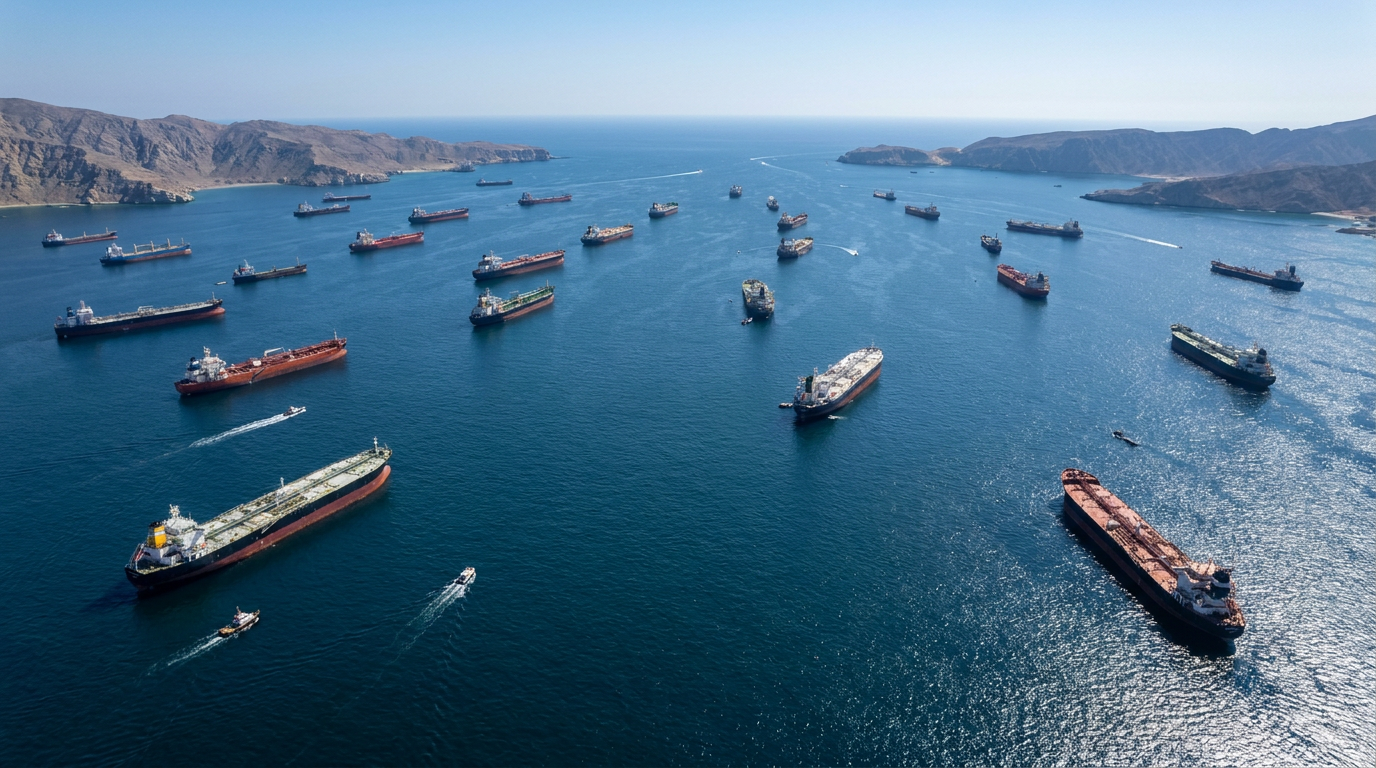
At the center of this geopolitical tug-of-war is the world's most important economic chokepoint. Roughly one-fifth of global seaborne oil and a significant portion of liquefied natural gas must pass through the Strait of Hormuz to reach international markets.[6][8]

The renewed tensions stem from a newly signed 14-point Memorandum of Understanding (MoU) between Washington and Tehran. The agreement was designed to end a severe military and economic standoff that began in late February 2026, establishing a 60-day negotiation period and mandating toll-free passage through the waterway.[2][6]
However, Iran's Islamic Revolutionary Guard Corps (IRGC) cited ongoing Israeli military operations against Hezbollah in southern Lebanon as a "blatant breach" of the ceasefire terms. In response, Iranian state media broadcast warnings for all vessels to refrain from approaching the strait.[3][7]
CENTCOM quickly provided specific transit data to counter Tehran's narrative. The U.S. military reported that 55 commercial vessels successfully completed the transit on Saturday alone, carrying more than 17 million barrels of oil under the watchful eye of American naval forces.[4]
To understand why a closure threat paralyzes global markets, one must look at the geography. The Strait is just 21 miles wide at its narrowest point, with the designated shipping lanes measuring only two miles wide in either direction.
To understand why a closure threat paralyzes global markets, one must look at the geography.
Because vessels must pass through Iranian and Omani territorial waters, they are highly susceptible to asymmetric warfare tactics. Naval mines, drone swarms, and fast-attack craft can easily disrupt the flow of massive, slow-moving oil tankers.[4][7]
When the Strait is threatened, the impact on the global economy is immediate and severe. During the peak of the conflict in March 2026, Brent crude oil prices skyrocketed to $126 per barrel, creating the largest disruption to world energy supplies in decades.[5][6]

The economic damage extends far beyond the gas pump. A recent analysis by the Dallas Federal Reserve highlighted how the disruption of the Strait fundamentally alters global shipping logistics. The resulting spike in freight costs completely offset the disinflationary benefits of recent U.S. tariff reductions, keeping core inflation elevated.[8]
Prior to Saturday's closure claims, the signing of the MoU had brought immense relief to energy markets. Analysts estimated that the peace deal would release more than 85 million barrels of oil that had been effectively trapped in the Persian Gulf.[6]
This optimism had driven Brent crude prices down to the $78–$82 range by mid-June. Bank of America projected that a full, uninterrupted reopening could keep prices stable through the second half of the year, averting a worst-case recessionary scenario.[5][6]

Despite U.S. assurances that the waterway remains open, commercial shipping operators face a difficult calculation. The mere declaration of a closure by Iran drastically increases war-risk insurance premiums, making the journey prohibitively expensive for some carriers.[5]
Adding to the complexity, President Donald Trump has introduced a new economic variable into the negotiations. He warned that if the peace deal fails, the U.S. might impose its own tolls on the Strait to reimburse the costs of acting as the region's "Guardian Angel."[2]

The conflicting realities on the water are now colliding with high-stakes diplomacy. Negotiators from both sides are scheduled to meet in Switzerland to hash out the technical elements of the 60-day MoU framework, even as the military standoff continues.[4]
How we got here
Late February 2026
Conflict erupts, leading to severe restrictions on Hormuz traffic and a massive global energy shock.
March 2026
Brent crude oil prices peak at $126 per barrel amid the effective closure of the Strait.
Mid-June 2026
The U.S. and Iran sign a 14-point Memorandum of Understanding, establishing a 60-day negotiation period and reopening the waterway.
June 20, 2026
Iran's military declares the Strait closed again over strikes in Lebanon, a claim the U.S. military immediately denies.
Viewpoints in depth
Iranian Military Command
Views the Strait as a strategic lever to enforce ceasefire compliance.
Iran's Islamic Revolutionary Guard Corps (IRGC) and military command view the control of the Strait of Hormuz as their primary mechanism for projecting regional power and deterring adversaries. By declaring the waterway closed, Tehran is attempting to force the United States to pressure Israel into halting its military operations against Hezbollah in Lebanon. Iranian officials argue that a true ceasefire must be comprehensive, and they are willing to risk global economic fallout to ensure their regional allies are protected under the terms of the recent Memorandum of Understanding.
US Administration and CENTCOM
Focuses on freedom of navigation and enforcing the terms of the peace agreement.
For the United States, keeping the Strait of Hormuz open is a non-negotiable national security and economic priority. U.S. Central Command is actively monitoring the waterway to ensure commercial vessels can transit safely, directly challenging Iran's narrative by publishing daily transit data. The administration's goal is to separate the physical flow of global energy from the ongoing diplomatic disputes over Lebanon, ensuring that the 60-day negotiation window established by the MoU does not collapse into another inflationary energy crisis.
Global Energy Markets
Driven by physical supply realities and highly sensitive to any disruption.
Energy markets and commercial shippers operate on risk, not rhetoric. Even if the U.S. military guarantees safe passage, the mere threat of Iranian intervention forces insurance companies to drastically raise war-risk premiums. Market analysts note that while the recent peace deal successfully brought Brent crude prices down from their $126 peak, the underlying vulnerability remains. Shippers are caught in the middle, forced to weigh the immense cost of delaying shipments against the physical danger of navigating a contested chokepoint.
What we don't know
- Whether commercial shipping companies will continue to transit the Strait or pause operations due to soaring insurance costs.
- How the conflicting claims on the water will impact the scheduled diplomatic negotiations in Switzerland.
- Whether the U.S. will follow through on threats to impose its own tolls on the waterway if the peace deal collapses.
Key terms
- Strait of Hormuz
- A narrow waterway between the Persian Gulf and the Gulf of Oman, serving as the world's most important oil chokepoint.
- Brent Crude
- The primary international benchmark price for purchases of oil worldwide.
- Memorandum of Understanding (MoU)
- The preliminary 14-point diplomatic agreement signed between the U.S. and Iran to end the spring 2026 conflict.
- War-Risk Premium
- Additional insurance costs charged to shipping companies when vessels transit through conflict zones.
Frequently asked
Why is the Strait of Hormuz so important?
It is a narrow waterway connecting the Persian Gulf to the open ocean. Roughly 20% of the world's seaborne oil passes through it, making it a critical chokepoint for the global economy.
Why did Iran announce the closure?
Iran's military cited ongoing Israeli strikes in Lebanon against Hezbollah, which Tehran views as a violation of the newly signed U.S.-Iran peace agreement.
Is the Strait actually closed right now?
The situation is disputed. Iran claims it is closed, while U.S. Central Command states that 55 commercial vessels safely transited the waterway on Saturday.
How does this affect the global economy?
Threats to the Strait cause oil prices and shipping insurance premiums to spike. This drives up the cost of gasoline and consumer goods, fueling global inflation.
Sources
Source coverage
8 outlets
3 viewpoints surfaced








[1]NPRUS Administration & Military
Iran claims Hormuz closure, U.S. says ships still passing
Read on NPR →[2]ForbesUS Administration & Military
Iran Says Strait Of Hormuz Is Closed After Lebanon Attacks—U.S. Denies It's Shut
Read on Forbes →[3]CNBCIranian Military Command
Iran reportedly closes Strait of Hormuz again, casting shadow over nuclear talks
Read on CNBC →[4]The Washington PostUS Administration & Military
Iran says it is closing Strait of Hormuz, testing fragile agreement with U.S.
Read on The Washington Post →[5]Al JazeeraGlobal Energy Markets
Oil prices continue slide amid hopes for peace, opening of Strait of Hormuz
Read on Al Jazeera →[6]BOE ReportGlobal Energy Markets
Full Hormuz reopening could lower 2026 Brent average to $82/bbl, BofA says
Read on BOE Report →[7]Jerusalem PostIranian Military Command
Iran claims Strait of Hormuz closed in retaliation for US, Israel breaches of MoU
Read on Jerusalem Post →[8]Dallas FedGlobal Energy Markets
Strait closure mitigates court's tariff ruling
Read on Dallas Fed →

Every angle. Every day.
Get business stories with full source coverage and perspective breakdowns delivered to your inbox.