
The Science of No-Dig Gardening: How Leaving Soil Alone Transforms Yields
By abandoning the rototiller and embracing undisturbed fungal networks, a growing movement of gardeners is achieving higher yields with a fraction of the labor.
By Factlen Editorial Team
- Regenerative Growers
- Advocates for minimizing labor and maximizing soil health through natural layering.
- Soil Microbiologists
- Scientists focused on the microscopic ecosystems that drive plant health.
- Sustainability Advocates
- Environmentalists focused on agriculture's role in climate change.
What's not represented
- · Commercial fertilizer manufacturers whose products are bypassed in regenerative systems.
- · Large-scale industrial farmers who argue that no-till is difficult to scale without heavy herbicide use.
Why this matters
Traditional tilling degrades soil health, releases trapped carbon, and creates endless weeding work. Transitioning to regenerative, no-dig methods allows home growers to cultivate healthier food while actively restoring local ecosystems.
Key points
- No-dig gardening involves layering compost on top of the soil rather than turning it over.
- Undisturbed soil allows beneficial mycorrhizal fungi to form vast nutrient-sharing networks.
- Tilling destroys these fungal networks and releases trapped carbon into the atmosphere.
- Leaving the soil intact prevents dormant weed seeds from reaching the surface to germinate.
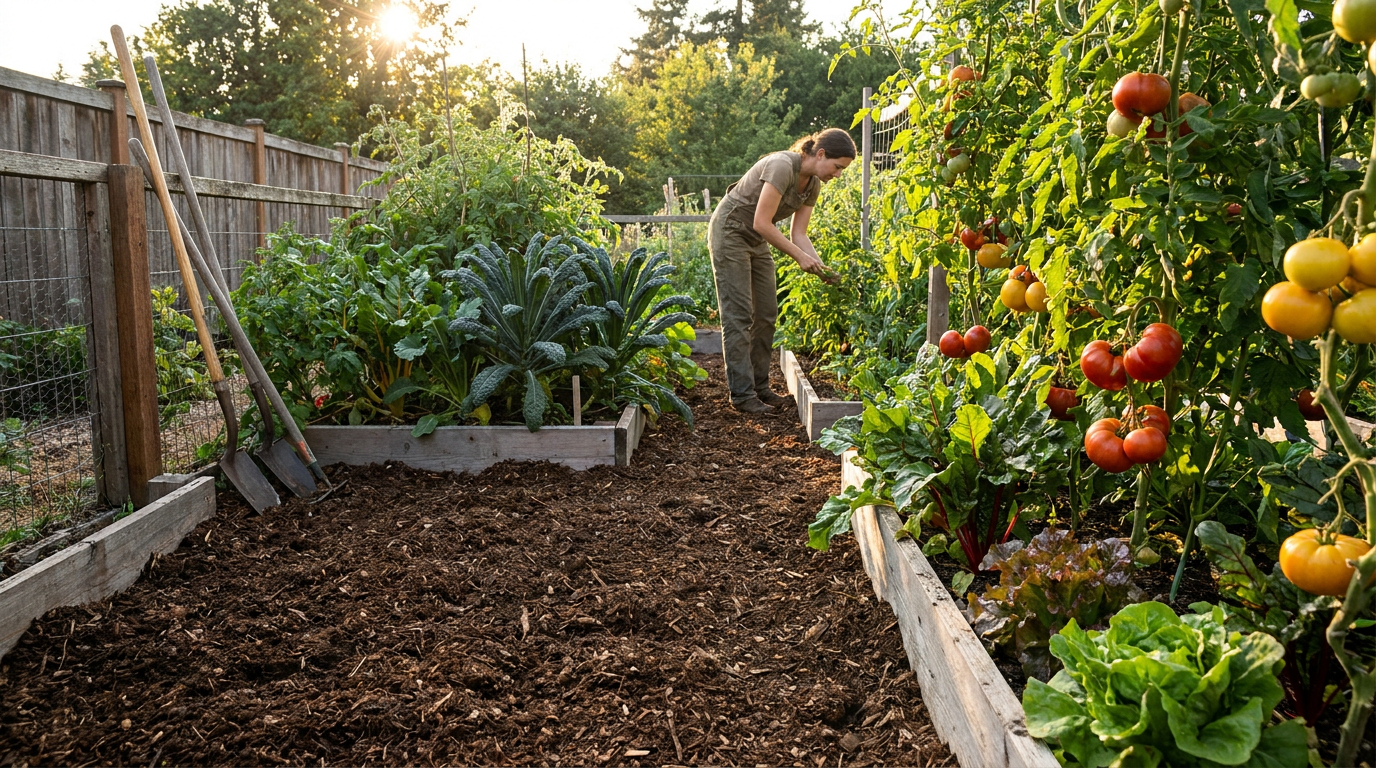
- New beds can be started easily by laying cardboard over grass and topping it with compost.
- The method dramatically improves water retention and drainage by preserving earthworm channels.
The image of the springtime gardener wrestling a rototiller is deeply ingrained in agricultural culture. For generations, aggressively turning the earth was considered the essential first step to a bountiful harvest, a necessary chore to loosen the dirt and prepare beds for delicate seedlings.[9]
But a quiet revolution is taking root in backyards and market farms worldwide. Known as "no-dig" or "no-till" gardening, this regenerative approach asks growers to put away their spades, sell their tillers, and leave the soil entirely undisturbed.[1][5]
The core philosophy is simple: mimic nature. In an old-growth forest, nobody tills the ground; organic matter like leaves, branches, and animal byproducts simply falls to the floor, where it slowly decomposes and feeds the complex ecosystem below.[2][4]
To understand why the no-dig method works so effectively, we have to look microscopically at what soil actually is. It is not an inert medium waiting to be filled with synthetic fertilizer, but a densely populated, living microbiome filled with billions of bacteria, nematodes, and fungi.[7][8]
The undisputed stars of this subterranean world are mycorrhizal fungi. These microscopic organisms form a symbiotic relationship with the roots of roughly 85 to 90 percent of all land plants, acting as a vital life-support system.[3][4]
The exchange between plant and fungus is a masterpiece of biological trade. Plants use photosynthesis to create carbon-rich sugars, which they exude through their roots to feed the fungi. In return, the fungi act as a massive secondary root system.[3][8]

These fungal threads, called hyphae, are much finer than plant roots. This microscopic profile allows them to mine the surrounding soil for water and difficult-to-access nutrients like phosphorus and zinc, delivering them directly into the host plant's cellular structure.[3][4]
This underground network—often playfully called the "wood wide web"—also serves as a communication highway. Plants can send chemical warning signals through the fungal network to alert neighboring plants of pest attacks or impending drought stress, allowing the community to bolster its defenses.[3]
When a gardener tills or double-digs a bed, they are effectively dropping a bomb on this delicate infrastructure. The spinning blades slice the mycorrhizal networks to ribbons, forcing the soil microbiome to rebuild its nutrient-delivery systems from scratch every single spring.[5][8]

When a gardener tills or double-digs a bed, they are effectively dropping a bomb on this delicate infrastructure.
Digging also triggers a massive release of carbon. When buried organic matter is suddenly exposed to oxygen by a plow or a spade, it rapidly oxidizes and releases carbon dioxide into the atmosphere, contributing to greenhouse gas emissions.[6]
Conversely, the no-dig method keeps carbon locked safely in the ground. By layering organic matter exclusively on top of the soil, gardeners actively sequester carbon, turning their vegetable patches into miniature climate-change buffers.[6][7]

The most famous proponent of the modern no-dig movement is Charles Dowding, a British market gardener who has spent four decades conducting side-by-side trials proving that undisturbed soil yields healthier, more prolific crops.[1][2]
Dowding's method for starting a new bed is remarkably straightforward. Instead of digging up grass or wrestling with established weeds, gardeners simply lay down a layer of plain, unwaxed cardboard directly over the existing vegetation.[1][2]
On top of the cardboard goes a thick layer—usually four to six inches—of rich compost. The cardboard smothers the weeds below, eventually rotting away into the earth, while the compost provides a perfect, weed-free planting medium for new seedlings.[2][7]

One of the most celebrated and immediate benefits of this system is the dramatic reduction in weeding. Tilling brings dormant weed seeds to the surface where sunlight triggers their germination; by leaving the soil intact, those seeds stay buried in the dark.[2][7]
Furthermore, undisturbed soil maintains its natural structural integrity. Earthworms and decaying roots create permanent vertical channels that act like a sponge, dramatically improving both drainage during heavy rains and water retention during severe droughts.[5][7]

The primary hurdle for new no-dig gardeners is the initial volume of compost required. Covering a large garden with six inches of organic matter can be expensive or labor-intensive if the gardener doesn't produce their own compost at scale.[7]
There are also questions about how the method translates to container gardening. Because isolated pots lack the vast, interconnected microbiome of open ground, the benefits of leaving potting soil undisturbed are less pronounced, though adding worm castings as a top mulch still provides a biological boost.[9]
How we got here
Early 20th Century
Traditional deep-tilling and synthetic fertilizer use become the global agricultural standard.
1982
Market gardener Charles Dowding begins experimenting with no-dig methods in the UK.
Late 1990s
Soil microbiologists begin mapping the extensive 'wood wide web' of mycorrhizal fungi.
2010s
No-dig gardening gains mainstream popularity through YouTube and regenerative agriculture movements.
Present Day
No-till practices are increasingly adopted to combat climate change through soil carbon sequestration.
Viewpoints in depth
Regenerative Growers
Advocates for minimizing labor and maximizing soil health through natural layering.
For regenerative farmers and home gardeners, the no-dig method is primarily a practical revelation. By observing that nature builds soil from the top down, they argue that human intervention should follow suit. This camp emphasizes the dramatic reduction in physical labor—specifically the elimination of weeding and heavy digging—as the primary selling point, alongside the visibly increased vigor and yield of their crops.
Soil Microbiologists
Scientists focused on the microscopic ecosystems that drive plant health.
Microbiologists view the garden not as a collection of plants, but as a complex fungal and bacterial metropolis. From this perspective, tilling is a catastrophic event that destroys the 'wood wide web.' They point to peer-reviewed evidence showing that intact mycorrhizal networks are essential for unlocking bound nutrients like phosphorus, and that plants grown in undisturbed soil possess stronger natural immune responses to pests and diseases.
Sustainability Advocates
Environmentalists focused on agriculture's role in climate change.
For climate-focused advocates, the shift away from tilling is a crucial step in carbon sequestration. They highlight that agricultural soils have lost massive amounts of organic carbon due to centuries of plowing. By adopting no-dig practices, they argue that even small-scale home gardeners can transform their yards from carbon emitters into carbon sinks, actively pulling CO2 out of the atmosphere and locking it safely underground.
What we don't know
- The exact long-term cost comparison between buying bulk compost for no-dig versus the fertilizer and labor costs of traditional tilling.
- How effectively no-dig principles translate to highly constrained environments like small balcony container gardens.
Key terms
- Mycorrhizal Fungi
- Beneficial fungi that form a symbiotic relationship with plant roots, exchanging soil nutrients for plant-produced sugars.
- Hyphae
- The microscopic, branching filaments of a fungus that make up its underground network.
- Soil Microbiome
- The complex community of microorganisms, including bacteria and fungi, that live in the soil and support plant life.
- Sheet Mulching
- A no-dig technique of layering cardboard and compost over existing vegetation to create a new planting bed.
- Tilling
- The traditional agricultural practice of mechanically digging, stirring, and overturning the soil to prepare it for planting.
Frequently asked
Can I start a no-dig garden over an existing lawn?
Yes. You can lay unwaxed cardboard directly over the grass and cover it with four to six inches of compost. The grass will die and decompose, feeding the new bed.
Do I need to buy special fungal powders?
Usually, no. If you stop tilling and add organic compost, the native mycorrhizal fungi already present in your environment will naturally repopulate the soil.
What if my soil is heavy clay?
No-dig is highly effective for clay. Layering organic matter on top encourages earthworms to tunnel up, which naturally aerates and breaks up the heavy clay over time without the need for digging.
How do I harvest root vegetables like carrots?
In a mature no-dig bed, the compost-rich top layer is loose enough that root vegetables can usually be pulled out by hand with minimal disturbance to the surrounding soil.
Sources
Source coverage
9 outlets
3 viewpoints surfaced








[1]Charles DowdingRegenerative Growers
What is no dig growing?
Read on Charles Dowding →[2]Gardens IllustratedRegenerative Growers
What is no dig gardening? Charles Dowding explains
Read on Gardens Illustrated →[3]Grow OrganicSoil Microbiologists
A Deep Dive into Mycorrhizae
Read on Grow Organic →[4]MediumSoil Microbiologists
Mutualist mycorrhizae: a wealth of beneficial effects
Read on Medium →[5]Learn DirtRegenerative Growers
No-Till Gardening: The Path to Better Soil
Read on Learn Dirt →[6]EarthEasySustainability Advocates
Regenerative Gardening 101
Read on EarthEasy →[7]Rural SproutRegenerative Growers
Why Go No-Dig or No-Till?
Read on Rural Sprout →[8]Maine Organic Farmers and GardenersSoil Microbiologists
Mycorrhizal Networks in the Soil
Read on Maine Organic Farmers and Gardeners →[9]Factlen Editorial TeamSustainability Advocates
Synthesis by Factlen editorial team
Read on Factlen Editorial Team →
Every angle. Every day.
Get home stories with full source coverage and perspective breakdowns delivered to your inbox.